
 Worksheets
Transport in Humans and Plants
Total questions: 40
Worksheet time: 21mins
Allows the flow of blood in only one direction from right atrium to the right ventricle
Bicuspid valve
Tricuspid valve
Semilunar valve
Human have double blood Circulatory system...what are those
Pulmonary circulatory system
Systemic circulatory system
Systole circulatory system
Diastole circulatory system


A complete of a cardiac cycle takes place for about
8 seconds
0.8 second
0.3 second
0.4 second
What is the type of muscle involves in cardiac cycle?
Smooth muscle
Cardiac muscle
Skeletal muscle

In the diagram below, which part of the tracing represents the contraction of the atria?
P
T
R
S

Which of the following represents the Purkinje fibres?
A
B
C
D

State the phase of cardiac cycle shown in the diagram.
Atrial systole, ventricular systole
Atrial diastole, ventricular systole
Atrial systole, ventricular diastole
Atrial diastole, ventricular diastole

What happen to the valves in the heart during the phase of cardiac cycle shown in the diagram.
Atrioventricular valves open, semilunar valves open
Atrioventricular valves open, semilunar valves close
Atrioventricular valves close, semilunar valves open
Atrioventricular valves close, semilunar valves close
During Atrial diastole & Ventricular systole phase, pressure between atria and ventricles?
Pressure in atria are greater than ventricles
Equal pressure in atria and ventricles
Pressure in ventricles are greater than atria
the correct order of heart conduction is ...
AV node-SA node-Bundle of his-Bundle branches-Purkinje network
SA node-AV node-Bundle of his-Bundle branches-Purkinje network
SA node-AV node-Bundle branches-Bundle of his-Purkinje network
AV node-SA node-Bundle branches-Bundle of his-Purkinje network
why is it important for signal conduction in heart to stop for a while in AV node?
to prevent atrium and ventricle from contracting at the same time
to prevent blood too much flowing from atrium to ventricle
to make sure that all valves are open before blood sent out from heart
to make sure there is enough time for atrium to receive blood from veins
The fluid from the blood capillary that is formed in the spaces between the cells is known ..................
interstitial fluid
blood
lymph
plasma
Which of the following is NOT found in the lymphatic system?
Tonsils
Lymph node
Lacteal
Thoracic duct
Heart
Why erythrocyte, platelets and protein plasma cannot be found in the interstitial fluid and lymph?
The size are too big
It can change the shape
It is too small
Red in colour
Choose ALL the importance of having lymphatic system
Maintain the fluid in the body
Transport lipid from lacteal
Transport waste product
Filter the fluid from foreign particles
Reduce the number of leucocyte

The condition shown when there is accumulation of interstitial fluid in the body tissue. Name the concequence.
Oedema
Inflamation
Thrombosis
Blood clot
Lymph enters the bloodstream from the collecting ducts at the:
Aorta
Hepatic Veins
Pulmonary Veins
Subclavian Veins
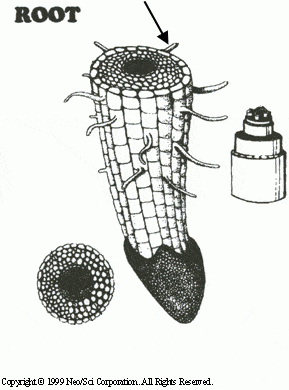
What is the name of the part of the root that allows water and minerals enter?
epidermis
root hairs
phloem
phyla
Water potential of the root hair cells is
equal to soil water
more negative than that of soil water
more positive in comparison to soil water
none of the above
here is the correct order of root parts from the highest to the lowest water potential ...
epidermis-cortex-endodermis-xylem
epidermis-endodermis-cortex-xylem
xylem-endodermis-cortex-epidermis
xylem-cortex-endodermis-epidermis
Casparian strip on endodermis cell are made of
Lignin
Pectin
Suberin
Cellulose
Structure of phloem consists all below, except?
Sieve tube element
Tracheids
Companion cell
Sieve plate
Which of the statement is true?
sinks: places where sugar is made
sinks: places where water is made
sinks: places where sugar is delivered to
sinks: places where water is delivered to
The loading of sucrose into sieve tubes is by ________ transport and consequently, requires ___________.
Active; ATP
Passive; energy
Active; ions
Passive;ions
Loading of sucrose actively in the sieve tube will causes
Water pressure in sieve tube decrease
Accumulation of sucrose in sieve tube and water potential remain unchanged
Sucrose dissolved in water and lowered the water potential in sieve tube
Sucrose converted into dissolved glucose which lowered the water potential in sieve tube
Which one is NOT the effect causes by loading of sucrose into sieve tube?
Increase water potential in sieve tube
Decrease the water potential in sieve tube
Water potential in sieve tube is lower than xylem
Water diffuse from xylem into sieve tube by osmosis
What is the best words to describe sugar source and sugar sink
Both are plants organ and act as storage
Sugar sink can be either roots, fruit or mature leaves and sugar source is shoots
Sugar source act as site for sugar production and sugar sink will store sugar
Companion tube carry food from a sugar source to a sugar sink
The mass flow theory is best defined as the idea that
sucrose is transported due to a negative pressure in a source
large volumes of solution are transported from an area of high hydrostatic pressure
water travels from a high to low concentration
sucrose diffuses to all cells equally
Choose the correct order of the chambers through which deoxygenated blood flows in the human heart.
right atrium-----> right ventricle------> aorta
right atrium -----> right ventricle------> pulmonary artery
left atrium------> left ventricle------> aorta
left atrium-------> left ventricle-------> pulmonary artery
The basic transpiration-cohesion-tension mechanism involves..
The entrance of water and ion actively through cell membrane of the root epidermis.
Water flows in, generating positive pressure
The formation of weak bonds between water molecules and between water molecules and vessel walls.
The movement of water into root tissue through stem xylem and leaf xylem, then to the atmosphere
Which of the following are lymphoid organs?
I.Tonsil
II. Spleen
III. Bone marrow
I only
I and II only
II and III only
I,II and III
Root pressure which plays a small role in xylem flow is caused by
transpiration of water out of the xylem.
cohesion of water molecules to one another
adhesion of water molecules to walls of the xylem
osmotic flow of water into the xylem
What is the function of valves in heart?
To prevent the backflow of blood in the chambers.
To allow the backflow of blood in the heart.
To initiate the flow of the blood in the heart.

The theory which states that transpiration pull is responsible for carrying water upward through the xylem is called
cortex-xylem theory
cohesion-pressure theory
cohesion-tension theory
pressure-tension theory

