
Font size
 Worksheets
BU Reviewer Part 2
Total questions: 81
Worksheet time: 41mins
A hoisting and lowering mechanism equipped with a car
or platform which moves in guides in a vertical or
diagonal direction serving two or more floors of a
building or structure.
Pulley
Elevator
Escalator
A hoisting and lowering mechanism equipped with a car. , used exclusively for carrying materials.
Inclined Lift
Paternoster
Dumbwaiter
A chair or platform installed on a steel guide rail and driven by a motor for raising or lowering a person. Often used to increase accessibility
for the disabled. Also known as a Stair Lift.
Inclined Lift
Paternoster
Dumbwaiter
A device which consists of open-
fronted two-person cars suspended by
hoisting chains.
Dumbwaiter
Inclined Lift
Paternoster
Average time spent by passenger(s) between arriving
in the lobby and leaving the lobby in the car.
Average Lobby (Waiting) Time
Average Trip/Travel Time (AVTRP)
Callback
Car Operating Station/Panel
Average time spent by the passenger in the lobby to
leaving the car at an upper floor.
Average Lobby (Waiting) Time
Average Trip/Travel Time (AVTRP)
Callback
Car Operating Station/Panel
In contact service, a customer request which requires a
check of an elevator other than scheduled
maintenance.
Average Lobby (Waiting) Time
Average Trip/Travel Time (AVTRP)
Callback
Car Operating Station/Panel
A panel mounted in the car containing car operating
controls which govern the operations of the elevator,
such as the opening and closing of door(s), alarm
emergency stop, and other required buttons or key
switches.
Average Lobby (Waiting) Time
Average Trip/Travel Time (AVTRP)
Callback
Car Operating Station/Panel
A control panel on top of an elevator which, when
activated, renders normal service and allows the
elevator to run at inspection speed from the car top
station only.
Car Top Inspection Station
Callback
Car Operating Station/Panel
Average Lobby (Waiting) Time
A system of regulations pertaining to the design,
manufacture, installation, and maintenance of
dumbwaiters, escalators, and moving walks.
Car Top Inspection Station
Code
Callback
Average Trip/Travel Time (AVTRP)
A (group of) device(s) which serves to control (in a
predetermined manner) the system to which it is
connected to.
Door Lock
Controller
Cylinder
The outermost lining of a
hydraulic jack or plunger.
Controller
Door Lock
Cylinder
Any type of mechanical
lock designed to prevent
the opening of a
hoistway door from
being opened.
Drive Machine
Door Operator
Door Lock
A motor-driven device
mounted on the car that
opens and closes the
door.
Door Lock
Drive Machine
Door Operator
The power unit which
supplies the energy
necessary to raise and
lower an elevator or
dumbwaiter, or to
drive an escalator,
inclined lift, or moving walk.
Door Operator
Door Lock
Drive Machine
The grooved wheel of a
traction-type hoisting machine
over which the hoist rope’s
motion is imparted to the car,
and counterweighed by the
hoist ropes.
Drive Sheave
Elevator Landing
Generator
The portion of a floor, balcony, or platform for the
loading or discharging of passengers or freight to or
from the computer.
Holding Capacity
Elevator Landing
Generator
Maximum number of passengers that can be handled
in a given period.
Registration Time
Holding Capacity
Interval (I) or Lobby Dispatch Time
Average time between departure of cars from the
lobby.
Relay
Registration Time
Interval (I) or Lobby Dispatch Time
Waiting time after registering a call.
Relay
Interval (I) or Lobby Dispatch Time
Registration Time
An electric device designed to interpret input
conditions in a prescribed manner, and if conditions
are met, to respond and cause contact operation or
create a change in an associated electrical system.
Traveling Cable
Registration Time
Relay
A cable made of electrical conductors which provide electrical connections between dumbwaiter car/material lit and a fixed outlet in hoistway/machine room. the
Relay
Registration Time
Traveling Cable
A group of floors.
space
area
zone
A conveying device used to
transport people to and from
building floors. Elevator
motion may be either vertical
or diagonal.
Passenger Elevator
Service or Freight Elevator
An elevator used for carrying materials and cargo. Allows operator and other persons necessary the convenience of loading and unloading of loads.
Service or Freight Elevator
Passenger Elevator
An elevator consisting of a car mounted on guide rails,
suspended by tension cables and operated by electric
hoisting machinery. Also referred to as a Traction
Elevator. This type of elevator is used exclusively in
tall buildings and is operated by direct current (dc)
motors.
Electric Elevator
Hydraulic Elevator
Winding Drum Machine
An elevator system where the car or cab is dependent on
the pressure applied through a system of retractable tubes
containing oil that is pumped into the system from a
reservoir. This type of elevator is used where short travel
and slower speed is required and overhead equipment is
not desired.
Hydraulic Elevator
Winding Drum Machine
Electric Elevator
Traction Machine
An elevator with cables
fastened to and wound around a drum; counterweights are not necessary.
Winding Drum Machine
Traction Machine
Electric Elevator
Hydraulic Elevator
An elevator in which the
movement of the car is
derived by means of
direct contact between
the traction sheave and
the hoisting cables,
caused by friction
between the two
machines.
Traction Machine
Winding Drum Machine
Gearless Traction Machine
The elevator hoisting ropes
or cables are placed
around this sheave, which
is an integral part of the
armature. No geared
reduction is applied on this
type of elevator traction
machine.
Gearless Traction Machine
Geared Traction Machine
This machine
consists of a
worm and a gear
interposed
between the
driving motor
and the hoisting
sheave, with the
power from the
motor being
transmitted through reduction gears.
Geared Traction Machine
Gearless Traction Machine
The load-bearing unit of an
elevator, including its
platform, frame, and
enclosure.
Car or Cab
Cables
Elevator Machine
Steel wire ropes used for the
suspension of a car and its
counterweight.
Cables
Car or Cab
Ropes
Bars
Machine that turns the
sheave and lifts or lowers
the car.
Elevator Machine
Elevator Gear
Elevator Generator
Rectangular blocks of
cast
iron stacked
inside a frame, which
is supported at the
opposite ends of the
cables to which the car
is attached. This is
weighed to balance the
car’s weight + 40% of
car capacity.
Counterweight
Countercapacity
Equalweight
Vertical tracks that guide
the car and counterweight.
Guide Bars
Guide Rails
Guide Rods
The vertical passageway for the car and
counterweight to move through.
Elevator Pit
Shaft or Hoistway
Penthouse/Elevator Machine Room
The room usually directly above the hoistway in
which the elevator machine is located.
Penthouse/Elevator Machine Room
Elevator Pit
Shaft or Hoistway
Guide Rails
The portion of the hoistway extending below
the level of the bottom landing to provide for
over-travel and clearance for parts which
require space below the bottom of the car travel.
Shaft or Hoistway
Elevator Pit
Penthouse/Elevator Machine Room
Guide Rails
A combination of push-buttons, contacts, relays,
cams, and devices, which are operated manually
or automatically, to initiate the door operation,
starting, acceleration, retardation, leveling, or
stopping of the car.
Control Panel
Control Equipment
Control Board
Onboard interface that
registers calls and
governs response to
elevator.
Control Panel
Control Equipment
Control Board
Supplies direct
current (dc) to the
motor; used with
generator
field
control.
Generator
Motor Generator
Generator Field Control
Motor
Devices fastened to the
car
frame
and
counterweight at the top
and bottom, used to
secure their motion along
the guide rails.
Guide Rails
Guide Frame
Guide Shoes
The
moving
component of the
brake lined with
frictional material;
when in contact, holds
the elevator at floor
level when power is
applied on the hoist
motor.
Motor Generator
Guide Shoes
Brake Shoe
Chains/ropes hung
from the bottom of
the
car
counterweight
and
in
order to balance the
weight of hoist ropes.
Brake
Buffer
Compensator
A device installed at
the bottom of a shaft
(the elevator pit)
used to absorb
impact from the car
Brake
Buffer
Compensator
prevent the device
from moving when
car motion is
applied to the hoist
motor; also stops
the elevator when
the sole source of
power is the hoist
motor.
Compensator
Buffer
Brake
Brake Shoe
A device usually
of carbon or
graphite
composition,
used to connect a
circuit with a DC
motor, generator,
or other electrical
device. Carries current to and from the car.
Secondary Sheave
Brush
Governor
Safety Switch
A device that
causes car and
counterweight
(if required) to
stop in case of
an emergency
by actuating the
safety.
Brush
Safety Switch
Governor
Provides a double
wrap of ropes for
traction and leads
rope over to the
counterweight.
Limit Switches
Safety Switch
Secondary Sheave
A
device
incorporated in the
bottom beam of the
car frame and
counterweight;
retarding
exerts
force in case of
over-speed
by
gripping the guide
rails.
Limit Switches
Safety Switch
Operating Devices
Automatic devices
that stop the car
within
the
overtravel,
independently of
the
operating
device.
Safety Switch
Limit Switches
Operating Devices
Refers to any of the car switches, push-buttons,
wheels, levers, etc. which enables the operator
control actuation
Operating Devices
Limit Switches
Safety Switch
A component of an
elevator
that gives
stability to a governor
rope.
Landing Zone
Car Leveling Device
Tension Sheave
A mechanism or
control which will
move the car to within
a limited zone, and
stop it at the landing.
Operating Devices
Car Leveling Device
Landing Zone
Tension Sheave
This is measured within 18” above or below the
landing.
Landing Zone
Drop Zone
Arrive Zone
A direct current (dc) system of control by
varying resistance and reactance in the field
circuit of the hoisting motor, alternating current
motor starts across the line.
Rheostatic Control
Rheostatic System
Rheostatic Motor
One of the electric cables connecting an elevator car to a
fixed electrical outlet in the hoistway, moving along with
the car.
Travelling Cable
Long Cable
Stable Cable
The simplest system among the different modes
of elevator operation. Handles only one call at a
time, providing an uninterrupted trip for each
call.
Single Automatic Push-Button Control
Collective Control
Selective Collective Operation
Computerized System Control
This type of elevator system control does not
have any call storage provision. Waiting periods
become extremely long, particularly with slow
cars and in a moderately-sized high-rise.
Single Automatic Push-Button Control
Collective Control
Selective Collective Operation
Computerized System Control
This type of collective operation is selective in
that it is arranged to collect all waiting up calls
on the trip up and all waiting down calls on the
trip down.
Single Automatic Push-Button Control
Collective Control
Selective Collective Operation
Computerized System Control
The most advanced type of control system
which continuously monitors demand and
controls each car’s motion in response to
demand only, that is; it analyzes all the
possibilities and answers each call in optimum
fashion.
Single Automatic Push-Button Control
Collective Control
Selective Collective Operation
Computerized System Control
A power-driven inclined continuous stairway for raising
or lowering passengers; also referred to as a moving
stairway or an electric stairway.
People Mover
Moving walk
Escalator
A type of passenger-carrying service on which
passengers stand or walk, with its surface remaining
parallel to its direction of motion and is uninterrupted.
(e.g. Otis’ Trav-o-lator.)
Escalator
Moving walk
People Mover
Any forms of mass transit, as moving sidewalks or
automatic driverless vehicles, used for shuttling people
around airports or in congested urban areas.
Moving walk
People Mover
Escalator
A three-section (3) built-up welded steel trussed
framework which supports the moving stairway
equipment.
Truss
Balustrade
Top Machine Room
Includes the top and bottom sprocket wheel the
endless belt passes around while in operation.
Sprocket Assemblies
Sprocket Wheel
Sprocket Operation
Provides the motive power of the unit.
Driving Machine
Driving Motor
Driving Supply
Designed for maximum safety of persons
stepping on or off the escalator. Includes all
enclosures consisting of deckboards, concave
inside panel skirt guards, handrails, and
combplates.
Balustrade Assembly
Balustrade
Endless Belt
The side of the escalator extending above the
steps. Also includes the skirt and interior panels.
Balustrade Assembly
Endless Belt
Driving Machine
Balustrade
A continuous belt (chain) attached to the
handrail and indirectly connected to the steps.
Endless Belt
Step Assembly
Emergency Brake
A continuous assembly of steps which supports
the passengers.
Step Assembly
Emergency Brake
Endless Belt
Located at the top sprocket. Will safely stop a
loaded escalator in the event of a break in the
chain.
Emergency Brake
Step Assembly
Endless Belt
Balustrade Assembly
Consists of relays and a circuit breaker normally
located near the driving machine.
Emergency Brake
Controller
Step Assembly
Emergency Stop Button
Wired to the controller and placed near or on
the escalator housing which will stop the
driving machine and apply the brakes.
Emergency Stop Button
Emergency Brake
Controller
Step Assembly
Located at the top and bottom newels, these
switches start, stop, and reverse the movement
of the escalator steps.
Key-Operated Control Switches
Combplate
Emergency Stop Button
Key-Operated Control Buttons
The toothed portion of the threshold plate at
both ends of an escalator or moving walk,
designed to mesh with the grooved surface of
the moving steps or treadway.
Combplate
Combdisk
Comb bar
The angle of inclination of an escalator shall not
exceed ____ from the horizontal.
30 deg
20 deg
10 deg
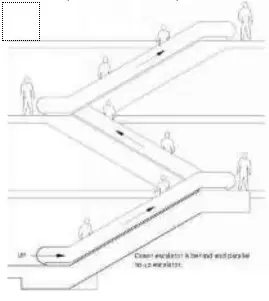
Parallel (No walkaround)
Parallel (With walkaround)
Crisscross

Parallel (No walkaround)
Parallel (With walkaround)
Crisscross
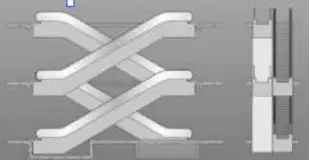
Parallel (No walkaround)
Parallel (With walkaround)
Crisscross

