
 Worksheets
no it does not
Total questions: 66
Worksheet time: 54mins
Adaptation to reduce transpiration
Broader leaves
Stunted growth
More stomata
Narrow leaves
The plant that does not exhibit guttation is
Strawberry
Nasturtium
Mango
Banana
The plants transpire more in
high humid conditions
low temperature
reduced pressure
calm day
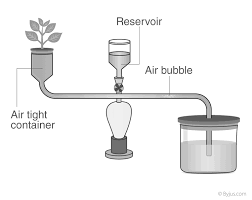
What happens to the movement of air bubble if apparatus is kept in front of a fan
Air bubble does not move
Air bubble moves very little
Air bubble does not change its position
Air bubble moves very fast
The rate of transpiration increases with
High atmospheric CO2 level
Low water content of leaf
Shedding of leaves
Dry air
The rate of transpiration decreases with
high temperature
high water content of leaf
closure of stomata
intensity of sunlight
What is transpiration?
Excess water being released from the aerial parts of plants in the form of water vapor
Excess sugar being released from the leave
The way a plant makes its food
When the plant uses sugar for energy
Water transported from stems to leaves through what?
xylem
phloem
stems
roots
Which of the following indicates the pathway of water through a plant?
root hair cell --> xylem --> Mesophyll --> substomatal space --> stomata
substomatal space -- > stomata --> root hair cell --> xylem --> Mesophyll
xylem --> stomata --> root hair cell --> Mesophyll --> Substomatal space
Select all of the environmental factors that would increase transpiration.
Increased humidity
Increased wind speed
Increased temperature
Decreased surface area
Which statement correctly identifies the substance and direction it is transported in the xylem?
Water, only upwards
Glucose, only upwards
Water, up and down the plant
Glucose, up and down the plant

Which is true?
99% of water taken by the plant evaporates through transpiration
9% of water taken by the plant evaporates through transpiration
Evaporation through transpiration accounts only for 1% of all the water the plant takes in
Evaporation through transpiration is minuscule
Stomata opens during night and closes during day
True
False
Adaptations in plant to reduce transpiration are -
No of stomata
Thickness of cuticle
Loss of leaves
All of the above
More root hairs will lead to
Less transpiration
More transpiration
Closure of stomata
What cycle is Transpiration a part of?
Life Cycle
Water Cycle
Carbon Cycle
Phosphorus Cycle
Transpiration is a part of____________?
Condensation
Sublimation
Evaporation
Precipitation
What is absorbed by the plant by it's roots, and transpiration takes place as the water exits the ________?
Leaves
Stem
Branch
Roots
What is the effect of increasing light intensity in transpiration?
It decreases transpiration rates
It increases transpiration rates
It doesn't impact the rate of transpiration
Which of the following indicates the pathway of water through a plant?
Stomata=>Root hair cell=>Xylem
Root hair cell=>Xylem=>Stomata
Xylem=>Stomata=>Root hair cell
Which statement describes the phloem transport system of plants?
It transports sugar and is lignified
It transports sugar and is not lignified
It transports water and is lignified
Select all of the environmental factors that would increase transpiration.
Increased humidity
Increased wind speed
Increased temperature
Decreased surface area
Choose the two statements that indicate what would be happening in the plant when stomata are open.
Guard cells are turgid
Guard cells are plasmolysed
Transpiration increase
Transpiration decrease
Which statement correctly identifies the substance and direction it is transported in the xylem?
Water, only upwards
Glucose, only upwards
Water, up and down the plant
Glucose, up and down the plant
Which statement correctly identifies the substance and direction it is transported in the phloem?
Water, only upwards
Water, up and down the plant
Sucrose, only upwards
Sucrose, up and down the plant
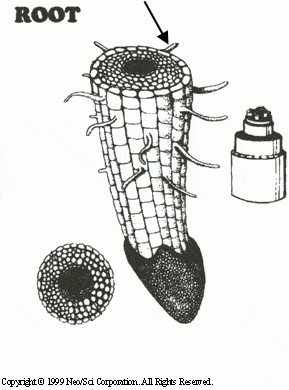


Which process are the xylem tubes part of?
Translocation
Transpiration


What is the purpose of the XYLEM?
To bring food from the soil to the whole plant.
To carry water and minerals from the roots to the whole plant.
To carry sugars from the leaves to all parts of the plant.

If plants don't store up water, how does water leave the plant?
The roots get rid of excess water.
Most plants DO store water.
It is released from the leaves by TRANSPIRATION.
Which statement correctly identifies the substance and direction it is transported in the xylem?
Water, only upwards
Glucose, only upwards
Water, up and down the plant
Glucose, up and down the plant
Which of the following indicates the pathway of water through a plant?
Stomata=>Root hair cell=>Xylem
Root hair cell=>Xylem=>Stomata
Xylem=>Stomata=>Root hair cell
Which picture shows the palisades layer?


The main function of stomata is to
capture sunlight
protect leaves from insects
allow gases to move rapidly in/out of leaves
release sugars into the atmosphere

The guards cells are located in the
lower epidermis.
upper epidermis.
cuticle.
palisades layer.
Which of the following indicates the pathway of water through a plant?
root hair cell --> xylem --> stomata
stomata --> root hair cell --> xylem
xylem --> stomata --> root hair cell
Which statement describes the phloem transport system of plants?
It transports sugar and is lignified
It transports sugar and is not lignified
It transports water and is lignified
Which type of plant tissue transports water and minerals?
Meristem
Phloem
Xylem
Select all of the environmental factors that would increase transpiration.
Increased humidity
Increased wind speed
Increased temperature
Decreased surface area

Which label points to palisade mesophyll?
B
G
J
H

Which letter points to the leaf vein?
A
D
J
G
Which label points to the region where photosynthesis takes place?
A
B
I
D

Which label points to the transparent layer?
A
B
D
F
Which letter points to the guard cells?
H
I
J
G
Choose the two statements that indicate what would be happening in the plant when stomata are open.
Guard cells are turgid
Guard cells are plasmolysed
Transpiration increase
Transpiration decrease
Which transport process occurs during transpiration?
Diffusion
Osmosis
Active transport
Which statement correctly identifies the substance and direction it is transported in the xylem?
Water, only upwards
Glucose, only upwards
Water, up and down the plant
Glucose, up and down the plant
Which statement correctly identifies the substance and direction it is transported in the phloem?
Water, only upwards
Water, up and down the plant
Glucose, only upwards
Glucose, up and down the plant

