
 Worksheets
Living Environment Exam Review- Spring 2021
Total questions: 50
Worksheet time: 34mins
Name
Class
Date
1.
1. Which sequence of terms is the correct order from simplest to the most complex?
a)
(1) systems —> organs —> tissues —> cells
b)
(2) cells —> organs —> tissues —> systems
c)
(3) tissues —> systems —> cells —> organs
d)
(4) cells —> tissues —> organs —> systems
2.
2. Hereditary information is stored inside the
a)
A ribosomes, which have chromosomes that contain many genes
b)
B ribosomes, which have genes that contain man ychromosomes
c)
C nucleus, which has chromosomes that contain many genes
d)
D nucleus, which has genes that contain man ychromosomes
3.
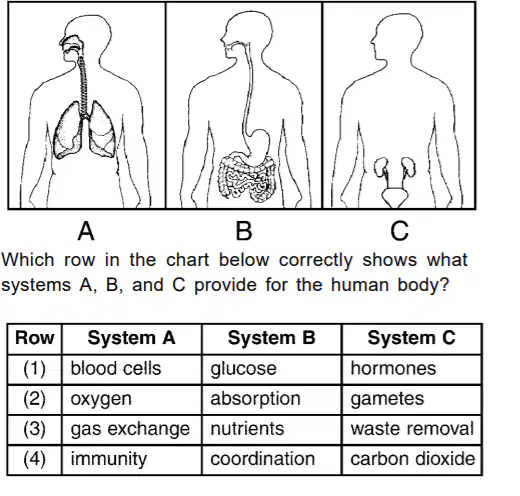
3. The diagram below represents three human body systems.
a)
(I)
b)
(2)
c)
(3)
d)
(4)
4.

4. The process in the diagram below is an example of
a)
A feedback mechanism maintaining homeostasis
b)
An immune system responding to prevent disease
c)
The digestion of sugar by insulin
d)
The hormonal regulation of gamete production
5.
5. Which function is associated with phagocytes in the blood?
a)
A) initiating blood clots
b)
B) transporting dissolved nutrients
c)
C) producing antibodies
d)
D) engulfing bacteria
6.
6. When the skin is broken from a cut or scrape, histamines are released, fluids and white blood cells move out of blood vessels and into surrounding tissues, and the white blood cells fight infection. What is this immune response called?
a)
A) clotting
b)
B) scab formation
c)
C) inflammation
d)
D) swelling
7.
7. Vaccinations help prepare the body to fight invasions of a specific pathogen by
a)
(A) inhibiting antigen production
b)
(B) stimulating antibody production
c)
(C) inhibiting white blood cell production
d)
(D) stimulating red blood cell production
8.
8. When a patient receives a vaccine against pneumonia, the patient's immune system produces memory cells. How do memory cells prevent illness?
a)
A) They weaken the pneumonia pathogens
b)
B) They kill the pneumonia pathogens from the vaccine
c)
C) They produce antibodies quickly the next time pneumonia pathogens invade
d)
D) They differentiate into B cells that attack the pathogens
9.
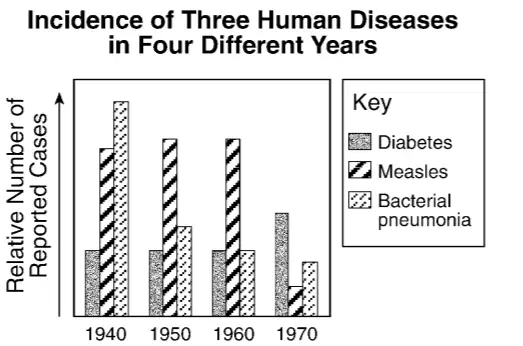
9. Base your answers to questions 9 through 11 on the graph below and on your knowledge of biology. The greatest difference between the incidence of measles and the incidence of bacterial pneumonia occurred in
a)
A 1940
b)
B 1950
c)
C 1960
d)
D 1970
10.
10. Which statement provides the best possible reason for the decrease in number of cases of bacterial pneumonia from 1940 to 1970?
a)
(A) As a result of genetic engineering, humans became immune to the bacteria.
b)
(B) Antibiotics were made available for the treatment of bacterial infections.
c)
(C) The bacteria did not respond to medical treatments
d)
(D) As a result of sexual reproduction, the bacteria evolved into a harmless form.
11.
11. Which statement best explains a change in the incidence of disease in 1970?
a)
(A) Children were vaccinated against measles.
b)
(B) New drugs cured diabetes.
c)
(C) The bacteria that cause pneumonia developed a resistance to drugs.
d)
(D) New technology helped to reduce the incidence of all three diseases.
12.
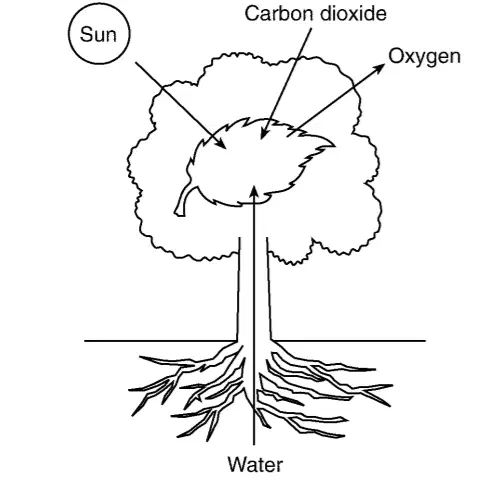
12. The diagram below represents events associated with a biochemical process that occurs in some organisms. Which statement concerning this process is correct?
a)
(A) The process represented is respiration and the primary source of energy for the process is the Sun.
b)
(B) The process represented is photosynthesis and the primary source of energy for the process is the sun
c)
(C) This process converts energy in organic compounds into solar energy which is released into the atmosphere.
d)
(D) This process uses solar energy to convert oxygen into carbon dioxide.
13.
13. Which statement best describes cellular respiration?
a)
(A) It occurs in animal cells but not in plant cells.
b)
(B It converts energy in food into a more usable form.
c)
(C) It uses carbon dioxide and produces oxygen.
d)
(D) It stores energy in food molecules
14.
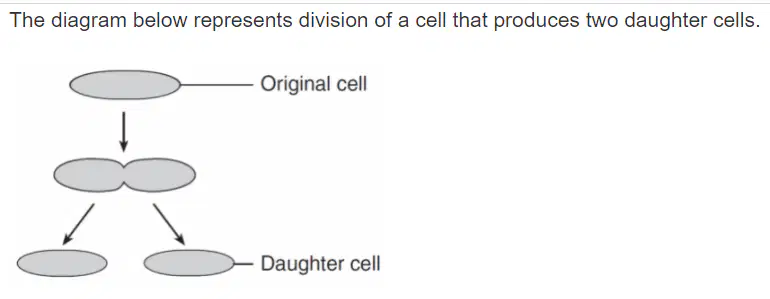
14. Which statement most likely describes the daughter cells produced?
a)
A) The daughter cells will pass on only half of the genetic information they received from the original cell.
b)
B) The daughter cells will each produce offspring that will have the same genetic information as the original cell.
c)
C) The daughter cells will each undergo the same mutations as the original cell after reproduction has occurred.
d)
D) The daughter cells will not pass on any of the genes that they received from the original cell.Your third question?
15.
15. Which statement best explains the significance of meiosis in the evolution of a species?
a)
A) Meiosis produces eggs and sperm that are alike.
b)
B) Meiosis provides for chromosomal variation produced by an organism.
c)
C) Equal numbers of eggs and sperm are produced by meiosis.
d)
D) The gametes produced by meiosis ensure the continuation of any particular species by asexual reproduction.
16.
16. Which sequence represents the correct order of events for the formation and development of an embryo?
a)
A) meiosis fertilization mitosis differentiation
b)
B) mitosis meiosis differentiation fertilization
c)
C) differentiation mitosis meiosis fertilization
d)
D) mitosis fertilization differentiation meiosis
17.
17. Which process normally occurs during meiosis, but not during mitosis?
a)
A) chromosomal replication
b)
B) crossing over of chromosomes
c)
C) spindle formation
d)
D) centromere replication
18.
18. Which of the following is not a purpose of mitosis?
a)
A) Production of gametes
b)
B) Repair of damaged cells
c)
C) Growth
d)
D) Development
19.
19. Uncontrolled mitosis results in?
a)
A) Cell death
b)
B) Cancer
c)
C) Meiosis
d)
D) Crossing over
20.
20. Horses are herbivores and, as a result, can be classified also as
a)
A) omnivores
b)
B) primary consumers
c)
C) secondary consumers
d)
D) decomposers
21.
21. Which human activity has probably contributed most to acid rain and the acidification of lakes in the Adirondack region?
a)
A) the release of hot water by nuclear power plants
b)
B) the release of CFC's by aerosol cans
c)
C) burning fossil fuels that produce air pollutants containing sulfur and nitrogen
d)
D) using pesticides for the control of insects that feed on trees
22.
22. What would most likely happen if most of the decomposers were removed from an ecosystem?
a)
A) Soil fertility would increase.
b)
B) Energy provided for autotrophic nutrition would be reduced.
c)
C) The rate of mutations in plants would increase.
d)
D) Nutrient recycling would be reduced.
23.
23. The ultimate source of energy for almost all living organisms is
a)
A. Carbohydrates
b)
B. Glucose
c)
C. Lipids
d)
D. Sun
24.
24. Biodiversity is declining all over the globe. This is mainly due to ______.
a)
A) habitat loss
b)
B) alien species
c)
C) overharvesting
d)
D) pollution
25.
25. Ecology is
a)
A) a subfield of environmentalism
b)
B) the study of animal behavior
c)
C) the study of organisms and their interaction with each other and with the environment
d)
D) concerned only with solving environmental problems
26.
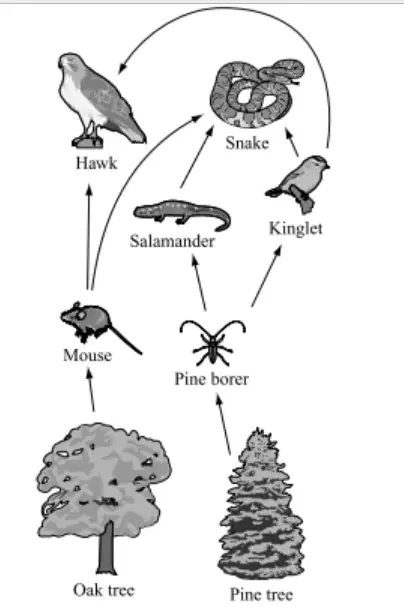
26. Which of the following organisms compete for the mouse as a food source?
a)
A) kinglet and snake
b)
B)snake and hawk
c)
C)oak tree and pine tree
d)
pine borer and salamander
27.
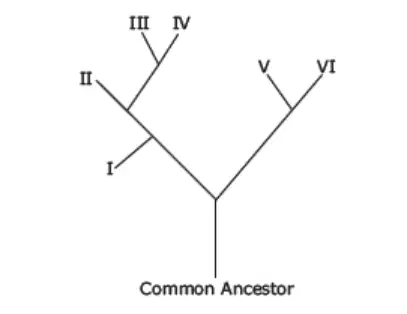
27. This diagram shows a cladogram of six species based on some similarities. These diagrams can be used to show
a)
A. common structures from organisms
b)
B. many generations of 1 type of organism
c)
C. evolutionary relationships amoung organisms
d)
D. eating habits of organisms
28.
28. Which of the following normally results from meiosis in a human cell that contains 46 chromosomes?
a)
A) an egg cell with 46 chromosomes
b)
B) a liver cell with 23 chromosomes
c)
C) a blood cell with 46 chromosomes
d)
D) a sperm cell with 23 chromosomes
29.
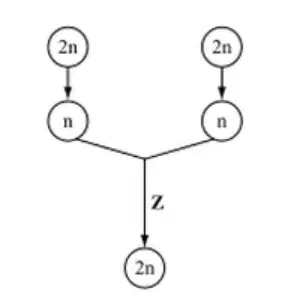
29. The diagram below represents steps in sexual reproduction. Which of the following occurs in the step labeled Z?
a)
A) meiosis
b)
B) fertilization
c)
C) mitosis
d)
D) translocation
30.
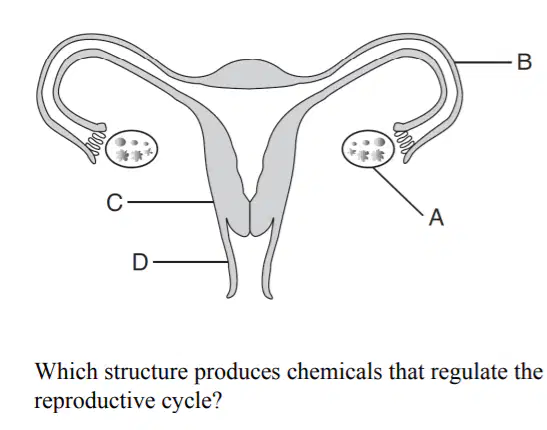
30. Base your answer on the diagram below, which represents the human female reproductive system.
a)
A
b)
B
c)
C
d)
D
31.
31. The human male's testes are located in an outpocketing of the body wall known as the scrotum. An advantage of this adaptation is that
a)
A) a temperature lower than body temperature is best for sperm production and storage
b)
B) a temperature higher than body temperature is best for sperm production and storage
c)
C) sperm production requires contact with the atmospheric air
d)
D) the testes are better protected in the scrotum than in the body cavity
32.
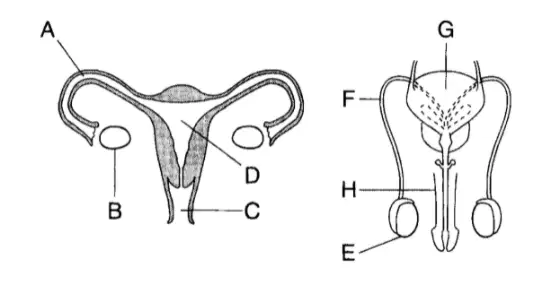
32. Base your answer on the diagram below and on your knowledge of biology. The diagram represents the reproductive systems of the human female and male. In which structure do gametes usually unite to produce a zygote?
a)
A
b)
D
c)
C
d)
F
33.
33. Regulation of sexual reproductive cycles of human males is related most directly to the presence of the hormone
a)
A) testosterone
b)
B) insulin
c)
C) estrogen
d)
D) progesterone
34.
34. In a eukaryotic cell, which of the following processes directly involves DNA?
a)
A) translation
b)
B) cellular respiration
c)
C) active transport of ions
d)
D) replication of chromosomes
35.
35. The largest amount of DNA in a plant cell is contained in
a)
A a chromosome
b)
B a nucleus
c)
C a protein molecule
d)
D an enzyme molecule
36.
36. DNA is a large molecule consisting of repeating units known as
a)
A) dipeptides
b)
B) nucleotides
c)
C) amino acids
d)
D) organic salts
37.
37. RNA is an example of a
a)
A) nucleic acid
b)
B) protein
c)
C) lipid
d)
D) carbohydrate
38.
38.Different forms of a gene are called
a)
A) karyotypes
b)
B) centromeres
c)
C) centrioles
d)
D) alleles
39.
39.In pea plants, the allele for purple flowers (P) is dominant to the allele for white flowers (p). A plant that is heterozygous for purple flowers is crossed with a plant with white flowers. What percentage of the offspring plants are expected to have purple flowers?
a)
A 25%
b)
B 50%
c)
C 75%
d)
D 100%
40.
40. In mussels, the allele for brown coloring (B) is dominant, and the allele for blue coloring (b) is recessive. For which parental genotypes are 100% of the offspring expected to be blue?
a)
A) Bb X Bb
b)
B) BB X bb
c)
C) bb X bb
d)
D) BB X BB
41.
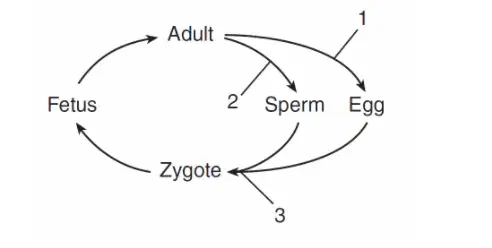
41. The diagram below represents some stages in the life cycle of humans. The numbers in the diagram represent various processes in the cycle.Identify the process(es) represented by 1 and 2. State how these processes (1 and 2) affect the amount of genetic information provided by a parent to its offspring.
4 lines
42.
42. Base your answer to the next 2 questions on the information below and on your knowledge of biology.A student uses a covered aquarium to study the interactions of biotic and abiotic factors in an ecosystem. The aquarium contains sand, various water plants, algae, small fish, snails, and decomposers. The water contains dissolved oxygen and carbon dioxide, as well as tiny amounts of minerals and salts. Describe one specific way the decomposers benefit the other organisms in the aquarium.
4 lines
43.
43. Describe one specific way the fish population changes the amount of one specific abiotic factor (other than oxygen) in this ecosystem.
4 lines
44.
44.Base your answer on the information below and your knowledge of biology. For over 100 years scientists have monitored the carbon dioxide concentrations in the atmosphere in relation to changes in the atmospheric temperature.Discuss the overall relationship between carbon dioxide concentration and changes in atmospheric temperature and the effect of these factors on ecosystems. Your answer must include:• The relationship between the concentration of carbon dioxide in the atmosphere and changes in atmospheric temperature• One specific way in which humans have contributed to the increase in atmospheric carbon dioxide• One specific negative effect the continued rise in temperature would be likely to have on an ecosystem• One specific example of how humans are trying to reduce the problem of global warming
4 lines
45.
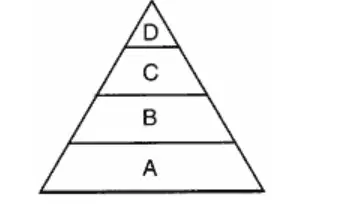
45. The diagram below represents an energy pyramid.What happens to the amount of available energy at each level from A to D? Why does this happen?
4 lines
46.
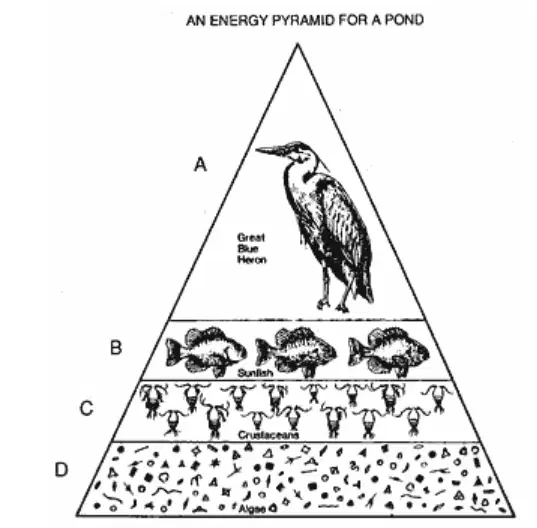
46. Which is the term for the trophic level labeled D in the diagram?
4 lines
47.
47. Many people become infected with the chicken pox virus during childhood. After recovering from chickenpox, these people are usually immune to the disease forthe rest of their lives. However, they may still be infected by viruses that cause other diseases, such as measles.Discuss the immune response to the chicken pox virus. In your answer, be sure to include:• the role of antigens in the immune response [1]• the role of white blood cells in the body’s response to the virus [1]• an explanation of why recovery from an infection with the chicken pox virus will not protect a person from getting a different disease, such as measles [1]• an explanation of why a chicken pox vaccination usually does not cause a person to become ill with chicken pox [1]
4 lines
48.
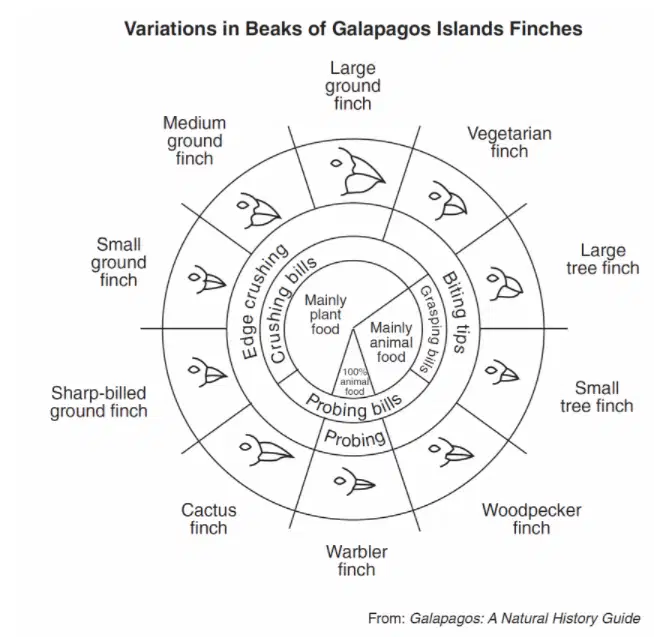
48. Base your answers to questions 48 through 50 on the diagrams below and on your knowledge of biology. The diagrams represent the variations in the beaks of finches in the Galapagos Islands and the relative abundance of food sources on a certain island. A bird count was done on the island and the small tree finch was found in all regions. State one possible reason why the small tree finch is able to inhabit the entire island.
4 lines
49.
49. Explain why researchers would most likely observe the large ground finch in regions A and D on the island and not in regions B and C.
4 lines
50.
50.The diagram of the island suggests that in region B finches can feed on
a)
A) large seeds and insects
b)
B) a large variety of different-sized seeds
c)
C) small seeds, only
d)
D) insects and a limited number of small seeds
100 %

