
 Worksheets
Week One
Total questions: 81
Worksheet time: 1hrs 16mins
hubungan antara Agen (manajemen suatu usaha) dan principal (pemilik usaha). Di dalam hubungan keagenan terdapat suatu kontrak dimana satu orang atau lebih (principal) memerintah orang lain (agen) untuk melakukan suatu jasa atas nama prinsipal dan memberi wewenang kepada agen untuk membuat keputusan yang terbaik bagi prinsipal, pengertian dari..
Kooperatif
Non-Kooperatif
Agensi Teori
Game Teori
Permasalahan muncul jika agent tidak melaksanakan hal -hal yang telah disepakati bersama dalam kontrak kerja adalah pengertian dari..
Adverse Selection
Moral Hazard
The Monitoring Expenditures by the principal
The Bonding Expenditures by The Agent
"Menekankan bahwa manusia memiliki sifat untuk mementingkan diri sendiri (self interest), memiliki keterbatasan rasionalitas (bounded rationality), dan tidak menyukai resiko (risk aversion)" merupakan pengertian dari Asumsi
Asumsi tentang Sifat Manusia
Asumsi tentang Informasi
Asumsi tentang Keorganisasian
Asumsi tentang Sifat Manager
Yang mana dibawah ini termasuk ke dalam Agency Cost
The Monitoring Expenditures by the Principal
The Bonding Expenditures by Agent
The Residual Loss
Semua Benar
pencetus angency teory pada tahun
1769
1676
1976
1967
prinsip signaling Actions convey information dikemukakan oleh spence tahun
1793
1973
1937
1979
Asumsinya Principal dan agen bertindak secara rasional, dimana agent adalah..
Risk Averse
Risk Neutral
Risk Taker
Effort Averse
Situasi dimana dua pemain saling memperhitungkan kemungkinan perilaku satu sama lain sambil masing-masing menetapkan harganya merupakan pengertian dari Tipe Teori Game...
Kooperatif
Non Kooperatif
Zero-sum game
Non-zero sum game
"The Choice by a manager of accounting policies so as to achieve some spesific objective" merupakan pengertian
Agency Theory
Game Theory
Earnings Management
Income Smoothing
Biaya yang dikeluarkan oleh prinsipal untuk memonitoring perilaku agen adalah pengertian dari...
The Residual Loss
The Monitoring Expenditures by the Principal
The Residual Gain
The Bonding Expenditures by Agent
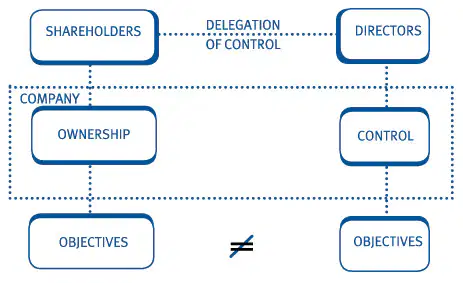
Objectives dari shareholders (principal) tidak sama dengan objectives dari directors (agent). Maka diperlukan keberadaan suatu sistem yang dikenal dengan istilah
Pengawasan Melekat
Tata Kelola Korporasi
Pengendalian Management
Manajemen Risiko
Principal-Agent Dilemma is the basis for corporate governance, and results from the separation of control between:
Management and the stakeholders of a firm
Shareholders and stakeholders of a firm
Government and private sector firms
Management and the shareholders of a firm
The purpose of the Board of Directors is to:
Manage the day-to-day activities of the company
Execute the managing director’s instructions
Set the strategy and effectively monitor management
Represent the company in front of the media
The requirements of a board of directors vary significantly by country and by state; however, there is a developing consensus as to what the major responsibilities should be. Which of the following is NOT one of the responsibilities?
Reviewing and approving the use of resources
Setting corporate strategy, overall direction, mission or vision
Controlling, monitoring, or supervising top management
Becoming directly involved in managerial decisions
The theory which states that problems arise in corporations because top management no longer is willing to bear the brunt of their decisions unless they own a substantial amount of stock in the corporation is called
agency theory
strategic leadership theory
ownership theory
sustainable theory
An agency problem can occur when
the desires and objectives of the owners and agents conflict.
when the owners and agents have different attitudes toward risk.
executives do not select risky strategies because they fear losing their jobs if the strategy fails.
All are correct
A _____ is a problem, situation, or opportunity requiring an individual, group, or
organization to choose among several actions that must be evaluated as right or wrong.
Crisis
ethical issue
fraud
violance
Most companies begin the process of establishing organizational ethics programs by developing:
ethics training programs.
codes of conduct
ethics enforcement mechanisms.
hidden agendas
An efficient market is defined as one in which:
all participants have the same opportunity to make the make the same returns.
all participants have the same legal rights and transactions costs.
securities’ prices quickly and fully reflect all available information.
securities’ prices are completely in line with the intrinsic value.
If a market is inefficient, as new information is received about a security:
nothing will happen.
the stock price will fall at first and then later rise.
there will be a lag in the adjustment of the stock price
there will be negative demand for the stock.
An efficient market does not require that:
stock prices incorporate all information.
all known information be reflected in prices.
price adjustments occur very quickly.
each adjustment be perfect.
Which of the following is NOT a test of semi-strong form efficiency?
Insider transactions
Stock splits
Accounting changes
Dividend announcements
Which is NOT consider as insider trading:
buying or selling of security by someone who has access to material non public information about security.
can be illegal and legal
Insider trading can beat weak and semi strong EMH
Insider trading can beat strong EMH
What does it mean by "what ever you pay in stock is fair value"
The price you pay for a stock is fair means that the prices has already incorporated all available information.
May imply the strong-form market efficiency hypothesis probably does not hold.
Its just a phrase, not reliable.
specified trading rules can prove to be extremely useful in generating excess returns
The __________ is NOT a market anomaly.
size effect
January effect
earnings announcement anomaly
accounting changes effect
The January effect concerns:
large cap stocks.
mid-cap stocks.
small cap stocks.
foreign stocks.
If a market is inefficient, as new information is received about a security:
nothing will happen.
the stock price will fall at first and then later rise.
there will be a lag in the adjustment of the stock price
there will be negative demand for the stock.
An efficient market does not require that:
stock prices incorporate all information.
all known information be reflected in prices.
price adjustments occur very quickly.
each adjustment be perfect.
Which of the following is NOT a test of semi-strong form efficiency?
Insider transactions
Stock splits
Accounting changes
Dividend announcements
Which is NOT consider as insider trading:
buying or selling of security by someone who has access to material non public information about security.
can be illegal and legal
Insider trading can beat weak and semi strong EMH
Insider trading can beat strong EMH
What does it mean by "what ever you pay in stock is fair value"
The price you pay for a stock is fair means that the prices has already incorporated all available information.
May imply the strong-form market efficiency hypothesis probably does not hold.
Its just a phrase, not reliable.
specified trading rules can prove to be extremely useful in generating excess returns
Which of the following is a statement of weak form efficiency?
I.
If the markets are efficient in the weak form, then it is impossible to make consistently superior profits by using trading rules based on past returns.
If the markets are efficient in the weak form, then prices will adjust immediately to public information.
If the markets are efficient in the weak form, then prices reflect all information.
One important implication of the efficient market hypothesis is that:
Investors can make profits by engaging in day trading
Investors should hold a diversified portfolio and avoid active trading
Investors should actively review their portfolio to achieve the highest profits
All of the above
The semi-strong form of market efficiency may be tested by measuring how rapidly security prices react to various news items like:
Earnings announcements
Dividend announcements
News of takeovers
News of inflation
An efficient market is defined as one in which:
all participants have the same opportunity to make the make the same returns.
all participants have the same legal rights and transactions costs.
securities’ prices quickly and fully reflect all available information.
securities’ prices are completely in line with the intrinsic value.
If a market is inefficient, as new information is received about a security:
nothing will happen.
the stock price will fall at first and then later rise.
there will be a lag in the adjustment of the stock price
there will be negative demand for the stock.
An efficient market does not require that:
stock prices incorporate all information.
all known information be reflected in prices.
price adjustments occur very quickly.
each adjustment be perfect.
Which of the following is NOT a test of semi-strong form efficiency?
Insider transactions
Stock splits
Accounting changes
Dividend announcements
Which is NOT consider as insider trading:
buying or selling of security by someone who has access to material non public information about security.
can be illegal and legal
Insider trading can beat weak and semi strong EMH
Insider trading can beat strong EMH
In order to make market efficient____________.
information must be equally accessible to all investors.
information must be kept by the companies privately.
information must be release only when it is necessary.
All of the above.
Features of efficient market are EXCEPT
There are many knowledgeable investors actively analysing, valuing and trading particularly security
Information is widely available to all investors at approximately the same time.
investors react quicly and accurately to new information, causing prices to adjust quickly and average
information such a GDP and taxes effects the market
Prices reflect all the security - market information contained in past prices refers to
Strong Form EMH
Weak form EMH
Semi strong form EMH
None of the above
The relevant information that might affect stock prices can be obtained from
economic reports, financial statements, historical data
company website, watsapp massages, facebook
news, forwarded messages
minutes of meetings, verbal news
Eugene F. Fama mengemukakan teori...
capital asset pricing model theory
dividend theory
efficient market hypothesis
asymmetric information theory
France Modigliani dan Merton Miller mengemukakan teori...
asymmetric information theory
perfect capital market theory
Capital structure theory
option pricing theory
Michael c. Jensen dan William H. Meckling mengemukakan teori...
discounted cash flow analysis theory
perfect capital markets
dividend theory
agency theory
Harry Markowitz mengemukakan teori...
discounted cash flow analysis
capital asset pricing model
capital perfect market analysis
agency theory
Myron J. Gordon mengembangkan teori...
discounted cash flow analysis theory
perfect capital markets theory
capital structure theory
option pricing theory
William Sharpe, John Lintner, dan Jan Moisin mengembangkan teori...
perfect capital markets theory
discounted cash flow analysis theory
asymmetric information theory
capital asset pricing model
Salah satu jenis pasar efisien menurut efficient market hypothesis adalah...
market informationally efficient
perfectly informationally efficient
completely informationally efficient
capital informationally efficient
Semua peserta pasar pada kondisi pasar efisien menurut efficient market hypothesis theory adalah...
unlogic
logic
irrasional
rasional
Menurut agency theory, hubungan keagenan muncul ketika perusahaan menggaji karyawan untuk bertindak...
atas namanya
sendiri
berkelompok
secara individu
Money market securities have all the following characteristics except they are not
short term
money
low risk
very liquid
Finance companies raise funds in the money market by selling
commercial paper
federal funds
negotiable certificates of deposits
Eurodollars
Compared to money market securities, capital market securities have
more liquidity
longer maturity
lower yields
less risk
The primary reason that individuals and firms choose to borrow long-term is to
reduce the risk that interest rates will fall before they pay off their debt
reduce the risk that interest rates will rise before they pay off their debt.
reduce monthly interest payments, as interest rates tend to be higher on short-term than long-term debt instruments
reduce total interest payments over the life of the debt
Typically, the interest rate on corporate bonds will be ________ the more restrictions are placed on management through restrictive covenants, because ________.
higher; corporate earnings will be limited by the restrictions
higher; the bonds will be considered safer by bondholders
lower; the bonds will be considered safer by buyers
lower; corporate earnings will be higher with more restrictions in place
A basic principle of finance is that the value of any investment is
the present value of all future net cash flows generated by the investment
the undiscounted sum of all future net cash flows generated by the investment
unrelated to the future net cash flows generated by the investment
unrelated to the degree of risk associated with the future net cash flows generated by the investment
Which of the following events will increase the Aggregate Demand in the economy. Check all that apply.
The government increasing Income Tax
The Fed lowering interest rates
A rise in the cost of raw material
A supply shock like a new production technology
An increase in consumer confidence
What is meant by the financial system?
The system used by the central bank to print new money.
The system that regulates fund transfers between banks at the international level.
The system that regulates fiscal and monetary policies in a country.
The system that includes financial institutions and financial markets.
The system used by the government to collect tax revenue.
What is meant by interest?
A portion of the profit distributed by a company to shareholders.
The fee charged by the bank for the use of banking services.
The nominal value of a bond at maturity.
A portion of income that borrowers must pay to lenders in exchange for using money.
The profit earned by the bank from the difference between the interest rate given to customers and the interest rate received from customer deposits.
According to the interest rate effect, aggregate demand slopes downward (negatively) because
lower prices increase money holdings, decrease lending, interest rates rise, and investment spending falls.
lower prices increase the value of money holdings and consumer spending increases
lower prices decrease the value of money holdings and consumer spending decreases.
lower prices reduce money holdings, increase lending, interest rates fall, and investment spending increases.
What determines the price of the loan?
Borrower creditworthiness
The amount of deposits
Bank liquidity position
Bank officer's mood
Other things equal, if the government runs a budget surplus, it will tend to
Increase national saving
Decrease the real interest rate
Increase the amount of investment
Increase economic growth
do all of the above
The largest component of Aggregate Demand is
Government Purchases
Net Exports
Consumption
Investment
Suppose the economy is producing at the natural rate of output and the government passes legislation that severely restricts a company's ability to reduce production costs via outsourcing. Everything else held constant, this policy action will cause ________ in the unemployment rate in the short run and ________ in inflation in the short run.
a decrease; an increase
a decrease; a decrease
an increase; an increase
no change; no change
A possible sequence for the three stages of a financial crisis in an advanced economy might be ______ leads to ______ leads to ______.
banking crises; increase in interest rates; unanticipated decline in price level
unanticipated decline in price level; banking crises; increase in interest rates
banking crises; increase in uncertainty; increase in interest rates
asset price declines; banking crises; unanticipated decline in price level
Financial crises in advanced economies might start from a
debt deflation
currency mismatch
mismanagement of financial innovations
currency crisis

