
 Worksheets
25-48
Total questions: 24
Worksheet time: 14mins
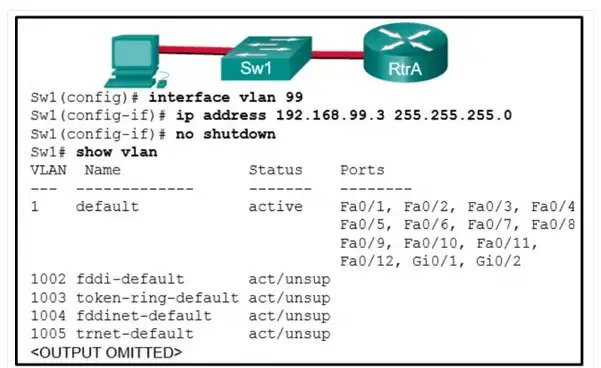
25. Refer to the exhibit. Based on the exhibited configuration and output, why is VLAN 99 missing?
because VLAN 99 is not a valid management VLAN
because there is a cabling problem on VLAN 99
because VLAN 1 is up and there can only be one management VLAN on the switch
because VLAN 99 has not yet been created
26. Which two VTP modes allow for the creation, modification, and deletion of VLANs on the local switch? (Choose two.)
client
master
distribution
slave
server
transparent
27. Which three steps should be taken before moving a Cisco switch to a new VTP management domain? (Choose three.)
Configure the switch with the name of the new management domain.
Reset the VTP counters to allow the switch to synchronize with the other switches in the domain.
Configure the VTP server in the domain to recognize the BID of the new switch.
Download the VTP database from the VTP server in the new domain.
Select the correct VTP mode and version.
Reboot the switch.
28. A network administrator is preparing the implementation of Rapid PVST+ on a production network. How are the Rapid PVST+ link types determined on the switch interfaces?
Link types can only be configured on access ports configured with a single VLAN.
Link types can only be determined if PortFast has been configured.
Link types are determined automatically.
Link types must be configured with specific port configuration commands
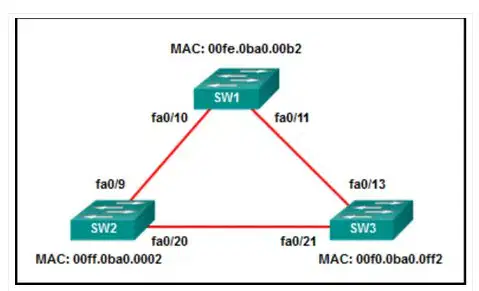
29. Refer to the exhibit. All the displayed switches are Cisco 2960 switches with the same default priority and operating at the same bandwidth. Which three ports will be STP designated ports? (Choose three.)
fa0/9
fa0/20
fa0/11
fa0/21
fa0/13
fa0/10
30. How will a router handle static routing differently if Cisco Express Forwarding is disabled?
It will not perform recursive lookups.
Ethernet multiaccess interfaces will require fully specified static routes to avoid routing inconsistencies.
Static routes that use an exit interface will be unnecessary.
Serial point-to-point interfaces will require fully specified static routes to avoid routing inconsistencies.
31. Compared with dynamic routes, what are two advantages of using static routes on a router? (Choose two.)
They improve network security.
They take less time to converge when the network topology changes.
They improve the efficiency of discovering neighboring networks.
They use fewer router resources.
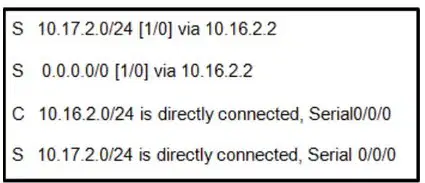
32. Refer to the exhibit. Which route was configured as a static route to a specific network using the next-hop address?
S 10.17.2.0/24 [1/0] via 10.16.2.2
S 0.0.0.0/0 [1/0] via 10.16.2.2
S 10.17.2.0/24 is directly connected, Serial 0/0/0
C 10.16.2.0/24 is directly connected, Serial0/0/0
33. What is the effect of entering the spanning-tree portfast configuration command on a switch?
It checks the source L2 address in the Ethernet header against the sender L2 address in the ARP body.
It enables portfast on a specific switch interface.
It disables all trunk ports.
It disables an unused port.
34. What is the IPv6 prefix that is used for link-local addresses?
FF01::/8
2001::/3
FC00::/7
FE80::/10
35. Which two statements are characteristics of routed ports on a multilayer switch? (Choose two.)
They are not associated with a particular VLAN.
They support subinterfaces, like interfaces on the Cisco IOS routers.
They are used for point-to-multipoint links.
The interface vlan command has to be entered to create a VLAN on routed ports.
In a switched network, they are mostly configured between switches at the core and distribution layers.
36. Successful inter-VLAN routing has been operating on a network with multiple VLANs across multiple switches for some time. When an inter-switch trunk link fails and Spanning Tree Protocol brings up a backup trunk link, it is reported that hosts on two VLANs can access some, but not all the network resources that could be accessed previously. Hosts on all other VLANS do not have this problem. What is the most likely cause of this problem?
The protected edge port function on the backup trunk interfaces has been disabled.
Inter-VLAN routing also failed when the trunk link failed.
Dynamic Trunking Protocol on the link has failed.
The allowed VLANs on the backup link were not configured correctly.
37. Which command will start the process to bundle two physical interfaces to create an EtherChannel group via LACP?
channel-group 2 mode auto
interface range GigabitEthernet 0/4 – 5
interface port-channel 2
channel-group 1 mode desirable
38. What action takes place when a frame entering a switch has a multicast destination MAC address?
The switch replaces the old entry and uses the more current port.
The switch adds a MAC address table entry mapping for the destination MAC address and the ingress port.
The switch forwards the frame out of the specified port.
The switch will forward the frame out all ports except the incoming port.
39. A junior technician was adding a route to a LAN router. A traceroute to a device on the new network revealed a wrong path and unreachable status. What should be done or checked?
Check the configuration of the exit interface on the new static route.
Create a floating static route to that network.
Check the configuration on the floating static route and adjust the AD.
Verify that there is not a default route in any of the edge router routing tables.
40. Select the three PAgP channel establishment modes. (Choose three.)
auto
extended
passive
default
on
desirable
41. A static route has been configured on a router. However, the destination network no longer exists. What should an administrator do to remove the static route from the routing table?
Nothing. The static route will go away on its own.
Change the routing metric for that route.
Change the administrative distance for that route.
Remove the route using the no ip route command.
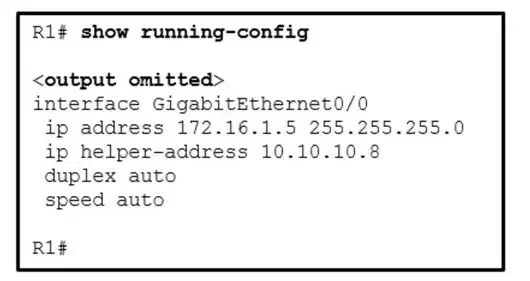
42. Refer to the exhibit. What can be concluded about the configuration shown on R1?
R1 is configured as a DHCPv4 relay agent.
R1 will send a message to a local DHCPv4 client to contact a DHCPv4 server at 10.10.10.8.
R1 will broadcast DHCPv4 requests on behalf of local DHCPv4 clients.
R1 is operating as a DHCPv4 server.
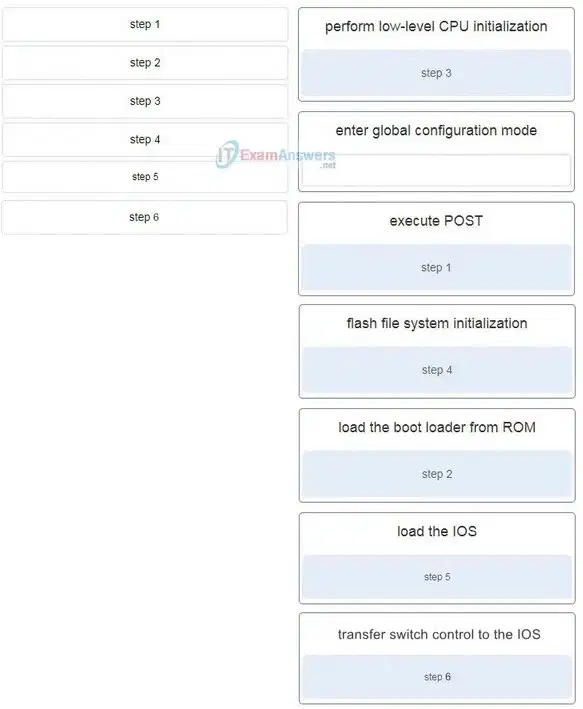
43. Match the step to each switch boot sequence description. (Not all options are used.)
1. execute POST
2. load the boot loader from ROM
6. transfer switch control to the IOS
5. load the IOS
4. flash file system initialization
3. CPU register initializations
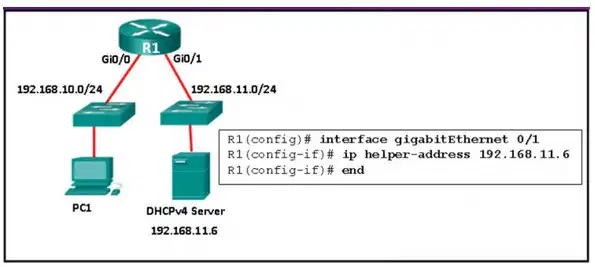
44. Refer to the exhibit. R1 has been configured as shown. However, PC1 is not able to receive an IPv4 address. What is the problem?
The ip helper-address command was applied on the wrong interface.
The ip address dhcp command was not issued on the interface Gi0/1.
A DHCP server must be installed on the same LAN as the host that is receiving the IP address.
R1 is not configured as a DHCPv4 server.
45. What two default wireless router settings can affect network security? (Choose two.)
The SSID is broadcast.
A well-known administrator password is set.
The wireless channel is automatically selected.
WEP encryption is enabled.
MAC address filtering is enabled.
46. What is the common term given to SNMP log messages that are generated by network devices and sent to the SNMP server?
traps
warnings
auditing
acknowledgments
47. A network administrator is adding a new WLAN on a Cisco 3500 series WLC. Which tab should the administrator use to create a new VLAN interface to be used for the new WLAN?
WIRELESS
WLANs
CONTROLLER
MANAGEMENT
48. A network administrator is configuring a WLAN. Why would the administrator change the default DHCP IPv4 addresses on an AP?
to reduce the risk of interference by external devices such as microwave ovens
to reduce outsiders intercepting data or accessing the wireless network by using a well-known address range
to monitor the operation of the wireless network
to restrict access to the WLAN by authorized, authenticated users only

