wayground logo

Free Printable Worksheets

Font size

S
M
L
XL
Worksheets

Introduction to enzyme

Total questions: 20

Worksheet time: 19mins
Name
Class
Date
1.
Enzymes are considered to be 
a)
Lipids
b)
Carbohydrate
c)
Protein
d)
Nucleic Acid
2.
What is the purpose  of an enzyme?
a)
give permission for the reaction
b)
raise activation energy
c)
speed up reactions
d)
control how many reactions occur
3.
Where do substrates bind on an enzyme?
a)
voltage-gated channels
b)
surface receptor
c)
calcium channels
d)
active site
4.
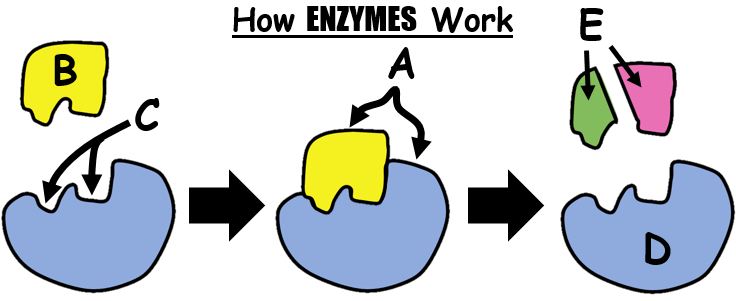
In the diagram, what is letter A? 
a)
product
b)
substrate
c)
enzyme-substrate complex
d)
active site
5.
Enzymes are capable of increasing the rate of a chemical reaction within a living cell.  Enzymes accomplish this through which of the following means?
a)
reducing the number of products   
b)
reducing the activation energy
c)
increasing the temperature of the cell
d)
increasing the concentration of reactants 
6.
The "lock and key hypothesis" attempts to explain the mechanism of?
a)
Vacuole formation
b)
Pinocytosis
c)
Sharing of electrons
d)
Enzyme specificity 
7.
How do competitive inhibitors affect enzymes?
a)
It binds to the active site, blocking the substrate
b)
It changes the shape of the enzyme
c)
It increases the activation energy
d)
It decreases the activation energy
8.
What is the name of structure A?
a)
Active Site
b)
Substrate
c)
Enzyme-Substrate Complex
d)
Product
9.
Which of the following is NOT true about enzymes?
a)
They speed up chemical reactions
b)
They are not specific.
c)
They are made up of amino acids
d)
They can interact with only one type of substrate
10.
What is the name of structure B?
a)
Active Site
b)
Substrate
c)
Enzyme-Substrate complex
d)
Product
11.
If an enzyme becomes over heated what effect, if any, will the heat have on the enzymatic activity? 
a)
The enzyme will not store much chemical energy.
b)
The enzyme will not be able to catalyze reactions.
c)
The enzyme will lose its net electrical charge.
d)
The enzyme will lose stored genetic information.
12.
An enzyme speeds up a reaction by
a)
lowering the activation energy.
b)
raising the activation energy.
c)
releasing energy.
d)
absorbing energy.
13.

Which statement is not true for all enzymes?

a)

Enzymes break down large molecules to small ones.

b)

Enzymes remain unchanged at the end of a reaction.

c)

Enzymes are affected by pH.

d)

Enzymes catalyse reactions.

14.
The "lock and key hypothesis" attempts to explain the mechanism of?
a)
Vacuole formation
b)
Pinocytosis
c)
Sharing of electrons
d)
Enzyme specificity 
15.

What does an enzyme need in order to work properly?

a)

The right amount of oxygen & CO2

b)

The right temperature & amount of water

c)

The right temperature & pH

d)

The right temperature & pressure

16.

Vitamin derived molecules which help enzymes.

a)

Inorganic ions

b)

Coenzyme

c)

Metal ions

d)

Cofactor

17.

An enzyme that hydrolyzes protein will not act upon starch. This fact is an indication that enzymes are

a)

Hydrolytic

b)

Specific

c)

Catalytic

d)

Synthetic

18.

At high temperatures, the rate of enzyme action decreases because the increased heat

a)

changes the pH of the system

b)

alters the active site of the enzyme

c)

neutralizes the acids and bases in the system

d)

increases the concentration of the enzyme

19.

Any chemical reaction that requiring energy

a)

Exergonic reaction

b)

Catabolic reaction

c)

Endergonic reaction

d)

Metabolism

20.
When a molecule can occupy the same active site as the substrate, a situation called __________________ can result
a)
Competitive lnhibition
b)
Allosteric Regulation
c)
Non-Competitive Inhibition
d)
Feedback Inhibition