
 Worksheets
22a: Hydrological Cycle + Drainage Basin
Total questions: 65
Worksheet time: 52mins
What is the hydrological cycle?
The continuous movement of water in Earth's atmosphere.
The continuous movement of water between Earth’s atmosphere and land.
when water melts
when clouds form

The hydrological cycle is often described as an _____________ cycle.
Open
Leaky
Spikey
Closed
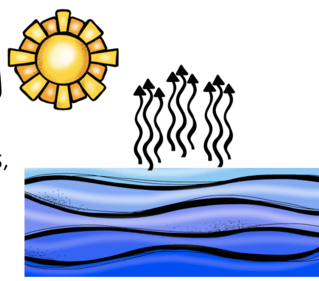

What is the term for water flowing back to the sea over the land.
Groundwater Flow
Surface Runoff
Through Flow
Infiltration
What is it called when trees get in the way of rain reaching the surface?
Evapotranspiration
Interception
Infiltration
Photosynthesis
What is it called when moisture from plants and leaves is lost to the atmosphere?
Transpiration
Condensation
Throughflow
Percolation
The movement of water from the soil layer to the rock layer is called...
Interception
Percolation
Infiltration
Evaporation

Which of the following is the fastest flow to the river?
Percolation
Through flow
Evaporation
Surface run-off
Which of the following is an input?
Precipitation
evaporation
condensation
transpiration
Which of the following best describes infiltration?
Rain, snow, sleet or hail
The process in which water is soaked into the soil and cracks in the earth
Water moving deep within the ground
Water vapour turning into water droplets
What does the water cycle show?
How water moves around between the atmosphere, oceans, rivers and land
How water gets into our homes
How waste water is purified so that it's safe to drink
What does the process of interception do?
It slows down or prevents some water flowing back to the river
It stops water completely so it is lost from the system
It stores water in ice caps
Water vapour is a...
solid
liquid
gas
Which of the following are types of precipitation?
snow
clouds
condensation
hail
rivers
"Throughflow is usually a faster process than run-off"
True
False
How many different states can water exist in?
7
2
4
3
Rivers are a good example of...
run-off
throughflow
precipitation
water changing state

Which numbers on the diagram all represent stages when water changes state?
1, 3 and 4
2 and 5
2, 3 and 4
2 and 3

In what forms is water stored in the global hydrological cycle?
Liquid
Solid
Gas
Liquid, Solid and Gas

What is the transfer of water from plants to the air as water vapour?
Infiltration
Interception
Transpiration
Evaporation

When water is trapped on the leaves of trees slowing down the transfer of water to the surface of the ground?
Infiltration
Interception
Transpiration
Evaporation

What is the movement of water down into the underlying rock?
Percolation
Precipitation
Infiltration
Throughflow

What is the sideways transfer of moisture downhill through the soil?
Groundwater Flow
Overland Flow
Throughflow
Stemflow

Which of the following is a store?
Groundwater flow
Precipitation
Rivers
Clouds

What are the 3 basic stages of hydrological cycle process?
Evaporation, Condensation, Collection
Condensation, Transportation, Evaporation
Evaporation, Condensation, Precipitation

Surface runoff is
When water hits the land, some of it flows over the surface.
Water flows though the soil.

Throughflow is...
When water hits the land, some of it flows into rivers.
The water vapour cools in the sky and turns back into water liquid
Water flows though the soil.

True or False: The water from your tap could contain molecules that dinosaurs drank
True
False
Which process causes runoff to become groundwater?
Evaporation.
Perspiration.
Infiltration.
Transpiration.
Which of these shows a diagram of a Drianage Basin?


Which of these shows a river channel?


The _________ is where streams/rivers begin.
Source
Confluence
Tributary
Mouth
A _________ is a smaller stream/river that contributes to the main river a drainage basin.
Tributary
Mouth
Watershed
Source
_________ is where streams/rivers meet each other.
Confluence
Tributary
Mouth
Watershed
The _________ is an area of land that separates water flowing into different drainage basins.
Watershed
Source
Confluence
Tributary
The _________ is where the main river will eventually drain all its water into.
Mouth
Watershed
Source
Confluence
The _________ is an area of land that separates water flowing into different drainage basins.
Watershed
Source
Confluence
Tributary
All rivers receive there water from ____?
Ocean
Precipitation
Watershed
Discharge
What is Evapotranspiration
How wide the water in the river is?
Area of flowing water when measured bank-to-bank
The Border of a drainage system
Water that returns to the atmosphere through plants

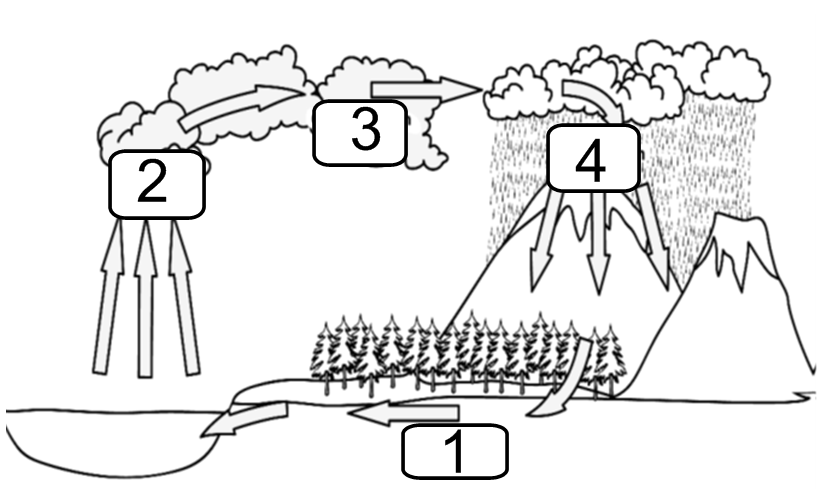
Which stage does the arrow below #2 show in the diagram?
condensation
evaporation
precipitation
run off
A ………………………………. is the area of land drained by a river system ( a river and its tributaries).
Watershed
Drainage Basin
Confluence
Water table
Inputs into the drainage basin system includes
Rain
Snow
Hail
True or False: Everybody lives in a drainage basin
True
False

The section labelled A is known as the
watershed
source
tributary
mouth

The section labelled D is known as the
river valley
main stream
tributary
spring

What is the name of the area labelled B?
Boundary
Watershed
Tributary
Drainage basin

What is the name of the area labelled C?
Mouth
Watershed
Source
Confluence
Which of the following are importance's of drainage basins?
supports agriculture
provides water for drinking
provides water for washing
prevents floods
True or False: Water underground feeds into drainage basins.
True
False
True or False: A drainage basin and a watershed are the same.
True
False
Which of the following statements are correct?
Overland flow occurs under the surface of the land
Water percolates from the surface into the soil
Groundwater flow moves water through the rocks
Water flows to the river on the surface by through flow
Infiltration occurs when water soaks into the soil

