
NEW
Font size
 Worksheets
Electric charges and fields
Total questions: 48
Worksheet time: 28mins
Two students Aditi and Ishaan are sitting at the ends of a straight line. Another student Anika is placed at the midpoint of the line. Then the student Anika placed at the midpoint will:
lie at rest
move towards the bigger student
move towards smaller student and then come to rest
move towards the bigger student and then come to rest.
A charge q is placed at the center of the line joining the two equal charges Q. This system of three charges will be in equilibrium if q is equal to:
- Q/2
– Q/4
Q/4
Q/2
A student named Kabir is studying the interaction between charges. He observes that a charge q1 exerts some force on a second charge q2. A third charge q3 is brought near. Then, the force exerted by q1 and q2 will:
decrease in magnitude
increase in magnitude
remain unchanged
increase, if q2 is of the same sign as q1 and will decrease, if q2 is of opposite sign.
Five students named Kiara, Shreya, Naira, Aarav, and Arjun are participating in a science experiment. Pairs (Kiara, Shreya), (Shreya, Aarav), and (Aarav, Kiara) show strong friendship, while pairs (Shreya, Naira) and (Aarav, Arjun) have conflicts. Therefore, Kiara must be:
best friends with Shreya
enemies with Naira
neutral towards Aarav
related to Arjun
Three charges +4q, Q and q are placed in a straight line of length l at points distance O, l/2 and l, respectively. What should be Q in order to make the net force on q to be zero?
-q
-2q
– q/2
4q.
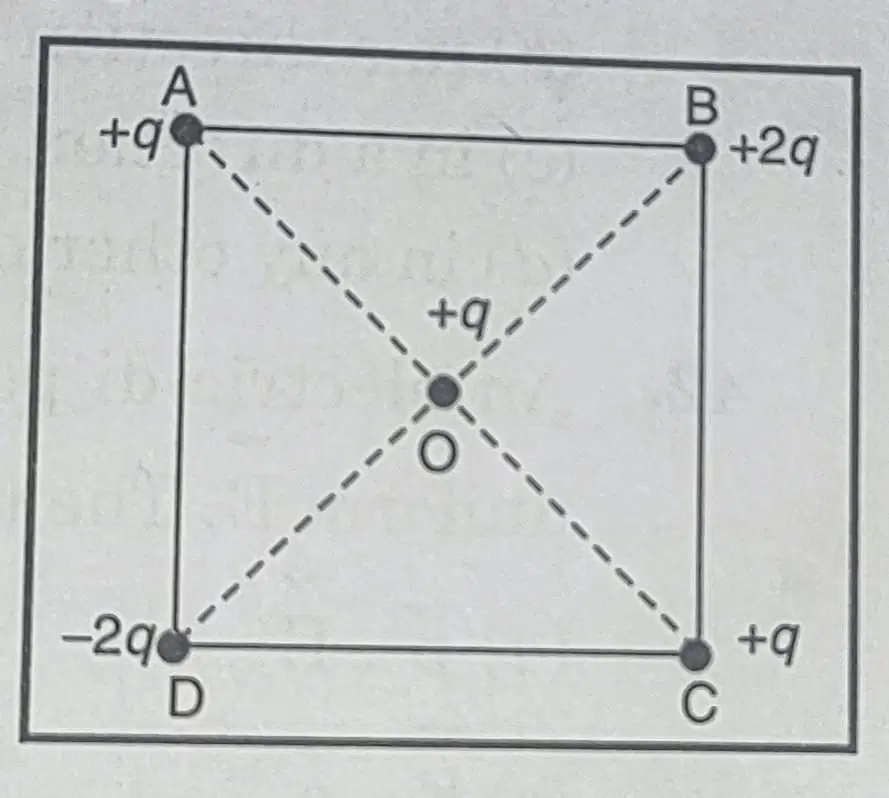
Four students are sitting at the corners of a square classroom [as shown in the figure]. The teacher asks a question, and the correct answer is with the student sitting at the centre of the classroom. What is the force on the student at the centre?
along the diagonal AC
along the diagonal BD
perpendicular to the side AB
zero.
A small metal ball is suspended in a uniform electric field with the help of an insulated thread. If high energy X-ray beam falls on:
the ball will be deflected in the direction of field
the ball will be deflected opposite to the direction of field
the ball will not deflect at all
the ball will fly to infinity.
Three charges each of +q are placed at the three vertices of an equilateral triangle. If the distance of centroid from each vertex of the triangle is r, then strength of electric field at the centroid will be:
4Πξo r3q,
4Πξo r23q,
4Πξo r2q,
zero
Two fixed point charges +4q and +q units are separated by a distance a. The point, where the resultant field intensity is zero is:
2/3 a
½ a
3/2 a
None of these.
Three students Tisha, Divya, and Nikita are participating in a science experiment. They are representing point charges +4q, -q, and +4q respectively, placed on the X-axis at points x = 0 and x = 2a. Which of the following statements is true about their equilibrium?
Tisha is the only one in stable equilibrium.
None of the students are in unstable equilibrium.
All three students are in unstable equilibrium.
All three students are in stable equilibrium.
An electron of mass M, initially at rest, moves through a certain distance in a uniform electric field in time t1, A proton of mass Mp also initially at rest takes time t2 to move through an equal distance in this uniform electric field. Neglecting the effect of gravity, the ratio t2/t1, is nearly equal to:
1
MeMp
MpMe
1836
In a science fair, a demonstration of an electric field is shown using a set of lines of force which are:
parallel
converging
diverging
of some other form.
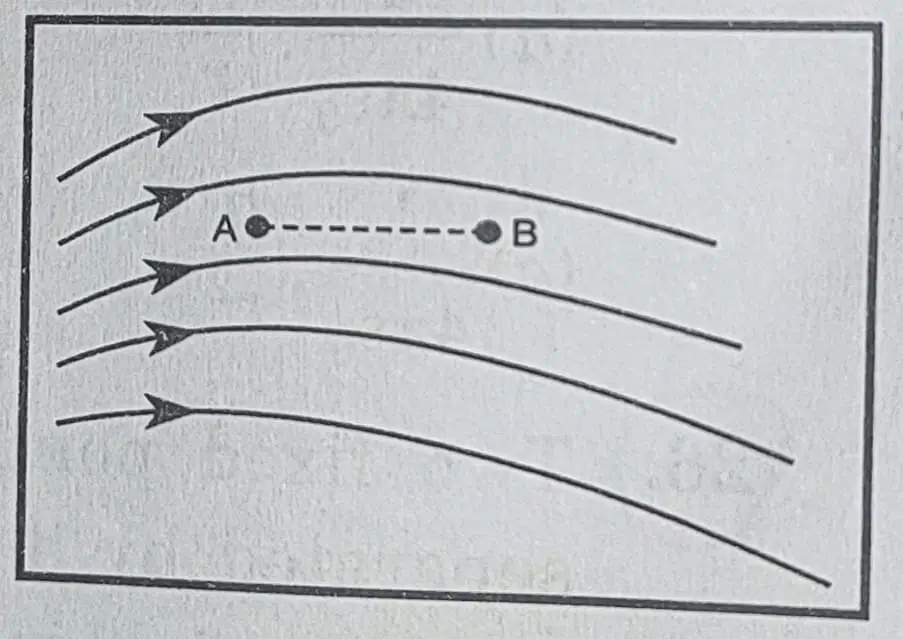
The scenario in the [figure] shows electric lines of force emerging from a charged body. If the electric fields at points A and B are EA and EB respectively and the distance between points A and B is r, then:
EA > EB
EA < EB
EA = EB
cannot be predicted

Which of the following scenarios cannot possibly represent a real-world application of electrostatic field lines:
(i) (ii) (iii) (iv)
(i) (ii) (iii) only
(i) (iii) (iv) only
(ii) (iii) (iv) only.
What is the unit of electric intensity in the context of physics?
Nm
N C
N c-1
N s-1
A positively charged ball hangs from a silk thread. We put a positive test charge q0 at a point measure E / q0 . Then, it can be predicted that the electric field strength E:
>q0F
=q0F
<q0F
can not be predicted
A cube of side b has a charge q at each of its vertices. The electric field due to this charge distribution at the centre of the cube will be:
4πϵ0b2q
4πϵ02b2q
4πϵ0b232q
zero
Electric intensity, at any point, on the axial line of an electric di-pole in a physics lab is:
4πϵ0r3p
4πϵ0r32p
4πϵ0r2p
4πϵ0r22p
Electric intensity, at any point, in the equatorial plane of a di-pole is:
4πϵ0r3p
4πϵ0r32p
4πϵ0r2p
4πϵ0r22p
Electric intensity, due to an electric di-pole at any point on the equatorial line is directed:
in the direction of
p
in the opposite direction of p
in the direction perpendicular to
p
in any other direction.
An electric di-pole of moment
p
is suspended in a uniform
E .
The torque acting on it is given by:
p. E
p× E
E. p
E×p
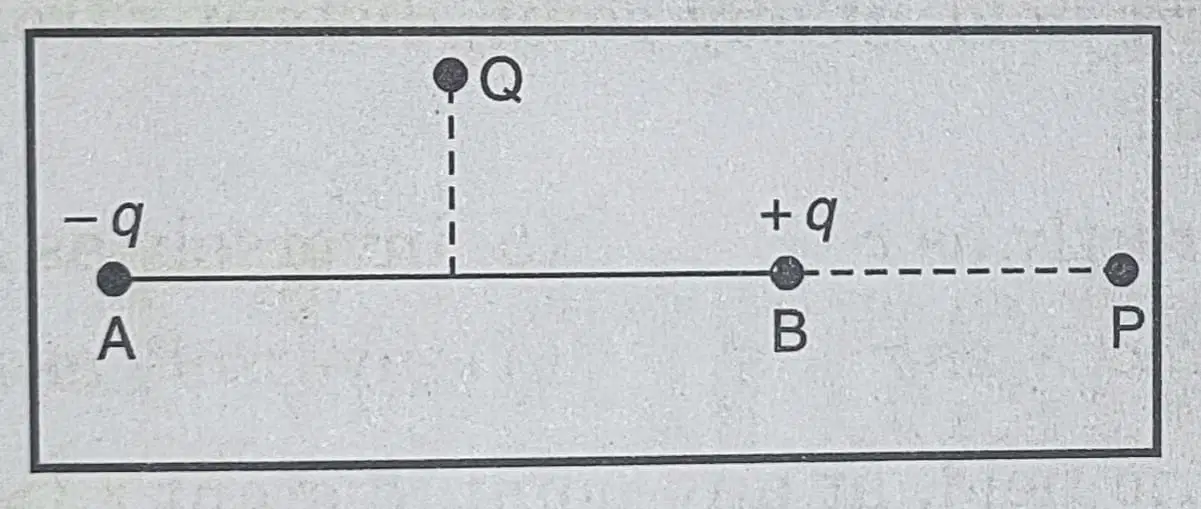
Due to the dipole shown in the figure, electric intensity will be parallel to the dipole at the point:
Q
P
both P and Q
neither P nor Q.
An electric dipole consists of two opposite charges each of magnitude. 1.0 µC separated by a distance of 2.0 cm. The dipole is placed in an external field of 1.0 X 10⁻³ NC-1. The maximum torque on the dipole is:
0.2 x 10⁻³ N m
1.0 x 10⁻³ N m
2.0 x 10⁻³ N m
4.0 x 10⁻³ N m.
Solid angle is an entity which is:
one dimensional
two dimensional
three dimensional
may be either of them.
Which of the following relations gives the solid angle subtended by a surface dS at a given point distant r from the surface:
rdS.n^
r2dS.n^
rdS×n^
r2dS×n^
In a cooking competition, what is the unit of measurement used to determine the amount of space a dish occupies?
teaspoon
cup
tablespoon
steradian
In a science fair, the solid angle subtended by a dome at its center is:
2π
2π2
4π
4π2
A glass window is placed perpendicular to the direction of sunlight. The amount of light passing through it is:
zero
infinite
minimum
maximum
Electric flux linked with a given plane surface is maximum if the angle between the electric lines of force and the normal to the surface is:
0°
45°
90°
135°
A square sheet of side ‘a’ is held perpendicular to a uniform magnetic field of strength B. The magnetic flux linked with the surface is:
zero
Ba
Ba2
4Ba
A circular disc of radius R is placed in a magnetic field of strength B. What is the net magnetic flux linked with the disc?
zero
B×πr2
B×2πr
B×4πr2
A hollow pipe of diameter D and length L is filled with water uniformly. The water flow through the pipe will be proportional to:
D
1/D
1/D2
there will be no flow
According to Gauss’s theorem, the total outward normal induction (in c.g.s. electrostatic system) over a closed surface is equal to:
the positive charge enclosed within the surface
4π times the net charge outside the surface
4π times the total charge enclosed within the surface
the charge density on the surface.
A point charge +q is placed at the mid-point of a classroom of size L. The electric flux emerging from the classroom is:
ϵ0q
6L2ϵ0q
ϵ06qL2
Zero
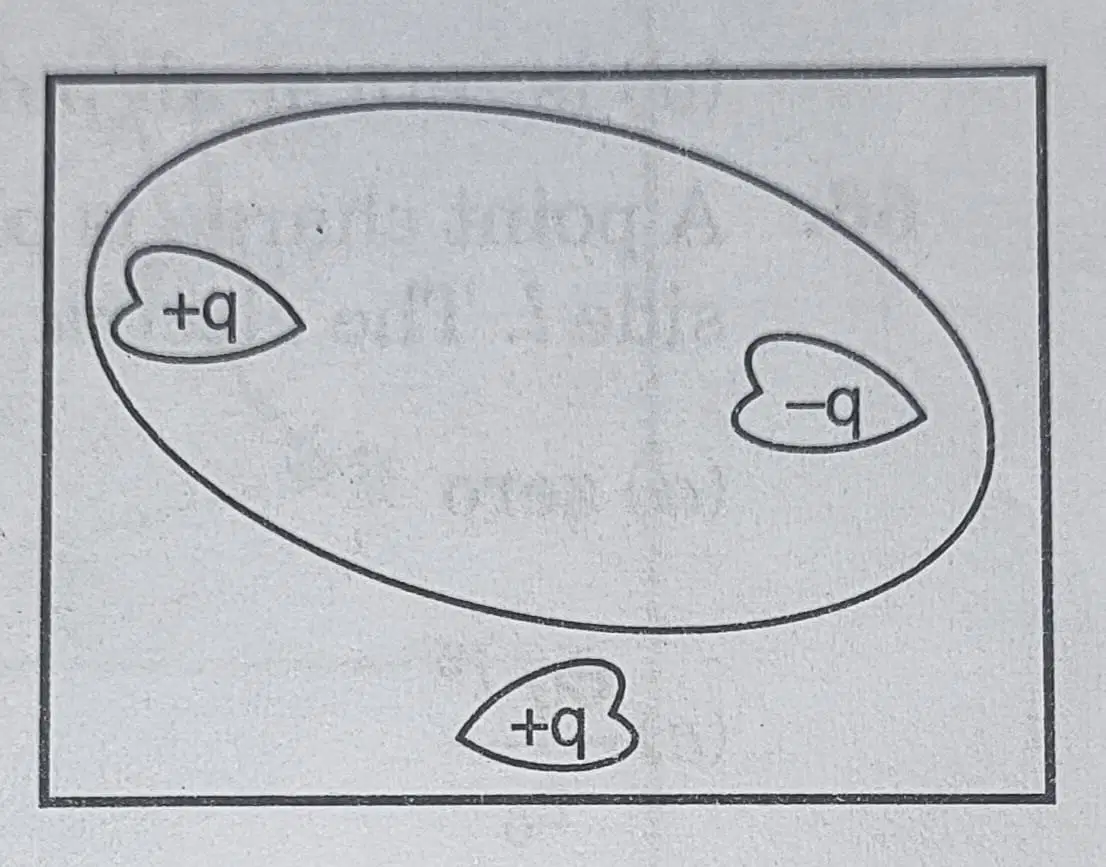
Given below (figure) is a distribution of charges. The flux due to these charges through the surface S is:
ϵ03q
ϵ02q
ϵ0q
Zero

Figure shows a closed surface which intersects a conducting sphere. If a positive charge is placed at the point P, the flux of the electric field through the closed surface:
will remain zero
will become positive
will become negative
will become undefined.
Electric intensity, at any point, distant ‘r’ from a plane charged conducting sheet varies as:
r2
r1
r0
r−1
Electric intensity, at any point, in between the two oppositely charged walls of a classroom depends:
only on the charge on the walls
only on the ratio of distances of the given point from the two walls
only on the ratio of charge and area of the walls
only on the product of charge and area of the walls.
A hollow sphere of the charge does not produce an electric field at any:
interior point
outer point
beyond 2m
beyond 10m
Electric field, at any point, distant r from a power line varies:
directly as r
inversely as r
directly as r2
inversely as r2
Potential at any point inside a charged hollow sphere in a physics lab:
increases with distance from the center
is a constant
decreases with distance from the center
is zero
Electric field, at any point, distant r (>R) from the centre of a spherically symmetric charge distribution of radius R varies:
directly as r
inversely as r
directly as r2
inversely as r2
Potential at any point inside a charged hollow sphere:
increases with distance
is a constant
decreases with distance from centre
is zero
A hollow metal sphere of 5cm is charged, such that the potential on its surface is 10V. The potential at the centre of the sphere is:
0V
10V
same as at a point 5 cm away from the surface
same as at point 25 cm away from the surface
If a student enters a room with a uniformly distributed air freshener, the scent intensity:
increases
decreases
remains the same as at the entrance
is zero at all points.
A point charge is placed at the center of a spherical balloon. The electric flux emerging from the balloon is:
Zero
ϵ0q
ϵ04πq
4πϵ0q

[Figure] A charged particle q is placed at the centre O of a cube of length L. Another charge q is placed at a distance L from O. Then electric flux through surface ABCD is:
4πϵ0Lq
6ϵ0q
2πϵ0Lq
3πϵ0Lq
If the electric flux entering and leaving an enclosed surface respectively are Φ1 and Φ2. The electric charge inside the surface will be:
(Φ2 – Φ1) ϵ0
(Φ1 + Φ2) / ϵ0
(Φ2 – Φ1) / ϵ0
(Φ1 + Φ2) ϵ0

