wayground logo

Free Printable Worksheets

Font size

S
M
L
XL
Worksheets

Chemistry Review Quiz

Total questions: 43

Worksheet time: 47mins

Name
Class
Date
1.

What is the vertical line on the periodic table called?

a)

The group number, which tells you how many valence electrons there are for those elements.

b)

periods

c)

similar

d)

vertical line

2.

What are the horizontal rows of the periodic table called?

a)

Layers

b)

Lines

c)

The periods, which tells you how many outer electron shells there are for those elements

3.

All of the elements are made up of _________.

a)

energy 

b)

atoms 

c)

electrons 

d)

compounds 

4.

Atoms are made up of ________________

a)

energy

b)

electrons

c)

subatomic particles

d)

gasses

5.

The subatomic particles that make up an atom.

a)

solid, liquid, gas

b)

electrons, protons, nucleus

c)

energy, protons, nucleus

d)

electrons, protons, neutrons

6.
What does the nucleus of an atom contain?
a)
Electrons and neutrons
b)
Protons and neutrons
c)
Neutrinos and positrons
d)
DNA and RN
7.

How many electrons can the first outer electron shell hold?

a)

1

b)

2

c)

8

d)

0

8.

The second outer electron shell from the center of an atom can hold how many electrons?

a)

2

b)

6

c)

8

d)

18

9.

Valence electrons are located...

a)

inside the nucleus

b)

in outer space

c)

on the outermost electron shell of an atom

10.
What is the mass number defined as?
a)
the number of protons
b)
the number of protons and neutrons
c)
the number of neutrons
d)
the number of protons and electrons
11.
What is the atomic number of Fe? (click to see image)
a)
26
b)
55.845
c)
56
d)
None of these
12.

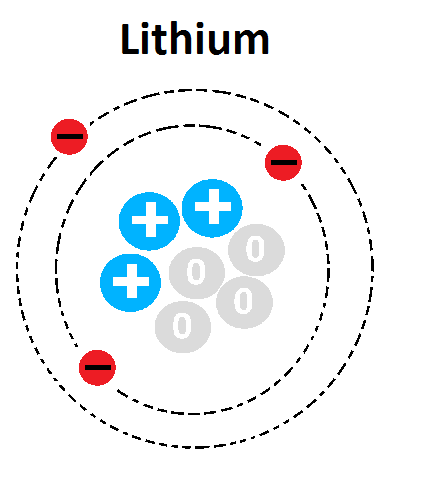
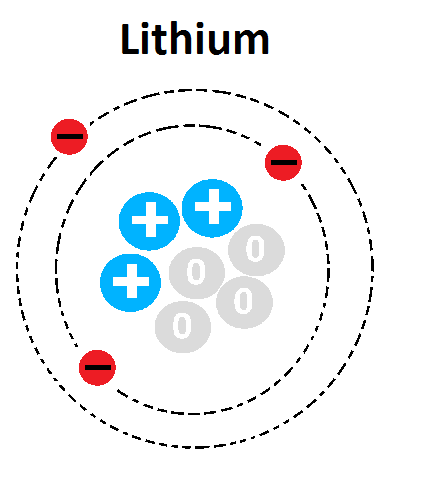
What is the mass number of this atom?

a)

1

b)

3

c)

4

d)

7

13.
What is the atomic number of this atom?
a)
1
b)
3
c)
4
d)
7
14.
an atom with atomic number 6 would have how many protons 
a)
6
b)
12
c)
3
d)
cannot be determined 
15.

How many electrons and protons does an element have if the atomic number is 3?

a)

2

b)

1

c)

3

d)

6

16.

An element has the mass number 12 and atomic number 6. The number of neutrons in it is:

a)

6

b)

10

c)

4

d)

8

17.
What is the chemical symbol for the element copper?
a)
co
b)
c
c)
Cu
d)
cu
18.
What is the chemical symbol for the element Silicon
a)
S
b)
Si
c)
si
d)
Sl
19.
What is the compound formula for Carbon Monoxide?
a)
CO2
b)
CO
c)
C2O4
d)
None of these
20.
The group of an element tells us...
a)
The number of protons
b)
The number of electron shells
c)
The number of valence electrons
d)
The number of total electrons
21.
An electron has what kind of charge?
a)
no charge
b)
positive 
c)
negative
d)
it depends
22.
The positive particles of an atom are 
a)
electrons 
b)
positrons 
c)
neutrons 
d)
protons 
23.
the central region of an atom where its neutrons and protons are is its 
a)
nucleus 
b)
electron cloud
c)
core 
d)
center 
24.
If an element has 5 protons and 5 electrons, what is its net charge?
a)
+5
b)
-5
c)
0
d)
-1
25.
An ion forms when an atom gains or loses
a)
Protons
b)
Neutrons
c)
Electrons
26.
Which is the best definition for an ion?
a)

An atom has a net charge greater or less than zero.

b)

An ion has the same number of electrons as an atom of the same element.

c)

An ion has a charge greater or less than zero.

d)

There is no difference

27.

A Bromine ion gains 1 electron, which of the following is the correct symbol for a Bromine ion?

a)

Br-

b)

Br+1

c)

Br+7

d)

Br-7

28.

How many electrons would a Calcium ion gain/lose? If it has 2 valence electrons.

a)

lose 1

b)

gain 1

c)

lose 2

d)

gain 2

29.

Describe the anion S2-

a)

Silicon that gained 2 electrons

b)

Sulfide that gained 2 electrons

c)

Sulfur that gained 2 electrons

d)

Strontium that gained 2 electrons

30.

Oxygen has 6 valence electrons. When oxygen forms its ion it will have a charge of _______, due to gaining two valence electrons.

a)

+1

b)

-1

c)

+2

d)

-2

31.
When an atom loses a valence electron, it becomes a(n) _____________ ion.
a)

positive cation

b)

negative

c)

neutral

d)

polyatomic

32.
When an atom gains a valence electron, it becomes a(n) _____________ ion.
a)

positive

b)

negative anion

c)

neutral

d)

polyatomic

33.

What is the charge of an ion that has lost one electron?

a)

-1

b)

-2

c)

+1

d)

+2

34.

What is the charge of an ion that has gained one electron?

a)

-1

b)

-2

c)

+1

d)

+2

35.
Volume is.....
a)
the weight of an object
b)
the gravity of an object
c)
how much space an object takes up
d)
measured with a balance scale
36.
Mass is
a)
the amount of matter in an object
b)
the shape of an object
c)
measured using l x w x h
d)
the amount of space an object takes up
37.
When the temperature of matter increases the particles...
a)
speed up and move closer
b)
speed up and move farther apart
c)
slow down and move closer together
d)
slow down and move farther apart
38.

Particles vibrate in place and do not change relative positions.

a)

solid

b)

liquid

c)

gas

39.

Particles move relative to each other, but remain in contact with each other.

a)

solid

b)

liquid

c)

gas

40.

What are the three states of matter? Tick the three that you have learnt in class.

a)

Solid

b)

Liquid

c)

Matter

d)

Plasma

e)

Solid, Liquid, Gas and Plasma

41.
What is the formula for density?
a)
density = mass x volume
b)
density = mass / volume
c)
density = mass + volume
d)
density = mass - volume
42.
Frank has a paper clip. It has a mass of 9g and a volume of 3cm3. What is its density?
a)
3 g/cm3
b)
1/3 g/cm3
c)
27 g/cm3
d)
39 g/cm3
43.

What is the correct formula for volume?

a)

Length X Width X Height

b)

Mass X volume

c)

Height X Mass

d)

Mass X Width