
NEW
Font size
 Worksheets
Electrostatic Force
Total questions: 12
Worksheet time: 6mins
Two charges +q and +2q are placed at the ends of a straight line. Another charge +q is placed at the midpoint of the line. Then the charge +q placed at the midpoint will:
lie at rest
move towards the bigger charge
move towards smaller charge and then come to rest
move towards the bigger charge and then come to rest.
A charge q is placed at the centre of the line joining the two equal charges Q. This system of three charges will be in equilibrium if q is equal to:
- Q/2
– Q/4
Q/4
Q/2
A charge q1 exerts some force on a second charge q2. A third charge q3 is brought near. Then, force exerted by q1 and q2 will:
decrease in magnitude
increase in magnitude
remain unchanged
increase, if q2 is of the same sign as q1 and will decrease, if q2 is o opposite sign.
Five balls numbered 1 to 5 are suspended using separate threads. Pairs (1, 2), (2, 4) and (4, 1) show electrostatic attraction, while pairs (2, 3) and (4, 5) show repulsion. Therefore, ball 1 must be:
positively charged
negatively charged
neutral
made of metal.
Three charges +4q, Q and q are placed in straight line of length l at points distance O, l/2 and l, respectively. What should be Q in order to make the net force on q to be zero.
-q
-2q
– q/2
4q.
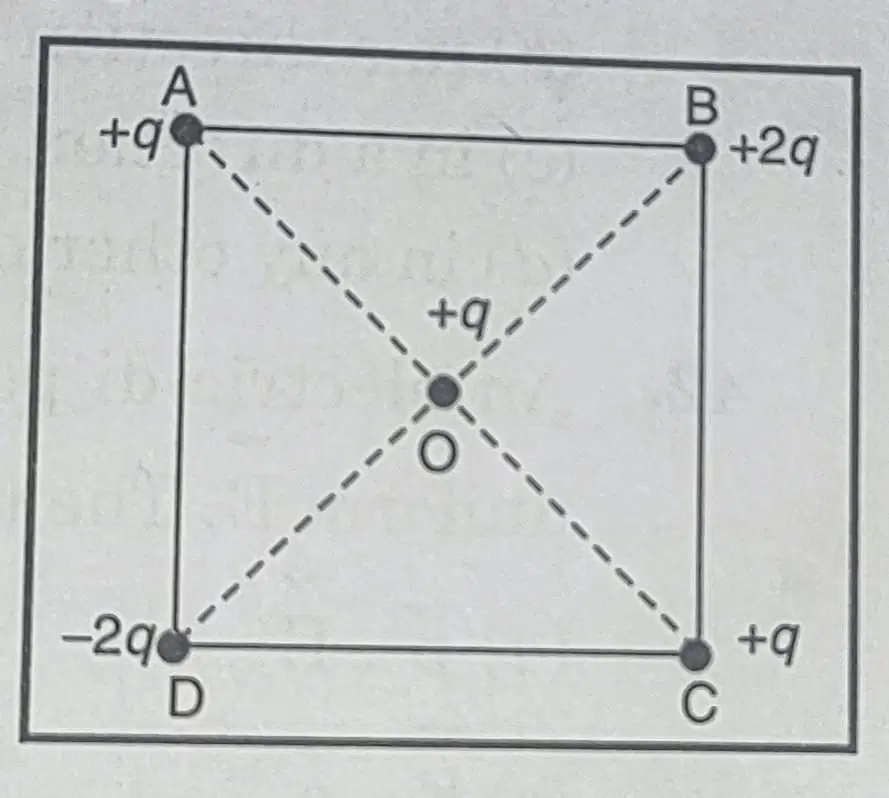
Four charges are arranged at the corners of a square ABCD [as shown in the figure]. The force on the charge +q kept at the centre of O is:
along the diagonal AC
along the diagonal BD
perpendicular to the side AB
zero.
A small metal ball is suspended in a uniform electric field with the help of an insulated thread. If high energy X-ray beam falls on:
the ball will be deflected in the direction of field
the ball will be deflected opposite to the direction of field
the ball will not deflect at all
the ball will fly to infinity.
Three charges each of +q are placed at the three vertices of an equilateral triangle. If the distance of centroid from each vertex of the triangle is r, then strength of electric field at the centroid will be:
4Πξo r3q,
4Πξo r23q,
4Πξo r2q,
zero
Three charges each of +q are placed at the three vertices of an equilateral triangle. If the distance of centroid from each vertex of the triangle is r, then strength of electric field at the centroid will be:
4Πξo r3q,
4Πξo r23q,
4Πξo r2q,
zero
Point charges +4q, -q and +4q are kept on the X-axis at points x = 0, and x = 2a, respectively:
only -q is in stable equilibrium
none of the charges are in unstable equilibrium
all the charges are in unstable equilibrium
all he charges are in the stable equilibrium.
Two neutrons are separated by a distance r meter and have a coulomb force equal to F. Two alpha particles separated by 2r meter will have a force equal to:
2F
3F
F/2
F
An electron of mass M, initially at rest, moves through a certain distance in a uniform electric field in time t1, A proton of mass Mp also initially at rest takes time t2 to move through an equal distance in this uniform electric field. Neglecting the effect of gravity, the ratio t2/t1, is nearly equal to:
1
MeMp
MpMe
1836

