wayground logo

Free Printable Worksheets

Font size

S
M
L
XL
Worksheets

Ecology & Evolution SOL Review

Total questions: 34

Worksheet time: 1hrs 8mins

Name
Class
Date
1.

Deer ticks are responsible for spreading Lyme disease. This organism, which feeds on the blood of warm-blooded organisms like mice, deer, and humans, is best described as a

a)

predator

b)

scavenger

c)

parasite

d)

host

2.

In this pyramid, the greatest amount of stored energy is found at level

a)

A

b)

B

c)

C

d)

D

3.

If the fish population decreases, what is the most direct effect this will have on the aquatic ecosystem?

a)

The leopard seals will all die from lack of food.

b)

The krill population will only be consumed by seagulls.

c)

The zooplankton population will increase in size.

d)

The phytoplankton population will increase in size.

4.

Which group of organisms in an ecosystem fills the niche of recycling organic matter back to the environment?

a)

carnivores

b)

decomposers

c)

producers

d)

predators

5.

Energy in this ecosystem passes directly from the Sun to

a)

herbivores

b)

consumers

c)

heterotrophs

d)

autotrophs

6.
Bacteria, fungi, and earthworms are examples of: 
a)
scavengers
b)
predators
c)
prey
d)
decomposers
7.
All the living things in an environment
a)
Biotic factors
b)
Traits
c)
Animals
d)
Natural Selection
8.
All the nonliving things in an environment
a)
Ecosystem
b)
Dead Animals
c)
Genes
d)
Abiotic factors
9.

Which of the following describes a population?

a)

the wild dogs and cats that live in the city

b)

four different species of fish living in a pond

c)

a group of Canadian Geese living in a pond in Ijams

d)

roses and sun flowers in a garden

10.
Where the better adapted organisms survive to pass traits along to offspring.
a)
Evolution
b)
Natural Selection
c)
Extinction
d)
Artifical Selection
11.
What characteristic did Darwin observe about the finches on the Galapagos Islands?
a)
Their feathers 
b)
Genotypes 
c)
Their beaks
d)
Their body sizes
12.
symbiotic relationship in which both organisms benefit
a)
competition
b)
Mutualism
c)
nitrogen fixation
d)
energy pyramid
13.
Water temperature would be an example of ...
a)
A biotic factor
b)
An abiotic factor
14.
In the energy pyramid here, which organisms have the most energy available?
a)
Producers
b)
Carnivores
c)
Herbivores
d)
Top Predator
15.

Which is an example of primary ecological succession?

a)

Plants and animals invading an abandoned crop field

b)

Mangroves stabilizing the soils on tropical coasts

c)

Minerals spurring rapid plant growth

d)

Lichen growth on rocks

16.

After which event will primary succession MOST likely occur?

a)

Thunderstorm

b)

Crop Harvest

c)

Volcanic Eruption

d)

Urban Development

17.
a)

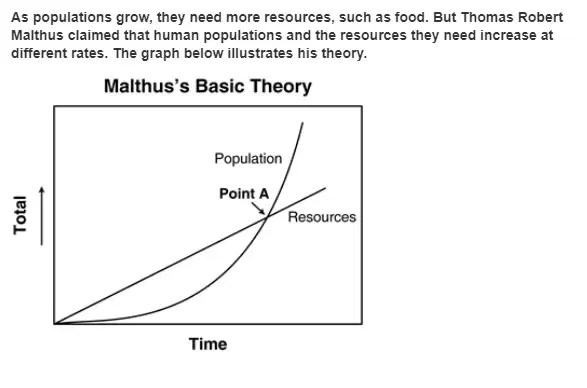
There is not enough resources for the population

b)

There are no resources available

c)

There are just enough resources

d)

There are more than enough resources

18.

Which of the following BEST explains what will occur when a population grows larger than it's carrying capacity of its environment?

a)

The death rate will increase

b)

The birth rate will increase

c)

The competition rate will decrease

19.

How much energy is transferred between each trophic level?

a)

15%

b)

50%

c)

10%

d)

100%

20.
Mistakes or changes that occur int he DNA sequence are called....
a)
adatations
b)
Darwinism
c)
mutations
d)
natural selection
21.
What do we call similar physical structures that indicate a link to a common ancestor?
a)
absolute dating
b)
adaptations
c)
gradualism
d)
homologous structures
22.
Which beneficial variation would be most helpful in a desert environment?
a)
white fur
b)
claws for burrowing
c)
grean and black camouflage
d)
flippers
23.
What is it called when an organism is best adapted to its environment, it will survive and reproduce more successfully than other organisms less adapted?
a)
cloning
b)
evolution of all species
c)
natural selection
d)
selective breeding
24.
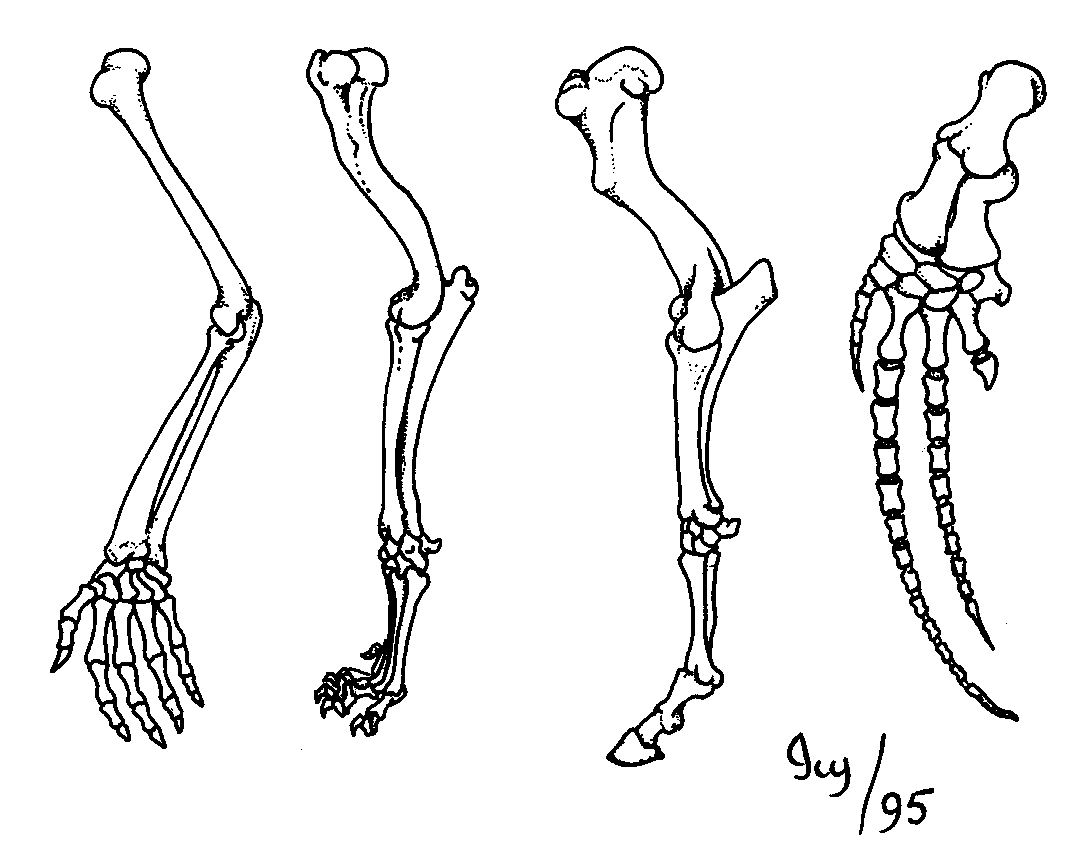
What type of structures are these?
a)
homologous
b)
vestigial 
c)
analogous
d)
fossil
25.
Which of these best represents a time period in which an organism could evolve?
a)
5 days
b)
100 years
c)
10,000 years
d)
2 decades
26.

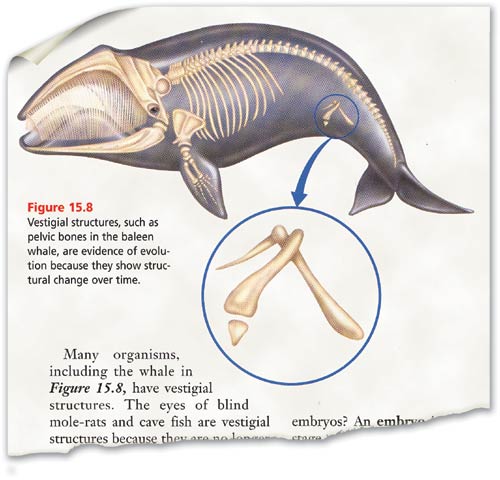
Whales are aquatic mammals that contain a pelvis (hip) bone. Even though it does not aid in its movement, the function must have been used by a common ancestor of the whale. Thus, the pelvis is referred to as a(n)

a)

vestigial structure

b)

analogous structure

c)

homologous structure

27.
Where humans have bred organisms together based on traits we like.
a)
Evolution
b)
Natural Selection
c)
Extinction 
d)
Artificial Selection
28.
Genetic differences between organisms of the same species
a)
Variation
b)
Adaptation
c)
Behavior
d)
Environment
29.
The difference in the physical traits of an individual from those of other individuals in a group is called a(n)
a)
change
b)
adaption
c)
species
d)
variation
30.
The long and sharp beak of a woodpecker is an example of:
a)
Natural Selection
b)
Selective Breeding
31.
Inherited trait that helps an organism survive is a(n) __________.
a)
Fossil
b)
Adaptation
c)
Ancestor
d)
Natural selection
32.
Structures with the same parts have different functions; suggests that organisms share a common ancestry
a)
vestigial structures
b)
homologous structures
c)
adaptive radiation
d)
fossil
33.
Which of the following is an example of a vestigial structure?
a)
the wings of a red-tailed hawk
b)
the hind limbs of a house cat
c)
the fins of sharks
d)
the tailbone of a human
34.
The diagram shows fossils in different rock layers. Which of these statements about the age of these fossils is most likely correct?
a)
Fossil A and C are the same age
b)
Fossil B is older than fossil C
c)
Fossils A is older than fossil B
d)
Fossil D is older than fossil C