
 Worksheets
Fundamentals of Electric Charge and Electric Fields
Total questions: 57
Worksheet time: 43mins
Which of the following is a conductor?
sheet of paper
t-shirt
penny
plastic bottle
Which of the following is the best insulator?
metal paper clip
wood log
bowl of water
penny
In static electricity, similar charges
attract.
behave like N & S poles
remain neutral
repel
To build a basic circuit, you need wires, a light bulb, and
an insulator
another light bulb
a battery
a rubber band
Which of the following demonstrates static electricity?
Putting your fingers near an electrical outlet could result in a painful shock.
You bend a paperclip back and forth until it breaks. The broken end feels hot.
After tumbling with other clothes in a warm dryer, your sock sticks to your shirt.
You use a charger to charge your cell phone battery.

Which of the pairs of balloons will repel each other?
Set A
Set B
Set B and Set C
Set A and set D
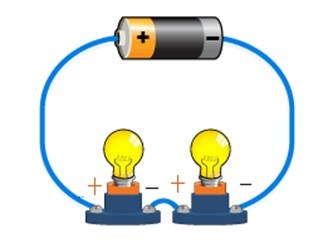
What will happen when you remove a bulb from the circuit pictured?
The other bulb will become brighter.
The other bulb will turn off.
The other bulb will become dimmer.
It will remain a closed circuit.

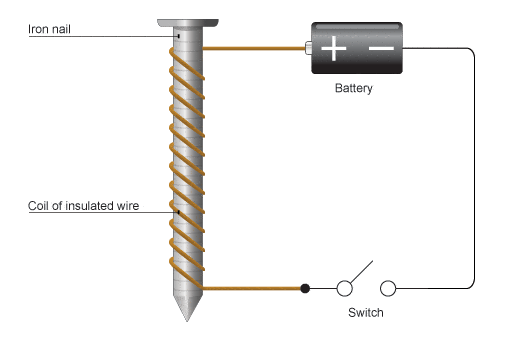
In the drawing of the electromagnet, A is the
battery
wires
metal nail
negative charges

In the drawing of the electromagnet, letter B is the
wires
metal nail
negative charges
battery
Which type of magnet can be turned off?
bar magnet
horseshoe magnet
iron filings
electromagnet
Which type of magnet is permanent?
bar magnet
electromagnet
What happens to the flow of electric current in an open circuit?
The electric current continues to flow.
The electric current cannot flow.
The electric current jumps to another object.
The lights get brighter.
In a basic circuit, what is considered to be the load?
battery
wires
switch
bulb
In a basic circuit, what is considered to be the power source?
battery
wires
switch
bulb
If an object gains electrons, what charge will the object have?
positive
negative
neutral
no charge


If a glass plate is placed over a magnet and iron filings are sprinkled over the glass, a pattern will be visible. What does this pattern indicate?
The magnetic field
The electrostatic field
The piezoelectric effect
The chemical reaction of the magnet and the filings

Magnets on refrigerator cannot be turned off. Which type of magnets they belong?
electromagnets
battery
permanent magnets
copper wire
What are the components of the electromagnets?
battery, wire and bulb
battery , copper wire and plastic bottle
battery, copper wire and iron nail
battery, wire and aluminum

What would happen if you took one end of the wire off the battery?
The nail will be a magnet.
The nail would no longer be a magnet
Nothing will happened.
The nail will heats up.
How can the strength of an electromagnet be increased? (mark all that apply)
increase the current flowing through the coil
increase the number of coils
add an amplifier to it
put iron core inside the coil

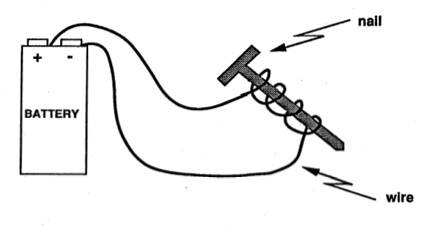
Which electromagnet is stronger?
A
B

Which electromagnet is stronger?
A
B
How do objects become positively charged?
They gain electrons
They lose electrons
Rubbing or Friction
How do objects become negatively charged?
They gain electrons
They lose electrons
Rubbing or Friction
This is a measure of electrical pressure
Current
Volt
Ohm
Ampere
This is the measure of the movement of the electric charge
Voltage
Volt
Ohm
Ampere
This is a measure of electrical resistance
Current
Volt
Ohms
Ampere
Force resulting from interaction between electrically charged particles
Magnetic Force
Electromagnetic Force
Electric Force
Current
The size or quantity of something
Magnetic Force
Magnitude
Electromagnetic Force
Current
As the distance between magnets increases-the attraction between them will
Decrease
Stay the Same
Increase
How can the strength of an electromagnet increase?
Remove the battery
Remove loops (coils) of wire from around the iron nail
Add more loops (coils) of wire around the iron nail
Remove the iron nail, leaving only the coils of wire
What is magnetic force?
Attraction or repulsion that arises between electrically charged particles because of their motion
How strong a magnet is
Force resulting from interaction between electrically charged particles
The size or quantity of something

Students attached both ends of a long wire to the poles of a battery and wrapped the wire around a spoon. In this arrangement, the spoon is able to pick up five paper clips. The students wrap more wire around the spoon and want to determine if the strength of the magnetic force has increased. Which of the following observations would indicate that wrapping more wire has increased the strength of the electromagnet?
More wire was needed to wrap around the spoon.
The spoon now picks up seven paper clips.
Eventually, the battery runs out of energy.
The ends of the wire must touch the battery's poles.
Students want to investigate how the amount of electric energy delivered to a motor affects its speed. Which of the following procedures will most likely produce the data students need to answer their question?
Measure the rotations per second of a motor when it is connected to one battery, two batteries, and three batteries.
Add larger and larger motors to a battery to determine the size of the largest motor the battery is able to run
Closely observe the rotation of the motor to see if the direction of spin reverses when the poles of the battery are switched
Connect a series of motors to the same battery to figure out how many motors can be run off the same battery.

The table provided shows data collected by students during an investigation of two electromagnets. Which of the following conclusions is supported by data on the table?
When two electromagnets are of like charges, they attract each other.
Electromagnets that repel each other have more force than those that attract each other.
The greater the charges of two electromagnets, the greater the size of the force.
If the charge on one magnet is positive, the charge on the other must be negative.

The illustration shows a hand generator. Turning the handle of the generator spins a magnet and creates an electric current that lights the bulb. Which of the following observations can be used to indicate the strength of the current created by the generator?
The brightness of the bulb
The size of the magnet
The length of the handle
The mass of the generator

This table shows the magnitude of electromagnetic force exerted by two electromagnets on each other as the distance between the two electromagnets is varied. The data on the table provide evidence for which of the following conclusions?
The force between any two magnets is always constant, regardless of distance.
As distance between electromagnets increases, the electromagnetic force also increases.
The smaller the distance between two electromagnets, the greater the force.
The force between two magnets depends only on the charge of the electromagnets.
What is a current?
A directional flow of electrical charge through an object or medium
Attraction or repulsion that arises between electrically charged particles because of their motion
The size or quantity of something
Attractive or repulsive interactions between any two charged objects
What will happen as an electron (-) gets closer to a proton (+)?
The repulsion will be stronger.
The attraction will be stronger.
The attraction will be weaker.
Nothing will happen to the electric field.
A current flowing through a wire is surrounded by a
Electric Current
Magnetic Field
Electric Field
None of these
What is an electric force?
The size or quantity of something
Attractive or repulsive interactions between any two charged objects
A directional flow of electrical charge through an object or medium
How strong a magnet is
What is magnetic strength?
Attractive or repulsive interactions between any two charged objects
Force resulting from interaction between electrically charged particles
How strong a magnet is
Attraction or repulsion that arises between electrically charged particles because of their motion
What will happen if the north ends of two magnets are placed near each other?
Both magnets will get weaker.
They will repulse (repel) each other.
They will attract each other.
Nothing will happen.

