
 Worksheets
Advanced Physics FINAL Review 2024
Total questions: 157
Worksheet time: 2hrs 45mins
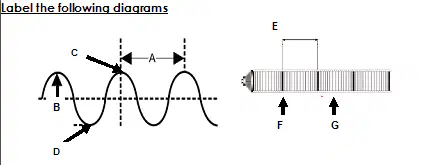
Letter D is...
Amplitude
Compression
Crest
Trough
Letter C is...
Amplitude
Compression
Crest
Trough
Letter B is...
Amplitude
Compression
Crest
Trough
Letter A is...
Amplitude
Wavelength
Period
Trough
Letter E is...
Amplitude
Wavelength
Period
Trough
Letter F is...
Amplitude
Wavelength
Compression
Rarefaction
Letter G is...
Amplitude
Wavelength
Compression
Rarefaction
What type of wave is the wave to the left?
Transverse
Longitudinal
Wavy
Stringy
What type of wave is the wave to the right?
Transverse
Longitudinal
Wavy
Stringy

What is the number of waves per second?
Amplitude
Period
Frequency
Wavelength
What is the distance between two consecutive crests?
Amplitude
Period
Frequency
Wavelength
What is the distance between a trough and the equilibrium line?
Amplitude
Period
Frequency
Wavelength
How do the particles move in a TRANSVERSE wave in relation to the movement of the wave?
Perpendicular
Parallel
Diagonal
Particles don't move
How do the particles move in a LONGITUDINAL wave in relation to the movement of the wave?
Perpendicular
Parallel
Diagonal
Particles don't move

What type of wave is a sound wave?
Transverse
Longitudinal
Wavy
Stringy
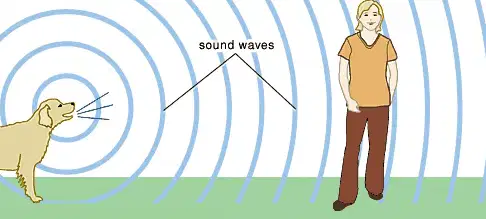
In order for sound to travel to your ear and be heard you need...
A vibrating source object
A medium for the sound wave to travel through
Both of these
Neither of these
Intensity is closely related to which of the following sound qualities?
Pitch
Frequency
Loudness
Interferences
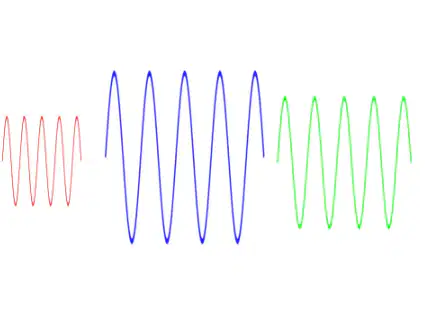
Which sound wave is the loudest?
Red
Blue
Green
All the same
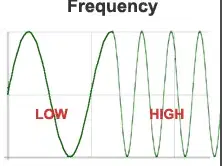
Frequency of a sound wave is related to which quality?
Pitch
Waveform
Loudness
Interference
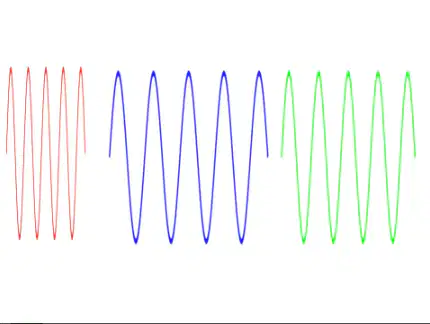
Which wave shows the highest pitch?
Red
Blue
Green
All the same

Which of the waves has the HIGHEST pitch and HIGHEST volume? (Assume the red, green, and blue waves each have the same amplitude)
Red
Yellow
Green
Blue
Which of the waves has the LOWEST pitch and LOWEST volume? (Assume the red, green, and blue waves each have the same amplitude)
Red
Yellow
Green
Blue

Which wave has the LEAST harsh waveform?
Sine Wave
Square Wave
Saw Tooth Wave
Triangle Wave
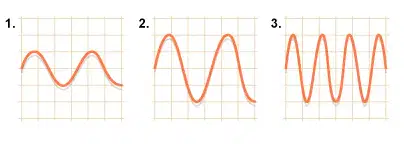
Which of the waves is the LEAST intense?
Wave 1
Wave 2
Wave 3
All the same
Which of the waves is the HIGHEST frequency?
Wave 1
Wave 2
Wave 3
All the same
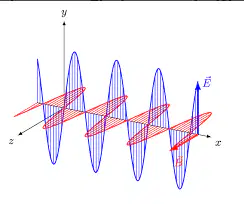
What type of wave is an EM wave?
Longitudinal
Transverse
Wavy
Stringy
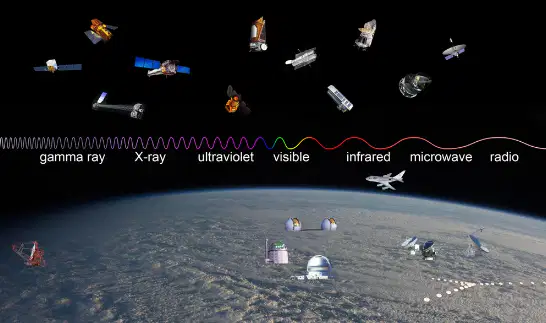
True or False:
EM waves need a medium to travel through.
True
False
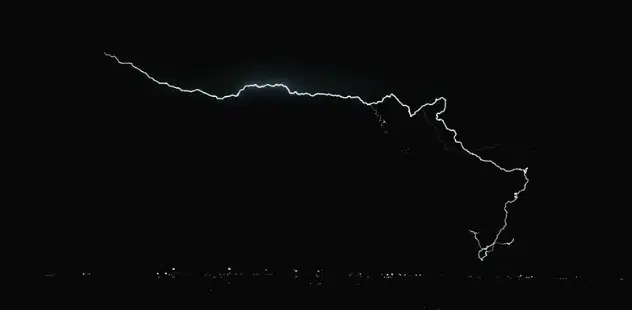
We see lightning before hearing thunder because...
Sound travels faster than light
Light travels faster than sound
Lightning always happens before thunder sounds are made
Thunder sounds always happens before lightning strikes

These EM waves are what send signals to your car antenna or Bluetooth device
Radio
Microwave
Gamma Rays
Infared
UV
These EM waves are what humans can see
X-Rays
Microwave
Visible
Infared
UV
These EM waves are used to heat food by making the water molecules move faster
X-Rays
Microwave
Gamma Rays
Infared
UV
These EM waves help our bodies produce vitamin D, but also cause sunburn.
X-Rays
Microwave
Gamma Rays
Infared
UV
These EM waves are the way we see heat signatures through thermal cameras
X-Rays
Microwave
Gamma Rays
Infared
UV
These EM waves are the way we see through a body and find broken bones.
X-Rays
Microwave
Gamma Rays
Infared
UV
These EM waves are very bad to be exposed to and can cause cancer when exposed.
X-Rays
Microwave
Gamma Rays
Infared
UV

When light is reflected off a straight, flat mirror, how does the angle it hits the mirror (angle of incidence) compare to the angle that it reflects off the mirror?
It is less
It is greater
It is the same
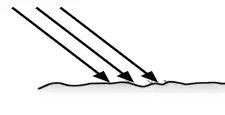
What kind of reflection exists when light hits a surface that is rough?
Smooth Reflection
Diffuse Reflection
Rough Reflection
Fusion Reflection
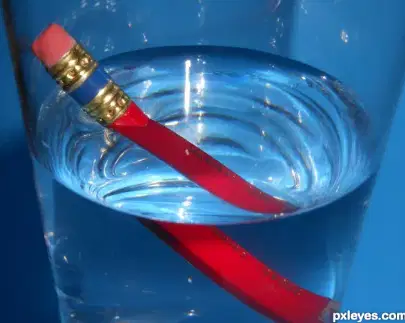
What does this image show?
Law of Reflection
Doppler Effect
Refraction of light
Interference
When light travels through a different medium, like from air into water, what happens to the light?
It cannot change mediums
Nothing happens
The speed of the light wave changes
It dissolves
A statement about what happens in nature and seems to be true all the time is defined as ...
Hypothesis
Scientific Theory
Scientific Law
A possible explanation for a problem using what you know and have observed is defined as ...
Hypothesis
Scientific Theory
Scientific Law
An explanation based on many repeated observations and investigations is defined as ...
Hypothesis
Scientific Theory
Scientific Law
The factor that depends on the independent variable is defined as ...
Independent Variable
Dependent Variable
Control Variable
The factor(s) that is held constant is defined as ...
Independent Variable
Dependent Variable
Control Variable
The factor that is changed by the experimenter in an experiment is defined as ...
Independent Variable
Dependent Variable
Control Variable
On any graph, what axis is the independent variable on?
x-axis
y-axis
z-axis
On any graph, what axis is the dependent variable on?
x-axis
y-axis
z-axis

What type of relationship is the graph?
Linear
Inverse
Squared

What type of relationship is the graph?
Linear
Inverse
Squared

What type of relationship is the graph?
Linear
Inverse
Squared

What is the independent variable of this graph?
Price
Size in square meters
What is the dependent variable of this graph?
Price
Size in square meters

What is the dependent variable of this graph?
Mass
Volume
What is the independent variable of this graph?
Mass
Volume

What is the independent variable of this graph?
Area
Length
What is the dependent variable of this graph?
Area
Length
The slope of a line can best be described as....
How many data points there are
How long a line is
The rate of change of the dependent variable in relation to the independent variable
Where the line crosses the y-axis
The y-intercept can best be described as....
How many data points there are
How long a line is
The rate of change of the dependent variable in relation to the independent variable
The value of the dependent variable when the independent variable is zero
Finding the slope of a
velocity vs. time (v-t) graph
gives you ...
Displacement
Distance
Velocity
acceleration


Which graph represents the greatest magnitude (number value) of acceleration?
A
B
C
D

How is the object moving?
Speeding Up
Slowing Down
Constant Velocity

How is the object moving?
Speeding Up
Slowing Down
Constant Velocity

How is the object moving?
Speeding Up
Slowing Down
Constant Velocity

How is the object moving?
Speeding Up
Slowing Down
Constant Velocity
What direction is the object moving?
Positive
Negative
No Direction

What direction is the object moving?
Positive
Negative
No Direction

What direction is the object moving?
Positive
Negative
No Direction

What direction is the object moving?
Positive
Negative
No Direction
What direction of acceleration?
Positive
Negative
No Direction

What direction of acceleration?
Positive
Negative
No Direction

What direction of acceleration?
Positive
Negative
No Direction

What direction of acceleration?
Positive
Negative
No Direction

What is the direction of the velocity of this object & how do you know!
Positive, because the slope is positive
Negative, because the slope is negative
Positive, because it is speeding up
Negative, because it is below the t=0 axis
Positive, because it is above the t=o axis

What is this object doing?
Speeding up
Slowing Down
Constant Velocity
None of these
What is sign of the acceleration of this object & how do you know!
Positive, because the slope is positive
Negative, because the slope is negative
Positive, because it is speeding up
Negative, because it is below the t=0 axis
Positive, because it is above the t=o axis
A rightward-moving car is slowing down.
What is the direction of the car's acceleration?
rightward
leftward
no acceleration
James is about to do a stunt for a movie. In the stunt he falls from a second floor window. He has the choice to land on a thin piece of cardboard or a thick air mattress both sunken into the ground so the top is at ground level. He reasons that the air mattress will be better to land on because…
The collision will take longer to occur for the mattress than with the cardboard
He will experience a smaller change in momentum (impulse) with the mattress than with the cardboard
He will experience a larger change in momentum (impulse) with the mattress than with the cardboard
He will experience a smaller change in velocity with the mattress than with the cardboard
Assume two people are driving identical cars, A and B, at 25 mph. The person driving Car A slams on their brakes to stop and experiences a large force from the seat belt. The person driving Car B eases on the brakes to come to a stop and experiences a small force from the seat belt. Why does the person in Car A experience such a large force?
The driver of Car A will experience a larger change in momentum (impulse) than that of the driver in Car B.
The driver of Car A will experience a smaller change in momentum (impulse) than that of the driver in Car B.
The driver of Car A will experience a shorter time to stop than that of the driver in Car B.
The driver of Car A will experience a longer time to stop than that of the driver in Car B.

The impulse of an object depends upon the object's ___________&_____________.
size and shape
force and time
mass and veloctiy
mass and energy
size and shape
force and time
mass and veloctiy
mass and energy
What is the value of "g" in PE = mgh
100
9.8
3.8
6
In order to find Kinetic Energy, you need which two variables?
force, distance
mass, velocity
velocity, distance
height, mass
To find work, you need which two variables?
distance, force
velocity, distance
force, velocity
height, gravitational acceleration
What does conservation of mechanical energy mean?
No energy is lost to non-mechanical forms
All energy is Kinetic or Potential at all times in a situation
Total ME Initial = Total ME Final
Work is done from/goes to an outside source of energy
There is a change in energy value in the center section of an energy bar chart
What type(s) of mechanical energy does an apple attached to a tree have?
Kinetic
Gravitational Potential
Both of These
Neither of These
What type(s) of mechanical energy does an log sitting on the forest floor have?
Kinetic
Gravitational Potential
Both of These
Neither of These
What type(s) of mechanical energy does a plane flying above a field have?
Kinetic
Gravitational Potential
Both of These
Neither of These
What type(s) of mechanical energy does a bike riding on street have?
Kinetic
Gravitational Potential
Both of These
Neither of These
If something in an elevated position above something it has this form of mechanical energy…
Gravitational PE
Kinetic
Thermal
Sound
Something that is moving has this form of energy
Gravitational PE
Kinetic
Nuclear
Radiant
What is energy?
the ability to do work or cause change
a force
movement
push or pull


Energy form based on the movement of molecules and atoms within an object
thermal
elastic
chemical
nuclear
An interaction with this causes a gravitational force
Earth
String
Supporting Surface
Spring
Rough Surface
An interaction with this causes a normal force
Earth
String
Supporting Surface
Spring
Rough Surface
An interaction with this causes a Tension force
Earth
String
Supporting Surface
Spring
Rough Surface
An interaction with this causes a Spring Force
Earth
String
Supporting Surface
Spring
Rough Surface
An interaction with this causes a Friction Force
Earth
String
Supporting Surface
Spring
Rough Surface
The meaning of this symbol - g
Force of Spring
Gravitational Field Strength
Mass
Weight
Spring Constant
The meaning of this symbol - k
Force of Spring
Spring Constant
Mass
Weight
Displacement
The rule for the direction of force of spring, Fs
Always Up
In the direction of motion
Parallel to surface
Toward the Center of the Earth (down)
Opposite how you displaced the spring
The rule for the direction of Friction force, f
Always Up
Parallel to the surface; against motion
Perpendicular to the surface; with motion
Toward the Center of the Earth (down)
Always left; never right
The rule for the direction of Normal Force, n
Always Up
Parallel to the surface
Perpendicular to the surface
Toward the Center of the Earth (down)
Against the direction of motion
The rule for the direction of Fg
Always Up
In the direction of motion
Depends on the exact situation
Toward the Center of the Earth (down)
Against the direction of motion
Δx The meaning of this symbol
Force of Spring
Spring Constant
Mass
Weight
Displacement
The meaning of this symbol μ
Force of Friction
coefficient of friction
Mass
Weight
Normal Force
When an object is at rest you can say... (select all that apply)
The acceleration is zero
The forces acting on it are balanced
The forces acting on it are unbalanced
The net force is zero
The net force is NOT zero
Mass is... (select all that apply)
The same as weight
The same as Fg
measured in kg
measured in N
the inertia of an object
An object is speeding up in the negative direction
Balanced Forces
Unbalanced Forces
An object is moving at a constant velocity across the floor
Balanced Forces
Unbalanced Forces
An object has a net force NOT equal to zero
Balanced Forces
Unbalanced Forces
An object is sitting at rest on the floor
Balanced Forces
Unbalanced Forces
An object’s resistance to changes in motion is defined as
Newton's 3rd Law
Acceleration
Inertia
Net Force
If you have two objects experiencing the same net force then, the one with ___________________ will experience a bigger acceleration
more inertia
less inertia
more friction
According to Newton's 3rd Law...
Forces are always directed downward
Forces always come in pairs
Forces cause things to stop moving
Forces are always unbalanced
What is the 3rd Law force that pairs with the Force of a table pushing on a box that is sitting on it?
F of earth on box
F of box on earth
F of table on box
F of box on table
F of gravity on box

In the graph above, what variable is on the y-axis (vertical axis)
Fg
m
y
x
none of these
In the graph above, what variable is on the x-axis (horizontal axis)
Fg
m
y
x
none of these

In the graph above, what is the physics equation of this graph?
y = mx
y = 9.8x
m = 9.8*Fg
Fg = 9.8*m
none of these
Voltage is defined as
The rate of flow of charge in a circuit
A complete loop of conductor that connects the + and - end of a voltage source
The energy per charge that is provided by the voltage source
How difficult it is for charge to flow in a circuit
Current is defined as
The rate of flow of charge in a circuit
A complete loop of conductor that connects the + and - end of a voltage source
The energy per charge that is provided by the voltage source
How difficult it is for charge to flow in a circuit
Resistance is defined as
The rate of flow of charge in a circuit
A complete loop of conductor that connects the + and - end of a voltage source
The energy per charge that is provided by the voltage source
How difficult it is for charge to flow in a circuit
Conducting Path is defined as
The rate of flow of charge in a circuit
A complete loop of conductor that connects the + and - end of a voltage source
The energy per charge that is provided by the voltage source
How difficult it is for charge to flow in a circuit


Based on Ohm's Law, which of the following would be true regarding the relationship between voltage, current, and resistance?
Select all that apply (think cause --> effect)
Current will reduce voltage.
Current will not pass through resistance.
Resistance will reduce current.
Voltage will reduce resistance.
Voltage will increase the current
In Ohm's Law... what determines the voltage of a circuit
The resistance
The current
The battery/voltage source
The objects you put in the circuit
In Ohm's Law... what determines the resistance of a circuit
The resistance
The current
The battery/voltage source
The objects you put in the circuit
Voltage provides which of the following for a circuit?
The energy/motivation for charge to flow
The resistance for the flow of charge
The electrons to fill up the wires
In Ohm's Law
Resistance and Current are ____________ proportional
directly
inversely
squared
squareroot
In Ohm's Law
Voltage and Current are ____________ proportional
directly
inversely
squared
squareroot


Which of the two circuits would have the brightest bulbs when switches are closed?
A
B

All three are connected to the same voltage source (battery), which one would have the greatest current drawn from the battery?
X
Y
Z
X, Y, and Z are the same.
As you add more and more items in parallel to a circuit you draw more current from the voltage source. In our houses how do we prevent too much current that could cause a fire?
We wire our houses in series so this is not an issue
We add circuit breakers/fuses that limit the max current in a circuit
We don't have any safety measures in place as this is unlikely to ever happen

