

wayground logo

Free Printable Worksheets

NEW

Font size

S
M
L
XL
Worksheets

Final Review Unit III: Roaring 20's and Great Depression

Total questions: 35

Worksheet time: 18mins

Name
Class
Date
1.
The Harlem Renaissance was
a)
Celebration of African American Culture
b)
Spark of increased industrial jobs
c)
Creation of controversial policies
d)
Creation of the Department of Interior
2.
Which African American writer wrote poems, books, and plays about the lives of African Americans?
a)
Bessie Smith
b)
Louis Armstrong
c)
Langston Hughes
d)
Al Capone
3.
President Harding’s idea for the US to return to life as it had been before WWI
a)
Prosperity
b)
Return to Normalcy
c)
Harlem Renaissance
4.

The period of time when African Americans moved from rural south and urban north is known as the ___________________.

a)

Great Movement

b)

Great Migration

c)

Economic Boom Period

d)

Harlem Renaissance

5.

What happened as a result of the women's suffrage movement?

a)

Congress passed the 18th amendment

b)

women were no longer allowed to do certain jobs in factories or on farms

c)

Congress passed the 19th amendment

d)

women were allowed to enter the military as soldiers

6.

Which answer most closely represents what African Americans found in the north during the Great Migration?

a)

no jobs but social equality

b)

better job opportunities but continued discrimination and segregation

c)

worse conditions than they faced in the south

d)

many jobs and much fairer treatment

7.

The main purpose of the women's suffrage movement was to get ___________________________.

a)

voting rights for women

b)

women electred to Congress

c)

people to take inventions by women seriously

d)

women the right to work on farms

8.

The period of time when African Americans in urban areas had the opportunity to allow their culture to flourish is known as the ______________________.

a)

Harlem Reconstruction

b)

Harlem Renaissance

c)

Harlem Recovery

d)

Harlem Revolt

9.
The 19th amendment is very important in history be cause it____________
a)
prohibited alchohol
b)
gave us freedom
c)
guaranteed women the right to vote
d)
abolished slavery
10.
 What was the most significant thing about the 1920 presidential election?
a)
We elected a new president.
b)
It was the first election on TV.
c)
The presidential choices were all good candidates.
d)
 It was the first election that women were allowed to vote in.
11.

The Roaring Twenties were characterized by --

a)

internment camps, the rationing of goods, and the first use of the atomic bomb

b)

bank failures, the New Deal and bread lines

c)

installment plans, Prohibition, and flappers

d)

brinkmanship, McCarthyism, and a policy of containment

12.

Why were more people able to own automobiles, radios, washing machines, and other goods in the 1920s?

a)

because of advertising

b)

because of lower taxes on imports

c)

because of installment buying

d)

because the trucking industry grew

13.

Which African American became a famous writer during the Harlem Renaissance?

a)

Langston Hughes

b)

Billie Holiday

c)

Duke Ellington

d)

Bessie Smith

14.
a type of credit in which a small down payment is followed by monthly payments
a)
bull market
b)
buying on margin
c)
installment buying
d)
consumer revolution
15.
a form of credit often used to purchase stock in the 1920s
a)
bull market
b)
buying on margin
c)
installment buying
d)
consumer revolution
16.

paying for an item over a period of time with a series of small payments

a)

Installment Buying

b)

Credit

c)

Reparations

d)

Productivity

17.
 What coincided with the Great Migration to the north from the South by African Americans, as well as an increase in education by these same people.
a)
Socialism
b)
Evolution
c)
Native Americans
d)
 Harlem Renaissance
18.
Who was president at the time of the Stock Market Crash of 1929?
a)
Abraham Lincoln
b)
Franklin D. Roosevelt
c)
Theodore Roosevelt
d)
Herbert Hoover
19.
Which economic factor contributed most directly to the start of the Great Depression?
a)
low worker productivity
b)
high income taxes
c)
decreasing tariff rates
d)
buying stocks on margin
20.

How did the Stock Market Crash lead to the beginning of the Great Depression?

a)

16 million stocks were shared in a single day that led to the loss of billions of dollars

b)

banks closed their doors to try to prevent a run on banks

c)

prices for goods increased so much that people couldn't buy basic items

d)

Herbert Hoover blamed the Stock Market Crash for the Great Depression

21.

Which of the following people created government agencies and social programs that led to the end of the Great Depression?

a)

Henry Ford

b)

Herbert Hoover

c)

Franklin D Roosevelt

d)

Theodore Roosevelt

22.

What was the name of the program created by President FDR?

a)

The Answer

b)

The Solution

c)

The New Deal

d)

The Right Deal

23.

Which of the following was a main feature of the New Deal?

a)

preparing for war

b)

regulating trade

c)

providing jobs

d)

desegregation

24.

This person was blamed for not helping struggling Americans during the beginning of the Depression.

a)

Franklin D Roosevelt

b)

Harry Truman

c)

Calvin Coolidge

d)

Herbert Hoover

25.

What was the "New Deal" of the 1930s?

a)

a government program that gave free land to homesteaders

b)

a government program that helped women get the vote

c)

a government program that spread civil rights throughout the country

d)

a government program designed to help people during the depression
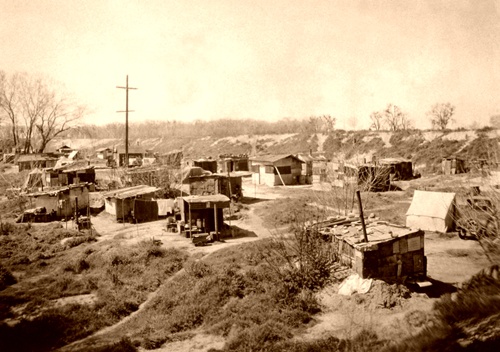
26.
President Franklin Roosevelt asked Congress to pass a series of acts called the New Deal. Which is one way the New Deal helped people during the Great Depression?
a)
It gave all people the right to vote. 
b)
It created programs to put people back to work.    
c)
It let all new immigrants become American citizens. 
d)
It let people travel around the country freely. 
27.
What was the main reason for the emergence of “Hoovervilles” like the one shown in the photograph?
a)
Many Americans had lost jobs during the Great Depression.
b)
Thousands of homes had been destroyed by the effects of the Dust Bowl.
c)
Housing projects could not keep up with the demand for homes needed by the poor.
d)
Preparations for World War I had created a shortage of building materials.
28.
Buying on margin means:
a)
buying stocks at a fraction of their price, with the promise of paying the rest later
b)
planning out your budget to make sure you have enough to get by
c)
Buying a few stocks from many companies to ensure profit
d)
Pouring all of your money into one stock in order to ensure profit
29.
The purpose of the New Deal program was to...
a)
improve working conditions in factories
b)
stop the sale of alcohol in states
c)
end discrimination against African Americans
d)
help the nation recover from the Depression
30.
A major difference between the philosophies of President Herbert Hoover and President Franklin D. Roosevelt in responding to the Great Depression is that Roosevelt
a)
wanted to rely on private charities to provide assistance
b)
stressed the need for individual rugged individualism
c)
supported direct relief to people out of work
d)
thought the government should not be involved in economic reform
31.
FDR addressed the American public in weekly broadcasts known as:
a)
FDR Hour
b)
Hangin' With Franklin
c)
Fireside Chats
d)
Around the Fire
32.
What was a guiding principle of the New Deal economic policies?
a)
Pro-business tax breaks would solve the problems associated with urban poverty.
b)
Antitrust legislation would destroy the free market economy of the United States.
c)
Rugged individualism must be allowed to solve social inequality.
d)
Government must assume more responsibility for helping the poor.
33.

Shantytowns were often called “Hoovervilles”. Why?

a)

many people blamed President Hoover for the Great Depression

b)

many people loved President Hoover so they named their neighborhoods for him

c)

President Hoover built small Shantytowns to help the homeless during the Great Depression

d)

people lived in a city called Hoover

34.

These were a series of radio addresses given by President Roosevelt

a)

Hooverville

b)

GNP

c)

Fireside chats

d)

Black Tuesday

35.
a form of credit often used to purchase stock in the 1920s
a)
bull market
b)
buying on margin
c)
installment buying
d)
consumer revolution
