
 Worksheets
Grade 7 *Final Exam 2023
Total questions: 49
Worksheet time: 25mins
Name
Class
Date
1.
Bases have this type of taste.
a)
sour
b)
sweet
c)
bitter
2.
Which form of energy is stored in fuels such gas and oil?
a)
chemical energy
b)
radiant energy
c)
nuclear energy
3.
What type of energy is found between the protons of an atoms within the nucleus of an atom?
a)
chemical energy
b)
electrical energy
c)
nuclear energy
4.
When an acid and base of equal strengths is mixed this forms.
a)
hydroxide and hydronium ions
b)
a neutral substance- salt and water
5.
A car slows down to turn. This motion can be best described as ________________.
a)
momentum
b)
acceleration
c)
velocity
6.
Where in the atom are the neutrons found?
a)
electron cloud
b)
nucleus
c)
spinning around outside of the nucleus
7.
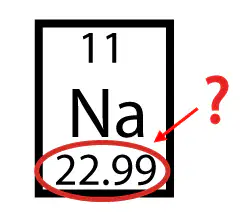
The circled number represents the __________ of sodium.
a)
atomic mass
b)
atomic number
8.
What are atoms made mostly of?
a)
protons
b)
neutrons
c)
empty space
9.
The atomic mass of an element equals the ____________ .
a)
number of electrons
b)
number of protons + the number of neutrons
c)
the number of neutrons - the number of electrons
10.
The elements found on the right side of a chemical equation are the
a)
isotopes
b)
products
c)
reactants
11.
The number of electrons is always equal to this.
a)
the number of neutrons
b)
the number of protons
c)
the sum of protons + neutrons
12.
Which of the following is a characteristic of a hypothesis?
a)
must be a testable statement based on research and prior knowledge
b)
must be a testable statement based on your experiment
c)
must be a correct statement based on data
13.
What is the name for the large number found in front of a compound in a chemical formula?
a)
subscript
b)
co-efficient
c)
exponent
14.
A bond formed between a metal and a non-metal will form this type of bond.
a)
ionic
b)
covalent
c)
polar covalent
15.
What type of energy is the flame of a candle?
a)
radiant energy and electrical energy
b)
thermal energy and nuclear energy
c)
radiant energy and thermal energy
16.
The tendency of an object at rest to stay at rest (or an object in motion to stay in motion) is known as -
a)
velocity
b)
acceleration
c)
inertia
17.
A force is described as a -
a)
push only
b)
pull only
c)
push or pull
18.
This force occurs when surfaces touch and works against motion and brings all things to a stop.
a)
friction
b)
acceleration
c)
velocity
19.

At which point does the roller coaster car have the maximum kinetic energy?
a)
Point (a)
b)
Point (b)
c)
Point (c)
d)
Point (d)
20.
Which of these statements about energy is true?
a)
Energy is the ability to cause change to matter but is not a type of matter because it does not have mass or volume.
b)
Energy is the ability to cause change and is matter because everything is made of matter.
c)
Energy is is the ability to cause change to some forms of matter but not others
21.
This is a reaction in which heat energy is absorbed during the reaction, making an ice-pack turn cold.
a)
reactant
b)
exothermic reaction
c)
endothermic reaction
22.
If an atom gives away an electron, this is formed.
a)
positively charged atom
b)
negatively charged atom
c)
neutral atom
23.
What is formed when two or more different substances combine to form a new substance with new properties?
a)
Element
b)
Compound
c)
Mixture
24.
What does pH mean?
a)
positive hydroniums
b)
potential of hydrogen
c)
possible hydrogen
25.
One water molecule sticks to another molecule forming a large drop of water. This is known as .......
a)
cohesion
b)
adhesion
c)
Osmosis
26.
Potential energy is determined by _________________.
a)
mass and speed
b)
speed and distance
c)
mass and position
27.
This type of bond is formed when there is an even sharing of electrons.
a)
ionic
b)
polar covalent
c)
nonpolar covalent
28.
What happens to the movement of the particles in a substance when the thermal energy is decreased?
a)
the particles slow down and spread apart
b)
the particles speed up down and move closer
c)
the particles slow down and move closer
29.
This is necessary for a chemical reaction to take place.
a)
bonds must be broken or formed to change substances
b)
activation energy is required
c)
all of these
30.
The stomach contains enzymes that aid in speeding up digestion. These enzymes act as __________.
a)
activation energy
b)
a catalyst
c)
an inhibitor
31.
The amount of matter in an object or substance is its _______________.
a)
mass
b)
volume
c)
density
32.
According to Newton’s second law, an object acted upon by forces will ______________.
a)
decrease its momentum and slow down
b)
cancell out and move in opposite direction
c)
accelerate in the direction of the greater force
33.
What is momentum?
a)
the measure of the amount of energy an object carries due to its position and speed
b)
the measure of how difficult it is to stop an object that is moving due to its mass and speed
c)
the measure of how quickly it is for an object to change its direction due to its position and speed
34.
Kinnetic energy is determined by:
a)
mass and position
b)
mass and force
c)
mass and speed
35.
All matter on Earth is made of about ___ different types of atoms called elements.
a)
50
b)
90
c)
1000
36.
Acids have a pH that is...
a)
Less than 7
b)
More than 7
c)
Between 1 and 7
37.
Water moves against gravity and is transported through the body and plants due to both cohesion and adhesion in a process known as
a)
capillary action
b)
surface tension
c)
active transport
38.
What is true about the noble gasses?
a)
They do not form bond because they have 8 valence electrons and are stable according to the Octet Rule
b)
They are highly reactive because they have 18 valence electrons according to Bohr's Law
c)
They are nonreactive because they have 18 valence elelectrons and stable according to the Octet rule
39.
Green food coloring is dropped into a beaker of water and without any further human action will mix and eventually turn the entire beaker of water green. This occurs due to.
a)
Diffusion
b)
Osmosis
c)
Cappilary action
40.
A change in an object's position is
a)
acceleration
b)
velocity
c)
motion
41.
The teacher showed the students element cubes of the same size and shape. One of the cubes was made of iron and the other of aluminum. The students checked the masses of the cubes and found that the iron was much greater. What must be true?
a)
The iron has a higher density than the aluminum.
b)
The iron must have a metal and the aluminum a nonmetal or metalloid
c)
The volume of the iron must be higher.
42.
Water is given the name polar and is the universal solvent due to
a)
the ionic bonding between nonmetals
b)
the uneven sharing of electrons that gives it a charge
c)
the even saring of electrons between these nonmetals that makes it charged
43.
Hydro-power uses the kinetic energy of moving water to spin a turbine and capture electrons and produce electricity. This type of energy resource is
a)
explosive and radioactive
b)
inexhaustible
c)
nonrenewable
44.
A scientist finds a substance and places it under the microscope. The substance contains the same type of atoms throughout. What MUST be true about the substance based on this observation alone.
a)
It is a metal
b)
It is an element
c)
It is a compound
45.
The measure of kinetic energy (speed of the particles) within matter is its.....
a)
temperature
b)
density
c)
weight
46.
What are ions?
a)
atoms that have the same numbers of protons but different numbers of neutrons
b)
atoms that have the same numbers of protons but different numbers of electrons
c)
atoms that are charged from gaining or losing an electron
47.
According to Newton's Third Law, for every action ....
a)
there is always an equal and opposite reaction
b)
there is always a motion in the direction of the force
c)
there is a tendency to stay at rest
48.
Mercury has an atomic number of 80. What does this tell you about mercury?
a)
Mercury has 80 protons
b)
Mercury has 80 neutrons
c)
none of these
49.
Most of the elements that exist are____________.
a)
metals
b)
nonmetals
c)
metalloids
100 %

