
 Worksheets
Evidence and Investigation- Review
Total questions: 39
Worksheet time: 1hrs 18mins

The part of the fingerprints circled in this picture is called what?
an island
a delta
a lake
a whorl

What type of fingerprint is shown in the pictures?
composite
whorl
loop
arch

What type of fingerprint pattern is shown in the pictures?
composite
loop
whorl
arch

What type of fingerprint pattern is shown in the pictures (ignore the small red circles)?
composite
loop
whorl
arch

What type of fingerprint is shown in the picture?
composite
whorl
loop
arch

What is chromatography?
The study of handwriting.
Technique used for separating mixture.
The study of chromium.
Technique used for combining mixtures.

Why would we use chromatography in an investigation?
To figure out what colour pen was used.
To analyze the handwriting of a criminal.
To analyze the chromium level at a crime scene.
To determine the writing utensil used (pencil, pen, marker, etc).

Who was lying?
The cook.
The maid.
The babysitter.

The prints shown in the picture were likely made by a:
wolf
bear
deer
crow

Were they running or walking in this photo based on the footprint
Walking
Running
vroom vroom
BOTH

The forensic scientist has many duties. Which of these is NOT a job of a forensic expert?
Presenting evidence in court
Convicting a suspect of a crime
Analyzing evidence
Searching for evidence

What is a collection of data using the 5 senses?
inference
fact
observation
hypotheses
Which of the following footprint characteristics would best assist an investigation in determining the weight of a suspect?
Depth
Width
Pattern
Length
When comparing handwriting samples, you need to consider which of the following characteristics?
The type of paper it was written on
The message that was written
The date it was written
The slant of the letters
Which of these are examples of natural fabrics
Silk
Wool
Polyester
Cotten
What does synthetic fabric mean
Natural fabric
Fabric that is manufactured by humans
Fabric made of 100% spandex
Fabric made of different things
Observations recorded and put into charts or graphs are called...
Hypothesis
Data
Variables
Materials
Which is NOT a step in the scientific method?
Problem or Question
Research
Ask other people for their opinion
Arrive at conclusion
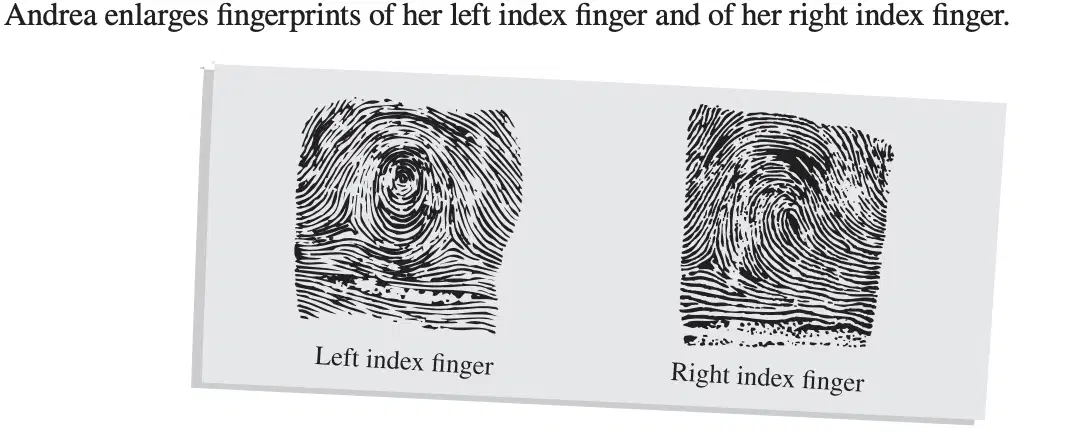
Which of the following identifies the fingerprint patterns on Andrea's left and right index fingerprints
Left whorl, right arch
Left whorl, right loop
Left arch. right whorl
Left arch, right loop
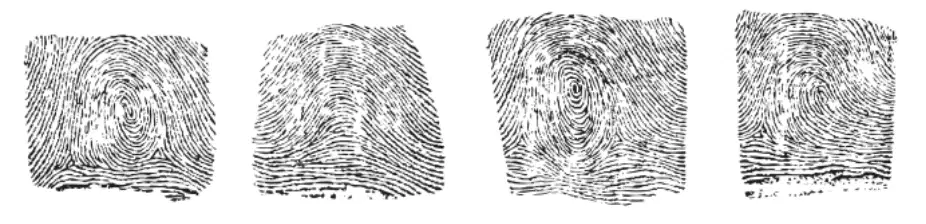
The police find the following set of fingerprints. The patterns on the fingerprints shown above, from left to right, are a....
a loop, an arch, a loop, and an arch
loop, an arch, a loop, and a whorl
whorl, an arch, a whorl, and an arch
whorl, an arch, a whorl, and a loop
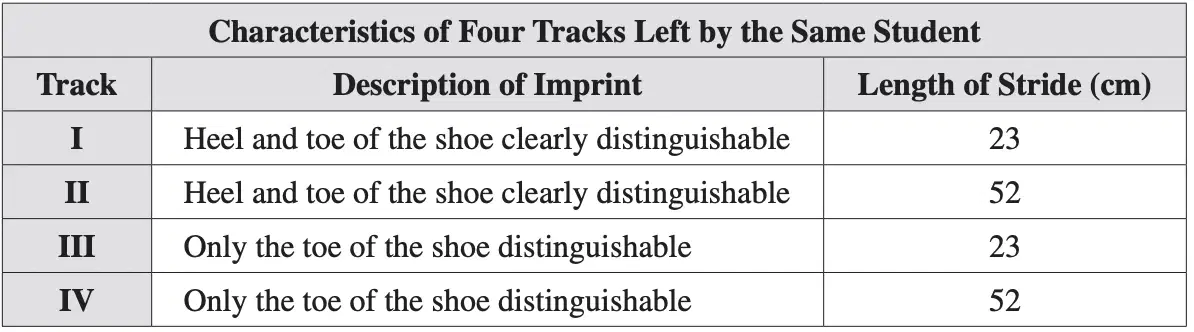
Which track was most likely made by the student when he was walking?
I
II
III
IV

Which of the following identifies the direction and speed of travel for the set of footprints EXITING the house?
West & Running
East & Walking
West & Walking
East & Running

Who was there first?
Car
Bicycle
Footprints

Which of the following inferences is supported by the information shown above?
The snowmobile broke through the fence
The snowmobile carried two people
The deer jumped over the fence
The man chased the dog
Which place is the best footprint (best impression) is most likely to be found?
loose sand
hard packed snow
fresh mud
sidewalk
Which of the following footprint characteristics would best assist an investigation in determining the weight of a suspect?
Depth
Width
Pattern
Length
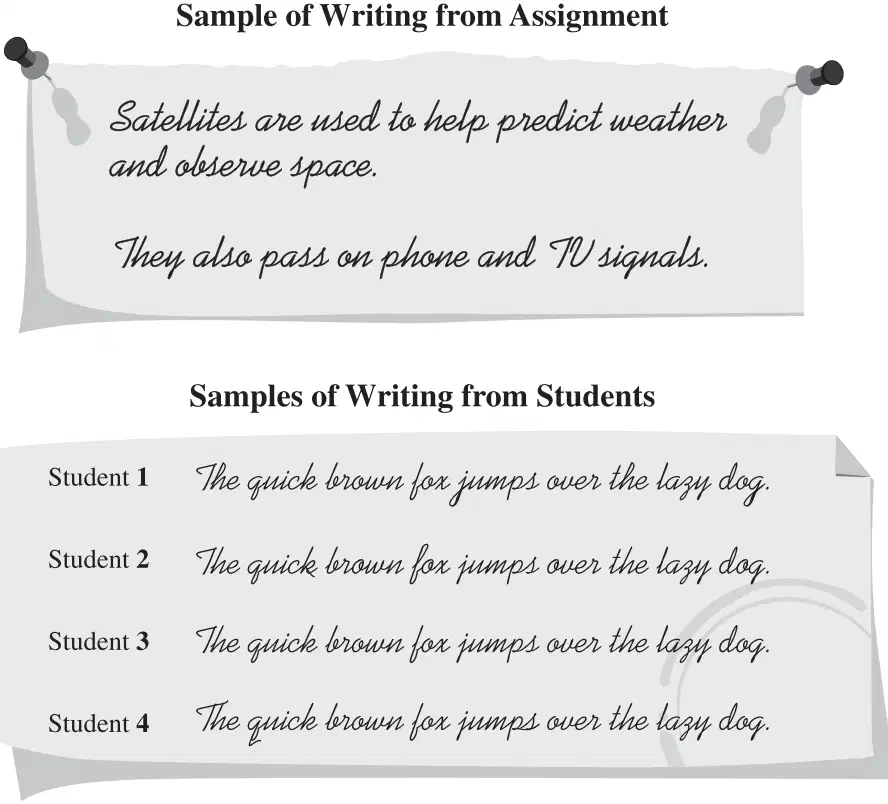
Which student's handwriting matches the sample of writing from assignment at the top of the picture?
Student 1
Student 2
Student 3
Student 4
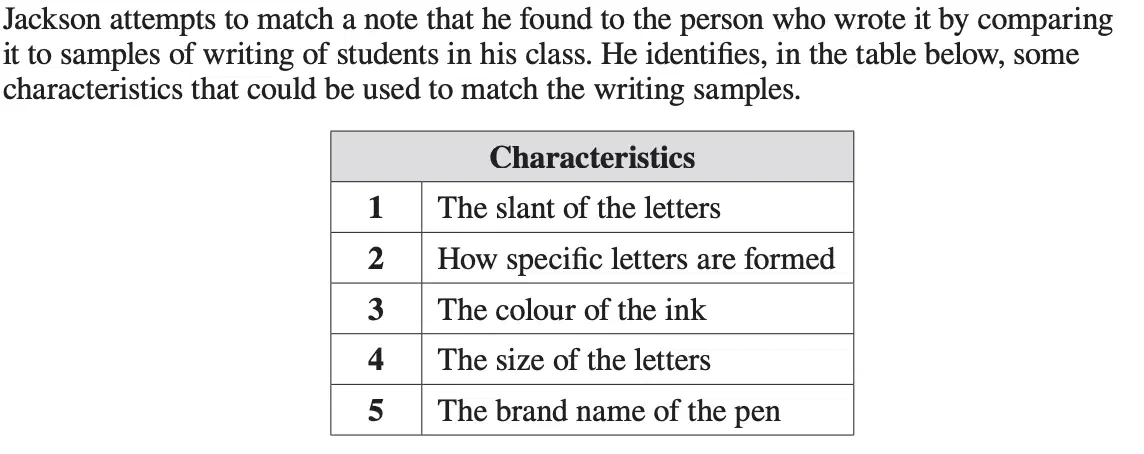
The three characteristics listed above that he should compare to most accurately identify the person who left the note are...
Characteristics 1, 2 & 4
Characteristics 1, 3 & 4
Characteristics 2, 3 & 5
Characteristics 2, 4 & 5
True or False: Handwriting evidence can be examined to match a suspect
True
False

The writing from which number best matches the sample from the crime scene?
1
2
3
4
5
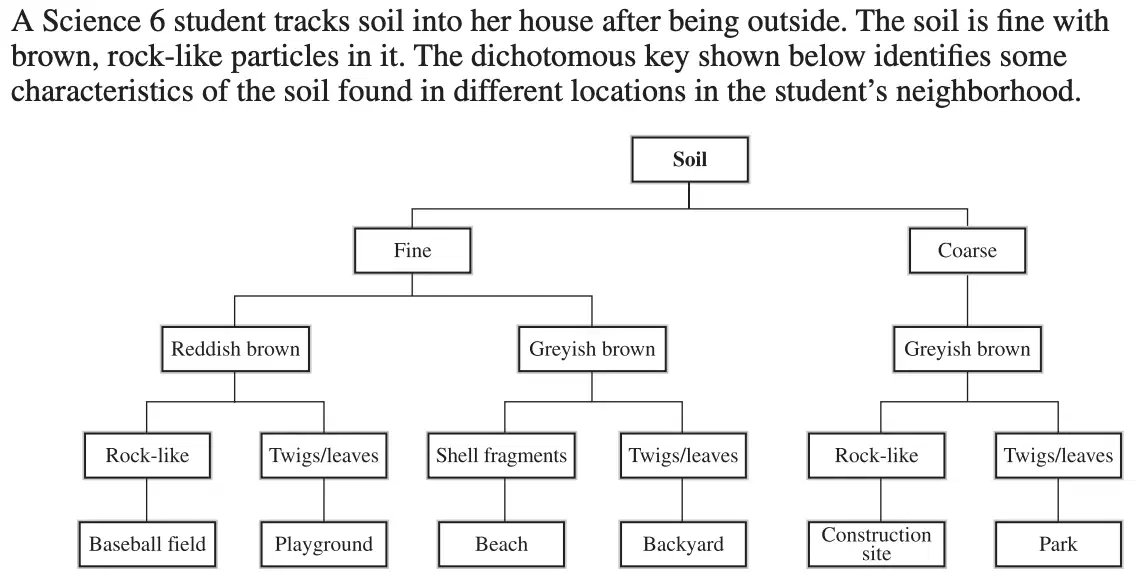
Which of the following locations did the student MOST LIKELY visit before she entered her house?
Beach
Playground
Baseball Field
Construction site
True or False: Analyzing soil samples and their characteristics can help investigators find evidence that a suspect was at the crime scene.
True
False
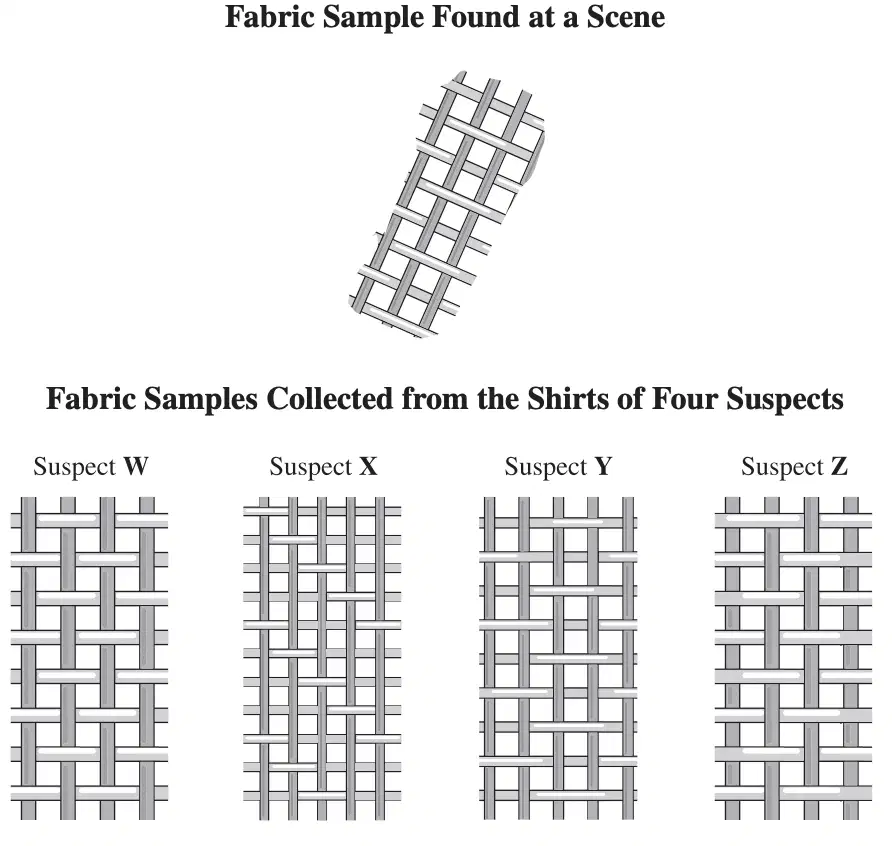
Which suspect's fabric sample MOST CLOSELY resembles the fabric found at the scene?
Suspect W
Suspect X
Suspect Y
Suspect Z
After conducting a burn test on a sample of fabric, the residue left was melted plastic. What type of material can we infer the sample was?
Synthetic
Natural
Animal
Plant
All of the following are useful tests for fabric samples EXCEPT...
Absorb/Repel
Stretch
Wrinkle
Odour
10. True or false. All fabrics absorb water at the same rate.
true
false
11. Ture or false. All fabrics melt at the same rate.
True
False
19. Will it wrinkle, burn or melt, are ways of
distinguishing one fabric from another..
testing the porosity of soil.
studying handwriting.
none of above
21. True or false. Police can tell if a tire track is from a large car or a small car.
True
False

