wayground logo

Free Printable Worksheets

Font size

S
M
L
XL
Worksheets

honors bio final review

Total questions: 205

Worksheet time: 44hrs 46mins

Name
Class
Date
1.
Genotype refers to the ...
a)
physical expression of the genes
b)
the possible combination of alleles in a gene
c)
whether an allele is dominant or recessive
d)
how an organism will appear
2.
the passing of genetic traits from parent to offspring.
a)
heredity
b)
trait
c)
gene
d)
allele
3.
Snapdragon flowers come in red, pink and white.  What type of inheritance is this?
a)
Complete Dominance
b)
Incomplete Dominance
c)
Codominance
d)
Polygenic Inheritance
4.
Incomplete dominance means that the traits are
a)
expressed equally
b)
dominant
c)
recessive
d)
blended
5.
One form of a gene is called_______________
a)
a DNA
b)
a Phenotype
c)
a trait
d)
an allele
6.
What blood type is the "universal donor" because it can be donated to anyone?
a)
A
b)
B
c)
AB
d)
O
7.
Someone with type A blood can receive blood from someone who is type AB.
a)
True
b)
False
8.
What antigens are present in a person with type AB blood?
a)
b)
A and B
c)
d)
none 
9.

What is NOT a possible genotype for someone with type B blood?

a)

BB

b)

AB

c)

BO

10.

What type of inheritance is determined by multiple genes and there can be a range of traits?

a)

Codominance

b)

Incomplete dominance

c)

Polygenic traits

11.

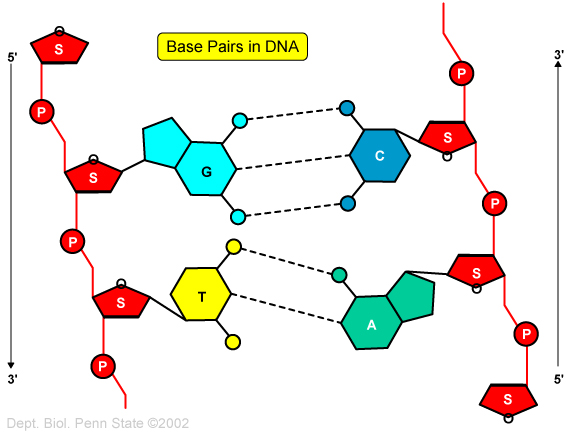
A segment of DNA is shown in the diagram. Which of these identifies the part of the DNA segment labeled X?

a)

Nucleotide

b)

Phosphate group

c)

Hydrogen bond

d)

Deoxyribose

12.
How does RNA differ from DNA?
a)
RNA contains uracil and deoxyribose
b)
RNA contains ribose and thymine
c)
RNA contains uracil and ribose
d)
RNA contains adenine and ribose
13.
Promoters are
a)
genes that code for individual proteins
b)
proteins that bind with DNA and prevent transcription
c)
DNA sequences near operons that regulate transcription
d)
small molecules that bind with repressor proteins
14.
The process by which the genetic code of DNA is copied into a strand of RNA is called
a)
translation
b)
transcription
c)
transformation
d)
replication
15.
In messenger RNA, each codon specifies a particular
a)
nucleotide
b)
enzyme
c)
amino acid
d)
promoter
16.
Which of the following describes RNA?
a)
RNA is usually double-stranded and contains the base thymine
b)
RNA is usually single-stranded and contains the base uracil
c)
RNA is longer than DNA and uses five bases to encode information
d)
RNA is made in the nucleus of eukaryotic cells and stays there to carry out its functions
17.
The number of codons in the genetic code is
a)
3
b)
4
c)
20
d)
64
18.
The process of making proteins on the ribosome based on instructions from messenger RNA is called
a)
transcription
b)
transformation
c)
translation
d)
molecular biology
19.
Changes is DNA sequences that affect genetic information are known as
a)
replications
b)
mutations
c)
transformations
d)
translations
20.
A group of genes that are regulated together is called a(n)
a)
promoter
b)
operon
c)
intron
d)
allele
21.
In a molecule of double-stranded DNA, the amount of Adenine present is always equal to the amount of
a)
cytosine
b)
guanine
c)
thymine
d)
uracil
22.
Which 2 molecules form the sides (backbone) of the DNA ladder?
a)
deoxyribose sugar and adenine
b)
deoxyribose sugar and a hydrogen bond
c)
deoxyribose sugar and the nucleus
d)
deoxyribose sugar and phosphate
23.
Which organelle is DNA usually found in?
a)
cell membrane
b)
vacuole
c)
chloroplast
d)
nucleus
24.
Nitrogenous bases are joined by which type of bond?
a)
polar bonds
b)
ionic bonds
c)
covalent bonds
d)
hydrogen bonds
25.
The enzyme that unzips the DNA to prepare for replication
a)
helicase
b)
replicase
c)
polymerase
d)
synthase
26.
DNA replication results in two DNA molecules,
a)
each one with two original strands
b)
each one with two new strands
c)
each one with one new strand and one original strand
d)
one with two new strands and the other with two original strands
27.
What are the 4 nitrogen bases?
a)
adenine, thymine, cytoplasm, and guanine
b)
adenine, thymine cytosine, and guanine
c)
adenine, thymine, cytosine, and gylcerol
d)
adenine, thymine, cytosine, and glucose
28.

What is synthesized to pass the DNA code to the ribosome?

a)

polymerase

b)

messenger RNA

c)

ligase

d)

ribosome

29.

A process called ____ uses the code carried by messenger RNA for protein synthesis.

a)

translation

b)

transcription

c)

unwinding

d)

elongation

30.

A process called ___________ uses DNA to make a RNA.

a)

translation

b)

transcription

c)

unwinding

d)

elongation

31.

The three-base code in DNA or messenger RNA is called a ____.

a)

polymerase chain

b)

translation

c)

codon

d)

transfer RNA

32.

Which substance shown here, binds to the site where messenger RNA will be synthesized?

a)

RNA polymerase

b)

template DNA strand

c)

nucleotide

d)

adenine

33.

What controls differentiation to determine an organism's body plan?

a)

lac operon

b)

protein complex

c)

polymerase

d)

hox genes

34.

Which of these is not a function of eukaryotic transcription factors?

a)

control rate of transcription

b)

ensure gene is used at the right time

c)

stabilize the binding of RNA polymerase

d)

prevent messenger RNA from translating

35.
A protein that binds to the operator and blocks the RNA polymerase
a)
regulator
b)
repressor
c)
activator
d)
corepressor
36.
The "on/off" switch for an operon is called the
a)
promoter
b)
repressor
c)
operator
d)
gene
37.
Operons are found in the cells of which of the following types of organisms?
a)
prokaryotes (bacteria)
b)
eukaryotes (plant and animals)
c)
animals only
d)
viruses
38.

Selective breeding is...

a)

a process to create an organism with desired traits from parents with those desired traits

b)

natural method of producing offspring with desired traits

c)

creating a new species

d)

making organisms reproduce during times of stress

39.

One problem with selective breeding is

a)

creating a new species

b)

gene variety is lost

c)

new food sources

40.
Which is another term for selective breeding?
a)
Artificial selection
b)
Natural Selection
c)
Intelligent selection
41.

This laboratory procedure is known as

a)

CLONING

b)

gel electrophoresis

c)

chromatography

d)

use of a dichotomous key

42.

In preparation for an electrophoresis procedure, enzymes are added to DNA in order to

a)

convert the DNA into gel

b)

cut the DNA into fragments

c)

change the color of the DNA

d)

produce longer sections of DNA

43.

Which chemicals are used to cut DNA into fragments for a gel electrophoresis procedure?

a)

enzymes

b)

molecular bases

c)

hormones

d)

ATP molecules

44.
DNA fingerprinting works because
a)
Most genes are dominant
b)
All organisms contain RNA
c)
The most important genes are different among most people
d)
No two people, except identical twins, have exactly the same DNA 
45.
Why do the fragments of DNA in gel electrophoresis travel away from the negative electrode?
a)
DNA is negatively charged so attracted to the positive end of the unit
b)
DNA is positively charged to attracted to the negative end of the unit
c)
the agarose gel in negatively charged
d)
the agarose gel is positively charged
46.

Restriction Enzymes can cut at any sequence of DNA

a)

True

b)

False

47.

The site where restriction enzymes cut are a called:

a)

cut sites

b)

restriction sites

c)

recognition sites

d)

cleave sites

48.

What enzyme binds to the promotor of the plasmid to transcribe the gene inserted into the plasmid?

a)

DNA polymerase

b)

helicase

c)

RNA polymerase

d)

ligase

49.

What enzyme is used to ensure that the recombinant DNA created is bonded together along the sugar-phosphate backbone?

a)

DNA polymerase

b)

RNA polymerase

c)

ligase

d)

helicase

50.
What does a filled in square represent?
a)
Not affected Female
b)
Not affected Male
c)
Affected Male
d)
Affected Female
51.
What do half colored symbols represent?
a)
The individual is a carrier (heterozygous).
b)
The individual expresses the trait.
c)
The individual has both recessive alleles.
d)
The individual has both dominant alleles.
52.
What does an open circle represent?
a)
Not Affected Male
b)
Not Affected Female
c)
Affected Male
d)
Affected Female
53.
Drawn observed several different types of finches.  Why are there so many different types?
a)
Finches live in different places, but eat the same food.
b)
Finches live in the same place, but eat different types of food.
c)
Finches live in different habitats and eat different types of food.
d)
Finches are found all over the world.
54.
The differences among a species, like different bird beaks, are called
a)
genes.
b)
variations.
c)
traits.
d)
theories.
55.
Organisms with the most beneficial traits will survive.  This is commonly known as
a)
theory of evolution.
b)
variations.
c)
survival of the fittest.
d)
ecosystems.
56.
Behavioral changes of individuals of a species that allow for better survival. (Acquired traits)
a)
Variation
b)
Adaptation
c)
Behavior
d)
Environment
57.
Where the better adapted organisms survive to pass traits along to offspring.
a)
Evolution
b)
Natural Selection
c)
Extinction
d)
Artifical Selection
58.

Organisms that do not make their own food

a)

Autotroph

b)

Prodcucer

c)

Chemotroph

d)

Consumer

59.

An organism that breaks down dead organisms 

        (ex: bacteria, fungus)

a)

Heterotroph

b)

Consumer

c)

Scavenger

d)

Decomposer

60.

A diagram of one energy flow/path through an 

        ecosystem

a)

Food Pyramid

b)

Food Chain

c)

Food Web

d)

Food Circle

61.

Organisms that make their own food

a)

Heterotroph

b)

Chemotroph

c)

Consumer

d)

Producer

62.

the selection pressure favors the extreme phenotypes, dividing the population into 2 distinct groups

a)

directional selection

b)

stabilizing selection

c)

geographic selection

d)

disruptive selection

63.

individuals with alleles for an extreme type are more likely to survive and reproduce

a)

stabilizing selection

b)

directional selection

c)

disruptive selection

d)

genetic drift

64.

Individuals with intermediate traits are more likely to survive and reproduce

a)

stabilizing selection

b)

directional selection

c)

adaptive radiation

d)

disruptive selection

65.
What are the nucleotides made of?
a)
Sugar, Phosphate, nitrogen base
b)
Phosphate, Adenine, nitrogen base
c)
Thymine, Adenine, Cytomine
d)
Phosphate, Nitrogen, Adenine
66.
Which of the following best describes a DNA molecule?
a)
double helix
b)
contains ribose
c)
made of amino acids
d)
contains Uracil
67.
Adenine bonds with ______________.
a)
Guanine
b)
Thymine
c)
Cytosine
d)
Adenine
68.

Bundled up, organized DNA is called a

a)

gene

b)

trait

c)

chromosome

d)

nucleotide

69.
What are the nucleotides made of?
a)
Sugar, Phosphate, nitrogen base
b)
Phosphate, Adenine, nitrogen base
c)
Thymine, Adenine, Cytomine
d)
Phosphate, Nitrogen, Adenine
70.
Which of the following best describes a DNA molecule?
a)
double helix
b)
contains ribose
c)
made of amino acids
d)
contains Uracil
71.
Adenine bonds with ______________.
a)
Guanine
b)
Thymine
c)
Cytosine
d)
Adenine
72.

Bundled up, organized DNA is called a

a)

gene

b)

trait

c)

chromosome

d)

nucleotide

73.
What is a gene?
a)
A bundle (like a hot dog bun) that the DNA is packed into
b)
something inside the nucleus
c)
a piece of DNA
d)
all of your DNA
74.

How many chromosomes do human cells have?

a)

46

b)

23

c)

2

d)

44

75.
Replicate the following strand of DNA: 
AATCATGGA
a)
AATCATGGA
b)
TTAGTACCT
c)
UUAGUACCU
d)
GGATAUCUA
76.
Which shows the correct complementary base pairing for DNA?
a)
C-A, T-G
b)
A-G, C-T
c)
C-G, U-A
d)
T-A, G-C
77.
Which 2 molecules forms the sides (backbone) of the DNA ladder?
a)
deoxyribose and adenine
b)
deoxyribose and a hydrogen bond
c)
sugar and the nucleus
d)
deoxyribose (sugar) and phosphate
78.
What are the 4 nitrogen bases?
a)
adenine, thymine, cytoplasm, and guanine
b)
adenine, thymine cytosine, and guanine
c)
adenine, thymine, cytosine, and gylcerol
d)
adenine, thymine, cytosine, and glucose
79.
Why is DNA important?
a)
it is very small and very complicated
b)
it's in everything
c)
it serves as the blueprint for traits of all living things
d)
because we eat it every day for energy
80.
Which 2 molecules form the sides (backbone) of the DNA ladder?
a)
deoxyribose sugar and adenine
b)
deoxyribose sugar and a hydrogen bond
c)
deoxyribose sugar and the nucleus
d)
deoxyribose sugar and phosphate
81.
DNA replication results in two DNA molecules,
a)
each one with two original strands
b)
each one with two new strands
c)
each one with one new strand and one original strand
d)
one with two new strands and the other with two original strands
82.
A process in which DNA has the unique ability to make an exact copy of itself.
a)
Replication
b)
Translation
c)
Transcription
83.
The two strands of a DNA molecule are held together by ________ bonds between their base pairs.
a)
covalent
b)
hydrogen
c)
ionic
d)
peptide
84.
If a segment of double-stranded DNA has 40 percent A, how much of it is C?
a)
40
b)
10
c)
15
d)
20
85.

Plants make their own energy molecules (food) using photosynthesis. What do we call this type of organism?

a)

Prokaryote

b)

Eukaryote

c)

Autotroph

d)

Heterotroph

86.

Unicellular organisms that lack a nucleus and other cellular organelles are known as...

a)

Prokaryote

b)

Eukaryote

c)

Heterotroph

d)

Autotroph

87.

The most specific level of biological classification is...

a)

kingdom

b)

genus

c)

phylum

d)

species

88.

The order of the levels of classification is:

a)

Domain, kingdom, phylum, class, order, genus, family, species

b)

Domain, class, kingdom, phylum, order, genus, family, species

c)

Domain, class, kingdom, phylum, order, genus, species, family

d)

Domain, kingdom, phylum, class, order, family, genus, species

89.

Living organisms respond to changes in their environment called ________________.

a)

homeostasis

b)

stimuli

c)

cells

d)

adaptations

90.

Living things can _____________________, or make babies.

a)

breathe

b)

adapt

c)

walk

d)

reproduce

91.
In cells a large oval organelle that contains the cells genetic material in the form of DNA and controls many of the cells activities
a)
organelle
b)
ribosome
c)
cell wall
d)
nucleus
92.
an organelle in the cells of plants and some other organisms that captures energy from sunlight and changes it to an energy from that cells can use in making food
a)
vacuole
b)
chloroplasts
c)
cytoplasm
d)
mitochondria
93.
What is the name of the genetic material that is inside the nucleus?
a)
ER
b)
ATP
c)
YOLO
d)
DNA
94.
What is the name for all populations of species within an area
a)
Community
b)
Ecosystem
c)
Biosphere
d)
Biome
95.
The term biotic means;-
a)
Not a robot or robotic
b)
Living Things
c)
Water based environments
d)
Non-living things
96.
Requires water, sunlight, and carbon dioxide to take place.
a)
respiration
b)
species growth
c)
habitat
d)
photosynthesis
97.
The shrew provides energy for the _______?
a)
cricket
b)
grasshopper
c)
frog
d)
snake
98.
Where does the energy start in this food chain?
a)
Plant
b)
Sun
c)
Deer
d)
Wolf
99.
A white flower (rr) is crossed with a white flower (rr). What is the phenotype of the offspring? Draw a Punnett square and answer the question.
a)
100% white
b)
75% white; 25% red
c)
75% red; 25% white
d)
100% red
100.
Two heterozygous white (brown fur is recessive) rabbits are crossed. What is their genotype?
a)
25% homozygous domestic; 25% homozygous recessive; 50% heterozygous
b)
50% homozygous dominant; 50% heterozygous
c)
25% homozygous domestic; 75% homozygous recessive
101.

If you cross a white flower (pp) with a purple flower (PP), the possible genotypes of the offspring are

a)

PP and pp

b)

All Pp

c)

All PP

d)

All pp

102.

If you crossed a PP (purple) with a pp (white), what would the phenotypes be?

a)

all white

b)

all tall

c)

all purple

d)

1/2 white, 1/2 purple

103.

_____________ describes a trait that covers over, or masks another form of that trait.

a)

recessive

b)

gene

c)

allele

d)

dominant

104.
If green is dominant over purple, then what is the genotype for this individual?
a)
Purple
b)
Green
c)
GG
d)
gg
105.
A heterozygous long-tusked elephant is crossed with a homozygous recessive short-tusked elephant. What is the probability of the offspring having short tusks?
a)
0%
b)
25%
c)
50%
d)
75%
106.

Produces four cells

a)

Mitosis

b)

Meiosis

c)

Both

107.
Most of the cells in the human body are produced by
a)
mitosis
b)
meiosis
108.
products of meiosis are genetically
a)
different
b)
identical
109.

During transformation...

a)

a cell takes in RNA from outside the cell.

b)

a cell changes from prokaryotic to eukaryotic.

c)

a cell takes in DNA from outside the cell.

d)

a cell changes into two new cells.

110.

Griffith's experiment with the heat killed bacteria must have contained what?

a)

DNA fragments

b)

RNA fragments

c)

no DNA

d)

lots of contagious bacteria

111.

What are the two types of bacteria?

a)

archaebacteria

b)

viralbacteria

c)

kilbacteria

d)

Eubacteria

112.

The first word in a scientific name is the

a)

species

b)

phylum

c)

genus

d)

class

113.

The scientist who came up with the current classification system

a)

Darwin

b)

Newton

c)

Mendel

d)

Linnaeus

114.

The science of grouping and naming organisms

a)

Phylogeny

b)

Dichotomy

c)

Taxonomy

d)

Genetics

115.

The taxonomic level that would include the MOST number of species

a)

class

b)

kingdom

c)

phylum

d)

genus

116.

Which of the following is the CORRECT form of a scientific name?

a)

canis lupus

b)

Canis Lupus

c)

Canis lupus

d)

canis lupus

117.

A ________ can be used to classify organisms based on characteristics.

a)

punnet square

b)

phylogenetic chart

c)

trophic pyramid

d)

dichotomous key

118.

Which taxonomic level would include the LEAST number of organisms?

a)

species

b)

genus

c)

order

d)

phylum

119.
Which kingdom is makes its own food AND has a cell wall?
a)
Bacteria
b)
Fungi
c)
Plant
d)
Protist
120.
This kingdom contains organisms such as trees, plants and shrubs.
a)
Fungi
b)
Plantae
c)
Animalia
d)
Protista
121.
A _________ causes living things to react or respond.
a)
Stimulus
b)
Taxonomy
c)
Function
d)
Classification
122.
__________ involves organizing organisms based on shared characteristics into groups.
a)
Classification
b)
Identification
123.
A species is larger than a genus.
a)
True
b)
False
124.
Photosynthesis:
water + _______ + sunlight = oxygen + glucose
a)
carbon monoxide
b)
carbon dioxide
c)
nitrogen
d)
helium
125.
A ______  is a group of similar organisms that can mate with each other and produce offspring that can also mate and reproduce.
a)
kingdom
b)
class
c)
family
d)
species
126.
What is the process of grouping things based on their similarities?
a)
Punnett Square
b)
Classification
c)
Taxonomy
d)
DNA
127.
A hetertrophic, eukaryotic organism associated with the decomposition of dead material is a(n):
a)
bacteria
b)
fungi
c)
plant
d)
archaea
128.
All of the following have a nucleus except...
a)
Eubacteria
b)
Animalia
c)
Plantae
d)
Protista
129.
All organisms that do not fit into plant, fungi, and animal kingdoms but have a nucleus are:
a)
archaebacteria
b)
eubacteria
c)
protists
130.

Which kingdom is prokaryotic?

a)

Animalia

b)

Archae

c)

Planta

d)

Fungi

131.

What kingdom- prokaryotic-single celled and have a cell wall of peptidoglycan

a)

eubacteria

b)

archaebacteria

c)

protists

d)

fungi

132.
An example of a mutation where a piece of chromosome breaks off and attaches to another chromosome is called ___.
a)
trisomy
b)
translocation
c)
inversion
d)
deletion
133.
A chromosome is found to be shorter than it's homologous match.  Which type of mutation would this most likely be?
a)
insertion
b)
deletion
c)
translocation
d)
inversion
134.
What process occurs during meiosis that can result in chromosomal disorders?
a)
crossing over
b)
non-disjunction
c)
anaphase I
d)
prophase II
135.
What causes mutations?
a)
Mistakes in replication or environmental substances
b)
The amino acids
c)
Passed down by genetics
d)
It's how your born
136.

Another name for a point mutation is:

a)

Substitution

b)

Frameshift

c)

Insertion

d)

Deletion

137.

ATTTGAGCC- Original

ATTGAGCC - Mutated

The example above is an example of a

a)

Insertion

b)

Point mutation

c)

Deletion

d)

Substitution

138.

This type of mutation involves inserting a piece of DNA where it does not belong. Known as a frameshift mutation.

a)

Substitution Mutation

b)

Deletion Mutation

c)

Insertion Mutation

139.

Mutations can be negative because

a)

They can cause cancer

b)

They can cause birth defects

c)

They can help an organism thrive in its environment.

d)

They can affect offspring.

140.

Mutations can benefit humans because they can:

a)

Cause illness

b)

Make an organism more suited to live in its environment.

c)

Make organisms live shorter lives

d)

Cause organisms to grow extra limbs.

141.

A mutation is defined as:

a)

A change in the cell's structure

b)

Anything that changes in an embryo

c)

Any change in the physical features of a human

d)

A change in the DNA sequence

142.
What causes mutations?
a)
Mistakes in replication or environmental substances
b)
The amino acids
c)
Passed down by genetics
d)
It's how your born
143.

A mutation can occur if a base pair is ____________, deleted or substituted for another.

a)

modified

b)

added

c)

transferred

144.

Another name for a point mutation is:

a)

Substitution

b)

Frameshift

c)

Insertion

d)

Deletion

145.

ATTTGAGCC- Original

ATTGAGCC - Mutated

The example above is an example of a

a)

Insertion

b)

Point mutation

c)

Deletion

d)

Substitution

146.

Mutations are random.

a)

True

b)

False

147.

Mutations are SOMETIMES helpful to the organism.

a)

True

b)

False

148.

Mutations create genetic diversity?

a)

True

b)

False

149.

This type of mutation involves inserting a piece of DNA where it does not belong. Known as a frameshift mutation.

a)

Substitution Mutation

b)

Deletion Mutation

c)

Insertion Mutation

150.

This type of mutation involves removing a piece of DNA where it belongs.

Known as a frameshift mutation.

a)

Substitution Mutation

b)

Insertion Mutation

c)

Deletion Mutation

151.

What type of Mutation is this to the sentence "THE CAT WAS FUN":

THE BAT WAS FUN

a)

Substitution Mutation

b)

Deletion Mutation

c)

Insertion Mutation

152.

What type of Mutation is this to the sentence "THE CAT WAS FUN":

THE CAT AWA SFU N...

a)

Substitution Mutation

b)

Deletion Mutation

c)

Insertion Mutation

153.

What type of Mutation is this to the sentence "THE CAT WAS FUN":

THE CAT WIS FUN

a)

Substitution Mutation

b)

Deletion Muation

c)

Insertion Mutation

154.

In the documentary "Life According to Sam," what was the disease Sam suffered from called?

a)

Autism

b)

Malaysia

c)

Benjamin Button

d)

Progeria

155.

In the documentary "Life According to Sam," what was unique about the clinical trials?

a)

They didn't offer a placebo due to it being such a rare disease

b)

They had 0 research about progeria until Sam's parents began conducting clinical trials

c)

Both of these are unique to the situation

d)

None of these are unique to the situation

156.

Which organelle is DNA usually found in?

a)

cell membrane

b)

vacuole

c)

chloroplast

d)

nucleus

157.

What are the building blocks of proteins called?

a)

DNA

b)

RNA

c)

Ribosomes

d)

Amino Acids

158.

The survival of a species depends on its ability to adapt to changes in the environment. Which statement correctly describes a way that mutations increase the likelihood that a species will survive in a changing environment?

a)

Mutations are a source of variation in the species

b)

Mutations are the cause of disease in the species

c)

Mutations are not harmful when they occur in somatic cells

d)

Mutations are always passed on to subsequent generations

159.
Any genetically controlled trait that increases an individual’s ability topass along copies of its genes
a)
adaptation
b)
divergent evolution
c)
vestigal organs
d)
genetic drift
160.
Over time, species become better suited to their environment as they respond
a)
natural selection
b)
homologous structures
c)
speciation
d)
Hardy-Weinberg Principle
161.
A method of selective breeding of organisms performed by humans to produce offspring with desirable characteristics
a)
artificial selection
b)
evolution
c)
convergent evolution
d)
gene pool
162.
The ability of a species to pass its genes on to the next generation
a)
fitness
b)
speciation
c)
adaptation
d)
artificial selection
163.
All living organisms are related to one another because they are derived from common ancestors
a)
common descent
b)
convergent evolution
c)
Hardy-Weinberg Principle
d)
genetic drift
164.
When natural changes make two groups more alike and their phenotypes converge
a)
convergent evolution
b)
artificial selection
c)
adaptation
d)
vestigal organs
165.
When similar organisms evolve different phenotypes because they are exposed to different selection pressures
a)
divergent evolution
b)
genetic drift
c)
artificial selection
d)
common descent
166.
Structures that develop from the same embryonic tissues but have different functions
a)
homologous structures
b)
common descent
c)
adaptation
d)
vestigal organs
167.
Leftover remainder from what may have been needed in the past, like legs on a snake
a)
vestigal organs
b)
speciation
c)
gene pool
d)
artificial selection
168.
Occurs when alleles become more or less common in a gene pool simply by chance
a)
genetic drift
b)
evolution
c)
adaptation
d)
Hardy-Weinberg Principle
169.
Organisms within a species share groups of alleles
a)
gene pool
b)
Hardy-Weinberg Principle
c)
natural selection
d)
vestigal organs
170.
Occurs when two or more new species form from what once was a single species
a)
speciation
b)
convergent evolution
c)
vestigal organs
d)
fitness
171.

Swapping DNA segments with non-homologous chromosomes is known as which type of mutation?

a)

Point

b)

Frameshift

c)

Nondisjunction

d)

Gene Translocation

172.

When a nucleotide is added to a DNA sequence, which of the following will occur?

a)

Point Mutation

b)

Silent Mutation

c)

Frameshift Mutation

d)

Gene Duplication

173.

A point mutation that does not change the amino acid sequence is known as a(n) ____________ mutation.

a)

Frameshift

b)

Nondisjunction

c)

Inversion

d)

Silent

174.

What type of mutation is shown in the image?

a)

Nondisjunction

b)

Gene Translocation

c)

Trinucleotide Repeat Expansion

d)

Frameshift

175.

The process of using a DNA template to create an mRNA copy

a)

tRNA

b)

Transcription

c)

Translation

d)

mRNA

176.

The process of reading a strand of mRNA to produce a protein.

a)

Transcription

b)

Translation

c)

on the ribosome

d)

Vacoule

177.

Transcription occurs...

a)

on the nucleus

b)

on the ribosome

178.
What does mRNA do?
a)
provides information from DNA to ribosomes
b)
transfers amino acids to the ribosomes
c)
makes up ribosomes
d)
builds proteins
179.
What does tRNA do?
a)
provides information from DNA to ribosomes
b)
transfers amino acids to the ribosomes
c)
makes up ribosomes
d)
builds proteins
180.

The picture below shows an enzyme unwinding and unzipping DNA.

​What is the name of this enzyme?

a)

DNA Helicase

b)

DNA Ligase

c)

DNA polyermase

d)

RNA Polymerase

181.

Which enzyme is responsible for adding the free nucleotides to the replicating DNA? ​

a)

DNA Helicase

b)

DNA Ligase

c)

DNA polyermase

d)

RNA Polymerase

182.

The following diagram shows the steps of gene expression. What type of cell could this diagram NOT be representing?

a)

human pancreatic cell

b)

a mesophyll cell in an oak tree leav

c)

a cell in the hyphae of a mushroom

d)

an E. coli bacteria cell

183.
A protein that binds to the operator and blocks the RNA polymerase
a)
regulator
b)
repressor
c)
activator
d)
corepressor
184.
The "on/off" switch for an operon is called the
a)
promoter
b)
repressor
c)
operator
d)
gene
185.

Why is the transcription of structural genes of the trp operon turned off in the presence of tryptophan?

a)

Tryptophan is the repressor that binds to the operator, preventing transcription.

b)

The structural genes are used to make tryptophan, which would not be needed if tryptophan is available.

c)

Tryptophan has no effect on the transcription of the structural genes.

d)

Tryptophan RNA polymerase from finding the promoter of the trp operon, preventing structural gene transcription.

186.

Which of the following statements regarding the trp operon is true?

a)

The operator region produces the mRNA that codes for the repressor.

b)

The regulatory gene is not transcribed in the presence of the repressor.

c)

Repressor proteins are inactivated by the presence of the repressor. .

d)

The trp operon is always activated unless deactivated by a repressor

187.
what is an operon?
a)
a part of a ribsome
b)
a part of a Rna
c)
a unit made up of linked genes that code for proteins needed to do a specific task
d)
needed for dna replication
188.
A protein that binds to the operator and blocks the RNA polymerase
a)
regulator
b)
repressor
c)
activator
d)
corepressor
189.
The "on/off" switch for an operon is called the
a)
promoter
b)
repressor
c)
operator
d)
gene
190.
What is the name of the stretch of DNA where RNA polymerase binds?
a)
operator
b)
promoter
c)
enhancer
d)
origin
191.
What is the role of operons in prokaryote gene expression?
a)
It makes the genes prokaryotes be turned on
b)
It accounts for the regulation of gene activity in response to the needs of the cells
c)
To make DNA for the gene
d)
To make the gene turn of and off
192.
The lac operon genes only become expressed if:
a)
lactose binds to the repressor
b)
glucose binds to the repressor
c)
lactose binds to the operator
d)
the repressor binds to the operator
193.
In the lac operon model the genes within the operon will be expressed if:
a)
lactose is absent in the cell
b)
glucose is present in the cell
c)
lactose is present in the cell
194.
Inducible negative control is when when the gene is transcribed by the ____ of a specific molecule
a)
presence
b)
absence
195.
Repressible negative control is when when the gene is transcribed by the ____ of a specific molecule
a)
presence
b)
absence
196.
What type of operon is the trp (tryptophan) operon?
a)
inducible
b)
repressible
c)
positive control
d)
promoible
197.
Operons are found in the cells of which of the following types of organisms?
a)
prokaryotes (bacteria)
b)
eukaryotes (plant and animals)
c)
animals only
d)
viruses
198.
How can a person's muscle cells have the same exact DNA sequences as their nerve cells even though the look and perform completely different?
a)
The two different cells become mutated
b)
The proteins expressed in each cell are different
c)
They actually have different DNA in the two types of cells.
d)
The genome of the different cells changes
199.

lac operon was proposed by

a)

Meselson and Stahl

b)

Jacob and Monod

c)

Hershey and Chase

d)

Watson and Crick

200.

The regulation of an operon by repressor is referred to as

a)

negative regulation

b)

positive regulation

c)

both a and b

d)

neutral regulation

201.

In the lac operon the inducer is

a)

allolactose

b)

glucose

c)

galactose

d)

all of the above

202.
Most gene regulation happens at which step along the way?
a)
translation
b)
transcription
c)
signal transduction
d)
DNA replication
203.

For a repressible operon to be transcribed, which of the following must be true?

a)

A corepressor must be present.

b)

RNA polymerase and the active repressor must be present.

c)

RNA polymerase must bind to the promoter, and the repressor must be inactive and not blocking the promoter region.

d)

RNA polymerase cannot be present, and the repressor must be inactive.

204.

Which of the following statements regarding the trp operon is true?

a)

The operator region produces the mRNA that codes for the repressor.

b)

The regulatory gene is not transcribed in the presence of the repressor.

c)

Repressor proteins are inactivated by the presence of the repressor. .

d)

The trp operon is always activated unless deactivated by a repressor

205.

Why is the transcription of structural genes of the trp operon turned off in the presence of tryptophan?

a)

Tryptophan is the repressor that binds to the operator, preventing transcription.

b)

The structural genes are used to make tryptophan, which would not be needed if tryptophan is available.

c)

Tryptophan has no effect on the transcription of the structural genes.

d)

Tryptophan RNA polymerase from finding the promoter of the trp operon, preventing structural gene transcription.