wayground logo

Free Printable Worksheets

Font size

S
M
L
XL
Worksheets

Bio Exam Review

Total questions: 171

Worksheet time: 3hrs 25mins

Name
Class
Date
1.

In a Punnett square, a lower case letter stands for a ____________ allele.

a)

dominant

b)

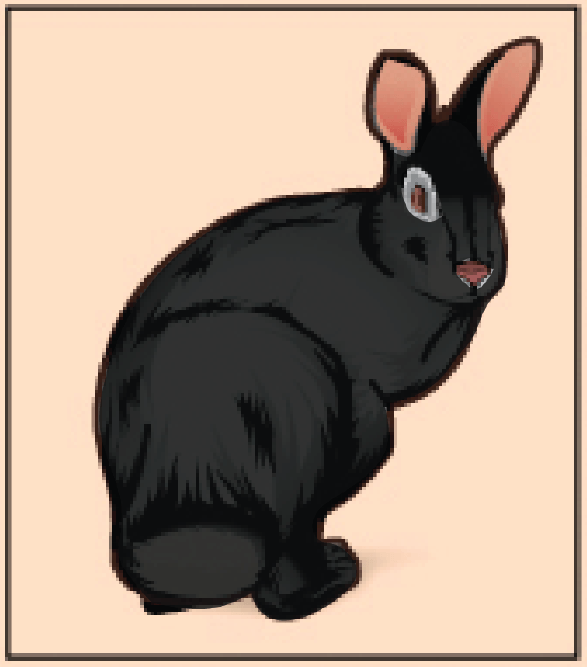
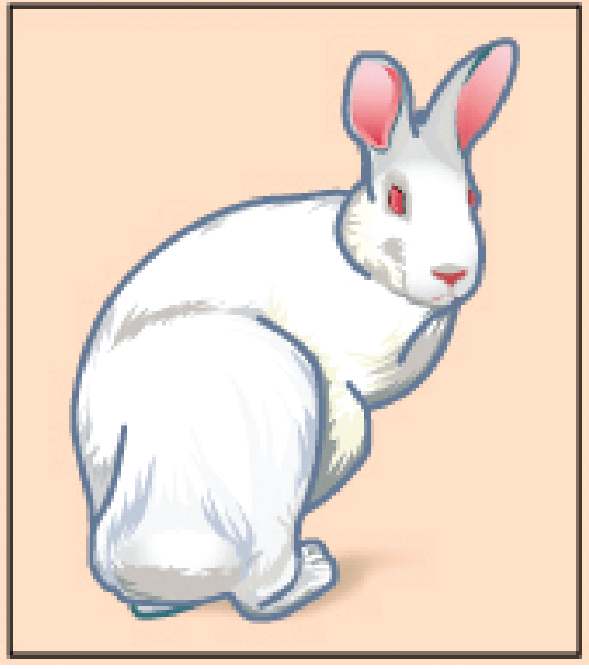
recessive

c)

homozygous

d)

heterozygous

2.

Hair color, height, eye color and freckles are examples of human traits. What do we call the physical expression of the genetic material of an organism?

a)

genetics

b)

heredity

c)

genotype

d)

phenotype

3.

In animals, shaggy fur is dominant to short fur. The Punnett Square shows the genotypes of the offspring of a shaggy fur animal and a short fur animal. What were the genotypes of the parents?

a)

FF and FF

b)

Ff and ff

c)

ff and ff

d)

Ff and Ff

4.

In animals, shaggy fur is dominant to short fur. According to the genotypes shown, what percent of offspring will have short fur?

a)

0

b)

25

c)

50

d)

75

e)

100

5.
In a punnet square where are the parent alleles written?
a)
Top and inside the boxes
b)
Only on the left and right side of the boxes. 
c)
outside of the boxes (top and left side)
d)
All on the top side of the boxes
6.

Heterozygous is when...

a)

the alleles are the same.

b)

the alleles are different.

c)

the alleles are absent.

d)

the alleles are present.

7.

T = tall and t = short

In the punnett square shown, what belongs in the missing square

a)

tt

b)

Tt

c)

Bb

d)

TT

8.

In a heterozygous genotype, the ___________ allele takes over in the phenotype.

a)

recessive

b)

dominant

9.
Which of the following alleles is homozygous (purebred) recessive?
a)
Tt
b)
tt
c)
TT
d)
t
10.
G = green, g = yellow
The genotype for a yellow plant is...
a)
GG
b)
Gg
c)
gg
d)
all of the choices result in yellow
11.

In plants, tall (T) is dominant to short (t). Perform the following cross: Tt x Tt. What is the probability of producing a short plant?

a)

0%

b)

25%

c)

50%

d)

75%

12.

The genotypes AA and Aa always show up as the __________ phenotype.

a)

dominant

b)

recessive

13.
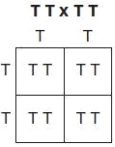
What ratio of the offspring from the cross shown will be homozygous recessive for the trait of tallness? 
a)
0 in 4
b)
1 in 4
c)
2 in 4
d)
4 in 4
14.

Which of the following genotypes is homozygous dominant?

a)

A

b)

Aa

c)

AA

d)

aa

15.

Which of the following genotypes is heterozygous?

a)

Bb

b)

BB

c)

bb

d)

B

16.

A recessive allele is represented by a ______ letter.

a)

lower-case

b)

capital

17.

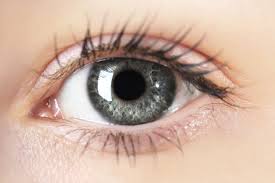
Blue-eyed is a ______.

a)

genotype

b)

phenotype

18.

Bb is a ______.

a)

genotype

b)

phenotype

19.

If a black guinea pig (BB) and a white guinea pig (bb) mate, there is a ______ chance that a white guinea pig will be born.

a)

0%

b)

25%

c)

50%

d)

75%

e)

100%

20.
this image is an example of
a)
codominance
b)
dominance
c)
incomplete dominance
21.
this image is an example of
a)
codominance
b)
dominance
c)
incomplete dominance
22.
A dog gives birth to 5 puppies. What percentage of the chromosomes does each puppy share with the mother?
a)
25%
b)
50%
c)
75%
d)
100%
23.
The study of heredity and the variation of inherited characteristics 
a)
gene
b)
genetics 
c)
meiosis 
d)
hybrid 
24.
W=white hair
w= non-white hair
If you cross a horse with WW and a horse with ww what fraction of the offspring would be expected to have white hair?
a)
none
b)
3/4
c)
1/2
d)
all
25.
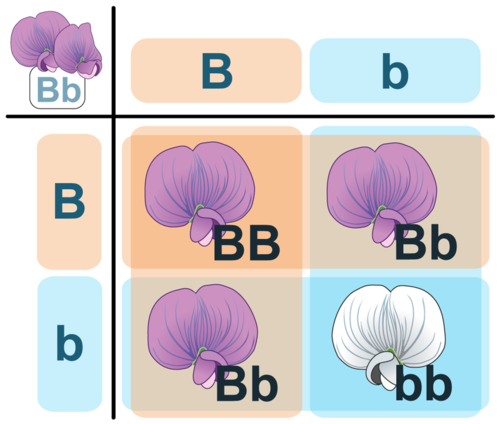
In this punnett square, which is the dominant trait?
The B stands for bud.
a)
purple flower bud
b)
white flower bud
c)
dominant
d)
recessive
26.
One form of a gene is called_______________
a)
a DNA
b)
a Phenotype
c)
a trait
d)
an allele
27.
Which of the following is a phenotype?
a)
Aa
b)
red hair
c)
heterozygous
d)
DNA
28.
How many alleles (letters) does a child get from each parent for each trait?
a)
1
b)
2
c)
3
d)
4
29.
How many alleles (letters) do each person carry for a trait?
a)
1
b)
2
c)
3
d)
4
30.
What you see, or the physical appearance.
a)
Genotype
b)
Phenotype
c)
Homozygous
d)
Heterozygous
31.
In a flowering plant species, red flower color (R) is dominant over white flower color (r). What is the genotype of any red-flowering plant resulting from this species?
a)
rr
b)
R
c)
RR
d)
RR or Rr
32.
Aa, DD, bB, yy are all examples of
a)
genotypes
b)
phenotypes
33.
Which of the following alleles is homozygous (purebred) recessive?
a)
Tt
b)
tt
c)
TT
d)
t
34.
having two different genes for a trait (sometimes called hybrid).
a)
protein
b)
homozygous
c)
heterozygous
d)
genotype
35.
having two of the same genes for the trait (sometimes called purebred).
a)
homozygous
b)
hetrozygous
c)
protein
d)
chromosome
36.
Two brown eyed parents (Bb) have a baby. What is the chance the baby is blue eyed?
a)
0 %
b)
25%
c)
50%
d)
75%
37.
An allele whose trait only shows up when no dominant allele is present.
a)
hidden allele
b)
dominant allele
c)
recessive allele
d)
present allele
38.
Snapdragon flowers come in red, pink and white.  What type of inheritance is this?
a)
Complete Dominance
b)
Incomplete Dominance
c)
Codominance
d)
Polygenic Inheritance
39.
Incomplete dominance means that the traits are
a)
expressed equally
b)
dominant
c)
recessive
d)
blended
40.
If green is dominant over purple, then what is the genotype for this individual?
a)
Purple
b)
Green
c)
GG
d)
gg
41.
What are the nucleotides made of?
a)
Sugar, Phosphate, nitrogen base
b)
Phosphate, Adenine, nitrogen base
c)
Thymine, Adenine, Cytomine
d)
Phosphate, Nitrogen, Adenine
42.
Adenine bonds with ______________.
a)
Guanine
b)
Thymine
c)
Cytosine
d)
Adenine
43.
Guanine bonds with ______________.
a)
Adenine
b)
Guanine
c)
Cytosine
d)
Thymine
44.
Which sequence of DNA bases would pair with this partial strand
ATG TGA CAG
a)
ATG TGA CAG
b)
TAC ACT GTC
c)
GTA AGT GAC
d)
CAT TCA CTG
45.
Which organelle is DNA usually found in?
a)
cell membrane
b)
vacuole
c)
chloroplast
d)
nucleus
46.
Which 2 molecules forms the sides (backbone) of the DNA ladder?
a)
deoxyribose and adenine
b)
deoxyribose and a hydrogen bond
c)
sugar and the nucleus
d)
deoxyribose (sugar) and phosphate
47.
The two strands of nitrogenous bases in DNA are joined by which type of bond?
a)
polar bonds
b)
ionic bonds
c)
covalent bonds
d)
hydrogen bonds
48.

A process in which DNA has the unique ability to make an exact copy of itself.

a)

Replication

b)

Translation

c)

Transcription

d)

Protein Synthesis

49.
Identify #2.
a)
nitrogen base
b)
phosphate group
c)
deoxyribose sugar
d)
nucleotide
50.
What determines the code, or information, of a DNA molecule?
a)
the shape (structure) of the nitrogen bases
b)
the order (sequence) of the nitrogen bases
c)
the color of the nitrogen bases
d)
the frequency (number) of nitrogen bases
51.
The shape of the DNA molecule is a double __________________?
a)
"S"
b)
helix
c)
rope
d)
curve
52.
The enzyme that unzips the DNA to prepare for replication
a)
helicase
b)
replicase
c)
polymerase
d)
synthase
53.
DNA replication results in two DNA molecules,
a)
each one with two original strands
b)
each one with two new strands
c)
each one with one new strand and one original strand
d)
one with two new strands and the other with two original strands
54.
order of replication
a)
3, 2, 1, 4
b)
2, 1, 4, 3
c)
2, 3, 1, 4
d)
3, 4, 1, 2
55.
Based on the diagram, the enzyme (represented in gray) is most likely...
a)
DNA polymerase
b)
DNA Ligase
c)
Nuclease
d)
Helicase
56.
Rosalind Franklin's "photo 51" was critical in helping Watson and Crick to discover what?
a)
The double helix structure of DNA
b)
X-Ray crystalography was a technology worth looking in to. 
c)
That stealing is a great way to get ahead in life
d)
That there could possibly be life on other planets. 
57.
Which of the following best describes a DNA molecule?
a)
double helix
b)
contains ribose
c)
made of amino acids
d)
contains Uracil
58.
Why is DNA important?
a)
it is very small and very complicated
b)
it's in everything
c)
it serves as the blueprint for traits of all living things
d)
because we eat it every day for energy
59.
In a molecule of double-stranded DNA, the amount of Adenine present is always equal to the amount of
a)
cytosine
b)
guanine
c)
thymine
d)
uracil
60.
What sugar is in DNA?
a)
deoxyribose
b)
ribose
c)
oxyribose
d)
deoxyose
61.
Replicate the following strand of DNA: 
AATCATGGA
a)
AATCATGGA
b)
TTAGTACCT
c)
UUAGUACCU
d)
GGATAUCUA
62.
Who was given credit for determining the shape of DNA? 
a)
Avery
b)
Watson and Darwin
c)
Watson and Crick
d)
Franklin and Crick
63.

Which of the following are the bases for RNA?

a)

adenine, uracil, thymine, and guanine

b)

adenine, uracil, guanine, and cytosine

c)

adenine, thymine, guanine, and cytosine

d)

adenine, uracil, thymine, and cytosine

64.

Which of the following is a type of RNA?

a)

mRNA

b)

tRNA

c)

rRNA

d)

All of these are types of RNA

65.

Which statement is true about RNA?

a)

RNA is usually single stranded and contains the base uracil

b)

RNA is usually double stranded and contains the base thymine

c)

RNA is made in the nucleus and stays there to carry out its function

d)

All of the above are true.

66.

True or False: RNA uses deoxyribose sugar.

a)

True

b)

False

67.

True or False: Transcription is the process by which the information in a strand of DNA is copied into a messenger RNA (mRNA).

a)

True

b)

False

68.

Transcribe the following DNA strand:

ATAGC

(a)  

69.

Transcribe the following DNA strand:

ACT GTA CCA

(a)  

70.

RNA and DNA have different structures. Which of the following statements are correct?

a)

RNA is double stranded and DNA is single stranded.

b)

RNA and DNA are both single stranded.

c)

RNA is single stranded and DNA is double stranded.

d)

RNA and DNA are both double stranded.

71.

RNA and DNA are composed of different sugars. Which of the following statements are true?

a)

RNA uses ribose and DNA uses deoxyribose.

b)

RNA uses deoxyribose and DNA uses ribose.

c)

DNA and RNA both use ribose sugars.

d)

DNA and RNA both use deoxyribose sugars.

72.

What does RNA stand for?

a)

Ribonucleic acid

b)

Ricenucleic acid

c)

Ribouncenucleic acid

d)

Rinucleic acid

73.

DNA contains the template to make RNA

a)

True

b)

False

74.

RNA is double-stranded.

a)

true

b)

false

c)

it depends on the type

75.

What is the process that makes a complementary mRNA strand from a DNA strand?

a)

protein synthesis

b)

transcription

c)

translation

d)

DNA Polymerase

76.
Where does transcription take place?
a)
nucleus
b)
cytoplasm
c)
ribosome
77.
What is occurring in this picture?
a)
Translation
b)
Replication
c)
Translocation
d)
Transcription
78.
What does mRNA do?
a)
provides information from DNA to ribosomes
b)
transfers amino acids to the ribosomes
c)
makes up ribosomes
d)
builds proteins
79.

Using this DNA sequence AAA TTT, what is the complementary RNA sequence will be

a)

UUU AAA

b)

AAA UUU

80.

Using this DNA sequence ATA CGA GGA TTT, what is the complementary RNA sequence will be

a)

UAU GCU CCU AAA

b)

UAU GCU CCU TTT

c)

TAT GCT CCT AAA

d)

TAT GCT CCT TTT

81.
Which phrase best describes translation?
a)
converts mRNA into a polypeptide
b)
catalyzes bonds between amino acids
c)
produces RNA from DNA molecules
d)
recycles tRNA molecules for reuse
82.

After transcription mRNA goes from the nucleus to the _________.

a)

Ribosome

b)

Mitochondria

c)

Endoplasmic Reticulum

d)

Vacuoles

83.

The first step of protein synthesis is.....

a)

replication

b)

mitosis

c)

translation

d)

transcription

84.
What type of RNA travels outside the nucleus?
a)
transfer
b)
messenger
c)
ribosomal
d)
nuclear
85.

The actual decoding of mRNA to a protein is called ?

a)

translation

b)

replication

c)

transcription

d)

nuclear fission

86.
The building blocks of proteins are?
a)
carbs
b)
sugars
c)
lipids
d)
amino acids
87.
The three letter code is called a?
a)
script
b)
codon
c)
tri code
d)
gene
88.

What organelle does the mRNA attach to in order to make the protein?

a)

ribosome

b)

mitochondria

c)

chloroplast

d)

lysosome

89.

What best explains the interaction between tRNA and mRNA during translation?

a)

anticodons on the mRNA line up with complementary codons on the tRNA

b)

anticodons on the tRNA line up with complementary codons on the mRNA

c)

tRNA attach amino acids to the complementary mRNA sequence

d)

mRNA attach amino acids to the complementary tRNA sequence
90.

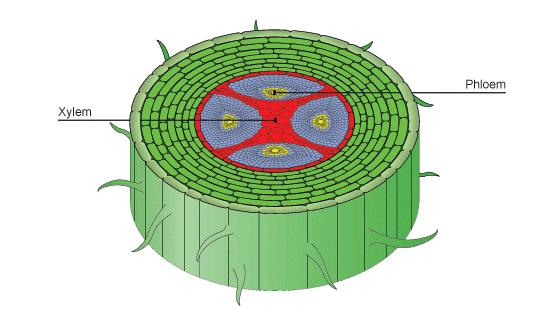
Specific type of plant tissue that transports water and minerals from the roots, through the stems, to leaves

a)

vascular plant

b)

nonvascular plant

c)

xylem

d)

phloem

91.

Specific type of plant tissue that transports food (sugar) made in the leaves to the entire plant

a)

vascular plant

b)

nonvascular plant

c)

xylem

d)

phloem

92.

The process by which plants make food

a)

Photosynthesis

b)

phototropism

c)

embryo

d)

seeds

93.

Examples of these plants include mosses, liverworts, and other plants with no xylem or phloem

a)

dicot

b)

vascular plant

c)

monocot

d)

nonvascular plant

94.

This is what almost all non-flowering plants reproduce from (except cone bearing plants)

a)

spores

b)

seeds

c)

monocots

d)

dicot

95.

A type of plant with a seed that has one food storage area

a)

monocot

b)

dicot

c)

vascular

d)

nonvascular

96.

A type of plant with a seed that has two food storage areas

a)

monocot

b)

dicot

c)

vascular

d)

nonvascular

97.

Other than transporting water, what is a function of xylem?

a)

making food

b)

transporting food

c)

helping support the plant

d)

catching light

98.

These classifications of flowering plants have leaves with veins that are parallel to each other.

a)

Monocot Plants

b)

Dicot Plants

c)

Nonvascular Plants

d)

Spore Producing Plants

99.

These classifications of flowering plants produce flowers with 4 or 5 petals.

a)

Monocot Plants

b)

Dicot Plants

100.

Which of the following plants are considered nonvascular plants?

a)

Monocot Plants

b)

Dicot Plants

c)

Ferns

d)

Moss

101.

What structure on a conifer or evergreen plant produces seeds?

a. Flowers b. Cones c. Spores d. Pine Needles

a)

Flowers

b)

Cones

c)

Spores

d)

Pine Needles

102.

Which of the following is NOT a characteristic of a dicot?

a)

Two cotyledons

b)

Vascular tissue bundles arranged in a ring

c)

Floral parts often in multiples of three

d)

One main root

103.

True or False: All flowering plants are gymnosperms.

a)

True

b)

False

104.

Which statement best describes a gymnosperm?

a)

A nonvascular plant with roots, stems, and leaves.

b)

A low-growing nonvascular plant lacking true roots.

c)

A vascular plant that uses spores to reproduce.

d)

A vascular plant that uses pollen to produce seeds that are not enclosed in protective fruits.

105.

Which type of plant has seeds that are encased in a protective fruit?

a)

Gymnosperms

b)

Conifers

c)

Angiosperms

d)

Horsetails

106.

This organism is NOT part of the plant kingdom because it CANNOT make it's own food!

a)

oak tree

b)

fungi

c)

moss

d)

bacteria

107.
Stomata
a)
openings that allow only carbon dioxide to enter the leaf.
b)
openings in leaves that allows carbon- dioxide to enter. Also allows oxygen and water to exit
c)
openings in the leaf that allow oxygen and water to exit.
108.

Vascular plants

a)

produce seeds

b)

are seedless

c)

are leafless

109.
Xylem is 
a)
another name for roots
b)
is a vascular tissue that carries water and minerals from the root up to the plants.
c)
carries food from the leaves to the root.
110.
phloem is 
a)
a vascular tissue that carries water and nutrients from the roots up to the stem and leaves.
b)
a vascular tissue that carries food from leaves to the the roots.
c)
another name for leaf.
111.
The function of a root is to
a)
make food.
b)
supply the leaf with chlorophyll.
c)
anchor a plant in the ground and absorb water and minerals from the soil.
112.
Function of a stem is 
a)
make the plant or tree look tall and wavy.
b)
another name for bark.
c)
is to provide the means by which water, minerals and food is exchanged between the roots and leaves of the plant.
113.
Function of a stem is to 
a)
is to give color to the leaf
b)
make chlorophyll.
c)
they have the same function as the root.
d)
hold the leaves of a plant up in the air, thus enabling the leaves to receive sunlight and make food.
114.
what is the most important function of a leaf?
a)
they capture sun's energy to make food.
b)
they protect the tree from predators
c)
they make food using oxygen.
115.
In photosynthesis, the sun's light energy is captured by 
a)
roots
b)
stems
c)
fruits
d)
chlorophyll in leaves
116.
In photosynthesis
a)
the light energy combines with carbondioxide and water to make glucose.
b)
the light energy combines with oxygen and water to make food.
c)
light energy combines with both carbon dioxide and oxygen to make food.
117.
They byproducts of photosynthesis  are 
a)
carbon dioxide and water.
b)
carbon dioxide and oxygen
c)
oxygen and glucose
118.
The outermost layer of the leaf is called
a)
Veins
b)
Stomata
c)
Epidermis
119.
Charles Darwin’s observation that finches of different species on the Galápagos Islands have many similar physical characteristics supports the hypothesis that these finches 
 
a)
have the ability to interbreed.
b)
acquired traits through use and disuse.
c)
all eat the same type of food.
d)
descended from a common ancestor.
120.
Darwin theorized that individuals having an advantage due to their traits or abilities will be more likely to survive and reproduce.  This theory is known as
a)
evolution
b)
speciation
c)
adaptation
d)
natural selection
121.
What is survival of the fittest?
a)
It is where the fittest die out and therefore reproduce and pass on their genes
b)
It is where the fittest die out and therefore can't reproduce and pass on their genes
c)
It is where the fittest don't die out and therefore can't reproduce and pass on their genes
d)
It is where the fittest don't die out and therefore reproduce and pass on their genes
122.
Which of the following ideas is supported by Darwin’s observation of local variation among tortoises in the Galápagos Islands? 
a)
artificial selection
b)
adaptation
c)
acquired characteristics
d)
tendency towards perfection
123.
Darwin wrote that organisms with traits that are best suited to the environment will ________________
a)
increase in number
b)
become extinct
124.
What characteristic did Darwin observe about the finches on the Galapagos Islands?
a)
Their feathers 
b)
Genotypes 
c)
Their beaks
d)
Their body sizes
125.
The white feathers of a snowy owl allow it to blend in with its environment during the winter months (snow). This is an example of ________________
a)
Species
b)
Environmental Change
c)
Adaptation
d)
Variation
126.
Darwin referred to this as survival of the fittest. Over time, it results in changes in the inherited characteristics of a population because organisms with adaptations that make them fit for their environment will survive and reproduce better than those without favorable traits.
a)
Natural Selection
b)
Genetic Variation
c)
Survival of the Fittest
127.
Genetic differences between organisms of the same species
a)
Variation
b)
Adaptation
c)
Behavior
d)
Environment
128.
According to the theory of natural selection, why are some individuals more likely than others to survive and reproduce? 
a)
Some individuals pass on to their offspring new characteristics they have acquired during their lifetimes. 
b)
Some individuals are better adapted to exist in their environment than others are. 
c)
Some individuals do not pass on to their offspring new characteristics they have acquired during their lifetimes. 
d)
Some individuals tend to produce fewer offspring than others in the same environment. 
129.
Base your answer(s) to the following question(s) on the information below and on your knowledge of biology. The diagram below represents the relationship between beak structure and food in several species of finches in the Galapagos Islands. 
Which factor most directly influenced the evolution of the diverse types of beaks of these finches? 
a)
predation by humans 
b)
available food sources 
c)
oceanic storms 
d)
lack of available niches 
130.

Who developed the theory of evolution?

a)

Charles Darwin

b)

Mike Tyson

c)

George Washington

d)

Patton Manning

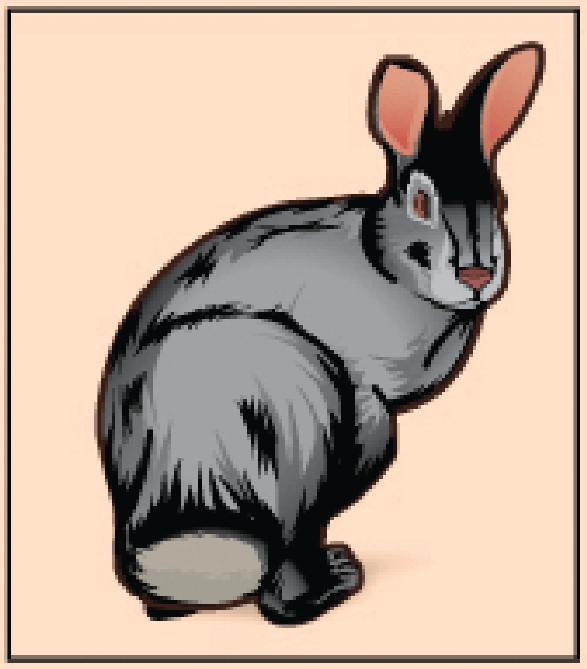
131.

Which of these will be more successful in a cold region with NO snow? (think about the color that will be warmer)

a)
b)
c)
d)
132.
Which of the following is a factor in natural selection?
a)
Individuals of species compete with one another to survive.
b)
All species are genetically diverse.
c)
Individuals better able to adapt to changes leave more offspring.
d)
All are correct 
133.
Starting in 1954, commercial fishers in the northwest Pacific were paid by weight, rather than by the individual fish, for pink salmon. The fishers increased the use of a type of net that selectively catches larger fish.  Which of the following effects did this change in fishing technique most likely have on the salmon population over the next 20 years?
a)
The average body size of the salmon population decreased significantly.
b)
The average body size of the salmon population increased significantly.
c)
The average body size of the males in the salmon population increased, and the females stayed the same.
134.

Colorblindness is a recessive X-linked disorder.

Which genotype represents a male with normal vision?

a)

XN YN

b)

Xn Yn

c)

XN Y

d)

Xn Y

135.
Which of the following genotypes belongs in the red box in the Punnett square?
a)
XBXb
b)
XbXb
c)
XbY
d)
XBY
136.
Different variations of a gene are called?
a)
Alleles
b)
DNA
c)
Chromosome
d)
Gene
137.

What would the genotype be of a colorblind male?

a)

XNY

b)

XNYn

c)

XnY

d)

XnYn

138.

The blending of two traits in which one is not completely dominant over the other is known as ---

a)

incomplete dominance

b)

codominance

139.

The green fish offspring in this image is an example of ---

a)

Incomplete dominance

b)

Codominance

140.

A calico cat shows both the traits for orange fur and black fur. What kind of allele expression is this?

a)

Incomplete dominance

b)

Codominance

141.

Incomplete dominance occurs in cats, which allows them to be Black, White, or gray as shown on this Punnett square. What percentage of the offspring will be black?

a)

25

b)

50

c)

75

d)

100

142.
What does a filled in square represent?
a)
Not affected Female
b)
Not affected Male
c)
Affected Male
d)
Affected Female
143.
How many generations are shown in this pedigree?
a)
1
b)
2
c)
3
d)
4
144.
How many kids did the mother and father from the first generation have?
a)
2
b)
4
c)
5
d)
6
145.
What do half colored symbols represent?
a)
The individual is a carrier (heterozygous).
b)
The individual expresses the trait.
c)
The individual has both recessive alleles.
d)
The individual has both dominant alleles.
146.
What does an open circle represent?
a)
Not Affected Male
b)
Not Affected Female
c)
Affected Male
d)
Affected Female
147.
In the second generation-how many people are carriers of the trait?
a)
2
b)
3
c)
5
d)
6
148.
How many people in this whole pedigree have the trait/disease?
a)
2
b)
3
c)
4
d)
6
149.
How many females are in this pedigree?
a)
3
b)
4
c)
6
d)
7
150.
What is this?
a)
Pedigree
b)
Karyotype
c)
Venn diagram
d)
Punnett Square
151.
How many affected females are deceased? 
a)
0
b)
2
c)
4
d)
All 
152.
Which generation connects these two pedigrees? 
a)
1
b)
2
c)
3
153.
A carrier is represented by what symbol? 
a)
Clear 
b)
Shaded 
c)
Half Shaded
d)
1:4 ratio 
154.
Offsprings are represented by....
a)
Horizontal Line 
b)
Vertical Line 
155.
What does a horizontal line between a square and a circle mean?
a)
They are siblings
b)
They are cousins
c)
They are married ("together")
d)
They are the children
156.
If a trait SKIPS a generation, it is an indication that the trait is....
a)
dominant
b)
recessive
c)
incompletely dominant
d)
co-dominant
157.

Objective #13

This is a pedigree that follows blue eyes which is a recessive trait. What is the phenotype of the mother (circle) in generation 1?

a)

Brown

b)

Blue

c)

1 blue, 1 brown

158.

Objective #13

On a pedigree how do we know if they have the trait?

a)

Not shaded

b)

Shaded

159.
·  Copying and carrying the genetic code is the responsibility of which molecule?
a)
RNA
b)
Glucose
c)
Oxygen
160.
The base Uracil is only found in which molecule?
a)
DNA
b)
RNA
c)
Carbohydrates
161.
DNA never leaves the nucleus
a)
True
b)
False
162.
Proteins are made of which molecule?
a)
Amino Acids
b)
Lipids
c)
Carbohydrates
163.

The "female" reproductive structure of flowers is called...

a)

Filament

b)

Anther

c)

Pistil

d)

Stamen

164.

This structure is sticky and helps catch pollen grains!

a)

Stigma

b)

Style

c)

Stamen

d)

Ovary

165.

Protects the reproductive structures of the flower and also attracts pollinators.

a)

Peduncle

b)

Receptacle

c)

Sepals

d)

Petals

166.

Located at the top of the filament and creates pollen grains.

a)

Pistil

b)

Stamen

c)

Anther

d)

Filament

167.

The "male" reproductive structure on flowers is called...

a)

Style

b)

Ovule

c)

Pistil

d)

Stamen

168.

The first leaves to develop that protect the flower and support the flower.

a)

Sepal

b)

Petal

c)

Receptacle

d)

Peduncle

169.

Part of the female structure of the flower that holds the ovules and swells with glucose when the flower is pollinated.

a)

Pistil

b)

Ovary

c)

Style

d)

Stigma

170.

The structure that carries pollen from the stigma to the ovary and contains the pollen tube.

a)

Stigma

b)

Stamen

c)

Pistil

d)

Style

171.

Part of the male structure that holds the anther up.

a)

Stamen

b)

Pistil

c)

Style

d)

Filament