
 Worksheets
SAT Revision
Total questions: 155
Worksheet time: 4hrs 2mins
Natural frequency is best described as
the frequency at which an object naturally vibrates at when it is disturbed
a vibration that can be heard in the wild
the radio frequency that astronauts naturally use when travelling into space
the material used to make a swing
True or false? Every object has a natural frequency.
True
False
Resonance occurs when
energy is transferred between 2 objects vibrating at different frequencies
energy is transferred between 2 objects vibrating at the same natural frequency
energy is transferred between 2 objects via heat
energy is transferred between 2 objects via gravity
Resonance occurs when
energy is transferred between 2 objects vibrating at different frequencies
energy is transferred between 2 objects vibrating at the same natural frequency
energy is transferred between 2 objects via heat
energy is transferred between 2 objects via gravity
A sympathetic vibration occurs when
an object reacts to a certain level of heat
an object reacts to a vibration with its natural frequency
an object reacts to a loud sound
an object reacts to a quiet sound
How can resonance break an object?
forcing an object to vibrate at its natural frequency for a short time
forcing an object to vibrate at different frequencies for a short time
forcing an object to vibrate at different frequencies for a longtime
forcing an object to vibrate at its natural frequency for a long time
If you are a supervillain, which of the following statements is true?
We want bridges to resonate at their natural frequency to remain functional.
We want bridges to resonate at their natural frequency to collapse.
We do not want bridges to resonate at their natural frequency to remain functional.
We do not want bridges to resonate at their natural frequency to collapse.
Natural frequency is best described as
the frequency at which an object naturally vibrates at when it is disturbed
a vibration that can be heard in the wild
the radio frequency that astronauts naturally use when travelling into space
the material used to make a swing
True or false? Every object has a natural frequency.
True
False
Resonance occurs when
energy is transferred between 2 objects vibrating at different frequencies
energy is transferred between 2 objects vibrating at the same natural frequency
energy is transferred between 2 objects via heat
energy is transferred between 2 objects via gravity
A sympathetic vibration occurs when
an object reacts to a certain level of heat
an object reacts to a vibration with its natural frequency
an object reacts to a loud sound
an object reacts to a quiet sound
How can resonance break an object?
forcing an object to vibrate at its natural frequency for a short time
forcing an object to vibrate at different frequencies for a short time
forcing an object to vibrate at different frequencies for a longtime
forcing an object to vibrate at its natural frequency for a long time
If you are a supervillain, which of the following statements is true?
We want bridges to resonate at their natural frequency to remain functional.
We want bridges to resonate at their natural frequency to collapse.
We do not want bridges to resonate at their natural frequency to remain functional.
We do not want bridges to resonate at their natural frequency to collapse.
Waves transfer
energy only
matter only
energy and matter
nothing
The motion of the listener or the source of sound causes
resonance
shock waves
echoes
the Doppler Effect
The frequency of sound waves determine
quality
type of interference
pitch
loudness

Bats use ________ to locate mosquitoes in the air.
solar
ecology
echolocation
refraction
Select the correct order of waves on the EMS from low to high energy
Radio, Micro, Infra, Visible, Ultra, X-ray, Gamma
Gamma, X-ray, Ultra, Vis, Infra, Micro, Radio
Vis, Micro, Infra, Ultra, X-ray, Gamma, Radio
Micro, Radio, Vis, Infra, Ultra, X-ray, Gamma
Which has the LONGEST wavelength and, therefore, the LOWEST frequency/energy
Gamma Rays
Ultraviolet
Visible Light
Infrared rays
Which of the following electromagnetic waves has the lowest frequency?
gamma ray
infrared wave
visible light wave
microwave

The _______________ determines the color of visible light.
wavelength (and frequency)
speed
amplitude
particles of the medium

Put the visible light colors in order from SHORTEST wavelength (highest frequency) to longest wavelength (lowest frequency)
Violet, Indigo, Blue, Green, Orange, Yellow, Red
Red, Yellow, Green, Orange, Violet, Blue, Indigo
Red, Orange, Yellow, Green, Blue, Indigo, Violet

All electromagnetic waves are...
transverse waves and have the same frequency
transverse waves and have the same speed
mechanical waves and have the same wavelength
longitudinal waves and have the same energy
What is different about the speed of sound waves vs. the speed of light?
sound waves are the FASTEST in solids (high density), while light waves are the FASTEST in gas (or no molecules)
sound waves are the FASTEST in gas (low density), while light waves are the FASTEST in solids
Both have the same speed all the time
Both are the FASTEST in the air or gas (low density)
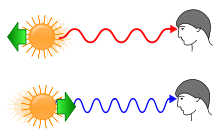
ex. police car siren sounding lower pitch after the car passes

The pitch of a sound wave relates to the wave's _________________.
Amplitude
Frequency
Wavelength
Period
What is the Doppler Effect?
A change in frequency due to the relative motion of a wave source and an observer
When a wave overlaps with another wave
When a wave bounces off of another object
When a wave bends due to traveling through a different medium
An ambulance is driving towards you as you stand on the sidewalk. What happens to the pitch of the siren as it comes towards you?
It increases
It decreases
You are driving in a car and honk the horn at a person standing in the street. As you approach the person, what happens to the pitch of the horn according to you in the car?
It increases
It decreases
It stays the same because you are in the car moving with the sound.
You are standing on the side of the road when a police car races past you with its siren on. After the police car passes you, what happens to the pitch of the siren?
It increases
It decreases
It turns red
An astronomer looks at a star in the night sky. Based on his calculations the star's light is shifting towards the color blue. What does this mean about the star?
It's moving towards the astronomer
It's moving away from the astronomer
It's not moving at all
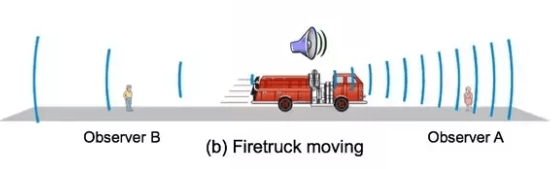
Look at the picture. Who is experiencing a lower pitched sound?
Observer A
Observer B
There is no difference
Look at the picture. Who is experiencing a lower pitched sound?
Observer A
Observer B
There is no difference


when the frequency is higher what happens to the wavelength?
the wavelength gets longer
The wavelength gets shorter
the wavelength doesn't change
I have no idea
A filament lamp is a source of unpolarised light.
A polarising filter is placed between a filament lamp and an observer. The filter is rotated in the plane perpendicular to the direction of travel of the light.
Which of the following is observed as the filter is rotated through an angle of 90°?
The light intensity changes from maximum to minimum.
The light intensity changes from minimum to maximum.
The light intensity does not change.
The light intensity is zero throughout the rotation.
Which of the following describes the oscillations in polarised waves?
in a single plane which is perpendicular to the direction of wave travel
in many planes, which include the direction of wave trave
in many directions and parallel to the direction of wave travel
in one direction and perpendicular to the direction of wave travel
Which of the following statements about waves is correct?
Both longitudinal and transverse waves can be polarised.
Neither longitudinal nor transverse waves can be polarised.
Only longitudinal waves can be polarised.
Only transverse waves can be polarised.
In plane polarised light, the oscillations of the electric field are
in a single plane, which includes the direction of energy transfer.
in a single plane, which is perpendicular to the direction of energy transfer.
in perpendicular planes, which are perpendicular to the direction of energy transfer.
in perpendicular planes, which include the direction of energy transfer.
Which of the following types of wave cannot be plane polarised?
light
microwaves
ultrasound
ultraviolet
Which of the following properties could not be demonstrated using sound waves?
diffraction
polarisation
reflection
refraction
Which of the following phenomena provides evidence that light waves are transverse?
diffraction
interference
polarisation
refraction
A Polarizing filter is used to reduce glare on reflective surfaces including glass, windows, and water.
True
False
A Polarizing filter is used to reduce glare on reflective surfaces including glass, windows, and water.
True
False
A polarizer is used to:
reduce intensity of light
produce polarized light
increase intensity of light
produce unpolarized light
light waves can be polarized as they are:
transverse
of high frequency
longitudinal
reflected
Polarization of light can be done by:
Reflection
Filtering
Both of the above


When light waves move from passing through air to passing through a glass lens when happens to them?
They slow down and change direction
They speed up and change direction
They maintain the same speed and change direction
They maintain their same speed and direction

A concave lens has an inward curved shape. It refracts light outward from the lens. They light rays spread apart as they exit the lens. Which represents a concave lens?
A
B
A and B
neither A or B
What type of lens do you have in your eye?
Concave
Prismatic
Objective
Convex
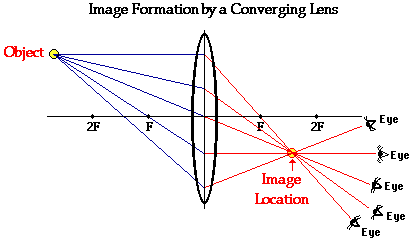


Type of mirror used by a dentist to get magnified view of a patient's teeth...
Plane
Convex
Concave

Type of mirror found in a bathroom...
Plane
Convex
Concave

Type of mirror used as a side mirror on a vehicle to provide a wide angle view...
Plane
Convex
Concave

Type of mirror that can produce a real image...
Plane
Convex
Concave

Type of mirror that can produce an inverted image...
Plane
Convex
Concave

Type of mirror that provides a wide angle view...
Plane
Convex
Concave

The size of an object and its image are the same in this type of mirror...
Plane
Convex
Concave

According to the law of reflection the angle of incidence is ____________ the angle of reflection.
less than
greater than
equal to
Type of mirror that can produce a virtual image...
Plane
Convex
Concave
All of the above
What is the ray of light that strikes the surface ?
Incident ray
reflected ray
normal ray
normal
A flat mirror is an example of a ___.
plane mirror
concave mirror
convex mirror
spherical mirror

Photoelectric effect provides the evidence for the ______ nature of radiation.
dual
wave
particle
electromagnetic
In the equation for a wave, "v" stand for
Velocity
Frequency
Wavelength
Speed of Light

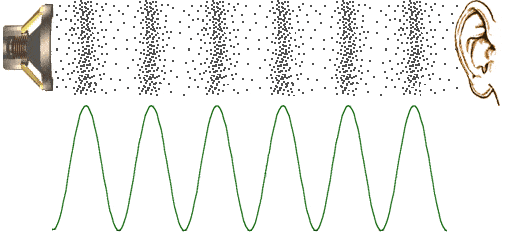
It is the high pressure part of the wave where the particles are close together. It is part A on this picture.
Compression
Amplituide
Rarefaction
Wavelength
High pitched waves would have wavelengths that are...
at a rarefaction
far apart
close together
at the trough
Compression
An increase in density caused by external
pressure
A wave that is moving in the same direction as the
displacement of the transmitting medium
A continuum of all electromagnetic waves
arranged according to frequency and wavelength
Oscillations of electromagnetic fields that carry
energy through a medium or through a vacuum
Compression or
Longitudinal Wave
A wave that is moving in the same direction as the
displacement of the transmitting medium
A continuum of all electromagnetic waves
arranged according to frequency and wavelength
Oscillations of electromagnetic fields that carry
energy through a medium or through a vacuum
A wave that propagates as an oscillation of matter
and therefore transfers energy through a medium
Electromagnetic Spectrum
A continuum of all electromagnetic waves
arranged according to frequency and wavelength
Oscillations of electromagnetic fields that carry
energy through a medium or through a vacuum
A wave that propagates as an oscillation of matter
and therefore transfers energy through a medium
The less dense, more spread out regions of
longitudinal waves
Electromagnetic Waves
Oscillations of electromagnetic fields that carry
energy through a medium or through a vacuum
A wave that propagates as an oscillation of matter
and therefore transfers energy through a medium
The less dense, more spread out regions of
longitudinal waves
A wave that is propagated in a direction
perpendicular to the displacement of the
transmitting field or medium
Mechanical Wave
A wave that propagates as an oscillation of matter
and therefore transfers energy through a medium
The less dense, more spread out regions of
longitudinal waves
A wave that is propagated in a direction
perpendicular to the displacement of the
transmitting field or medium
An increase in density caused by external
pressure
Transverse Wave
A wave that is propagated in a direction
perpendicular to the displacement of the
transmitting field or medium
A wave that propagates as an oscillation of matter
and therefore transfers energy through a medium
Oscillations of electromagnetic fields that carry
energy through a medium or through a vacuum
A continuum of all electromagnetic waves
arranged according to frequency and wavelength
Rarefaction
The less dense, more spread out regions of
longitudinal waves
A wave that is propagated in a direction
perpendicular to the displacement of the
transmitting field or medium
An increase in density caused by external
pressure
A wave that is moving in the same direction as the
displacement of the transmitting medium
Compression or
Longitudinal Wave
A wave that is moving in the same direction as the
displacement of the transmitting medium
A continuum of all electromagnetic waves
arranged according to frequency and wavelength
Oscillations of electromagnetic fields that carry
energy through a medium or through a vacuum
A wave that propagates as an oscillation of matter
and therefore transfers energy through a medium
Compression or
Longitudinal Wave
A wave that is moving in the same direction as the
displacement of the transmitting medium
A continuum of all electromagnetic waves
arranged according to frequency and wavelength
Oscillations of electromagnetic fields that carry
energy through a medium or through a vacuum
A wave that propagates as an oscillation of matter
and therefore transfers energy through a medium
Mechanical Wave
A wave that propagates as an oscillation of matter
and therefore transfers energy through a medium
The less dense, more spread out regions of
longitudinal waves
A wave that is propagated in a direction
perpendicular to the displacement of the
transmitting field or medium
An increase in density caused by external
pressure
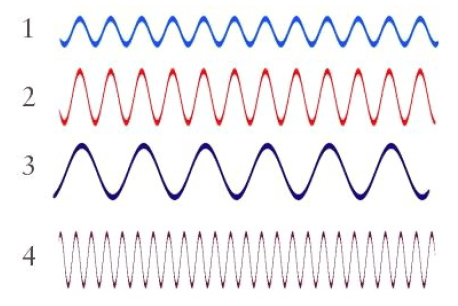
A guitar string vibrates with a frequency of 320 hz. If the wavelength of the vibration is 0.23 meters what is the speed of the wave?
320.23 m/s
1391.3 hz
73.6 m/hz
73.6 m/s

Wavelength= .5m
Frequency= 150 hertz
Wavelength= 2.0m
Frequency= _________
Sound is an example of what type of wave?
Transverse
Longitudinal

The speed of a wave is 74m/s. If the wavelength is 12m, what is the frequency?
6.2 Hz
16.2 Hz
888 Hz
0.16 Hz

The frequency of a wave is 3.3 Hz. If the wavelength is 7.4 m, how fast is the wave moving?
2.24 m/s
24.4 m/s
0.45 m/s
0.24 m/s

What are the spaced out sections of this wave called?
Reflections
Rarefactions
Wavelength
Compressions
The lowest part of the wave is called the ?
Frequency
Amplitude
crest
trough
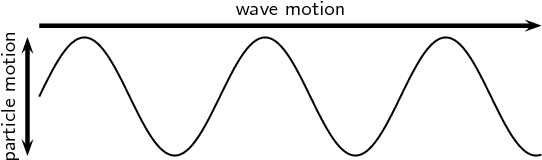
The particles of the medium move perpendicular to the direction of a _____________ wave.
Transervse
Longitudinal
Electromagnetic

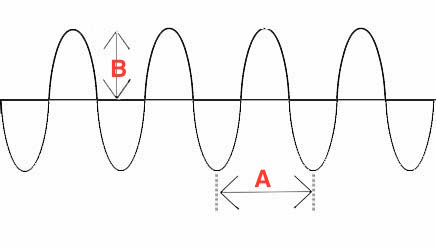
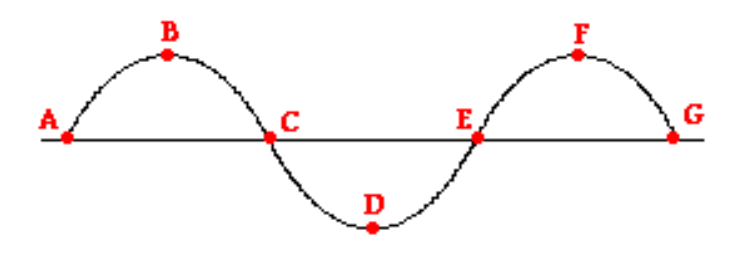
What is shown at A?
Amplitude
Wavelength
Frequency

Sound is an example of which type of wave?
Transverse
Longitudinal
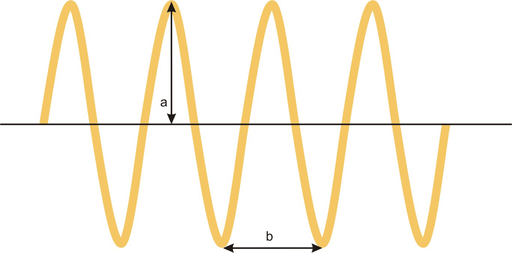
The distance from one crest to another is called the
Amplitude
Frequency
Wavelength
The wave equation is
V = f x wavelength
V = 1/ wavelength
V = f x T
Frequency is
The number of seconds per wave
The number of waves per second
The distance travelled by the wave
Amplitude is a measure of
Time
Distance
Speed
Frequency
Frequency is measured in
Seconds
Metres
metres per second
Hertz
T is
Wavelength
Amplitude
Speed
Period
Which is correct
T = 1 x f
T = f
T = 1/ f
T = f / 1

