Wayground logo

Free Printable Worksheets

Font size

S
M
L
XL
Worksheets

STAAR Biology Reporting Category 5

Total questions: 20

Worksheet time: 14mins

Name
Class
Date
1.
A living relationship between two species in which one organism is harmed is called...
a)
mutualism
b)
commensalism
c)
parasitism
d)
niche
2.
According to the food web, which of these supply energy for all the other organisms?     
a)
snakes
b)
insects
c)
grasses
d)
cougars
3.
Striped fish are affected by abiotic and biotic factors in the environment.  Which of these factors is biotic?
a)
water temperature
b)
mineral nutrients
c)
algae
d)
sediment
4.
A pond ecosystem is shown in the diagram below. Which statement describes an interaction that helps maintain the dynamic equilibrium of this ecosystem?
Which statement describes an interaction that helps maintain the dynamic equilibrium of this ecosystem?
a)
The frogs make energy available to this ecosystem through the process of photosynthesis.
b)
The algae directly provide food for both the rotifers and the catfish.
c)
The green-backed heron provides energy for the mosquito larvae.
d)
The catfish population helps control the populations of water boatman and waterfleas.
5.
Refer to the illustration above. Level “A” is composed of
a)
secondary consumers
b)
primary consumers
c)
producers
d)
predators
6.
The diagram represents a food chain. The arrows in the diagram indicate the  
a)

return of chemical substances to the
environment
b)
order of importance of the various organisms.  
c)
direction of energy flow through a series of organisms
d)
direction in which organisms move in the environment. 
7.
Deforestation by burning has been described as a "double whammy" to the environment, meaning it has 2 negative impacts. Why is this description accurate? 
a)
Forest burning releases CO2 while decreasing oxygen, which disrupts cycles
b)
Deforestation reduces the amount of oxygen in the atmosphere, which depletes the ozone layer
c)
Forest clearing is often followed by land development, which often leads to increased noise pollution
d)
Deforestation increases the number of plant and animal species by destroying habitat
8.
The amount of energy that usually transfers from one trophic level to the next...
a)
10%
b)
20%
c)
80%
d)
50%
9.
largest number of individuals of a population that the environment can support  
a)
carrying capacity
b)
primary succession 
c)
denitrification
d)
mutualism
10.
The number of species within a specific habitat.
a)
Conservation
b)
Sustainable development
c)
Biodiversity
d)
Preservation
11.
Grass>>>>>mouse>>>>>cat>>>>>coyote.  The coyote is a
a)
primary consumer
b)
producer
c)
second level consumer
d)
tertiary consumer
12.
All energy originates from ?
a)
food
b)
the sun
c)
mitochondria
d)
consumers
13.

Which will most likely cause an increase in the frequency of genetic mutations in humans?

a)

increased exposure to mold spores in the air

b)

increased exposure to the rising levels of atmospheric CO2

c)

increased exposure to bacteria in drinking water

d)

increased exposure to X-rays

14.

Line B in the graph represents the reaction with an enzyme added to the substrates.


How did the enzyme affect the reaction?

a)

Increased the activation energy

b)

Increase the energy change

c)

Lowered the energy change

d)

Lowered the activation energy

15.
Which of the following would be the most likely effect, if there were a sudden increase in the cricket population?
a)
There would be a decrease in the small bird population.
b)
There would be a decrease in the grass/flowers population.
c)
There would be a decrease in the mice population.
d)
There would be an increase in the grass/flowers population.
16.
Which of the following is true in a climax community?
a)
the community will constantly evolve and change
b)
if one species dies, a new species will fulfill the same role
c)
They are stable for a long time, with the same species maintaining their population
d)
it goes through a major change called "climax" every few hundred years
17.
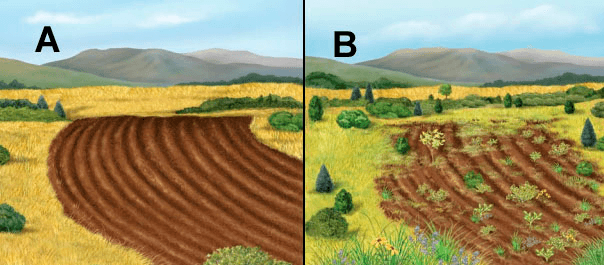
What type of succession is shown going from figure A to figure B?
a)
primary succession
b)
ecological succession
c)
secondary succession
d)
intermediate
18.
In the mid-1980s an aggressive strain of algae known as Caulerpa was accidentally introduced into the Mediterranean Sea when a seaside aquarium cleaned out its tanks. The algae contains a toxin that prevents native herbivores from consuming it. Caulerpa quickly spread over the sea floor, crowding out many species including sponges, corals, sea fans, and lobsters. Which statement explains the most likely impact Caulerpa has had on the biodiversity in the Mediterranean Sea?
a)
The presence of Caulerpa within an ecosystem is an indicator of the ecosystem’s health.
b)
The spread of Caulerpa improved the habitat for many species of sea grasses, and increased the biodiversity.
c)
Caulerpa interbred with native species with the same adaptations within the ecosystem.
d)
Caulerpa became dominant within the ecosystem and reduced the biodiversity.
19.

Enchanted Rock State Natural Area is located in Central Texas. Enchanted Rock is a dome of granite. The area contains four easily identifiable communities. The table describes characteristics of each type of community in the area.

a)

Open oak woodland

b)

Mesquite grassland

c)

Floodplain

d)

Granite rock

20.

Scientists are studying the effects of climate change on the Baltic Sea. Some scientist predict that if current trends continue, the Baltic sea will become less salty, and it will contain less dissolved oxygen. As a result of theses changes, the Baltic Sea will have less biodiversity. The location of the Baltic Sea is shown on the map below. Which statement best explains why biodiversity in the Baltic Sea could decrease f these changes occur?

a)

Fewer types of plants and animals are found in warm water than in cool water.

b)

Plants and animals adapted for living in saltwater will grow more slowly in water that has less salt.

c)

Plants and animals adapted for living in saltier conditions will not be able to survive and reproduce.

d)

Animals adapted for living in warm water will eat all of the plants and animals adapted for living in cool water.