wayground logo

Free Printable Worksheets

Font size

S
M
L
XL
Worksheets

CHEMISTRY REVISION

Total questions: 134

Worksheet time: 4hrs 28mins

Name
Class
Date
1.

What would be the effect on the particles if more heat is added?

a)

They would slow down

b)

They would stop moving

c)

They would speed up

d)

There would be no effect

2.

Think about a pan of water sitting on an electric stove. The stove is then turned on to high.

What will happen to the movement of the particles in the pan?

a)

They will slow down

b)

They will stay the same speed

c)

They will stop moving

d)

They will speed up

3.
Which states allow easy flow of particles
a)
Gas and Solid
b)
Gas and Liquid
c)
Solid and Liquid
d)
Gas only
4.
which of the following would be most stolid?
a)
Ice
b)
Jelly
c)
Honey
d)
Tomato Sauce
5.
How do materials change from one state of matter to another?
a)
They gain or lose energy
b)
They break appart
c)
The particles get stickyer
d)
They are magnetised to themselves
6.
Which of the following is a property of a liquid
a)
Can't be compressed
b)
Can be compressed
c)
Particles are far appart
d)
Particles hold the object's shape 
7.
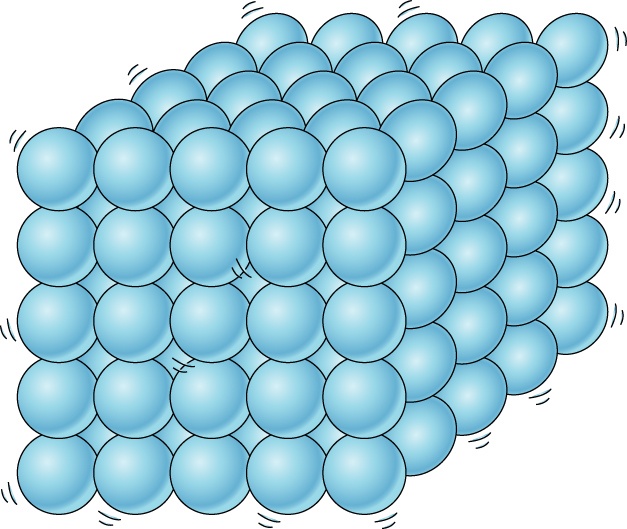
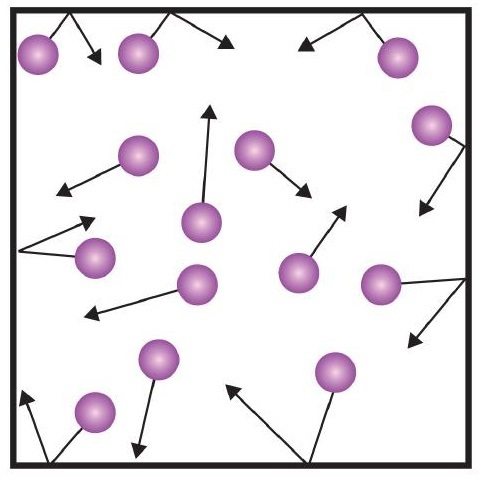
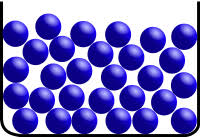
Which description best matches this particle model?
a)
Closely packed and can't move a lot. 
b)
Particles are close together but can move a little. 
c)
Particles have lots of energy and can move around. 
8.
Which description best matches this particle model?
a)
Closely packed and can't move a lot. 
b)
Particles are close together but can move a little. 
c)
Particles have lots of energy and can move around. 
9.
Which description best matches this particle model?
a)
Closely packed and can't move a lot. 
b)
Particles are close together but can move a little. 
c)
Particles have lots of energy and can move around. 
10.
Which state of matter can be compressed?
a)
Solid
b)
Liquid 
c)
Gas
11.
Which of the following occurs when a liquid becomes a gas?
a)
the particles slow down
b)
the particles beak away from one another
c)
the particles move closer together
12.
An increase in temperature does what to diffusion?
a)
Speeds it up
b)
Slows it down
c)
Has no effect
d)
I wish i knew. Really I do.
13.
The movement of particles from high concentration to low concentration is called?
a)
Thermal Expansion
b)
Diffusion
c)
Compression
d)
Mass Conservation
14.
If a balloon is cooled what will happen to the volume?
a)
Volume will increase
b)
Volume will decrease
c)
Volume will not change
15.

A ___________ substance has a definite volume but not a definite shape.

a)

gas

b)

liquid

c)

solid

16.

The particles in a _____________ vibrate, are close together, and do not move freely.

a)

liquid

b)

gas

c)

solid

17.
The phase change from water vapor to liquid water is known as...
a)
evaporation
b)
precipitation
c)
condensation
d)
sublimation
18.
What is the change from a Solid to a Gas due to the gaining of energy?
a)
Condensation
b)
Vaporization
c)
Sublimation
d)
Deposition
19.
Flammability (burns)
a)
Physical Property
b)
Chemical Property
20.
Solubility (dissolves)
a)
Physical Proeprty
b)
Chemical Property
21.
Melting point
a)
Physical Property
b)
Chemical Property
22.
Which of the following is a sign that a chemical reaction has occurred?
a)
change in shape
b)
melting
c)
formation of a gas
d)
dissolving
23.
Is burning wood a chemical or physical change?
a)
chemical
b)
physical
24.
Ability to rust is this type of property:
a)
Physical property
b)
Chemical property
25.
Physical properties are
a)
properties that can be observed without changing the identity of the substance
b)
properties that describe how a substance changes into a completely different substance
c)
properties that we can only observe with our eyes
d)
properties that we need special tools to observe
26.

You mixed two liquids and a precipitate formed, what kind of change occured?

a)

Physical

b)

Chemical

27.

Which state of matter has both definite shape and definite volume?

a)

Gas

b)

Liquid

c)

Solid

28.
In a fireworks show, the fireworks explode giving off heat and light. 
a)
Physical Change
b)
Chemical Change
29.

Which of these examples is a physical change?

a)
b)
c)
d)
30.
A change in phase ...
a)
Chemical Change
b)
Physical Change
31.
Bubbles form when two or more substances are combined ...
a)
Chemical Change
b)
Physical Change
32.

In a chemical reaction, the substances listed on the left side of the arrow are:

a)

Products

b)

Chemicals

c)

Precipitates

d)

Reactants

33.

In a chemical reaction, the substances listed on the right side of the arrow are:

a)

Products

b)

Precipitates

c)

Coefficients

d)

Reactants

34.

Magnesium was reacted with hydrochloric acid. What products would be formed?

a)

Magnesium chloride + carbon dioxide + water

b)

Magnesium sulfate + hydrogen

c)

Magnesium chloride + hydrogen

d)

Sodium chloride + hydrogen + water

35.

The worded equation for photosynthesis is:

a)

Carbon dioxide + water \rightarrow glucose + oxygen

b)

Glucose + oxygen \rightarrow carbon dioxide + water

c)

Octane + oxygen \rightarrow carbon dioxide and water

d)

Carbon dioxide + oxygen \rightarrow glucose + carbon dioxide

36.

The worded equation for cellular respiration is

a)

Carbon dioxide + water \rightarrow glucose + oxygen

b)

Glucose + oxygen \rightarrow carbon dioxide + water

c)

Octane + oxygen \rightarrow carbon dioxide and water

d)

Carbon dioxide + oxygen \rightarrow glucose + carbon dioxide

37.

What test is used to identify if hydrogen is produced in a reaction?

a)

Limewater test

b)

Pop test

c)

Litmus paper

d)

Cobalt chloride paper

38.

How many atoms of oxygen are represented in the picture?

a)

2

b)

3

c)

5

d)

6

39.
How many Aluminum are in Al2O3?
a)
3
b)
2
c)
5
40.

In a chemical equation...

a)

a new substance is formed

b)

new atoms are formed

c)

old atoms disappear

d)

a equal sign is always used

41.

A worded equation...

a)

are detailed

b)

includes subscripts

c)

includes coefficients

d)

uses the full names of the substances

42.

The law of conservation of mass states

a)

chemical reactions create new atoms

b)

atoms cannot be created or destroyed

c)

reactants vanish once a reaction takes place

d)

products appear when a reaction takes place

43.

How many Potassium (K) atom are there?

a)

1

b)

2

c)

3

d)

4

44.

How many Iron (Fe) and Oxygen (O) are there?

a)

Fe = 1, O = 2

b)

Fe = 2, O = 3

c)

Fe = 2, O = 1

d)

Fe = 1, O = 3

45.

How many Hydrogen (H) and how many Chlorine (Cl) are there?

a)

H = 4, Cl = 1

b)

H = 4, Cl = 0

c)

H = 4, Cl = 3

d)

H = 4, Cl = 4

46.

How many molecules are there?

a)

3

b)

6

c)

12

d)

18

47.

Which of the following is true?

a)

H = 6, So = 4

b)

H = 3, So = 4

c)

H = 6, So = 12

d)

H = 6, So = 2

48.

Identify the Reactants in this equation.

a)

A

b)

B

49.

What coefficient should be used to make the following equation balanced?

N2+O2--> __?__NO

a)

1

b)

2

c)

3

d)

4

50.
What is the little number after an element in a chemical equation called.
Example: H2
a)

Coefficient 

b)

Subscript

c)

Atom

d)

Equation

51.
Which of the following equations are correctly balanced?
a)

12CO2 +H2O --> C6H12O6 + O2

b)

CO2 + 9H2O --> C6H12O6 + O2

c)

CO2 + H2O --> 3C6H12O6 + O2

d)

6CO2 + 6H2O --> C6H12O6 + 6O2

52.
Is the following equation balanced?
4Fe + 3O2 --> 2Fe2O3
a)
yes
b)
no
53.
How many elements are in C6H12O6?
a)
1
b)
2
c)
3
d)
4
54.
What is the number before a chemical formula called?
Ex: 2H2 + O2 --> 2H2O
a)
Coefficient
b)
Subscript
c)
Atom
d)
Equation
55.
How many atoms are in the neurotransmitter serotonin? The formula for serotonin is C10H12N2O
a)
10
b)
20
c)
25
d)
23
56.
How many HCl molecules do you need to balance this equation? 
Mg +  __HCl --->  MgCl2 + H2
a)
1
b)
2
c)
3
d)
4
57.

How many Hydrogen atoms are in 4H2O?

a)

6

b)

8

c)

2

d)

4

58.

How many Magnesium atoms are in 10MgCl2?

a)

10

b)

5

c)

20

59.

How many Nitrogen atoms are in the in H2C3O4N5?

a)

2

b)

3

c)

4

d)

5

60.
How many total atoms are in this compound?
H2C3O4N5
a)
5
b)
14
c)
15
d)
19
61.

How many Nitrogen atoms are in (NH₄)₂CrO₄?

a)

1

b)

2

c)

8

d)

16

62.

How many Hydrogen atoms in 3(NH₄)₂CrO₄?

a)

4

b)

2

c)

8

d)

24

63.
Can compounds be found in the periodic table?
a)

Yes

b)

No

64.

Choose all the images that represent compounds.

a)
b)
c)
d)
65.

Choose all the images that represent molecular elements (diatomic elements).

a)
b)
c)
d)
66.
What is the tiniest particle in the entire universe?
a)
cells
b)
gases
c)
atoms
d)
liquids
67.
What is the name of a single type of atom?
a)
cell
b)
proton
c)
element
d)
atom
68.

This diagram represents...

a)

An element

b)

A molecule

c)

A compound

d)

A mixture of elements and compounds

69.

What makes elements and compounds different from mixtures? Elements & compounds-

a)

have a constant composition (pure substances)

b)

are made of gases

c)

Will not change when heated

d)

conduct electric current

70.

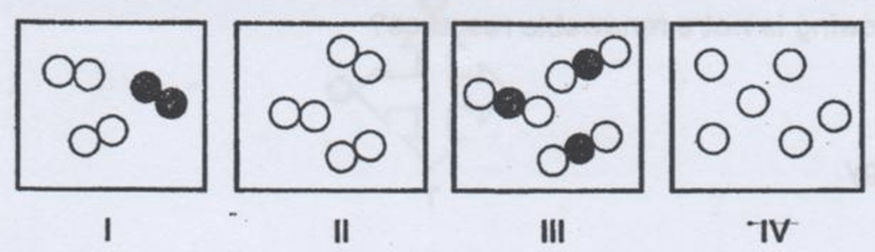
In the diagrams provided, the circles of different colors represent the atoms of different elements. Which diagram represents a mixture?

a)

I

b)

II

c)

III

d)

IV

71.

Mixtures are different than pure substances because mixtures-

a)

have lower boiling points

b)

can be separated physically

c)

are less dense than pure substances

d)

contain only one type of atom

72.

Which of the following is true of oxygen?

a)

Oxygen is an element because its most basic unit is a single type of atom

b)

Oxygen is a compound because its most basic unit is a single type of atom.

c)

Oxygen is a mixture because its most basic unit contains more than one particle.

d)

Oxygen is a compound because its most basic unit contains more than one type of particle.
73.
Which particle has a positive charge?
a)
electron
b)
orbital
c)
proton
d)
neutron
74.
Choose the particle that has no charge.
a)
nucleus
b)
neutron
c)
proton
d)
electron
75.
An electron has a _____ charge.
a)
negative
b)
positive
c)
neutral
76.
Which particles make up the nucleus of an atom?
a)
protons and neutrons
b)
electrons and protons
c)
electrons, protons, and neutrons
d)
electrons and neutrons
77.
The subatomic particle that determines the identity of an element.
a)
neutron
b)
proton
c)
electron
d)
outer shell
78.
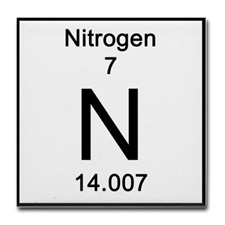
What is the number of protons that the element in this image contain?
a)
14
b)
7
c)
15
d)
18
79.
In an atom, what is the number of protons equal to?
a)
The number of electrons.
b)
The number of neutrons.
c)
The number of molecules.
d)
The number of nuclei.
80.

Mass minus Atomic Number Equals (M-A=?)

a)

Neutrons

b)

Protons

c)

Nucleus

d)

Atom

81.

Atomic number equals ______________ and _______________

a)

Neutrons

b)

Protons

c)

Electrons

d)

Elements

82.

How many neutrons does this element have?

a)

1

b)

2

c)

3

d)

4

83.

The size of the negative charge of an electron is exactly the same as the size of the positive charge on a proton. What is the overall charge of the helium atom shown in the diagram?

a)

positive

b)

negative

c)

neutral

84.

How are the individual atoms held together?

a)

There is electrostatic attraction

b)

They are holding hands

c)

There is Earth's gravity

85.

Electrons have less mass than protons do

a)

true

b)

false

86.

A region around the nucleus of an atom where electrons are likely to be found.

a)

Electron Cloud or shell

b)

Nucleus

c)

Protons

d)

Electrons

87.

The vertical (up and down) columns in the Periodic Table are called

a)

groups

b)

towers

c)

periods

d)

atomic numbers

88.

Elements in a .................. have similar chemical properties.

a)

period

b)

group

c)

row

89.
The horizontal row on the periodic table is called a
a)
group
b)
family
c)
period
d)
atomic number
90.
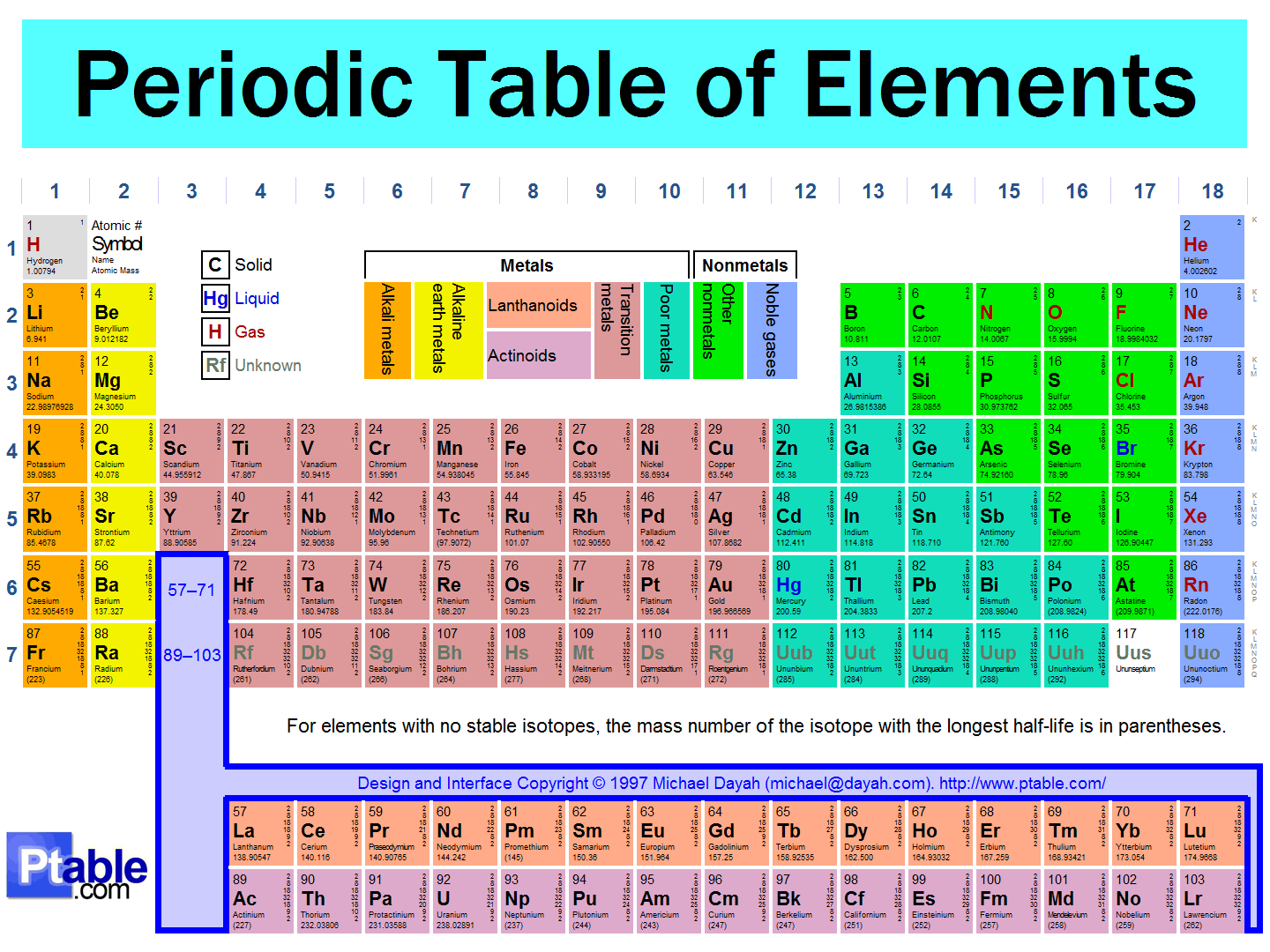
What does the 1.00794 stand for?
a)
Hydrogen
b)
atomic number
c)
atomic mass
d)
atomic explosion
91.

Which element is similar to Li?

a)

Be

b)

K

92.

Which element is similar to Mg?

a)

Ca

b)

B

93.

Students in Mrs. Clark's science class are investigating a substance that has the following properties

-shiny

-bends easily

-hard, not easily broken


Based on these properties how would you classify the substance?

a)

metal

b)

nonmetal

c)

metalloid

94.

A student is studying a mystery substance. It breaks easily. It has a very dull luster. It doesn't conduct any electricity. What is the most likely substance this is?

a)

Metal

b)

Metalloid

c)

Nonmetal

95.

Valence electrons are in the _________ shell.

a)

innermost

b)

outermost

c)

nucleus

96.

How many valence electrons are in this atom?

a)

2

b)

5

c)

8

97.

The number of valence electrons in each atom help determine the ________ properties of that element.

a)

chemical

b)

rational

98.

Select the subatomic particles that have a mass of 1 AMU

a)

Protons

b)

Neutrons

c)

Electrons

99.

If Beryllium has 4 protons, how many valence electrons does it have?

(a)  

100.

Neon has 10 protons, how many valence electrons does it have?

(a)  

101.

Match the electron shell with how many electrons its capacity is

a)

1st Shell

1.

2

b)

2nd Shell

2.

8

c)

3rd Shell

3.

18

d)

4th Shell

4.

32

102.
What is the name of this element?
a)
Helium
b)
Hydrogen
c)
Argon
d)
Silver
103.
What is the name of this element?
a)
Lithium
b)
Boron
c)
Carbon
d)
Neon
104.
How many valence electrons?
a)
2
b)
3
c)
5
d)
10
105.

How many Valence electrons are there?

a)

6

b)

4

c)

2

d)

3

106.

What is a positive ion called?

a)

anion

b)

cation

c)

isotope

d)

covalent

107.

What is a negative ion called?

a)

anion

b)

cation

c)

covalent

d)

isotope

108.

Which types of elements from cations?

a)

metals

b)

nonmetals

c)

metalloids

d)

noble gases

109.

Which types of elements from anions?

a)

metals

b)

nonmetals

c)

metalloids

d)

noble gases

110.

Why do elements form bonds?

a)

to get a charge

b)

so they can make friends

c)

to become stable by getting a full valence shell

d)

to become stable by increasing their mass

111.

How many electrons would a Nitrogen ion gain/lose?

a)

lose 5

b)

gain 5

c)

lose 3

d)

gain 3

112.

How many electrons would a Calcium ion gain/lose?

a)

lose 1

b)

gain 1

c)

lose 2

d)

gain 2

113.

A Bromine ion gains 1 electron, which of the following is the correct symbol for a Bromine ion?

a)

Br-1

b)

Br+1

c)

Br+7

d)

Br-7

114.
What is the charge of an atom that has gained one electron?
a)
-1
b)
-2
c)
+1
d)
+2
115.

Sodium (Na) has 1 electron (e-) in its outer shell (orbital). How can it make a full outer shell? (HINT: Think of which option would be "easier" for the atom.)

a)

Giving away or donating the outer electron.

b)

Taking on or accepting 7 more electrons.

116.
Ions are: 
a)
atoms with a positive or negative charge
b)
atoms with no charge
c)
atoms with ONLY a positive charge
d)
atoms with ONLY a negative charge
117.
What is an ion?
a)
A Charged Atom
b)
A Large Atom
c)
A Small Atom
d)
A Cute Atom
118.
Negative ions form when atoms _________ valence electrons.
a)
lose
b)
gain
c)
share
119.
When an atom loses a valence electron, it becomes a(n) _____________ ion.
a)
positive
b)
negative
c)
neutral
d)
polyatomic
120.
An atom becomes _______ when it loses electrons.
a)
Positive
b)
Negative
c)
Neutral
d)
Invinsible
121.
An atom becomes _________ when it gains electrons.
a)
Positive
b)
Negative
c)
Neutral
d)
Invinsible
122.
Negative ions form when atoms _________ valence electrons.
a)
lose
b)
gain
c)
share
123.

If a Magnesium atom loses 2 electrons what will be its’ charge?

a)

0

b)

+2

c)

-2

d)

12

124.

If a Sulfur atom gains 2 electrons what will be its' charge?

a)

0

b)

+2

c)

-2

d)

16

125.

If a Bromine atom gains 1 electron what will be its’ charge?

a)

0

b)

+1

c)

-1

d)

35

126.
The rate of a reaction increases as temperature__________________.
a)
Decreases
b)
Increases
c)
Stays the Same
127.
A ______________ is a substance that increases the rate of a reaction without being used up during the reaction. 
a)
catalyst
b)
product
c)
reactant
d)
solute
128.
Smaller particle size allows for a _________ surface area to be exposed for the reaction.
a)
larger
b)
smaller
129.

When Magnesium strips are ground to powder:

a)

The mass increases.

b)

The surface area increases.

c)

The mass decreases.

d)

The surface area decreases.

130.

The variable we measure during an experiment is:

a)

The dependent variable.

b)

The independent variable.

c)

The control variables.

131.

The one thing that a scientist changes in their investigation

a)

Variable

b)

Independent variable

c)

data

d)

Hypothesis

132.
Hydrogen peroxide breaks down to form water and oxygen gas. Which observation is evidence that a chemical reaction has occurred?
a)
The mass of the solution remains the same.
b)
 Phase changes are observed.
c)
 The color of the solution remains clear.
d)
The temperature of the solution increases. 
133.
A clear liquid from a flask is poured into another clear liquid in a beaker. Which of the following results of this procedure would indicate a new substance was formed?
a)
The level of the substance in the beaker is higher after the other liquid is added.
b)
A yellow solid forms and then settles to the bottom of the beaker.
c)
Small white crystals are left behind in the flask that held the first liquid.
134.
Which of the following is an example that includes evidence of a chemical reaction?
a)
A sample of zinc is placed in water and it settles to the bottom
b)
A solid block of ice is heated and it completely melts into a liquid. 
c)
Sugar that is burned gives off an odor and turns brown and then black.
d)
A tomato is placed into a blender and chopped up into smaller pieces.