
 Worksheets
Physical Science Exam Review
Total questions: 132
Worksheet time: 2hrs 41mins


Carbon has how many protons?
12
6
7
4

Argon has how many Valence Electrons?
18
40
8
3

Potassium has how many energy levels?
4
19
39
1

Bromine has how many Neutrons?
35
80
45
8
Elements in the same period all have the same...
Mass
Valence Electrons
Neutrons
Energy Levels
An electron has what charge?
Positive
Negative
It has no charge (it is neutral)
A neutron has what charge?
Positive
Negative
It has no charge (it is neutral)
A substance that increases the rate of a reaction without being used up during the reaction is called a
catalyst
product
reactant
solute
What is the formula for sulfuric acid?
H2S
HS
H2SO4
H2SO3
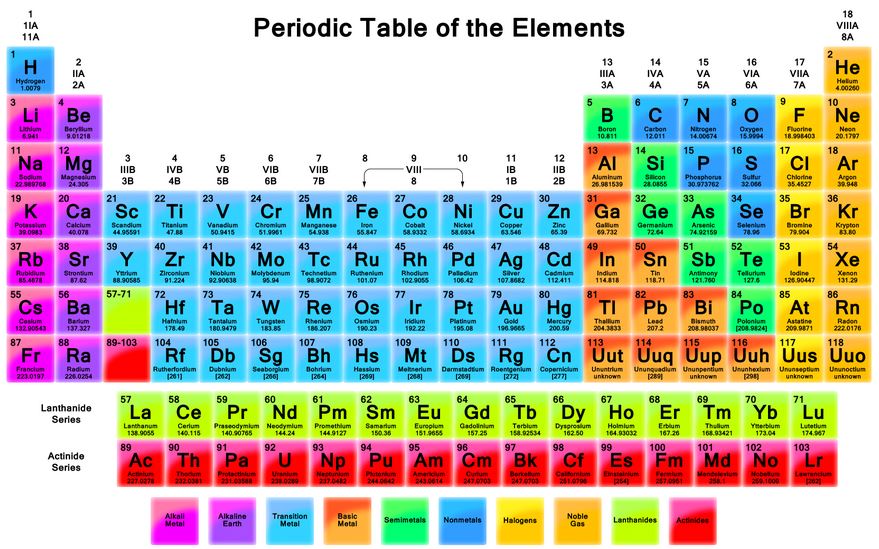
Look at the periodic table. What should be the charge on the ion formed by calcium?
+1
+2
-1
-2
Most elements are most stable when their outermost energy levels contain ________ electrons.
2
6
8
18

Predict the charge on this metal cation
+1
-1
+2
-2

Predict the charge on this metal cation
+3
-3
+5
-5
Which answer choice lists evidence of two possible chemical changes?
rusting and freezing
melting and precipitate created
bubbles and precipitate formed
dissolving and evaporating

Select the description of motion from A - B.
Slowing down away from the origin
Speeding up away from the origin
Constant velocity away from the origin
Constant velocity towards the origin
Select the description of motion from A - B.
Slowing down away from the origin
Speeding up away from the origin
Constant velocity away from the origin
Constant velocity towards the origin

What segment of the graph shows no motion, or standing still?
A - B
B - C
C - D
None

Describe the motion from B - C.
Standing still
Constant velocity of 60 m/min
Constant velocity of 0 m/min
Accelerating

2Li + Cl2 -> LiCl



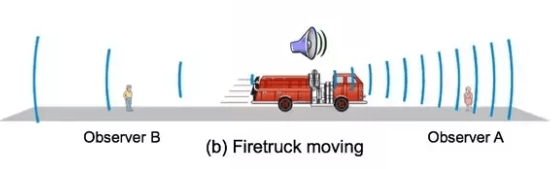
Look at the picture. Who is experiencing a lower pitched sound?
Observer A
Observer B
There is no difference
What is the Doppler Effect?
A change in frequency due to the relative motion of a wave source and an observer
When a wave overlaps with another wave
When a wave bounces off of another object
When a wave bends due to traveling through a different medium

How many electrons are in Potassium?
19
20
58
39

How many neutrons are in Argon?
18
40
58
22

How many protons are in Chlorine?
35
18
17
52

How many VALENCE ELECTRONS does Chlorine have?
2
7
8
10
17

Ionic bonds are formed when electrons get
Shared between two atoms
Removed from both atoms
Transferred from one atom to another
Added to both atoms

Why do elements form chemical bonds?
Because they're friendly
To create a new element
To become stable
Because they all need to gain more electrons

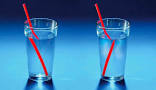
A student placed a pencil in a cup of water. The pencil appears broken because light
always travels in a straight line.
bends when it passes through water.
makes the water in the glass evaporate.
reflects the pencil on the water's surface.

What phase of matter exists in part C of the graph?
Gas
Liquid
Solid
Plasma
What phase of matter exists in part D of the graph?
Gas
Liquid
Solid
Plasma
What phase of matter exists in part E of the graph?
Gas
Liquid
Solid
Plasma
What phase change occurs when you start at D and end at E?
Freezing
Melting
Condensing
Vaporization
What phase change occurs when you start at D and end at C?
Freezing
Melting
Condensing
Vaporization

What SI Unit is used for Length?
Gram
Foot
Meter
Liter
Which of the following is the SI unit of temperature?
kelvin
degree Celsius
degree Fahrenheit
candela
Which of the following is the SI unit of mass?
gram
kilogram
ounce
pound
Stirring the solution increases the rate of dissolution (rate of dissolving).
True
False
The smaller the particle size the faster the rate of dissolution (rate of dissolving).
True
False
The smaller the particle size the faster the rate of dissolution (rate of dissolving).
True
False
Which will dissolve faster? Crushed table salt or a cube of table salt. Assume they have an equal mass.
crushed table salt
crystal of table salt
How many atoms are in C3H6O?
10
9
1
18
How many atoms in (CH3)2CO?
1
10
8
None of the above
Which radioactive element is used to determine the absolute age of late Pleistocene animal remains?
rubidium-87
uranium-238
potassium-40
carbon-14
A sample of wood that originally contained 100 grams of carbon-14 now contains only 25 grams of carbon-14. Approximately how many years ago was this sample part of a living tree?
2,850 years
5,700 years
11,400 years
17,100 years
Newtons could be used to measure __________ and __________.
mass, speed
momentum, work
force, weight
direction, power
What is the effect of one negatively charged object and one positively charged object coming close to each other.
The objects repel each other.
The objects attract each other.
SI unit for weight
Pound
Liter
Newton
Second
Acceleration is measured in
m/d3
g/n
m/s2
k/j2
All of these are measured in joules EXCEPT
Work
Potential Energy
Kinetic Energy
Weight
Work is measured in
Joules
Watts
Seconds
Meters
The force that pushes a plane upward
lift
thrust
weight
drag
The force that pulls the plane downward
lift
thrust
weight
drag
When lift equals weight, what happens during flight?
The plane goes higher
The plane stays the same altitude
The plane goes down
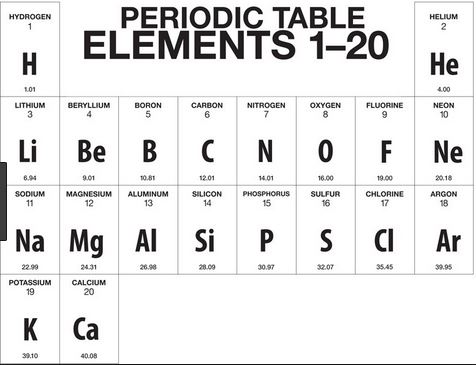
How many valence electrons does Nitrogen Have?
1 Valence electron
2 Valence electron
3 Valence electron
4 Valence electron
5 Valence electron
How many valence electrons does Magnesium Have?
1 Valence electron
2 Valence electron
3 Valence electron
4 Valence electron
5 Valence electron
How many valence electrons does Aluminum Have?
1 Valence electron
2 Valence electron
3 Valence electron
4 Valence electron
5 Valence electron
How many valence electrons does Potassium Have?
1 Valence electron
2 Valence electron
3 Valence electron
4 Valence electron
5 Valence electron
The pH scale is a range from
1 to 7
0 to 14
1 to 14
1 to 20
Which statement is true?
the lower the pH, the stronger the acid
the higher the pH, the stronger the acid
the lower the pH, the more neutral the acid
the higher the pH, the weaker the alkali
A very strong acid would have a pH of
1
7
9
14
Which pH number below reflects a weak base?
1
6
8
13
Which pH number below reflects a strong base?
1
6
8
13

The following properties are all characteristics of ionic compounds EXCEPT
high melting and boiling points
soft
crystal lattice structure
conduct electricity when dissolved in water

Complete the law:
For every action, there is an ____________ reaction.
equal and opposite
equal
opposite
bigger and better
Your friend pushes you for making fun of him/her. What is the reaction force?
You pushing back on your friend
You pushing on the ground
There is no reaction force
Your friend pushing on the ground
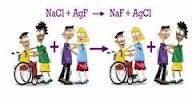
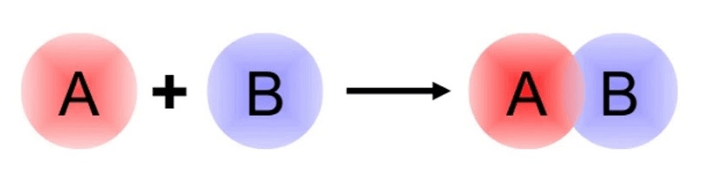
What is the type of reaction shown above?
Synthesis
Decomposition
Single Replacement
Double Replacement


Which type of reaction is shown?
Combustion
single replacement
double replacement
decomposition
Objects that are less dense than the water
float
sink
Objects that are denser than water
float
sink
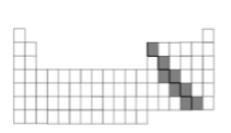
Elements in the shaded area can best be described as -
Shiny and brittle
Insulators
Good conductors

Elements in the shaded area can best be described as -
Malleable
Brittle
Dull
Insulators


The bottom part of the wave is called trough.
True
False

The highest part of the wave is called the _______________.
Amplitude
Wavelength
Trough
Crest

_________________________ is the distance between a point on one wave and the identical point of the next wave.
Amplitude
Frequency
Crest
Wavelength
The amplitude measures from
Crest to Crest
Crest to Rest Position
Crest to wavelength
Crest to Trough
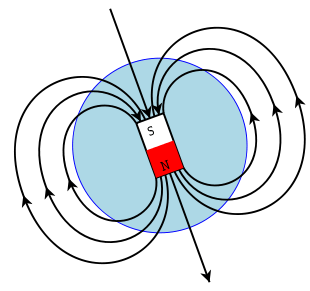
The area of magnetic force around a magnet is known as its _____________.
magnetic field
magnetic declination
magnetic fan lines
magnetic tan lines

The strongest part of a magnet is...
the bars .
the force field.
the poles.
the middle.


What makes an atom "happy"?
Forming a bond
Giving or taking electrons
Sharing electrons
Having a complete outer shell

What type of bonding does this picture show?
Ionic
Covalent

To calculate a
a = Force × m
a = Force ÷ m
a = Force + m
a = m ÷ Force

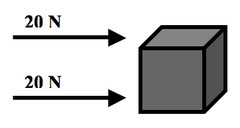
Force = 20 N and Mass = 4 kg. Calculate the acceleration.
80 N
80 ms-2
5 ms-2
0.2 ms-2

Based on the solubility curve, how many grams of sugar will dissolve in a 100 mL of water at 20°C?
100 g
150 g
200 g
250 g

The picture shows an electrical circuit. This circuit is a series circuit because:
It has 3 light bulbs.
The same current flows through all three light bulbs.
It uses a single battery.
The electrical current is divided between the three light bulbs.

What will happen if one light bulb is removed from this circuit?
The other bulbs will go out.
The other bulbs will stay on
The other bulbs will get dimmer.
The battery will become stronger.

Look at the picture of the series circuit here. When one light bulb is removed from series circuit, will the second light bulb still light on?
Yes
No
I am not sure

In a parallel circuit, if one of the light bulbs burns out, the rest _________.
stop the flow of electric current
can still light up
of the light bulbs burn out also
of the bulbs become dim
In each of the following cases, determine where the car has no acceleration?
A car speeds up after a stoplight turns green.
A car slows down as it approaches a red light
A car with the cruise control set at 80 km/h going down a straight highway
A car turning a curve at a constant speed

Which is not an example of a pure substance
Atom
Solution
Molecules
compound

Classify this substance
Pure element
Mixture of elements
Pure compound
Mixture of compounds

Classify this substance
Pure element
Mixture of elements
Pure compound
Mixture of compounds

