
 Worksheets
Chapter 6
Total questions: 15
Worksheet time: 8mins
Which of the following should not be included in the physical inventory of a company
Goods held on consignment from another
company.
Goods shipped on consignment to another
company.
Goods in transit from another company shipped
FOB shipping point.
None of the above.
As a result of a thorough physical inventory, Railway Company determined that it had inventory worth $180,000 at December 31, 2017. This count did not take into consideration the following facts: Rogers Consignment store currently has goods worth $35,000
on its sales floor that belong to Railway but are being
sold on consignment by Rogers. The selling price of
these goods is $50,000. Railway purchased $13,000 of goods that were shipped on December 27, FOB desti- nation, that will be received by Railway on January 10. Determine the correct amount of inventory that Rail-
way should report.
$230,000.
$215,000.
$228,000
193,000
Cost of goods available for sale consists of two elements: beginning inventory and
ending inventory.
cost of goods purchased.
cost of goods sold.
All of the answer choices are correct.

$99,000.
$108,000.
113,000.
$117,000.
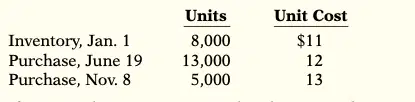
Using the data in Question 4 above, the cost of the ending inventory under LIFO is:
$113,000.
$108,000.
$99,000.
$100,000.
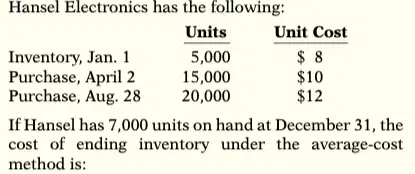
$84,000.
$70,000.
$56,000.
$75,250.
In periods of rising prices, LIFO will produce:
higher net income than FIFO.
the same net income as FIFO.
lower net income than FIFO.
higher net income than average-cost.
factors that affect the selection of an inventory cost- ing method do not include
tax effects.
balance sheet effects.
income statement effects.
perpetual vs. periodic inventory system.
Falk Company’s ending inventory is understated $4,000. The effects of this error on the current year’s cost of goods sold and net income, respectively, are:
understated, overstated.
overstated, understated.
overstated, overstated.
understated, understated.
Pauline Company overstated its inventory by $15,000 at December 31, 2016. It did not correct the error in 2016 or 2017. As a result, Pauline’s owner’s equity was:
overstated at December 31, 2016, and understated
at December 31, 2017.
overstated at December 31, 2016, and properly
stated at December 31, 2017.
understated at December 31, 2016, and under-
stated at December 31, 2017.
overstated at December 31, 2016, and overstated
at December 31, 2017.
Norton Company purchased 1,000 widgets and has
200 widgets in its ending inventory at a cost of $91 each and a current replacement cost of $80 each. The ending inventory under lower-of-cost-or-market is:
$91,000.
$80,000.
$18,200.
$16,000.
Santana Company had beginning inventory of $80,000, ending inventory of $110,000, cost of goods sold of $285,000, and sales of $475,000. Santana’s days in inventory is
73 days.
121.7 days.
102.5 days.
84.5 days.
Which of these would cause the inventory turnover to increase the most?
Increasing the amount of inventory on hand.
Keeping the amount of inventory on hand con-
stant but increasing sales.
Keeping the amount of inventory on hand con-
stant but decreasing sales.
Decreasing the amount of inventory on hand and
increasing sales.
In a perpetual inventory system:
LIFO cost of goods sold will be the same as in a periodic inventory system.
average costs are a simple average of unit costs incurred.
a new average is computed under the average-cost method after each sale.
FIFO cost of goods sold will be the same as in a periodic inventory system.
Company has sales of $150,000 and cost of (LO 6) goods available for sale of $135,000. If the gross profit
rate is 30%, the estimated cost of the ending inven-
tory under the gross profit method is:
(a) (c) (b) (d)
$15,000.
$30,000.
$45,000.
$75,000.

