
 Worksheets
Tamkeen Science Exam Revision
Total questions: 20
Worksheet time: 23mins
Which of the following mediums does a sound wave travel the FASTEST in?
solid
liquid
gas
vacuum

The 2 types of regions that make up longitudinal waves are:
compressions and extensions
compressions and rarefactions
vibrations and transmissions
compressions and transmissions
How does the temperature of a medium affect the speed of sound waves?
As the temperature of a medium increases, sound waves travel more slowly through that medium.
Temperature does not affect the speed of sound waves
As the temperature of a medium increases, sound waves travel more quickly through that medium.
As the temperature of a medium decreases, sound waves travel more quickly through that medium.

Which of the following will change if you turn up a radio's volume?
Intensity and loudness
Wave velocity and intensity
Frequency and amplitude
Intensity and pitch

Which statement is correct according to the image given?
In 1, the observer hears a higher pitched sound and this is related to the Doppler effect.
In 2, the observer hears a higher pitched sound and this is related to the Doppler effect.
In 1, the observer hears a higher pitched sound and this is related to the Compressional effect.
In 2, the observer hears a lower pitched sound and this is related to the Compressional effect.

optical axis
the focal point
refraction
focal length
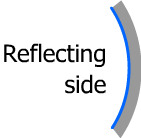
The following is a picture of what type of mirror?
Convex Mirror
Concave Mirror
Plane Mirror
Flat Mirror

If you stand 2m away from a plane mirror, how far away does your reflection appear to be from you?
1m
2m
4m
8m
What is the difference between a lens and a mirror?
A lens has an optic axis and a mirror does not.
A lens refracts light and a mirror reflects light
A lens does not have a focal point, a mirror has a focal point.
A lens reflects light and a mirror refracts light.

The diagram of a human eye illustrates a vision problem. Which of the following statements is correct?
The vision problem is farsightedness. The type of lens to correct it is convex.
The vision problem is nearsightedness. The type of lens to correct it is concave.
The vision problem is farsightedness. The type of lens to correct it is concave.
The vision problem is nearsightedness. The type of lens to correct it is convex.
Studying at night is hard in a room with dim light, and this is because of........
The amount of light rays absorbed by objects is lower in a dark room.
The human brain cannot process light waves at night.
Small amount of light ray reflected from the object to human eyes.
Huge amount of light ray travelled to human eyes.

In the following food web, under what category is the mockingbird classified as:
herbivore
autotroph
detritivore
omnivore

A solution to habitat fragmentation is
building ecosystem ladders
building more zoos
building more islands
building wildlife corridors
Which of the following descriptions about the organization of an ecosystem is correct?
Communities make up organisms, which make up populations.
(communities--organisms--populations)
Populations make up organisms, which make up communities.
(populations--organisms--communities)
Organisms make up populations, which make up communities.
(organisms--populations--communities)
Organisms make up communities, which make up populations.
(organisms--communities--populations)

At one time, huge flocks of passenger pigeons would darken the skies during their migration.
But by the early 1900s, they had become extinct.
This is an example of.........
Eutrophication
Overexploitation
Biological Magnification
Invasive species

Why are there usually few organisms at the top of the energy pyramid?
Organisms at the top are larger and require more living space.
Humans hunt for organisms in this level.
Energy is lost from one trophic level to the next, only 10% of energy is transferred.
Energy is transferred to the other form, and only 50% will be available in the next trophic level.

Which of the following is a method used to maintaining and improving biodiversity between habitat fragments?
legislative action
bioremediation
nature reserves
corridors

Which of the following describe the process shown in the figure?
Ultrasonic
Resonance
Reverberation
Echolocation
Ecology is concern in studying organisms and their interaction with the environment in the Biosphere. Which of the following is included in the Biosphere?
i. Earth's surface, surrounding atmosphere, and all locations below the Earth's surface that support life.
ii. All living and non-living things that make up an ecosystem.
iii. Landmasses, bodies of freshwater and saltwater.
i. only
i. & ii. only
i. & iii. only
i, ii. & iii

Using the figure below, what is the type of symbiotic relationship shown.
-The sloth receives protection by camouflage from the green colored algae.
-The algae take the sloths fur as shelter and the fur provide the algae with moisture it needs to survive.
Parasitism
Predator-prey
Mutualism
Commensalism

