
 Worksheets
Physics Gimanji
Total questions: 55
Worksheet time: 50mins
An object moves at a constant speed of 5 m/s. This means that the object:
Increases its speed by 5 m/s every second
Decreases its speed by 5 m/s every second
Doesn’t move
Has a positive acceleration
Moves 5 meters every second

Starting from the origin, a person walks 8 km east during first day, and 5 km west the next day. What is the net displacement of the person from the initial point in two days?
6 km east
3 km east
10 km west
5 km west
11 km west

A motorbike travels east and begins to slow down before a traffic light. Which of the following is the correct direction of the motorbike’s acceleration?
forward
up
down
backward
A car and a delivery truck both start from rest and accelerate at the same rate. However, the car accelerates for twice the amount of time as the truck. What is the traveled distance of the car compared to the truck?
half
same
twice
four times
quarter
Which of the following is a vector quantity?
speed
time
velocity
position
distance

What is the distance that the object travels in the first 5 seconds?
4m
5m
9m
20m
It is impossible to tell.

What is the acceleration during the first five seconds?
0 m/s^2
1m/s^2
4m/s^2
9 m/s^2
20 m/s^2
What is the acceleration during the last five seconds?
0 m/s^2
1m/s^2
4m/s^2
9 m/s^2
20 m/s^2

As shown to the right, a ball is thrown straight up from point A it
reaches a maximum height at point B and falls back to point C.
Which of the following is true about the direction the ball’s velocity
and acceleration between A and B?
velocity down, acceleration up
velocity up, acceleration down
velocity up, acceleration up
velocity down, acceleration down
velocity zero, acceleration zero

Two baseballs are thrown from the roof of a house with the same
initial speed, one is thrown up, and the other is down. Compare the
speeds of the baseballs just before they hit the ground.
The one thrown up moves faster because the initial velocity is up
The one thrown down moves faster because the initial velocity is
down
They both move with the same speed
The one thrown up moves faster because it has greater
acceleration
Definition: Crest
The highest point of a transverse wave
The lowest point of a transverse wave
The center of a transverse wave
The distance between two points on a wave
Definition: Trough
The center of a wave
The resting position of a wave
The lowest point of a transverse wave
The highest point of a transverse wave
What is the frequency of a wave?
# of oscillations produced in a certain amount of time
The distance the wave oscillates from it's resting position
The lowest point of a transverse wave
Resting point of a wave - no wave movement
What is the amplitude of a wave?
Where there is no wave movement
The distance the wave oscillates from it's resting position
A disturbance that transfers energy from one place to another
The distance between two corresponding parts of a wave
What is a medium?
The lowest point of a transverse wave
The size of a wave
The middle of a wave
Matter through which a wave travels
What type of matter can waves travel through?
Solid
Liquid
Gas
All of the Above
ex. police car siren sounding lower pitch after the car passes
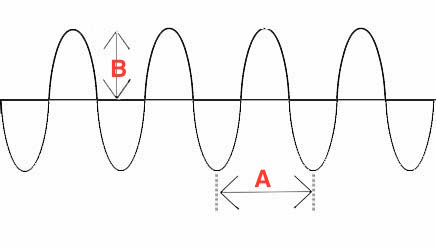
What property of this wave is represented by the letter "A"
amplitude
crest
trough
wavelength
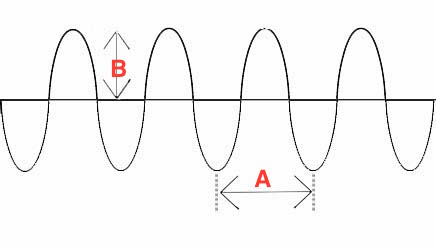
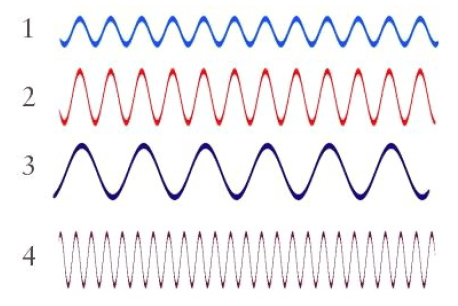

What type of interference is represented in this diagram?
Constructive
Destructive

What type of interference is represented in the diagram?
Constructive
Destructive

If the mystery machine moves 100 meters how much work is done?
130,000,000 J
70,000 J
100,000 J
30,000 J

If Jay Loppy pushes his van 20 meters how much work is done?
2,000 J
40,000 J
10,000 J
800,000 J
Fred kicks a ball with a force of 20N to George, who is 5M away.
How much work was done to the ball?
25 J
100 J
4 J
75 J
What is the formula for work?
Force = work × distance
Distance = force × work
Work = force × distance
Work = force × mass
If you push a cart with a force of 60 N for 2 m... how much work have you done?
120 J
30 J
120 N
30 N
Units of work are...
Newtons
Grams
Joules
Meters
Units of force are...
Newtons
Grams
Joules
Meters
Two factors that determine work are...
Force
Mass
Velocity
Distance
You do work when you mannequin pose with an object in your hand.
True
False
What is a beta particle made of?
One proton
A helium particle
One electron
One proton and one neutron
Which of these processes describes a nuclear fusion reaction?
A nucleus absorbs energy to produce lighter nuclei.
A nucleus splits to produce energy and lighter nuclei
Two nuclei bind together to produce energy and heavier nuclei.
Two nuclei bind together to produce energy and a lighter nuclei.
Of the main types of radiation emitted from naturally radioactive isotopes, which is the hardest to block?
Alpha deca
Gamma Decay
Beta decay
They are all blocked using the same method
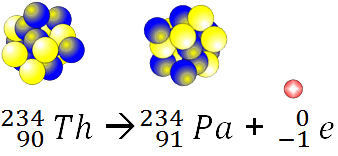
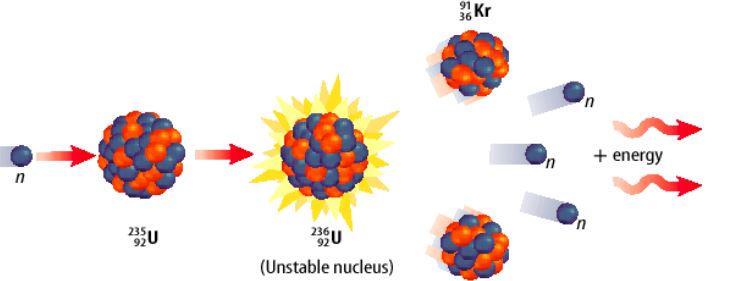

What kind of force holds the nucleus together?
Strong Nuclear Force
Weak Nuclear Force
Gravitational Force
Electromagnetic Force

What is the number of neutrons in Cesium?
55 neutrons
76 neutrons
84 neutrons
106 neutrons
139 neutrons

