
NEW
Font size
 Worksheets
TARGETS: Newton's 1st and 2nd Laws
Total questions: 40
Worksheet time: 40mins
Newton's 1st Law is described as:
An object at rest will continue at rest with no outside force acting upon it
An object in motion will continue in motion with no outside force acting upon it
The Law of Ineria
All answers
A bike is traveling at a constant speed in the presence of friction. The forces acting on the bike are _____.
balanced
unbalanced
If the outside forces acting on an object are not balanced, the object will change its motion.
True
False
You are riding on a rollercoaster and the ride is nearing its end. As the ride car pulls into the start/finish area, the cruel conductor suddenly engages the brakes. What will your body do and WHY?
Move forward because you are at rest and want to remain at rest
Move forward because you are in motion and want to stay in motion
Move backward because you are in motion and want to stay in motion
Move backward because you are at rest and want to remain at rest
What is Newton's 2nd Law?
Every action has an equal and opposite reaction
An object at rest stays at rest, an object in motion stays in motion.
F = ma
Friction
True or False. Acceleration of an object is directly proportional to the net force acting on it
True
False
Your car has a mass of 2500 kg and a force of 5000 N. How fast will it accelerate?
20 m/s2
0.5 m/s2
2 m/s2
120 N

Find how much force the man will need to exert to move the car.
5000 N
50 N
20,000 N
500 N

If the man pushes with an equal amount of force, which object will accelerate more?
Car because it has more mass
Lawnmower because it has less mass
Car because it has less mass
Lawnmower because it has more mass
A 25 kg bike accelerates at 10 m/s2. What was the force?
250 N
2.5 N
25 N
15 N
If an object was accelerating at 5 m/s2, and a force of 10 newtons was required to accelerate it, what was the object's mass?
50 kg
2 kg
0.5 kg
5 kg
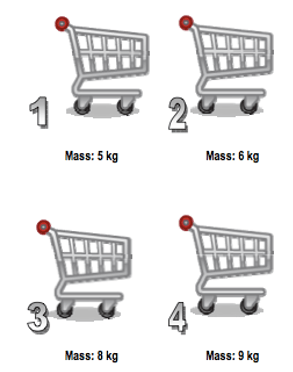

(Use Fnet=ma). Use the diagram to determine the net force, assume the object is accelerating at a rate of 2 m/s2. What amount of mass does the object have?
2 kg
4 kg
6 kg
8 kg

What is the slope of the line?
mass =(F/A)
acceleration=(F/m)
force = (ma)
a relationship between acceleration and force
Using the slope of the line in the graph provided, determine how much FORCE was required to accelerate this object by a rate of 2m/s2.
0.5 N
2N
2.5 N
Using Newtons 2nd Law of F=MA, and using the slope of the line in the graph provided, How much mass does this object have when it is accelerated at a rate of 4m/s2? (Hint: find the amount of force from the slope first. )
0.5 N
0.25 N
235 N
a measure of the gravitational force exerted on an object
weight
mass
density
friction
If an astronaut weighs 180 lbs on earth, how much will she weigh on the moon? (p. 135)
30 lbs
180 lbs
150 lbs
360 lbs
If a table exerts a normal force of 800 N on a television and a normal force of 100 N on a lamp, which object will experience greater friction?
television
lamp
both will experience equal friction


11 The acceleration due to gravity is lower on the
Moon than on Earth. Which of the following is
true about the mass and weight of an astronaut
on the Moon's surface, compared to Earth?
A Mass is less, weight is same
B Mass is same, weight is less
C Both mass and weight are less
D Both mass and weight are the same
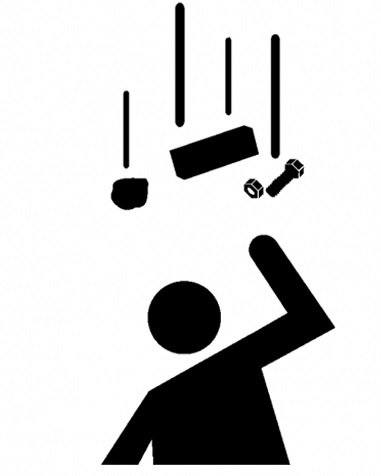
An object is falling downward through Earth's atmosphere. In which direction is the air resistance force?
Down
Up
Around the object
Through the object

An airplane flies east at 400 km/hr. In which direction is the air resistance force acting upon the airplane?
East
West
Up
Down
Which best describes why a falling object will reach its terminal velocity?
Gravity force is equal and opposite air resistance force.
Air resistance force is equal and opposite the freefall velocity.
Gravity force is equal and opposite the object's mass.
The object's mass is equal and opposite the gravity force.
What is a parachute designed to maximize?
Gravity
Air Pressure
Air Resistance
Thrust

