
 Worksheets
Linear Functions Vocabulary
Total questions: 208
Worksheet time: 4hrs 30mins
the horizontal axis on a coordinate plane
x-axis
y-axis
the vertical axis on a coordinate plane
x-axis
y-axis
The point on a graph where a function crosses the y-axis (Where X=0); point (0,y); the "b" in slope-intercept form.
y-intercept
x-intercept
The point on a graph where a function crosses the x-axis (Where Y=0 ,); point (x,0)
x-intercept
y-intercept
a line that slants up from left to right
no slope
zero slope
postiive slope
negative slope
a line that slants down from left to right
zero or no slope
negative slope
postivite slope
undefined slope
what is the slope of a line that goes horizontal (flat line)
no slope or zero slope
undefined slope
positive slope
negative slope
what is the slope of a line that goes vertical(up and down)
postive slope
negative slope
undefined slope
no slope or zero slope
rise/run; rate of change; Change in y/Change in x
slope
x-intercept
y-intercept
undefined
A function whose graph forms a straight line.
quadratic function
exponential function
Linear function
All inputs (x- values)
domain
range
slope
All outputs (y-values)
domain
range
slope
If ZERO is in the NUMERATOR, the slope is
positive
negative
undefined
zero
If ZERO is in the DENOMINATOR, the slope is
positive
negative
undefined
zero
the horizontal axis on a coordinate plane
x-axis
y-axis
the vertical axis on a coordinate plane
x-axis
y-axis
The point on a graph where a function crosses the x-axis (Where Y=0 ,); point (x,0)
x-intercept
y-intercept
The point on a graph where a function crosses the y-axis (Where X=0); point (0,y); the "b" in slope-intercept form.
y-intercept
x-intercept
a line that slants up from left to right
no slope
zero slope
postiive slope
negative slope
a line that slants down from left to right
zero or no slope
negative slope
postivite slope
undefined slope
what is the slope of a line that goes horizontal (flat line)
no slope or zero slope
undefined slope
positive slope
negative slope
what is the slope of a line that goes vertical(up and down)
postive slope
negative slope
undefined slope
no slope or zero slope
rise/run; rate of change; Change in y/Change in x
slope
x-intercept
y-intercept
undefined
slope; rise/run; change in y/change in x
is the same as
rate of change
y-intercept
x-intercept
zero or no slope
X intercepts; where line crosses the x-axis
is the same as
solutions
roots
y-intercepts
zeros
y=mx+b
(m is slope)
(b is y-intercept)
standard form
slope intercept form
point-slope form
Y-y1= m(x-x1),
(m is slope) point (x1,y1)
point-slope form
slope intercept form
standard form
A function whose graph forms a straight line.
quadratic function
exponential function
Linear function
y2-y1/x2-x1
change in y/change in x
choose all correct answers
slope of a line formula
quadratic parent function
exponential parent function
rate of change
All outputs (y-values)
domain
range
slope
All inputs (x- values)
domain
range
slope
Another word for slope is:
y = -3x + 4

What is the y-intercept.
y-intercept is -3
y-intercept -2
y-intercept is 3
y-intercept is -1

m is undefined
m = 0
m = 1
m = -1
Which of these represents slope-point form?
Bob has $150 in his savings account and saves $40 per month. Which function models his savings?
y = 150 + 40
y = 40x + 150
y = 150x + 40
Which of these represents the standard form of a linear equation?

What is the slope of the line?
Positive
Negative
Zero
Undefined
In the formula y = mx + b, what does "m" stand for?
y-intercept
slope
x-axis
y-axis

What type of slope is represented in the picture?
Positive
Negative
Zero
Undefined

What type of slope is this?
Positive
Negative
Zero
Undefined
y=75x−30
These lines are...
Parallel
Perpendicular
Neither
y=−6x+2
These lines are...
Parallel
Perpendicular
Neither
Slopes of perpendicular lines are:
opposite (sign)
reciprocal
identical
None of the above
Which equation is the graph of line that is perpendicular to the line y=−76x+7
y=−76x−2
y=76x+1
y=67x−8
y=−67x+12
Any set of ordered pairs
domain
range
relation
function
The x-coordinate of an ordered pair.
domain
range
relation
function
A relation where every x-coordinate goes to exactly one y-coordinate.
domain
range
relation
function
A relation where every x-coordinate goes to exactly one y-coordinate.
domain
range
relation
function
An ordered pair (x,y) that produces a true statement when the values of x and y are substituted into the equation.
graph
solution
linear function
equation in two variables
An equation that contains two different variables.
graph
solution
linear function
equation in two variables
When an equation in x and y is solved for y.
graph
solution
linear function
function form
The set of points in a coordinate plane that represent all the solutions of the equation.
graph
solution
linear function
function form
A function whose graph is a nonvertical line.
graph
solution
linear function
linear equation
An equation whose graph is a line.
graph
solution
linear function
linear equation
The y-coordinate of a point where the graph crosses the y-axis.
domain
range
x-intercept
y-intercept
The y-coordinate of a point where the graph crosses the x-axis.
domain
range
x-intercept
y-intercept

The image pictured is called a _____________. (Choose best answer).
grid
coordinate plane
plot
number line
The y-axis is the ________.
vertical line
horizontal line
The x-axis is the ________.
vertical line
horizontal line
Quadrant I is ________.
top right
top left
bottom left
bottom right
Quadrant II is ________.
top right
top left
bottom left
bottom right
Quadrant III is ________.
top right
top left
bottom left
bottom right
Quadrant IV is ________.
top right
top left
bottom left
bottom right
Points that fall in Quadrant I ________.
(+, +)
(-, +)
(-, -)
(+, -)
Points that fall in Quadrant II ________.
(+, +)
(-, +)
(-, -)
(+, -)
Points that fall in Quadrant III ________.
(+, +)
(-, +)
(-, -)
(+, -)
Points that fall in Quadrant IV ________.
(+, +)
(-, +)
(-, -)
(+, -)
The point where the x-axis and y-axis cross is called _____.
origin
zero
center
middle
The ordered pair for the origin is ______.
(0,0)
(1,1)
0
(-1,-1)
What does "Linear" mean?
Not a straight line
A straight Line
A curved line
What is the x-axis?
the horizontal number line in a coordinate plane
the vertical number line in a coordinate plane
The origin is (select all that apply):
The middle of a Cartesian Plane
(0,0)
The first section of the graph
The fixed point from where everything is measured
Input is:
The result of a system or function
What is being operated on by a system
The middle of a Cartesian Plane
A coefficient is:
The number at the end of an equation
Another word for variable
The number in front of a variable
A linear function
A graph scale must (select all that apply):
Count up by the same thing each time
Can count up by anything
Be equally spaced
make the graph larger
A Cartesian Plane has (select all that apply):
A X-axis
A Y-axis
Four Quadrants
An Origin
Non- Linear Functions are
Not straight lines
Straight Lines
Which value comes first in coordinates?
X- value
Y-value
A function could be (select one)
An equation
A machine
A graph
ALL OF THE ABOVE
The coordinates for the origin in the coordinate plane are________?
(1,1)
(0,0)
(0,1)
(1,0)

(8,10), (3, -4), (0, 8), (4, -3), (9, 0)

Determine the y-intercept from the table.
-2
2
9
7


The coordinate plane is divided by a HORIZONTAL numberline called _________________.
*(Look at the vocabulary that we completed in class!)
x-axis
origin
y-axis
quadrant
The coordinate plane is divided by a VERTICAL numberline called _______________.
*(Look at the vocabulary that we completed in class!)
x-axis
origin
y-axis
quadrant
How do you correctly write an ordered pair?
*(Look at the vocabulary that we completed in class!)
x, y
( y, x )
( x, y )
( a, b )
What does it mean for a function to be linear?
It will be linear
It will form a straight line
The slope will be steep
All of the above
What word means the place where we cross the y-axis
Slope
X-intercept
Linear
Y-intercept
Functions are:
a relation in which gives each y-value exactly one x-value
a relation in which each element of the x values is paired with exactly one element of the y values
a relation that gives each x-value multiple y-values
a relation that gives each y-value multiple x-values
A test on a graph that sees if a line will touch only one time...if it touches only one time it is a function:
Vertical Line Test
Horizontal Line Test
Diagonal Line Test
Linear Line Test
This means how steep a line is:
Range
Slope
Domain
Sloop
The Domain is the:
I should have studied more
The X and Y values in a function
The Y-values in a function
The X-values in a function
The Range is the:
I should have studied more
The X and Y values in a function
The Y-values in a function
The X-values in a function
In the equation, y = mx + b the m is the:
Slope
X-intercept
Y-intercept
Z-intercept
In the equation, y = mx + b the b is the:
Slope
X-intercept
Y-intercept
Z-intercept
Is this linear? y=x3
yes
no
Is this linear? y=x+2
yes
no


the horizontal axis on a coordinate plane
x-axis
y-axis
The point on a graph where a function crosses the y-axis (Where X=0); point (0,y); the "b" in slope-intercept form.
y-intercept
x-intercept
a line that slants up from left to right
no slope
zero slope
postiive slope
negative slope
what is the slope of a line that goes horizontal (flat line)
no slope or zero slope
undefined slope
positive slope
negative slope
what is the slope of a line that goes vertical(up and down)
postive slope
negative slope
undefined slope
no slope or zero slope
what is the slope of a line that goes vertical(up and down)
postive slope
negative slope
undefined slope
no slope or zero slope
y=mx+b
(m is slope)
(b is y-intercept)
standard form
slope intercept form
point-slope form
A function whose graph forms a straight line.
quadratic function
exponential function
Linear function
All outputs (y-values)
domain
range
slope
All inputs (x- values)
domain
range
slope

What is the orange line called?
Line of Solutions
Roots
Vertex
Axis of Symmetry

In the picture, what does the coordinate (0, -2), where the parabola crosses over the y-axis, represent?
the x-intercept
the minimum
the axis of symmetry
the y-intercept
The graph of a quadratic function is called a
line
parabola
half oval
vertex form
y = ax2 + bx + c
Which of these is true about the roots of a quadratic graph?
Roots are where the graph crosses the x - axis.
Roots determine if the graph goes through the origin.
Roots determine if the graph has a maximum or minimum.
Roots are the maximum and minimum points of the graph.

Does this function have a maximum or minimum?
maximum
minimum

The point (−2, 4) is called the _________ .
x−intercept
y−intercept
axis of symmetry
vertex

The axis of symmetry is _____________________ .
the line x=3
the point (3, 2)
the line y=3
the point (4, 0)

A mathematical statement that appears to be true, but has not been formally proven.
hypothesis
explanation
conjecture
guess
The values determined by subtracting consecutive output values when the input values have an interval of 1.
First Differences
First Ratios
Another name for the slope of a linear function. The formula represents the change in the output as the input changes.
Line
Speed
Average Rate of Change
Direction
A mathematical expression involving the sum of powers in one or more variables multiplied by coefficients.
Palomino
Monomial
Polynomial
Binomial
The greatest variable exponent in the expression.
Degree
Point
Leading Coefficient
Exponent
The numerical coefficient of the term with the greatest power.
Exponent
Variable
Leading Coefficient
Degree
A real number that makes the value of a function equal to zero, or f(x) = 0.
Leading Coefficient
y-intercept
Zero of a Function
x-intercept
f(x) = x is the simplest form of the linear function family.
One-to-One Function
Function Notation
Constant Function
Basic Function

What is the y-intercept of this function?
y = 1
y = - 1
y = 2
y = 1.5
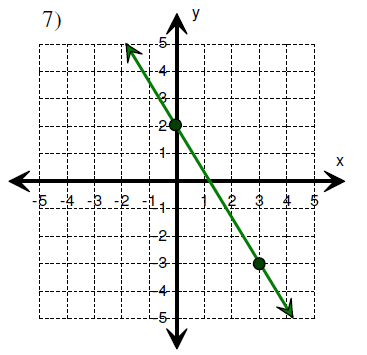

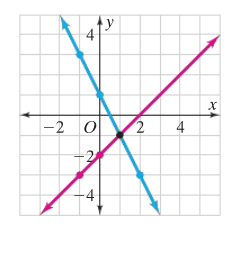
What is the solution to this system of equations?
(4, -2)
(4, 2)
(-2, 4)
No solution


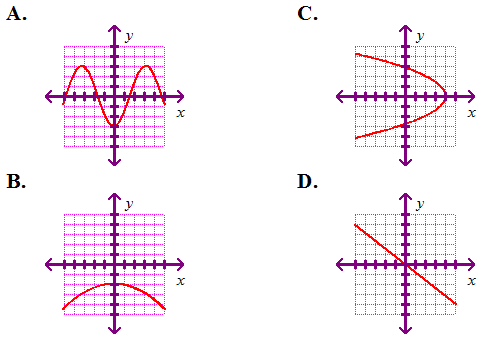
Which is the graphs has an x-intercept at -2 and
a y-intercept at -3?
A
B
C
D
What is the constant of variation in the equation: y=4x?
3
4x
4
3x
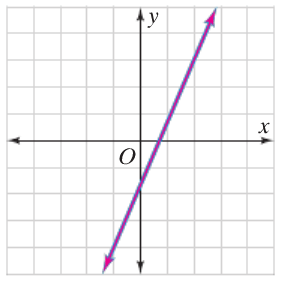
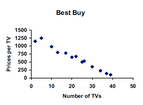
Without using a calculator, which of the following would be a logical correlation coefficient?
A) r = -0.9
B) r = 1
C) r = 0.9
D) r = .658

What is the zero(s) for the graph shown?
-2
-2 and 4
4
2
Which of the following means the same thing as the zero of a function?
x-intercept
y-intercept(s)
rate of change
correlation
If the slope of one line is 5/6, what is the slope of the line perpendicular to it?
-5/6
-6/5
5/6
6/5
What is the y-intercept of this equation: y=9x+6?
9
x
+
6
What is the linear parent function?
y=x7
y=x4
y=x2
y=x


What is the slope of the linear parent function?
m=2
m=1
m=0
m=9

What is the zero shown on the graph?
(2, 0)
(-2, 0)
(0, 3)
(3, 0)

What is the zero of this function?
(1,9)
(0,5)
(5,0)
(0,0)
What is the y-intercept of this function?
y = 1
y = - 1
y = 2
y = 1.5
What is the solution to this system of equations?
(4, -2)
(4, 2)
(-2, 4)
No solution
Which is the graphs has an x-intercept at -2 and
a y-intercept at -3?
A
B
C
D
What is the constant of variation in the equation: y=4x?
3
4x
4
3x
Without using a calculator, which of the following would be a logical correlation coefficient?
A) r = -0.9
B) r = 1
C) r = 0.9
D) r = .658
What is the zero(s) for the graph shown?
-2
-2 and 4
4
2
Which of the following means the same thing as the zero of a function?
x-intercept
y-intercept(s)
rate of change
correlation
If the slope of one line is 5/6, what is the slope of the line perpendicular to it?
-5/6
-6/5
5/6
6/5
What is the y-intercept of this equation: y=9x+6?
9
x
+
6
What is the linear parent function?
y=x7
y=x4
y=x2
y=x
What is the slope of the linear parent function?
m=2
m=1
m=0
m=9
What is the zero shown on the graph?
(2, 0)
(-2, 0)
(0, 3)
(3, 0)
What is the zero of this function?
(1,9)
(0,5)
(5,0)
(0,0)
Which answer describes the persistent quantity that represents the change in the relationship?
Rate of Change
Y-intercept
X-value
y = mx + b
If a table that represents a function has a constant rate of change, then it is a...
linear function
nonlinear function
relation
none of the above
What is NOT the initial value?
y-intercept
b
m
starting point
Rate of change is also called
input
output
slope
domain
range
If ZERO is in the DENOMINATOR, the slope is
positive
negative
undefined
zero
If ZERO is in the NUMERATOR, the slope is
positive
negative
undefined
zero
Output or range are also known as
y values
x values
change in y values
change in x values
Input or domain are also known as
y values
x values
change in y values
change in x values
"Linear" means
a straight line.
a line going up.
a line going down.
a curved line.
The formula for slope-intercept form is
y = mx + b
mx = y + b
b = mx + y
y = mb + x
Lines with the same slope are ________________ lines.
parallel
perpendicular
A function is a type of relation where every _____ has exactly one ______
input/output
output/input
inverse/output
output/inverse
The x values in a relation make up the __________
range
x-intercepts
domain
y-intercepts
The y values in a relation make up the ____________
x-intercepts
y-intercepts
range
domain
A simple test to see if a graph is or is not a function is the ___________________ test.
vertical line
horizontal line
slope
intercept
What is the slope in y=mx+b
y
m
x
b
What is the y-intercept in y=mx+b
y
m
x
b

