
Font size
S
M
L
XL
 Worksheets
Biology GMA Study Guide Quiz
Total questions: 20
Worksheet time: 10mins
Name
Class
Date
1.
Ruby-throated hummingbirds are found throughout eastern North America. They are omnivores, feeding on nectar, pollen, tree sap, insects, and spiders. They get all the water they need from nectar. Most nests are in forested areas, citrus groves, marshes, and scrubland. The hummingbirds breed in the spring and the summer, and females raise one to three broods per breeding season. Most of the hummingbirds migrate to Mexico or Central America for the winter. Many fly nonstop for 20 hours to cross the Gulf of Mexico. However, increasing numbers of the hummingbirds have begun to winter north of the gulf. Researchers have documented that the hummingbirds’ winter range has expanded northward by about 300 km in recent years. Which explanation BEST predicts the ability of the hummingbirds to survive their first winter in this new environment?
a)
Finding suitable nesting materials and sites is the most important task the hummingbirds must accomplish because they must produce offspring.
b)
Finding a sufficient supply of flowering plants, flowering trees, and insects is the most important task for hummingbirds because they need food to survive
c)
Finding bodies of water is the most important task for the hummingbirds because they need to supplement the supply of nectar if it is inadequate to provide all the calories the hummingbirds need to survive.
d)
Finding mates to allow the hummingbirds to lay fertile eggs and have two parents to feed the new hatchlings is the most important task for the hummingbirds because they need to ensure there is a new generation of hummingbirds in the region
2.
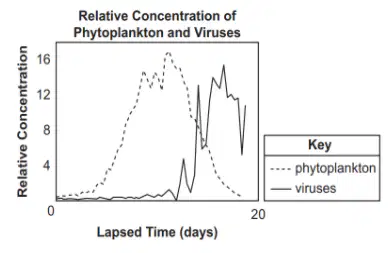
Scientists have studied a type of phytoplankton species. These phytoplankton are an important part of marine food webs and are major primary producers. As all organisms are regulated by their environment, so are the plankton. The scientists looked at the relationship between the populations of the phytoplankton and viruses found in the same environment. They created three environments in a laboratory setting to collect data on the growth of the plankton population and the viruses for a period of time and graphed the results once they were averaged, as shown below. The scientists claim that the growth and stability of the population of plankton were affected by the viruses. Using the information given, which TWO arguments support this claim?
a)
As the phytoplankton population increased, the number of viruses increased because the phytoplankton were the hosts to the viruses and replicated the viruses’ genome.
b)
The plankton population decreased as the number of viruses increased because the cells of the phytoplankton were destroyed as the viruses used them to increase the number of viruses in the environment.
c)
The phytoplankton population was unable to absorb the light necessary for growth because the viruses covered the surface of the water.
d)
The phytoplankton population was affected by the viruses because the viruses were competitors for the food sources in the environment.
e)
As the phytoplankton population increased, the number of viruses began to increase because the phytoplankton were consumed by the viruses.
3.
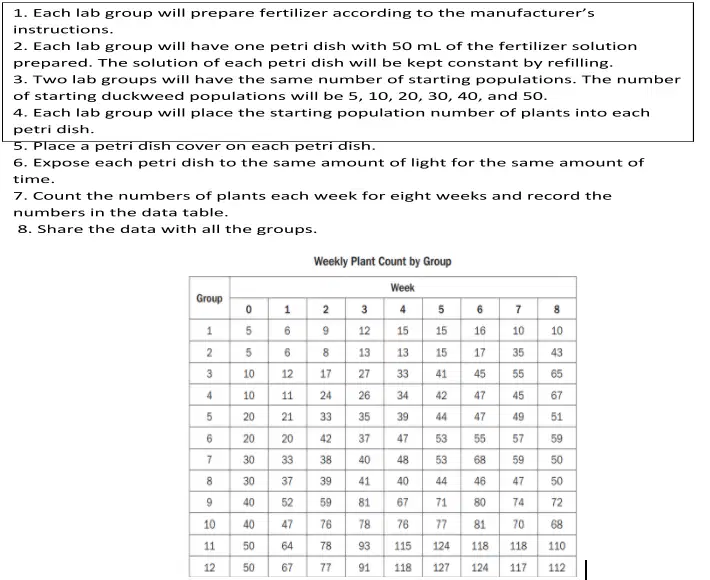
Students are studying factors that affect population sizes. They plan an investigation to explore the effect of the starting population size on growth rate and on the carrying capacity of the environment. The students select duckweed for the experiment because it has continuous growth. Duckweed is a free-floating aquatic plant that at times clogs waterways. It most commonly reproduces asexually by producing a new leaf-like structure that breaks off from the parent plant once the new structure has roots. The students agree on a hypothesis stating that the greater the number of individuals of the starting population, the faster the population will reach carrying capacity. The following procedure is developed by the students. Analyze the data from the investigation to identify which statement BEST explains the results.
a)
Each population reached the carrying capacity at different weeks.
b)
Populations 9 and 10 were unable to reach the carrying capacity before the end of the investigation period.
c)
Populations 11 and 12 reached carrying capacity at week 5 because there were fewer plants for the rest of the investigation period.
d)
The populations had different starting population numbers that grew at the same rate and reached their carrying capacities at the same time.
4.
Invasive insect species can cause severe damage to native trees and plants. Some insects bore into live trees and then get transported when trees are cut for use in numerous products. Wooden crates used for packing materials may be infested with insects or eggs that are then transported over long distances. What is one safe and practical way that people can act responsibly to prevent spreading potentially harmful and invasive insects?
a)
Store unused firewood from one winter until the next winter in a shaded grassy area to starve the insects and stop their propagation.
b)
Spray all wooden products with pesticide before bringing them into homes or other buildings to kill the insects before they can enter structures.
c)
Chop down trees suspected of being infected and use a wood chipper to make mulch for landscaping to chop up some of the insects before they can infect other trees.
d)
Buy local firewood near campsites instead of transporting raw wood from one area to another and then leave any extra for the next camper to prevent transferring the insects in infected wood.
5.
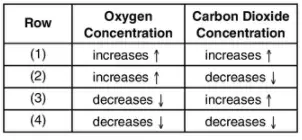
Which row in the chart above represents the most likely changes in the atmosphere due to widespread deforestation?
a)
Row 1
b)
Row 2
c)
Row 3
d)
Row 4
6.
Bromothymol blue (BTB) is a pH indicator that is also used to detect carbon dioxide (CO2). BTB is blue when pH is basic and CO2 is low. BTB is yellow when pH is acidic and CO2 is high. BTB is green when pH is neutral. A group of students are planning to perform an investigation in which they will place either a stalk of the aquatic plant elodea or a snail in a test tube that contains water with a neutral pH of 7 and BTB. The students will also include a test tube that contains elodea and a snail. Observing color change once the tubes have been placed under a growth light for several hours will allow the students to answer which TWO of the following questions?
a)
Does photosynthesis performed by elodea remove CO2 from the water?
b)
Does cellular respiration occur at a higher rate than photosynthesis in the tube with only elodea?
c)
Do both elodea and snails require oxygen to survive?
d)
Does elodea produce oxygen during photosynthesis?
e)
Do snails respire faster when placed in a tube with elodea?
7.
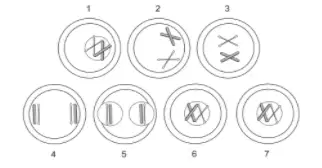
Students created the following model using paper plates, flat wooden sticks, cotton swabs, and construction paper. Which statement correctly uses the model to explain how mitosis maintains genetic continuity?
a)
The chromosomes in cell 1 are the same as in cells 6 and 7.
b)
Crossing-over occurs in cell 4, which increases the genetic diversity in cells 6 and 7.
c)
When the nuclear membrane reforms in cell 5, each nucleus becomes diploid in number.
d)
The independent assortment that is represented in cell 2 ensures that cell 3 has the correct number of chromosomes.
8.
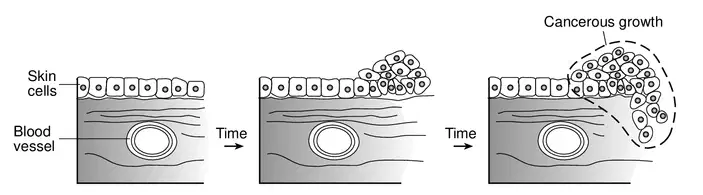
Which statement best explains the events represented in this diagram?
a)
A gene mutation caused the cells to become muscle cells.
b)
The growth resulted from the introduction of a vaccine.
c)
A gene mutation caused abnormal mitotic cell division.
d)
The growth results from uncontrolled meiotic cell division.
9.

Which description explains the role of the tRNA in the process shown in this model?
a)
the model delivers amino acids to the ribosome so that they can be added to the developing peptide.
b)
The model recognizes the stop codon of a developing peptide so that no new amino acids are added.
c)
The model signals the release of the peptide from the ribosome once all of the amino acids have been added.
d)
The model scans the developing peptide to make sure that the sequence of the amino acids matches the mRNA.
10.
Hemoglobin is a protein found in red blood cells of vertebrates and in the plasma of many invertebrates. The function of this protein is to transport oxygen throughout the body and to bring carbon dioxide back to be expelled from the organism. If the amino acid sequence of the protein is altered, the mutated protein is not as efficient at carrying oxygen as is the normal hemoglobin. Which argument is supported by this information?
a)
The mutated hemoglobin protein can still carry carbon dioxide to be expelled from the organism.
b)
Hemoglobin must be a simple molecule because it is found in both vertebrates and invertebrates.
c)
Structural changes of hemoglobin affect its ability to carry oxygen indicating that the shape of a protein is important to its function.
d)
Normal hemoglobin must be a larger molecule than the mutated hemoglobin since it has sufficient space to attach to and carry both oxygen molecules and carbon dioxide molecules.
11.
A male and female have a child that has three copies of chromosome 18. Although both parents are unaffected, their doctor claims that the disorder associated with having an extra chromosome 18 is the result of a chromosomal mutation in cells that carry inherited material. Which argument supports this claim?
a)
A mutation occurred when crossing over caused chromosome 18 to be replicated twice during meiosis, allowing one parent to donate two copies of chromosome 18 to the child.
b)
A nondisjunction mutation was caused by the improper separation of the genetic material during meiosis, allowing the gamete of one parent to donate two copies of chromosome 18 to the child.
c)
A substitution mutation during replication allowed the genetic material of chromosome 18 to replace the genetic material of a nearby chromosome, causing the child to have three copies of chromosome 18.
d)
An insertion mutation during replication allowed the genetic material of chromosome 18 to be inserted into the genetic material of another chromosome, causing three copies of chromosome 18 to be made.
12.
Agriculture companies produce plants that have genetic modifications that give the plants desired traits, such as resistance to drought or pests. Which question would gather information about an ethical consideration of genetically modified plants?
a)
Will these plants cause pollinators to avoid large areas of land?
b)
Can the amount of excess food produced by these plants be calculated?
c)
Can the genetic modifications of these plants be acquired by noxious plants?
d)
Will these plants require more land to grow than an equal amount of non-genetically modified plants require?
13.
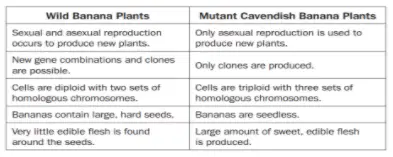
Today, the common type of banana we buy and eat is a Cavendish banana. They arose from chance mutants that were produced sexually from wild banana plants. The Cavendish banana is infertile and can only be produced by cloning from root shoots. Large commercial growers worldwide now plant only the mutant type. Some information about both types of banana is recorded in the table. Why are scientists warning that exclusively growing this mutant type by asexual reproduction presents a serious disadvantage?
a)
The loss of an adequate Cavendish banana seed supply could result in extinction of this variety.
b)
The changes in characteristics from a parent plant to a clone will produce inconsistent plants that are less healthy.
c)
The lack of genetic variability among clones puts the whole species at increased risk of extinction through a catastrophic disease or pest.
d)
The increasing number of homologous sets of chromosomes with each successive generation of clones will eventually result in widespread death of banana plants
14.

Students studied Mendel’s laws of segregation and independent assortment. They created a Punnett square to show a cross between a homozygous furred mouse (FF) and a homozygous hairless mouse (ff). The students then created a Punnett square for a cross between two heterozygous F1 mice. Which question could be answered using the information from the Punnett squares?
a)
Can furred mice produce furless mice?
b)
How many mice will be produced in the F1 generation?
c)
Will fewer furless mice survive to adulthood than furred mice?
d)
Are furred mice the best organism to use for this investigation?
15.
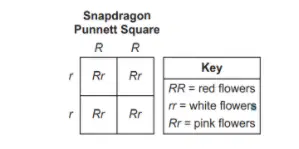
This Punnett square shows the inheritance of flower color in snapdragon flowers. Which statement BEST explains the inheritance of flower color in snapdragons?
a)
The allele for pink flower color is dominant because heterozygous individuals display this trait.
b)
The alleles for white flower and red flower color are dominant because they are expressed in homozygous individuals.
c)
The alleles for flower color show incomplete dominance because both alleles are partly expressed in heterozygous individuals.
d)
The alleles for flower color show codominance because both alleles are completely expressed in heterozygous individuals.
16.
Geographic isolation caused the separation of rainforest frog populations into a population in the north and a population in the south. The separated populations later reconnected because the climate got wetter and warmer, causing the rainforest to expand. When males from the north mated with females from the south, the offspring failed to develop past the tadpole stage. When males from the south mated with females from the north, the offspring developed more slowly than the offspring of pairs of northern frogs. These data support that which event occurred while the two populations of frogs were separated?
a)
The two populations developed into new species.
b)
The two populations mated with other species of frogs.
c)
The two populations began a new method of reproduction
d)
The two populations had fewer offspring than before the separation
17.
The ribosome of the bacterium E. coli includes the ribosomal protein L4 (rpl4). The rpl4 gene carries the instructions for making rpl4 protein. Which of the following arguments provides support for the claim that E. coli has a common ancestor with all other organisms?
a)
Every organism depends on proteins to carry out essential cellular processes. Ribosomes are needed by all organisms to synthesize proteins such as rpl4.
b)
Every organism possesses in its ribosome a protein that is similar to rpl4. This protein has an amino acid sequence that is similar to the sequence of E. coli’s rpl4.
c)
Every organism contains a structure that is similar to a ribosome. This structure helps convert the instructions from the rpl4 gene into amino acids.
d)
Every organism has proteins made of amino acids. The code for amino acids is the same in E. coli because the instructions for amino acids come from the DNA. DNA contains the same components in all organisms.
18.

Portions of the sequence alignments for a specific protein in some ciliates are shown below. Which of the following Cladograms BEST represents these data?
a)
Option 1
b)
Option 2
c)
Option 3
d)
Option 4
19.

The diagram represents a model of how bacteria become resistant to an antibiotic, allowing bacteria to survive treatment. Which BEST explains how the indicated step in the model allows bacteria to develop resistance?
a)
Genetic mutations that promote resistance occur.
b)
The bacteria are infected by viruses that confer resistance.
c)
Alleles for antibiotic resistance become dominant over recessive alleles
d)
A portion of the genetic material is re-replicated, allowing for resistance.
20.
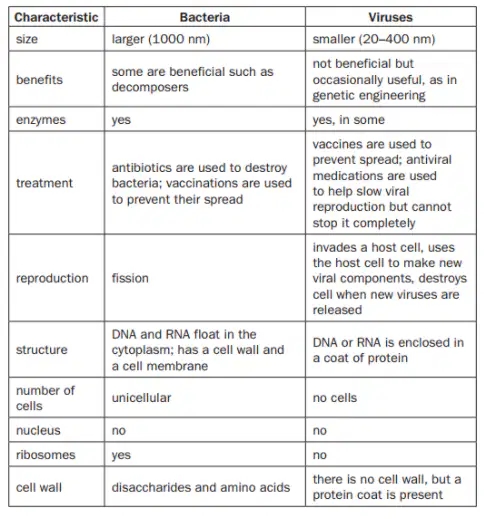
Some information about bacteria and viruses is arranged in this table. Which argument about bacteria and viruses is supported by this information?
a)
Bacteria are larger than viruses but are still small enough to enter cells.
b)
Bacterial infections such as diphtheria and tetanus cannot be prevented by vaccines.
c)
Only bacteria can acquire new characteristics, which makes them more difficult to treat.
d)
Both bacteria and viruses are surrounded by protective coverings, though the composition of each covering may be different.
Reset

