
 Worksheets
STEM OLYMPIAD-FINAL PREPARATION - ASSIGNMENT #3
Total questions: 51
Worksheet time: 26mins
Name
Class
Date
1.
An atom has 6 protons and 7 neutrons in its nucleus. What is its mass number?
a)
1
b)
6
c)
7
d)
13
2.
The property of a metal that makes it possible for it to be drawn into a wire is called
a)
conductivity
b)
ductility
c)
malleability
d)
resistivity
3.
A uniform mixture of two or more metals is called
a)
an alloy
b)
a colloid
c)
an aerosol
d)
a compound
4.
Gold is usually used to make jewellery because it is
a)
precious
b)
expensive
c)
less reactive with air
d)
a good conductor of heat
5.
The systematic name of the compound FeS is
a)
iron (I) sulphide
b)
iron (II) sulphide
c)
iron (III) sulphide
d)
iron (IV) sulphide
6.
Bronze is an alloy of
a)
iron and carbon
b)
zinc and copper
c)
iron and zinc
d)
copper and tin
7.
Which of the following elements is a liquid at room temperature?
a)
Carbon
b)
Mercury
c)
Silver
d)
Sulphur
8.
Which of the following gases helps in rusting?
a)
Carbon dioxide
b)
Hydrogen
c)
Oxygen
d)
Nitrogen
9.
Which of the following properties is true about all matter? Matter has
a)
volume and fixed shape
b)
volume and mass
c)
mass and indefinite volume
d)
density and fixed shape
10.
Which statement about isotopes of the same element is correct?
a)
They have different chemical properties.
b)
They have different numbers of protons.
c)
They have the same nucleon number.
d)
They have the same number of electrons in their outer shell.
11.
In humans, features of parents are passed on to offspring through
a)
breastfeeding
b)
reproduction
c)
good training
d)
sharing the same things
12.
The different types of teeth that an animal has gives an indication of the nature of its
a)
digestion
b)
environment
c)
feeding
d)
reproduction
13.
Caterpillar is an example of
a)
an animal parasite that feeds on plant
b)
a plant parasite that lives on an animal host
c)
an animal parasite that feeds on animal host
d)
a plant parasite that grows on plant host
14.
Exchange of gases takes place in the respiratory system in the
a)
bronchi
b)
alveoli
c)
nostrils
d)
trachea
15.
The chemical substances which help in the digestion of food are known as
a)
enzymes
b)
hormones
c)
plasma
d)
vitamins
16.
Some plants shed their leaves during the dry season to prevent
a)
water loss
b)
heat loss
c)
catching fire
d)
losing nutrients
17.
Which of the following pairs of structures form part of the female reproductive system in humans?
a)
Urethra and uterus
b)
cervix and uterus
c)
ureter and uterus
d)
cervix and ureter.
18.
A pupil looks at a cell using a microscope. The cell has chloroplasts and a cell wall. Which type of cell is it?
a)
a liver cell
b)
a mesophyll cell
c)
a sperm cell
d)
a white blood cell
19.
Blood is prevented from flowing back into the veins by the
a)
arteries
b)
capillaries
c)
heart
d)
valves
20.
Soluble digested food substances enter the blood of the human body by a process called
a)
absorption
b)
egestion
c)
excretion
d)
ingestion
21.
The type of energy obtained when an electric bulb is connected to a battery is
a)
chemical energy
b)
electrical energy
c)
light energy
d)
magnetic energy
22.
The force that binds molecules of the same substance together is called
a)
adhesion
b)
cohesion
c)
capillary action
d)
surface tension
23.
The process by which heat travels along a metal is called
a)
convection
b)
conduction
c)
expansion
d)
radiation
24.
A suitable machine for loading drums of palm oil onto a truck is
a)
a screw
b)
a crowbar
c)
a wheelbarrow
d)
an inclined plane
25.
The force which opposes the motion of one body on another body is called
a)
adhesion
b)
friction
c)
surface tension
d)
cohesion
26.
The instrument used to measure temperature is the
a)
ammeter
b)
barometer
c)
manometer
d)
thermometer
27.
A man did 75 J of work by lifting a 50N load from the floor onto a shelf. Calculate the height of the shelf.
a)
1.50 m
b)
0.67 m
c)
25.0 m
d)
125.0 m
28.
A stick placed in water appears to be bent because light travelling from the water to the air is
a)
dispersed
b)
displaced
c)
refracted
d)
reflected
29.
Which of the following properties of alcohol as a thermometric liquid is correct?
a)
It is opaque
b)
It does not wet glass
c)
It has a very low freezing point
d)
It has a high freezing point
30.
An aluminium cube with side measuring 2 m has a mass of 24 kg. Calculate the density of the aluminium.
a)
48 kgm^-3
b)
24 kgm^-3
c)
12 kgm^-3
d)
3 kgm^-3
31.
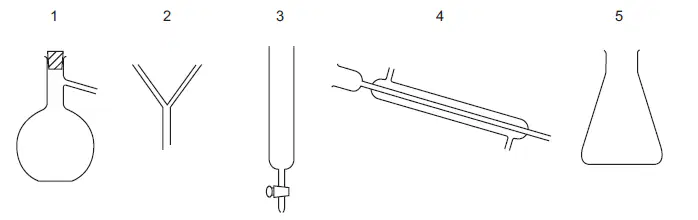
The diagram shows some laboratory apparatus. Which pieces of apparatus are needed to produce and collect pure water from seawater?
a)
1, 2 and 4
b)
1, 4 and 5
c)
2 and 5
d)
3 and 5
32.

Which diagram represents a neutral atom?
a)
A
b)
B
c)
C
d)
D
33.

Which electronic structure represents a fluorine atom?
a)
A
b)
B
c)
C
d)
D
34.
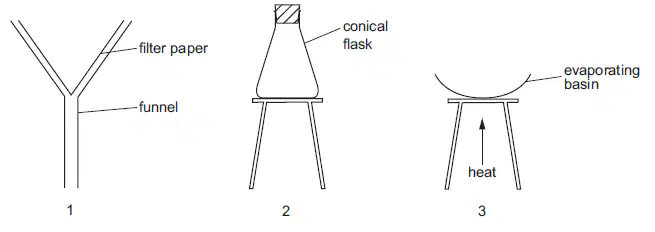
The diagrams show three sets of apparatus. Which apparatus is used to obtain separate samples of sand and salt from a mixture of sand and salt solution?
a)
1 and 3
b)
1 only
c)
2 and 3
d)
3 only
35.
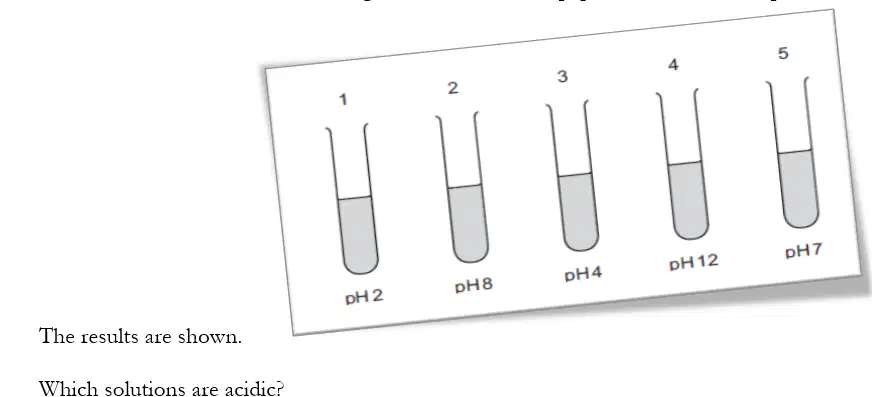
A student tests five solutions to discover which are acidic, alkaline or neutral. The student tests each solution using Universal Indicator paper to determine the pH.
a)
1 and 3
b)
1 and 5
c)
2 and 3
d)
2 and 4
36.
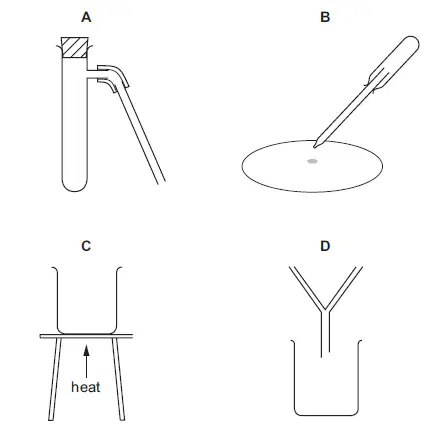
Which apparatus is used to separate and collect the water from a mixture of water and an insoluble powder?
a)
A
b)
B
c)
C
d)
D
37.
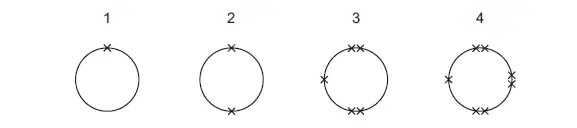
The outer-shell electrons of four atoms are shown. Which two atoms form an ionic compound with a formula XY2?
a)
1 and 3
b)
1 and 4
c)
2 and 3
d)
2 and 4
38.
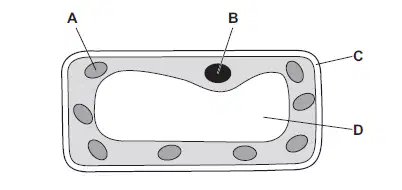
The diagram shows a plant cell. Which labelled structure is a chloroplast?
a)
A
b)
B
c)
C
d)
D
39.
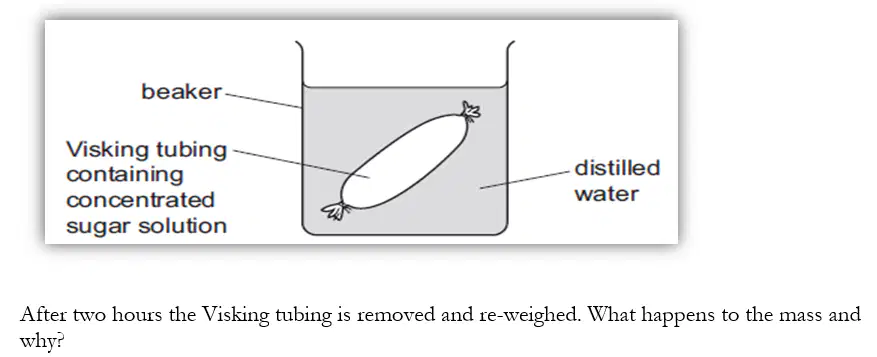
Visking tubing is a partially permeable membrane. Some Visking tubing containing a concentrated sugar solution is weighed and placed in distilled water, as shown.
a)
It decreases because sugar moves out.
b)
It decreases because water moves out.
c)
It increases because sugar moves in.
d)
It increases because water moves in.
40.
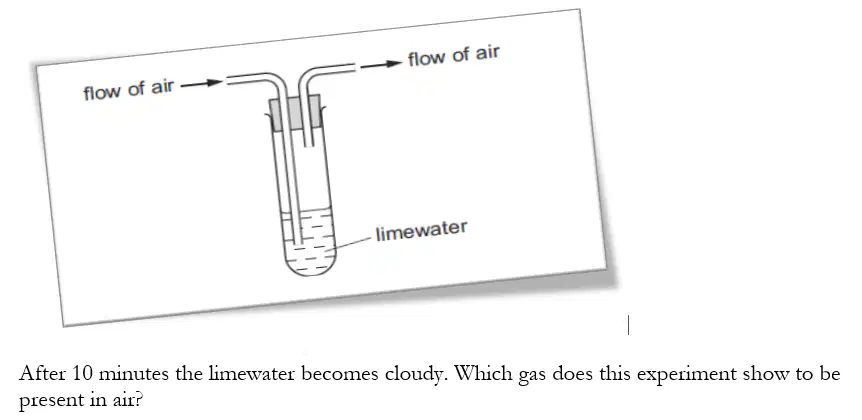
Air is drawn through the apparatus shown.
a)
argon
b)
carbon dioxide
c)
nitrogen
d)
oxygen
41.
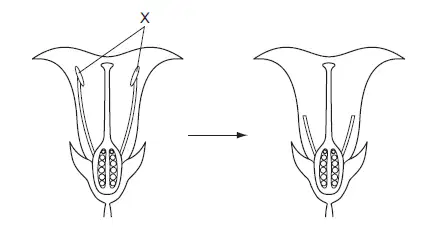
The diagram shows a flower. A plant breeder removed the structures labelled X before they had developed fully. What is the effect of removing these structures?
a)
It prevents asexual reproduction.
b)
It prevents the flower from being pollinated.
c)
It prevents the flower from pollinating itself.
d)
It prevents the flower from producing seeds.
42.
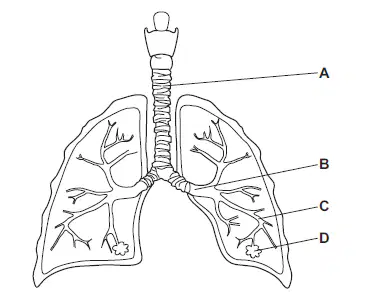
The diagram shows the human breathing system. Where does diffusion of oxygen and carbon dioxide take place?
a)
A
b)
B
c)
C
d)
D
43.
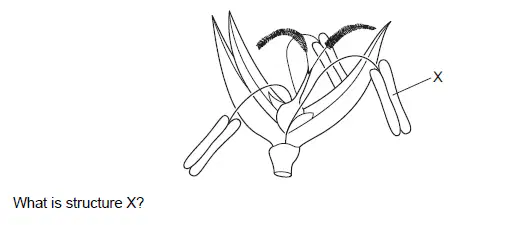
The diagram shows a wind pollinated plant.
a)
anther
b)
carpel
c)
petal
d)
sepal
44.
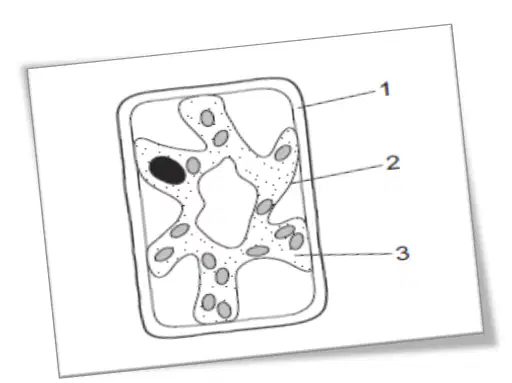
The diagram shows a typical plant cell which has been in a concentrated salt solution for ten minutes. Which numbered structure or structures are partially permeable?
a)
1 and 2
b)
1 and 3
c)
1 only
d)
2 only
45.
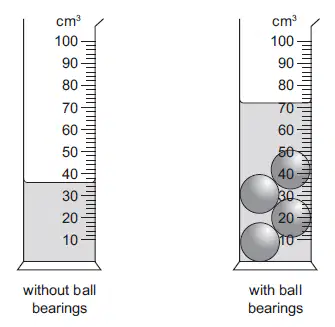
Four identical ball bearings are placed in a measuring cylinder containing water. What is the volume of one ball bearing?
a)
8.75 cm^3
b)
9.00 cm^3
c)
9.50 cm^3
d)
9.75 cm^3
46.

The diagram shows a ray of light being reflected from a plane mirror. The angle of incidence is increased by 10°. What does the angle of reflection become?
a)
30°
b)
40°
c)
50°
d)
60°
47.
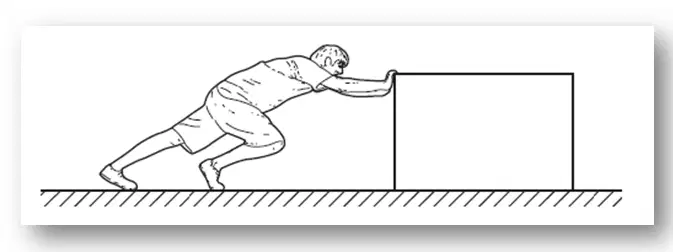
A man pushes a heavy box across a floor. He exerts a force of 80 N and the box moves 4.0 m in 5.0 seconds. What useful power does the man develop?
a)
4.0 W
b)
64 W
c)
100 W
d)
1600 W
48.
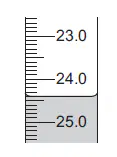
Part of a burette is shown. What is the reading on the burette?
a)
24.30
b)
24.40
c)
25.60
d)
25.70
49.
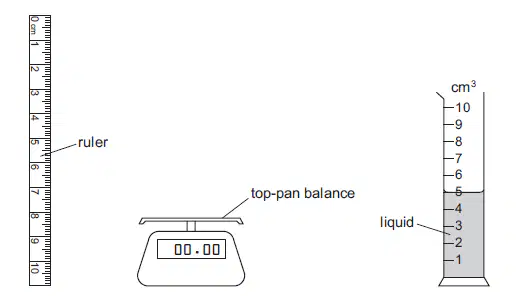
A student wants to find the density of an irregularly-shaped stone. A ruler, a top-pan balance and a measuring cylinder containing liquid are available. What is used to find the density of the stone?
a)
balance and a measuring cylinder containing liquid
b)
balance and a ruler
c)
balance only
d)
ruler and a measuring cylinder containing liquid
50.

The diagram shows the reflection, in a plane mirror, of a ray of light from an object. Which statement is correct?
a)
The image is at X.
b)
The image is between X and Y.
c)
The image is at Y.
d)
The image is between Y and Z.
51.

A metal cooking pan is used to heat up a liquid. How does placing a lid on the pan reduce heat loss?
a)
by reducing conduction through the air above the surface of the liquid
b)
by reducing conduction through the liquid
c)
by reducing convection in the air above the surface of the liquid
d)
by reducing convection in the liquid
100 %

