
 Worksheets
SS Chem Review Sem1
Total questions: 141
Worksheet time: 2hrs 34mins

Place the following in order
Question
Hypothesis
Experiment
Conclusion
Analyze
After you make an observation you state the ____________?
Problem/Question
Hypothesis
Conclusion
Research
An educated GUESS OR PREDICTION
CONCLUSION
RESEARCH
ANALYZE
HYPOTHESIS
LISTING PROCEDURES AND MATERIALS ARE PART OF THE __________?
EXPERIMENT
QUESTION
HYPOTHESIS
CONCLUSION
CHARTS AND GRAPHS ARE ALL PART OF ___________.
PROCEDURES
ANALYZING DATA
MATERIALS
QUESTION
A SUMMARY OF YOUR RESULTS
CONCLUSION
HYPOTHESIS
QUESTION
DATA
The Scientific Method is...
the way scientists make problems and ask questions.
the way scientists answer questions and solve problems.
the way scientists never solve problem.s
Which of the following is a statement that describes something that happens in nature that seems to be true all of the time?
theory
hypothesis
scientific law
conclusion
Which choice is a testable hypothesis?
Ocean water is too salty.
Water heats faster if it contains salt.
Summer is nicer than fall.
Dogs are better than cats.
How many variables should be tested at one time in a scientific investigation?
none
one
two
three
Why do scientists repeat their experiments?
to avoid making observations
to throw out the information they collected earlier
to make sure that the information they collected is reliable
Information from which a conclusion can be drawn. This is what you collect when you are performing your investigation:
control group
experiment
inference
data
Around 400 BC, Greek philosopher Democritus proposed that matter is made of indivisible particles called:
Plum pudding
Atomos
Bohr
Electrons

What is the independent variable on this graph?
Year
Number of Visitors
Visitors to a Park
none of these
A solid is a state of matter that has a(n)
indefinite volume and indefinite shape
definite volume and a definite shape
definite volume and an indefinite shape
indefinite volume and a definite shape
The freezing point of water is the same as its
melting point
boiling point
sublimation point
evaporation point
An uncovered pot of soup is simmering on a stove, and there are water droplets on the wall above the back of the stove. What sequence can you infer has occurred?
melting, then boiling
freezing, then thawing
vaporization, then condensation
condensation, then vaporization
A __________ has a definite shape and a definite volume.
Gas
Liquid
Solid
Plasma

Two flasks each contain water at 25 degrees Celsius. Which one has more heat energy?
They have the same heat energy because they are the same temperature.
The one on the right has more heat energy because it has less water.
The one on the left has more heat energy because it has more water.
Which of the following is true when particles gain thermal energy?
Particles move more slowly.
Particles move closer together.
Particles stop moving.
Particles move further apart.
When a substance changes directly from a gas to a solid, it is called :
Deposition
Sublimation
Condensation
Vaporization

This diagram represents particles in a __________ state.
solid
liquid
gas
plasma
The temperature at which a liquid changes to a gas
Melting Point
Boiling Point
Sublimation Point
Heat of Fusion
Heat of Vaporization
The amount of energy needed change a substance from a solid phase to a liquid phase
Melting Point
Boiling Point
Freezing Point
Heat of Fusion
Heat of Vaporization
The amount of energy required for the liquid at the correct temperature to become a gas.
Melting Point
Boiling Point
Freezing Point
Heat of Fusion
Heat of Vaporization
Which of the following is NOT a part of the Kinetic Theory of Matter?
All matter is made up of tiny particles.
Particles are always moving in random paths
Occasionally, particles stop moving.
The type of movement of particles depends on the amount of energy.

What happens to the average kinetic energy of matter when it is heated?
It increases
It stays the same
It decreases
It cannot be determined

What state of matter is shown in the image?
Solid
Liquid
Gas
Thermal Energy
If the atoms of an object are moving fast, the temperature would be...
High
Low
When the temperature of matter decreases the particles ...
speed up and move farther apart
slow down and move farther apart
speed up and move closer together
slow down and move closer together
When thermal energy is added to a substance, the substance's particles move:
More rapidly at an increased distance from each other.
More slowly with a greater distance between each other.
More rapidly with less distance between each other.
More slowly with a reduced distance between each other.
In the following, what is the unknown variable:
What is the volume of a balloon if it contains 3.2 moles of helium at a temperature of 20⁰C and 1.2 atm?
P
V
n
T
Which of the following variables is NOT correctly matched with its value for this problem:
What pressure is required to contain 0.023 moles of nitrogen gas in a 4.2 L container at a temperature of 20⁰C?
V = 4.2 L
R = 0.0821 L⋅atm∕mol⋅K
n = 0.023 mol
P = 20⁰C
What is the correct value for T in the following problem:
What pressure is required to contain 0.023 moles of nitrogen gas in a 4.2 L container at a temperature of 20⁰C?
T = 0.23 K
T = 293 K
T = 4.2⁰C
T = 20⁰C
Solve the following probem:
What pressure is required to contain 0.23 moles of nitrogen gas in a 4.2 L container at a temperature of 20⁰C?
1.32 atm
0.048 atm
2.49 atm
19.32 atm

When Temperature of a gas increases, the Volume will ____________________
Increase
Decrease
Stay the Same

When Temperature of a gas increases, the Pressure will ____________________
Increase
Decrease
Stay the Same

When Volume of a gas increases, the Pressure will ______________
Increase
Decrease
Stay the Same

What is the Standard for Temperature and Pressure?
273 K and 1 atm
273 C and 1 kPa
273 F and 1 mmHg
273 K and 1 Torr
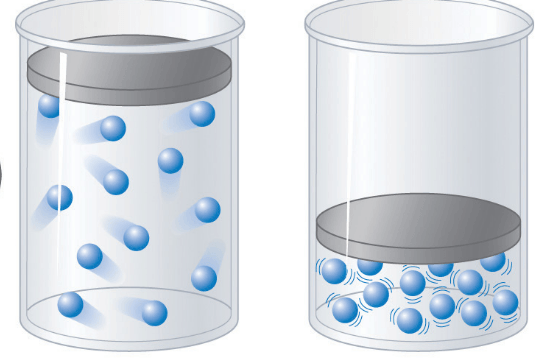
Which container will have a lower pressure?
left
right
they both have the same pressure
A container holds three gases: oxygen, carbon dioxide, and helium. The partial pressures of the three gases are 2.00 atm, 3.00 atm, and 4.00 atm, respectively. What is the total pressure inside the container?
900 atm
0.90 atm
9.00 atm
920 atm
In a mixture of gases, each gas contributes to the total pressure. The individual contribution of each gas is known as the _________________.
partial volume
partial pressure
molar mass
mole ratio
Match the Following
Element
A substance that cannot be broken down into simpler substances by chemical means.
Atom
The smallest unit of an element that keeps the element’s chemical properties.
Nucleus
The dense center of an atom containing protons and neutrons.
Proton
Positively charged particles found in the nucleus of an atom.
Neutron
Particles with a neutral charge found in the nucleus of an atom.
Using a periodic table (you can use the one in the textbook) order the following elements by mass number, least to greatest.
Hydrogen
Boron
Gallium
Thallium
Radon
Using a periodic table (you can use the one in the textbook) order the following elements by # of valence electrons, least to greatest.
Potassium
Barium
Carbon
Oxygen
Neon

How many electron shells does the pictured atom have?
1
2
3
4

How many valence electrons does the pictured atom have?
20
3
2
4

A horizontal row of elements in the periodic table
Molecule
Period
Family
Atom

The smallest particle of an element.
Element
Molecule
Atom

A substance that cannot be broken down into other substances by chemical or physical means.
Covalent bond
Atom
Element
A combination of two or more atoms
Period
Molecule
Atom
Family
A physical model that depicts the atom as a small positively charged nucleus with electrons in orbit at different levels.
Covalent bond
Ionic bond
Bohr Model
Electron dot diagram
Elements in the same vertical column of the periodic table; also called group
Family
Atom
Element
Metals

What is one way Neutrons are different from electrons?
they both are negative
neutrons have no charge, while electrons have a negative charge
Both are in the nucleus( center of atom)
Electrons are inside nucleus and neutrons are outside the nucleus.

What is the atomic number?
35
18
17
52

How many protons and electrons does this element have?
35
18
17
52

How many neutrons does Chlorine have?
18
17
35
52

Which part of the diagram represents the proton?
a
b
c
d
Subatomic Particles
Atomic Number
Mass Number
Gluons
If you leave a bottle of perfume open, eventually you will be able to smell the perfume from across the room. Why?
What causes a solid to have a definite volume and shape?
rigid structure
strong attractions
volume
The particles in a liquid can overcome some forces of attraction because
(a)
Describe the movement of particles in a fluid. Use complete sentence(s)
Match the following solutions or mixtures.
Solution
Coke
Mixture
Mud
Solution
Saltwater
Mixture
Salad
A ________ is a solution in which no more solute can dissolve.
saturated solution
unsaturated solution
supersaturated solution
In the ideal gas law, P = (a) , V = (b) , n = (c) , R = (d) , and T = (e)

What are our known values? You can pick more than one
P
V
n
R
T
Place the following values in the correct spot

Which container will have lower pressure?
First container
second container
You leave a soccer ball outside in the winter. Will the ball end up flatter than it was before?
Only if it's REALLY cold
No
Only if it has a leak
Yes
The more energy that particles have, the ___ they move.
faster
slower
Temperature measures the average ____ _____ of the particles in an object.
(a)

What part of the atom is indicated by the red sphere?
nucleus
electron cloud
electrons
neutrons
What best describes the nucleus?
Located in the center of the atom, holds the atom's mass, and is positively charged.
Located in the center of the atom, does not hold the atom's mass and is negatively charged
Located in the center of the atom, holds the atom's mass, and has no charge
Located in the center of the atom, does not hold the atom's mass, and is positively charged.
What best describes a neutron?
It is located outside of the nucleus and has a negative charge
It is located inside of the nucleus and has a positive charge
It is located outside the nucleus and has no charge
It is located inside the nucleus and has no charge
What best describes a proton?
It is located outside the nucleus and has a positive charge.
It is located inside the nucleus and has a positive charge.
It is located inside the nucleus and has no mass
It is located inside the nucleus and has no charge.
What best describes an electron?
It is located outside of the nucleus and has a negative charge
It is located outside of the nucleus and has no charge
It is located inside the nucleus and has a mass
It is located inside of the nucleus and has no mass
Which subatomic particle has a negative charge?
proton
neutron
electron
all of the above
An atom's reactivity is determined by it's what?
protons
neutrons
valence electrons
mass
What is an Atom?
Atoms are composed of smaller particles called what ?
atoms
subatomic particles
positive particles
nucleus
Protons have what type of charge?
neutral
negative
positive
radioactive
Neutrons have what type of charge?
neutral
negative
positive
radioactive
electrons have what type of charge?
neutral
negative
positive
radioactive
circle the atomic number and underline the atomic mass

A neutral Atom is have the same number of what?
Atomic mass is ____+ ____
Three protons have a total charge of _______.
+3
0
-3
2
Three neutrons have a total charge of ________.
+3
0
2
-3
A nucleus with three protons and three neutrons has a total charge of ________.
+3
0
-3
+6

How many protons are in a Helium atom? (Hint: same as atomic number!)
2
8
5
6

How many protons are in an Oxygen atom? (Hint: same as atomic number!)
2
8
5
6

This is a neutrally-charged lithium ion. It has 3 protons and 3 neutrons. How many electrons does it have?
9
0
6
3
There are _____ types of atomic orbitals.
1
2
3
4
Match the sub shell shape to its name

S

p

d
Match the number of electrons each sub shell can hold to the sub shell name
2
S
6
p
10
d
14
f
Look at a periodic table. Count how many columns on the periodic table are in the "p" block. How many columns did you find?
2
6
10
14
Forces that holds atoms together within the molecule
intermolecular forces
intramolecular forces

Intermolecular Forces are the forces that exist
Between two or more molecules
Within a single molecule
Only in molecules containing carbon
In all molecules
bond type
density
solubility
molecular polarity
The intermolecular force present in all matter is
Hydrogen Bonding
Ionic Bonding
Dipole-Dipole
London or Dispersion
The strongest IMF is
London/Dispersion
Dipole-Dipole
Hydrogen Bonding
For hydrogen bonding to occur, a molecule must have a hydrogen bonded to
carbon
another hydrogen
Fluorine, Chlorine or Oxygen
Fluorine, Nitrogen or Oxygen
The weaker the intermolecular forces of a substance the _____________ the boiling point
higher
lower
In general, substances with stronger intermolecular forces have ________ boiling points than those with weaker forces
Higher
Lower
The same
Which of the following is NOT a type of intramolecular force?
Covalent bonding
Hydrogen bonding
Ionic bonding
Metallic bonding
A pair of bonding electrons
One non-bonding electron
A pair of non-bonding electrons
A pair of electrons on the central atom
The model is based on the principle that electron pairs around the central atom ------ each other.
bond
attract
repel
The ------ of the molecule determines the properties of the compounds.
density
shape
mass

How many lone pair does each Chlorine atom have around it?
6
2
8
3

A linear molecule has _______ bonded pairs and _______ lone pairs on the central atom.
2, 0
0, 2
2, 2
0, 0

A bent molecule has _______ lone pair and _______ bonded pair.
2, 2
0, 0
2, 0
0, 2

What shape is this?
Bent
Linear
Tetrahedral
Trigonal Planar

What molecular shape is this?
Bent
Linear
Tetrahedral
Trigonal Planar

What molecular shape is this?
Bent
Linear
Tetrahedral
Trigonal Planar
A (a) is a positively charged metal ion. It is positive because metals (b) electrons when they form ionic bonds.
Select the compounds that are covalent
NBr3
Al2O3
CH4
PCl5
FeO
Number of electrons in the outer most energy level
Number of protons
Electrons gained or lost in chemical bonding
Number of neutrons gained or lost
For any neutral compound, the sum of the oxidation numbers of the atoms in the compound must equal ..........
-1
+2
0
Select the correct name for KBr?
K = potassium, Br = bromine
potassium bromine
potassium monobromine
phosphorus bromide
potassium bromide
Select the correct name for SrCl2?
Sr = Strontium, Cl = chlorine
strontium dichloride
strontium chloride
strontium chlorine
strontium carbon diioidide
What is the correct name for P2Cl4?
P = phosphorus, Cl = chlorine
Phosphorus chloride
phosphorus tetrachloride
phosphorus chlorine
diphosphorus tetrachloride
What is the name for As4O10?
As = arsenic, O = oxygen
Tetraarsenic decaoxide
arsenic oxide
tetraarsenic tenoxide
tetraarsenic decaoxygen

