
Font size
 Worksheets
BIO 330 Exam 3 Review!!
Total questions: 41
Worksheet time: 39mins
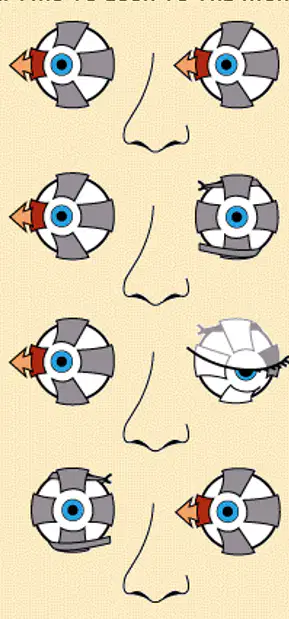
Here are four different patients attempting to look to the right voluntarily. Patient A is fine, but the rest have issues.
Describe what is happening with patient C.
Damage to L abducens nerve
Damage to L PPRF
Damage to L oculomotor nerve
Damage to L MLF
Describe the visual field for someone who has a damaged R optic nerve.
The right ophthalmic branch of the trigeminal nerve innervates the _________.
Right cheekbone area
Right eyebrow area
Right pupil
Right jaw
This nucleus contains UMNs that will innervate ganglia that slows the heartbeat.
Dorsal motor X
Edinger-Westphal
Superior salivatory
Nucleus ambiguus
Here are four different patients attempting to look to the right voluntarily. Patient A is fine, but the rest have issues.
Describe what is happening with patient D.
Damage to R abducens nucleus
Damage to L PPRF
Damage to R abducens nerve
Damage to L MLF
The nuc. ambiguus is an example of a/an ________ nucleus and the hypoglossal nucleus is an example of a/an ________ nucleus.
somatic motor; somatic motor
branchial motor; visceral motor
somatic motor; visceral motor
branchial motor; somatic motor
visceral motor; special sensory
Where are the upper motor neurons for voluntary lateral gaze found?
Optic nerve
Brainstem - midbrain
Frontal eye fields
Occipital lobe
What nerve innervates the superior oblique muscle?
(a)
Describe the function of the MLF.
Which of the following is NOT a parasympathetic (visceral) motor nucleus?
Nucleus solitarius
Dorsal motor X
Salivatory nuclei
Edinger-Westphal
Your patient has had an aneurysm, causing damage to the optic chiasm. How is vision impacted?
The nucleus solitarius is an example of a/an ________ nucleus and the cochlear nuclei are an example of a/an ________ nucleus.
somatic sensory; somatic sensory
branchial motor; visceral motor
somatic sensory; special sensory
branchial motor; somatic sensory
visceral sensory; special sensory
What ocular muscle is responsible for pointing the eye up and out?
Lateral rectus
Superior oblique mm
Inferior oblique mm
Superior rectus
What muscle opens the eye? What is it innervated by?
Levator palpebrae superioris mm; CN III
Orbicularis oculi mm; CN III
Levator palpebrae superioris mm; CN VII
Orbicularis oculi mm; CN VII
What information type does the spinal accessory nucleus process?
Somatic sensory
Visceral motor
Branchial motor
Somatic motor
What nucleus is most associated with chewing (mastication)?
Motor nucleus of CN V
Facial nucleus
Spinal trigeminal nucleus
Hypoglossal nucleus
What cranial nerve innervates the parotid gland? (just give number)
(a)
This houses the UMN for the tectospinal tract and is associated with vision.
Inferior colliculus
Superior colliculus
MGN
LGN
This structure recognizes angular motion via the movement of cilia on hair cells.
Ampulla of semicircular canals
Cochlea
Vestibule
Tympanic membrane
What nerve innervates the medial rectus, inferior rectus, superior rectus, and inferior oblique muscles?
(a)
This houses soma where auditory neurons synapse. It is associated with the reflexive turning of the head.
Inferior colliculus
Superior colliculus
Lateral lemniscus
LGN
This thalamic nucleus processes visual information.
VPM
VPL
MGN
LGN
Your patient, a child, has recently gotten over a fever. Their pupils are normal but the R eye is bloodshot. When asked to close their eyes tightly, the L closes fully but the R eye does not. Their smile is lopsided. You suspect damage to the _______.
Left facial nuc
Left facial nerve
Left trigeminal nerve
Right facial nerve
Right trigeminal nerve
The facial nucleus is an example of a/an ________ nucleus and the oculomotor nucleus is an example of a/an ________ nucleus.
somatic sensory; somatic sensory
branchial motor; visceral motor
somatic sensory; special sensory
branchial motor; somatic motor
visceral motor; special sensory
What cranial nerve constricts the pupil and changes lens shape? (just give number)
(a)
What cranial nerve innervates the sublingual and submandibular glands? (just give number)
(a)

What nucleus is shown in this cross-section?
This thalamic nucleus processes auditory information.
VPM
VPL
MGN
LGN
What type of information is typically found most medially in the brainstem?
Branchial motor
Somatic sensory
Visceral motor
Somatic motor
What cranial nerve causes lacrimation? (just give number)
(a)
The ______ is the roof of the midbrain; the ________ is the floor of the midbrain beneath the ventricle. The ________, sometimes called the cerebral peduncles, contains all the descending white matter tracts from the midbrain.
(a)
This structure recognizes linear/static motion via the movement of cilia on hair cells.
Ampulla of semicircular canals
Cochlea
Vestibule
Tympanic membrane
Here are four different patients attempting to look to the right voluntarily. Patient A is fine, but the rest have issues.
Describe what is happening with patient B.
Damage to L abducens nerve
Damage to L PPRF
Damage to L oculomotor nerve
Damage to L MLF
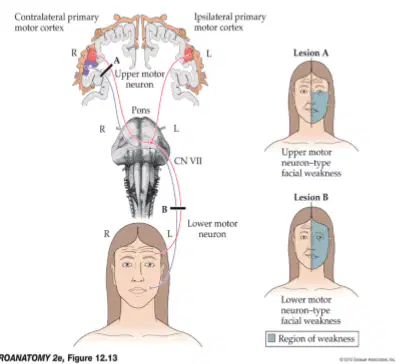
Your patient can't lift their entire L side of their face. Their eye is bloodshot and their eyelid is droopy. What do you suspect is damaged?
L facial nerve UMN damage
R facial nerve LMN damage
L facial nerve LMN damage
R facial nerve UMN damage
Which of the following nerves are associated with nucleus ambiguus, for its functions of speaking and swallowing.
CN VIII
CN IX
CN X
CN XII
Which of the following nerves are associated with nucleus solitarius, for its function of taste?
CN VII
CN IX
CN X
CN V
Which of the following nerves are associated with the dorsal motor nucleus of X?
CN VII
CN IX
CN X
CN V
Which of the following nerves are associated with the trigeminal nuclei (chief sensory and spinal V)?
CN VII
CN IX
CN X
CN V
Describe the visual fields for someone who has a damaged L optic tract.
What muscle closes the eye? What is it innervated by?
Levator palpebrae superioris mm; CN III
Orbicularis oculi mm; CN III
Levator palpebrae superioris mm; CN VII
Orbicularis oculi mm; CN VII
Which of these cranial nerves does not originate from the metencephalon?
CN IV - trochlear
CN V - trigeminal
CN VI - abducens
CN VII - facial

