
Font size
 Worksheets
Ecology questions
Total questions: 61
Worksheet time: 20mins
What is ecology
Room to stay
Environment
Where life interact with non living
Grass
Mistletoe grows and spreads on trees, taking their nutrients:
predation
parasitism
mutualism
commensalism

Barnacles do not affect whales as they grow, but receive the benefit of a food source. This is
parasitism
mutualism
commensalism
neutralism

What is this picture describing?
It is describing natural selection.
It is describing direct competition between flamingos and ducks.
It is describing abiotic factors of the tundra.
It is describing the niche of each bird.

90% of the energy that gets lost as you move up a food pyramid or chain gets lost as
pollution to the environment
heat to the environment
energy for decomposers
gets recycled


Which of the following statements account for the change in population seen between years 7 and 8?
The birth rate of the pigeons increased.
The emigration rate of the pigeons decreased.
The death rate of the pigeons exceeded the birth rate.
The neighborhood reached its carrying capacity for the pigeon population


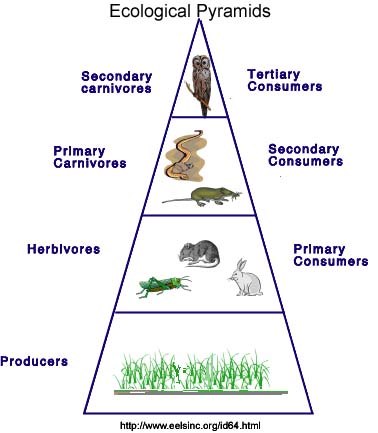
Which organisms would be at the top or last trophic level?
plant
herbivore
omnivore
carnivore
A lion that eats a zebra that eats grass is a
primary consumer
secondary consumer
tertiary consumer
quaternary consumer

These organisms are often not shown in a food chain, but are important for recycling nutrients
producers
decomposers
primary consumers
carnivores

What Biome is also known as the grasslands?
Tropical Rain Forest
Desert
Tundra
Tropical Savanna

The difference between weather and climate is that climate is:
The average, year-to-year conditions
The day-to-day conditions
Described in terms of months at a time
B and C are both correct

In an ecosystem, there are populations of moose, rabbits, grass, and pine trees. Suddenly, a fire blazes through the area, which kills all of the populations. As the months go on, new species of grass begin to take root. This attracts animals, and eventually the ecosystem is restored.
What type of ecological succession happened?
Primary succession
Secondary succession
Tertiary succession
None of the above
In the ocean nitrogen is often the limiting nutrient. What does this term mean?
An unlimited amount of nitrogen is in the ecosystem
Nitrogen is scarce or cycles very slowly through the ecosystem.
The presence of nitrogen limits the availability of other nutrients
Nitrogen is overabundant or cycles very quickly through the ecosystem
In addition to energy, organisms need matter to survive. Which of the following is true about matter in the biosphere?
The total amount of matter decreases overtime
The total amount of matter increases overtime
Biogeochemical cycles transform and reuse molecules
Matter flows through ecosystems in one direction
Each step in a food chain is called a trophic level. What percentage of energy available at one trophic level is transferred to organisms at the next level?
about 2 percent
about 10 percent
about 25 percent
about 50 percent
Although phosphorus is of great biological importance, it is not very common in the biosphere. Why is this?
Phosphorus doesn’t enter the atmosphere
Phosphorus doesn’t cycle through food webs
Phosphorus have been depleted by biological organism
Phosphorus evaporates easily and is quickly destroyed by sunlight

Which of these would be used to describe a Tundra?
Permafrost
Caribou
Cool summers
Rich topsoil
Which type of pollution is caused by Lead?
(a)
What is the primary source of energy for all ecosystems?
Plants
Animals
The water
The sun

A group of populations that interact in an area is called what?
Population
Resources
Squad
Community

This graph represents what?
boom or bust
exponential growth
logistic growth

Which one best describes what a food chain is?
Energy flowing through the ecosystem
A chain that shows who eats who
A chain that shows how life works
Energy flowing through animal cells

The picture depicts which symbiotic relationship?
mutualism
parasitism
predation
commensalism

A volcano in Hawaii erupts and completely decimates a nearby ecosystem covering everything in liquid hot magma. After the magma cools how would you expect life to come back the the ecosystem?
grasses -> small trees -> flowers -> shrubs -> large trees
mosses -> wild flowers -> grasses -> shrubs -> large trees
grass -> wild flowers -> shrubs -> small trees -> large trees
lichens/mosses -> grasses -> shrubs -> small trees -> large trees

What is Biology?
The study of blood
The study of Life
The study of emotions
The study of people

Which species will have the largest population?
Hawks
Snakes
Rabbits
Grass

Which of the following only lists biotic factors that can be found in this ecosystem in Alaska?
moss, aspen trees, weasels, and raccoons
tundra
freezing cold temperatures
hot temperatures

What human activity has the greatest climate change between these?
building buildings
construction
burning fossil fuels
waste

What is Evolution?
Evolution is the changes to one's ecosystem
Evolution is the adaptation to ones environment
Evolution is changes to an environment that change overnight
Evolution is inheritable changes to a population that adapt to an environment.

All living things need nitrogen as a part of DNA and RNA. One type of organism is responsible for "fixing" or helping to put it in a form so other living things can use it. That organism is
Bacteria
Animal fossils
Fungi
Plants
What is an example of a producer for Biology?
Algae
Frog
snake
shark

Which of the following best describes an ecosystem?
a region with a safe climate
all the living organisms of the same species throughout the world
all the living organisms in one area
all the living organisms in an area and their physical surroundings


A hypothesis is an educated guess?
True
False
Which one is another name for a consumer?
Homologous
Sun
Heterotroph
Autotroph
Which of these would be used to describe a Tundra?
Permafrost
Caribou
Cool summers
Rich topsoil
Which type of pollution is caused by Lead?
(a)
Which species will have the largest population?
Hawks
Snakes
Rabbits
Grass
This graph represents what?
boom or bust
exponential growth
logistic growth
Which one is another name for a consumer?
Homologous
Sun
Heterotroph
Autotroph

A group of populations that interact in an area is called what?
Population
Resources
Squad
Community
What is Biology?
The study of blood
The study of Life
The study of emotions
The study of people
What is a Producer?
An organism that eats dead organisms
An organisms that uses sunlight to make its own food
An organism that eats other organisms
An organism that produces protein
Which of the following best describes an ecosystem?
a region with a safe climate
all the living organisms of the same species throughout the world
all the living organisms in one area
all the living organisms in an area and their physical surroundings
All living things need nitrogen as a part of DNA and RNA. One type of organism is responsible for "fixing" or helping to put it in a form so other living things can use it. That organism is
Bacteria
Animal fossils
Fungi
Plants
What is Evolution?
Evolution is the changes to one's ecosystem
Evolution is the adaptation to ones environment
Evolution is changes to an environment that change overnight
Evolution is inheritable changes to a population that adapt to an environment.
What is the source of energy that flows through most of the food chains on Earth?
Plants
Animals
The Sun
Water
A hypothesis is an educated guess?
True
False
What is the primary source of energy for all ecosystems?
Plants
Animals
The water
The sun

After a natural disaster such as a hurricane, tornado, what will happen within the ecosystem?
Nothing and will stay uninhabited
An ecosystem like the previous one will be re-established and renovated
A new ecosystem will be resolved
No one really knows what could happen next
The picture depicts which symbiotic relationship?
mutualism
parasitism
predation
commensalism
What is an example of a producer for Biology?
Algae
Frog
snake
shark
What human activity has the greatest climate change between these?
building buildings
construction
burning fossil fuels
waste

