
Font size
 Worksheets
Chapter 10 Understanding Cryptography and PKI
Total questions: 36
Worksheet time: 36mins
Question #1: A symmetric encryption algorithm is BEST suited for:
key-exchange scalability
protecting large amounts of data
providing hashing capabilities
implementing non-repudiation
Question #2: A security analyst needs to generate a server certificate to be used for 802.1X and secure RDP connections. The analyst is unsure what is required to perform the task and solicits help from a senior colleague. Which of the following is the FIRST step the senior colleague will most likely tell the analyst to perform to accomplish this task?
Create an OCSP
Generate a CSR
Create a CRL
Generate a .pfx file
Question #3: A security analyst discovers that a company username and password database was posted on an internet forum. The username and passwords are stored in plain text. Which of the following would mitigate the damage done by this type of data exfiltration in the future?
Create DLP controls that prevent documents from leaving the network
Implement salting and hashing
Configure the web content filter to block access to the forum.
Increase password complexity requirements
Question #5: A security architect at a large, multinational organization is concerned about the complexities and overhead of managing multiple encryption keys securely in a multi cloud provider environment. The security architect is looking for a solution with reduced latency to allow the incorporation of the organization's existing keys and to maintain consistent, centralized control and management regardless of the data location. Which of the following would BEST meet the architect's objectives?
Trusted Platform Module
laaS
HSMaaS
PaaS
Key Management Service
Question #6: A security assessment determines DES and 3DES are still being used on recently deployed production servers. Which of the following did the assessment identify?
Unsecure protocols
Default settings
Open permissions
Weak encryption
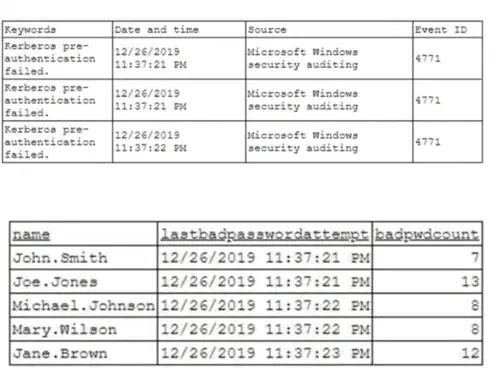
Question #7: A security analyst has been asked to investigate a situation after the SOC started to receive alerts from the SIEM. The analyst first looks at the domain controller and finds the following events:
To better understand what is going on, the analyst runs a command and receives the following output:
Based on the analyst’s findings, which of the following attacks is being executed?
Credential harvesting
Keylogger
Brute-force
Spraying
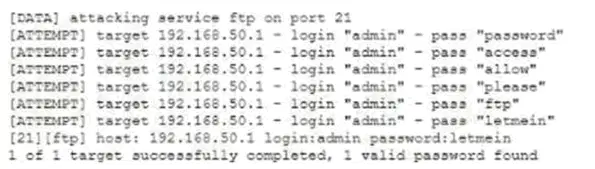
Question #8: Given the following logs: Which of the following BEST describes the type of attack that is occurring?
Rainbow table
Dictionary
Password spraying
Pass-the-hash
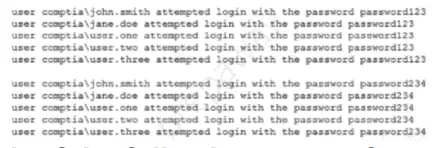
Question #9: A security analyst is reviewing the following attack log output: Which of the following types of attacks does this MOST likely represent?
Rainbow table
Brute-force
Password-spraying
Dictionary
Question #10: Which of the following algorithms has the SMALLEST key size?
DES
Twofish
RSA
AES
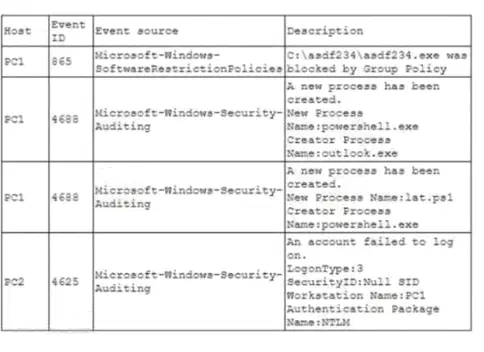
Question #11: A security analyst is investigating an incident to determine what an attacker was able to do on a compromised laptop. The analyst reviews the following SIEM log: Which of the following describes the method that was used to compromise the laptop?
An attacker was able to move laterally from PC1 to PC2 using a pass-the-hash attack
An attacker was able to bypass application whitelisting by emailing a spreadsheet attachment with an embedded PowerShell in the file
An attacker was able to install malware to the CAasdf234 folder and use it to gain administrator rights and launch Outlook
An attacker was able to phish user credentials successfully from an Outlook user profile
Question #13: A security engineer at an offline government facility is concerned about the validity of an SSL certificate. The engineer wants to perform the fastest check with the least delay to determine if the certificate has been revoked. Which of the following would BEST meet these requirements?
RA
OCSP
CRL
CSR
Question #14: A security analyst is hardening a Linux workstation and must ensure. It has public keys forwarded to remote systems for secure login. Which of the following steps should the analyst perform to meet these requirements? (Select TWO)
Forward the keys using ssh-copy-id.
Forward the keys using scp.
Forward the keys using ash -i.
Forward the keys using openssl -s.
Forward the keys using ssh-keygen.
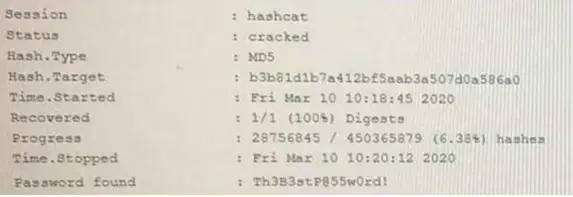
Question #16: An attacker has successfully exfiltrated several non-salted password hashes from an online system. Given the logs below:
Which of the following BEST describes the type of password attack the attacker is performing?
Dictionary
Pass-the-hash
Brute-force
Password spraying
Question #17: A database administrator needs to ensure all passwords are stored in a secure manner, so the administrator adds randomly generated data to each password before the string. Which of the following techniques BEST explains this action?
Predictability
Key stretching
Salting
Hashing
Question #18: Which of the following would MOST likely support the integrity of a voting machine?
Asymmetric encryption
Blockchain
Transport Layer Security
Perfect forward secrecy
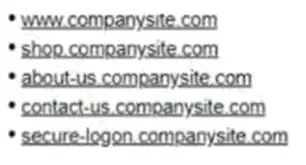
Question #19: A retail company that is launching a new website to showcase the company's product line and other information for online shoppers registered the following URLs:
Which of the following should the company use to secure its website if the company is concerned with convenience and cost?
A self-signed certificate
A root certificate
A code-signing certificate
A wildcard certificate
An extended validation certificate
Question #21: A financial analyst is expecting an email containing sensitive information from a client. When the email arrives, the analyst receives an error and is unable to open the encrypted message. Which of the following is the MOST likely cause of the issue?
The S/MIME plug-in is not enabled.
The SSL certificate has expired.
Secure IMAP was not implemented
POP3S is not supported.
Question #25: After a ransomware attack a forensics company needs to review a cryptocurrency transaction between the victim and the attacker. Which of the following will the company MOST likely review to trace this transaction?
The public ledger
The NetFlow data
A checksum
The event log
Question #26: A security analyst is performing a forensic investigation of compromised account credentials. Using the Event Viewer, the analyst was able to detect the following message, ‘’Special privileges assigned to new login.’’ Several of these messages did not have a valid logon associated with the user before these privileges were assigned.
Which of the following attacks is MOST likely being detected?
Pass-the-hash
Buffer overflow
Cross-site scripting
Session replay
Question #28: A technician enables full disk encryption on a laptop that will be taken on a business trip. Which of the following does this process BEST protect?
Data in transit
Data in processing
Data at rest
Data tokenization
Question #32: In which of the following common use cases would steganography be employed?
Obfuscation
Integrity
Non-repudiation
Blockchain
Question #34: A security analyst was called to Investigate a file received directly from a hardware manufacturer. The analyst is trying to determine whether the file was modified in transit before installation on the user's computer. Which of the following can be used to safely assess the file?
Check the hash of the installation file
Match the file names
Verify the URL download location
Verify the code-signing certificate
Question #35: An application developer accidentally uploaded a company's code-signing certificate private key to a public web server. The company is concerned about malicious use of its certificate. Which of the following should the company do FIRST?
Delete the private key from the repository-.
Verify the public key is not exposed as well.
Update the DLP solution to check for private keys.
Revoke the code-signing certificate.
Question #36: An application owner reports suspicious activity on an internal financial application from various internal users within the past 14 days. A security analyst notices the following:
•Financial transactions were occurring during irregular time frames and outside of business hours by unauthorized users.
•Internal users in question were changing their passwords frequently during that time period.
•A jump box that several domain administrator users use to connect to remote devices was recently compromised.
•The authentication method used in the environment is NTLM.
Which of the following types of attacks is MOST likely being used to gain unauthorized access?
Pass-the-hash
Brute-force
Directory traversal
Replay
Question #37: A customer called a company's security team to report that all invoices the customer has received over the last five days from the company appear to have fraudulent banking details. An investigation into the matter reveals the following:
The manager of the accounts payment department is using the same password across multiple external websites and the corporate account. One of the websites, the manager used recently experienced a data breach. The manager's corporate email account was successfully accessed in the last five days by an IP address located in a foreign country Which of the following attacks has MOST likely been used to compromise the manager's corporate account?
Remote access Trojan
Brute-force
Dictionary
Credential stuffing
Password spraying

Question #39: Security analysts notice a server login from a user who has been on vacation for two weeks The analysts confirm that the user did not log in to the system while on vacation After reviewing packet capture logs, the analysts notice the following:
Which of the following occurred?
A. A buffer overflow was exploited to gain unauthorized access
B. The user's account was compromised, and an attacker changed the login credentials
C. An attacker used a pass-the-hash attack to gain access
D. An insider threat with username smithJA logged in to the account
Question #46: Which of the following encryption algorithms require one encryption key? (Choose two.)
MD5
3DES
BCRYPT
RC4
DSA
Question #47: An organization is migrating several SaaS applications that support SSO. The security manager wants to ensure the migration is completed securely. Which of the following should the organization consider before implementation? (Select TWO).
The back-end directory source
The identity federation protocol
The hashing method
The encryption method
The registration authority
The certificate authority
Question #48: A forensic analyst needs to prove that data has not been tampered with since it was collected. Which of the following methods will the analyst MOST likely use?
Look for tampering on the evidence collection bag
Encrypt the collected data using asymmetric encryption
Ensure proper procedures for chain of custody are being followed
Calculate the checksum using a hashing algorithm
Question #49: Which of the following would be indicative of a hidden audio file found inside of a piece of source code?
Steganography
Homomorphic encryption
Cipher suite
Blockchain
Question #51: Business partners are working on a security mechanism to validate transactions securely. The requirement is for one company to be responsible for deploying a trusted solution that will register and issue artifacts used to sign encrypt, and decrypt transaction files. Which of the following is the BEST solution to adopt?
PKI
Blockchain
SAML
OAuth
Question #55: A company wants to simplify the certificate management process. The company has a single domain with several dozen subdomains, all of which are publicly accessible on the internet. Which of the following BEST describes the type of certificate the company should implement?
A. Subject alternative name
Wildcard
Self-signed
Domain validation
Question #60: Which of the following supplies non-repudiation during a forensics investigation?
A. Dumping volatile memory contents first
B. Duplicating a drive with dd
C. Using a SHA-2 signature of a drive image
D. Logging everyone in contact with evidence
E. Encrypting sensitive data
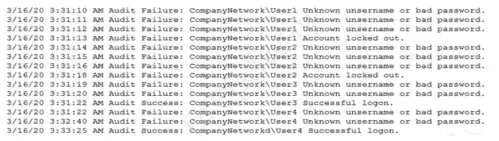
Question #63: A security analyst needs to determine how an attacker was able to use User3 to gain a foothold within a company's network. The company's lockout policy requires that an account be locked out for a minimum of 15 minutes after three unsuccessful attempts. While reviewing the log files, the analyst discovers the following:
Which of the following attacks MOST likely occurred?
Dictionary
Credential-stuffing
Password-spraying
Brute-force
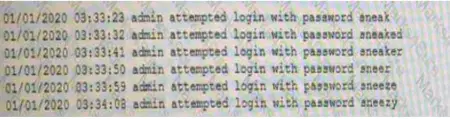
Question #64: A security analyst is reviewing logs on a server and observes the following output:
Which of the following is the security analyst observing?
A rainbow table attack
A password-spraying attack
A dictionary attack
A keylogger attack
Question #69: A systems administrator needs to install the same X.509 certificate on multiple servers. Which of the following should the administrator use?
Key escrow
A self-signed certificate
Certificate chaining
An extended validation certificate

