wayground logo

Free Printable Worksheets

Font size

S
M
L
XL
Worksheets

Geometry Summer School Final Exam

Total questions: 170

Worksheet time: 43hrs 30mins

Name
Class
Date
1.

Which of these symbols represent this picture?

a)

<

b)

c)

d)

2.

Which one is a way to name this line?

a)

̅A̅ ̅B̅

b)

̅B̅ ̅A̅

c)

Line A

d)

Line l

3.

What does this picture represent?

a)

Ray

b)

Line

c)

Segment

d)

Angle

4.
What is this Symbol called?
a)
Congruent
b)
Equal
c)
Parallel Lines
d)
Angle
5.
What is it called when points lie on the same line.
a)
Midpoint
b)
Coplanear
c)
Segment Bisector
d)
Collinear
6.
Points that lie in the same plane.
a)
Colinear
b)
Intersection
c)
Parallel Planes
d)
Coplanear
7.

A straight path of points that goes on and on in opposite directions is called a ____________.

a)

ray

b)

point

c)

line

d)

line segment

8.

A ______ is an exact location in space.

a)

point

b)

planet

c)

right angle

d)

ray

9.

A _______________ is part of a line with two endpoints.

a)

point

b)

ray

c)

straight angle

d)

line segment

10.

What is a plane?

a)

An endless flat surface.

b)

A straight path that goes on and on in two directions.

c)

A part of a line with two endpoints.

d)

A part of a line with one endpoint and one arrow that goes on forever.

11.

What does this image represent?

a)

A point

b)

A line

c)

A line segment

d)

A ray

12.

What does this image represent?

a)

A point

b)

A line

c)

A line segment

d)

A ray

13.

What does this image represent?

a)

A point

b)

A line

c)

A line segment

d)

A ray

14.

Which of the following is the correct formula for distance?

a)

d=(y2y1)2+(x2x1)2d=\sqrt{\left(y_2-y_1\right)^2+\left(x_2-x_1\right)^2}  

b)

d=(y1y2)2+(x1x2)2d=\sqrt{\left(y_1-y_2\right)^2+\left(x_1-x_2\right)^2}  

c)

d=(y2y1) 2(x2x1)2d=\sqrt{\left(y_2-y_1\right)_{\ }^2-\left(x_2-x_1\right)^2}  

d)

d=(y2y1)2+(x2x1)2d=\left(y_2-y_1\right)^2+\left(x_2-x_1\right)^2  

15.

Find the distance between the given points: (5, 5), (−6, −4)

a)

14

b)

7

c)

7.212

d)

14.212

16.

Find the distance of line segment AB between the points at (8,0) and (5,9)

a)

10

b)

9.5

c)

9

d)

11.5

17.

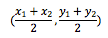
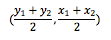
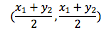
Which of the following is the correct midpoint formula given two endpoints (x1, y1) and (x2, y2)?
a)
b)
c)
d)
18.

Find the midpoint of the line segment with the given endpoints (-2,-6) and (8,8)

a)

(-4,8)

b)

(18,22)

c)

(3,1)

d)

(-5,-7)

19.

Find the midpoint of the line segment with the given endpoints (3,9) and (5,9)

a)

(-1,0)

b)

(4,9)

c)

(6,7)

d)

(7,9)

20.

Find the other endpoint of the line segment with the given endpoint (1,-9) and midpoint (-9,3)

a)

(-19,15)

b)

(5,-6)

c)

(-4,-3)

d)

(6,2)

21.

Find the other endpoint of the line segment with the given endpoint (4,0) and midpoint (-2,8)

a)

(3,-4)

b)

(-8,16)

c)

(2,3)

d)

(5,9)

22.
Find AB.
a)
69
b)
20
c)
19
d)
11
23.
Solve for x
a)
x = 2
b)
x = 4
c)
x = 6
d)
x = 8
24.
What does the word BISECT mean?
a)
To cut something into more than five pieces.
b)
It is a plane with two sets of wings.
c)
A shape that has three sides. 
d)
To cut something into two congruent pieces or in half.
25.
Solve
a)
50°
b)
58°
c)
115°
d)
226°
26.
Solve
a)
25°
b)
125°
c)
145°
d)
45°
27.
What are vertical angles?
a)
Angles that are adjacent to each other
b)
Angles that add up to 180°
c)
Angles that are opposite of each other when lines intersect
d)
Angles that add up to 90°
28.
1. Find X 
a)
28
b)
5
c)
55
d)
40
29.
Given, "If I have a Siberian Husky, then I have a dog." Identify the hypothesis.
a)
If I have a Siberian Husky.
b)
I have a Siberian Husky.
c)
Then I have a dog.
d)
I have a dog.
30.
Given, "If I have a Siberian Husky, then I have a dog." Identify the conclusion.
a)
If I have a Siberian Husky.
b)
I have a Siberian Husky.
c)
Then I have a dog.
d)
I have a dog.
31.
Given, "If I have a Siberian Husky, then I have a dog." Identify the converse.
a)
If I do not have a Siberian Husky, then I do not have a dog.
b)
If I have a dog, then I have a Siberian Husky.
c)
If I do not have a dog, then I do not have a Siberian Husky.
d)
If I do not have a Siberian Husky, then I have a dog. 
32.
Given, "If I have a Siberian Husky, then I have a dog." Identify the inverse.
a)
If I do not have a Siberian Husky, then I do not have a dog.
b)
If I have a dog, then I have a Siberian Husky.
c)
If I do not have a dog, then I do not have a Siberian Husky.
d)
If I do not have a Siberian Husky, then I have a dog. 
33.
Given, "If I have a Siberian Husky, then I have a dog." Identify the contrapositive.
a)
If I do not have a Siberian Husky, then I do not have a dog.
b)
If I have a dog, then I have a Siberian Husky.
c)
If I do not have a dog, then I do not have a Siberian Husky.
d)
If I do not have a Siberian Husky, then I have a dog. 
34.
Conditional: If it does not rain today, then we will have practice.
What is this statement called: If it rains today, then we will not have practice.
a)
Converse
b)
Inverse
c)
Contrapositive
d)
Negation
35.
Conditional: If Maria gets married, then the reception will be at the country club.
What is this statement: If the reception is at the country club, then Maria will be getting married.
a)
Converse
b)
Inverse
c)
Contrapositive
d)
Negation
36.
Original: If Jenny buys a guitar, then she will not buy a keyboard.
What is this? If Jenny does buy a keyboard, then she will not buy a guitar.
a)
Converse
b)
Inverse
c)
Contrapositive
d)
Negation
37.

If possible, use the Law of Detachment to draw a conclusion from the two given statements. If not possible, write not possible.

Conditional: If x = 2, then 2x – 10 = –6.

Premise: x = 2

a)

2x – 10 = –6

b)

If 2x – 10 = –6, then x = 2

c)

x = 2

d)

not possible

38.

If a figure is a rhombus, then the figure is a parallelogram.

If a figure is a parallelogram, then the figure is a quadrilateral.

a)

If a figure is a rhombus, then the figure is a quadrilateral.

b)

If a figure is a quadrilateral, then the figure is a rhombus.

c)

Not possible

39.

Which of the following theorems would verify that ∠COB & ∠AOD are congruent?

a)

Straight Angle Theorem

b)

Congruent Angle Theorem

c)

Vertical Angles Theorem

d)

Linear Pair Theorem

40.

What is the Properties of equality for "If a=b, then a+c=b+c"

a)

Subtraction

b)

Multiplication

c)

Addition

d)

Division

41.

What is the division property of equality?

a)

If a=b, then a+c=b+c

b)

If a=b, then ac=bc

c)

If a=b, then a-c=b-c

d)

If a=b, then a/c=b/c

42.

What is the Property of Equality for "If a=b, then b=a"?

a)

Reflexive

b)

Subsitution

c)

Symmetric

d)

Transitive

43.

What is the Reflexive property of equality

a)

If a=b, then a can be substituted for b in any equation or expression

b)

For any real number a, a=a .

c)

a(b+c)=ab+ac

d)

If a=b, then b=a

44.

for all real numbers x,y and z, If x=y and y=z, then x=z

a)

Substition

b)

Reflexive

c)

Symmetric

d)

Transitive

45.
What is always the 1st statement in reason column of a proof?
a)
Prove
b)
Given
c)
Reason
d)
Statement
46.
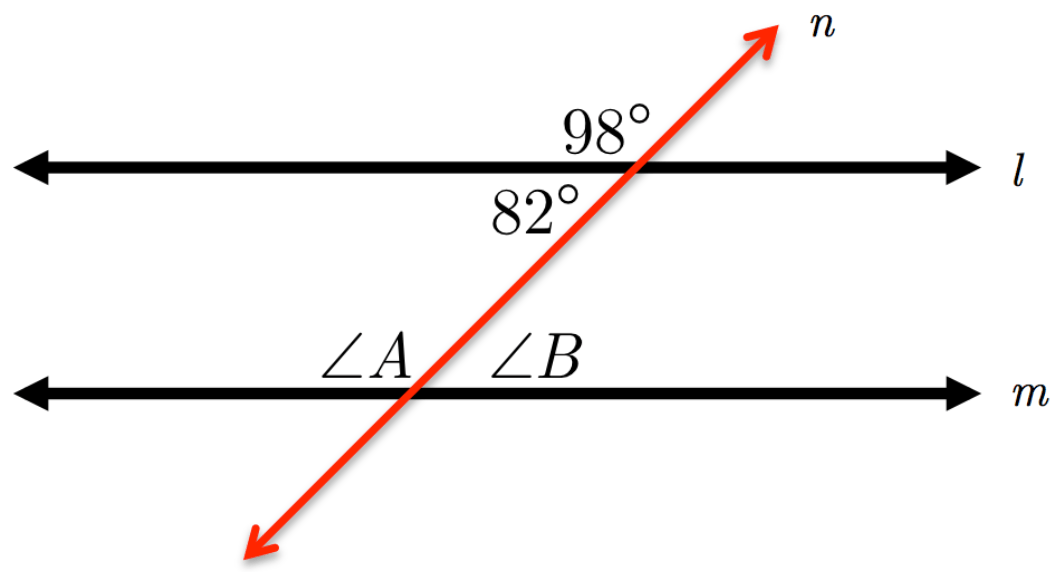
a)
∠B=82°
b)
∠B=98°
c)
∠B=180°
d)
∠B=8°
47.
∠2 & ∠6 are...
a)
Supplementary angles
b)
Vertical angles
c)
Corresponding angles
d)
Alternate interior angles
48.
a)
∠1 & ∠8
are alternate interior angles
b)
∠2 & ∠3
are alternate interior angles
c)
∠4 & ∠5
are alternate interior angles
d)
∠7 & ∠4
are alternate interior angles
49.
a)
alternate interior angles
b)
alternate exterior angles
c)
vertical angles
d)
corresponding angles
50.
Slopes of parallel lines are...
a)
opposite reciprocals.
b)
opposites.
c)
identical.
d)
always 7.
51.
Slopes of perpendicular lines are...
a)
opposite reciprocals.
b)
opposites.
c)
identical.
d)
always 7.
52.

What is the point-slope form of equation of the line that is PARALLEL to y = -2x - 6 and passes through the point (-3, 11)?

a)

y - 11 = -2 (x + 3)

b)

y - 11 = -2 (x - 3)

c)

y - 3 = -2 (x - 11)

d)

y + 3 = -2 (x - 11)

53.

What is the distance between point D and point E?

a)

20\sqrt{20}

b)

6\sqrt{6}

c)

20

d)

~4.5

e)

~2.4

54.

Find the distance between point D and E.

a)

3

b)

18\sqrt{18}

c)

12\sqrt{12}

d)

~3.2

e)

~4.2

55.

Identify the triangle by its sides and angles

a)

Equilateral

b)

Obtuse Equilateral

c)

Acute Equilateral

d)

Acute Isosceles

56.
The Triangle Sum Theorem states that the sum of all angles in a triangle is ______. 
a)
45°
b)
90°
c)
180°
d)
360°
57.
Find the measure of the indicated angle. 
a)
95
b)
85
c)
35
d)
45
58.

A student is trying to construct triangles using four different sets of angles. The angles in each set are given below. Which set will form a triangle?

a)

45°, 65°, 70°

b)

150°, 110°, 100°

c)

50°, 50°, 50°

d)

90°, 90°, 90°

59.

What is the measure of x?

a)

101°

b)

111°

c)

121°

d)

131°

60.
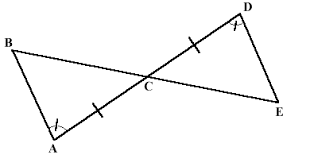
Which triangle congruence theorem can be used to prove the triangles are congruent?
a)
SSS
b)
ASA
c)
AAS
d)
SAS
61.
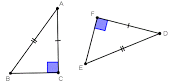
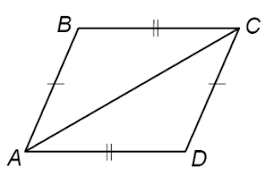
Which triangle congruence theorem can be used to prove the triangles are congruent?
a)
HL
b)
SSA
c)
SAS
d)
AAS
62.
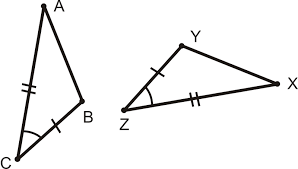
Which triangle congruence theorem can be used to prove the triangles are congruent?
a)
ASA
b)
SAS
c)
AAS
d)
Not enough information
63.
Which triangle congruence theorem can be used to prove the triangles are congruent?
a)
SAS
b)
Not enough information
c)
SSS
d)
AAS
64.
What does CPCTC stand for?
a)
Corresponding Parts of Congruent Triangles are Congruent
b)
Congruent Parts of Congruent Triangles are Corresponding
c)
Colorful Pieces of Corresponding Triangles are Congruent
d)
Congruent Pieces of Congruent Triangles are Congruent
65.
The figure is an example of a(n) ...
a)
altitude 
b)
perpendicular bisector
c)
midsegment
d)
angle bisector
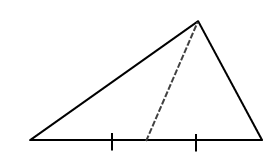
66.
The figure is an example of a(n) ...
a)
angle bisector
b)
midsegment
c)
altitude
d)
median
67.
The figure is an example of a(n) ...
a)
midsegment
b)
perpendicular bisector
c)
altitude
d)
midsegment
68.

What is this point of concurrency?

a)

Centroid

b)

Circumcenter

c)

Orthocenter

d)

Incenter

69.

What is this point of concurrency?

a)

Circumcenter

b)

Orthocenter

c)

Centroid

d)

Incenter

70.

What is this point of concurrency?

a)

Circumcenter

b)

Orthocenter

c)

Incenter

d)

Centroid

71.

a)

F

b)

G

c)

H

d)

J

72.

a)

A

b)

B

c)

C

d)

D

73.

a)

F

b)

G

c)

H

d)

J

74.
List the side measures in order, shortest to longest.
a)
QM, QP, MP
b)
MQ, MP, QP
c)
MP, MQ, QP
75.
List the angles in order by measure, smallest to largest.
a)
∠B, ∠A, ∠C
b)
∠A∠,B, ∠C
c)
∠A, ∠C, ∠B
76.
The sum of the interior angles of a polygon is __________________ where n is the number of sides.
a)
(n - 2)180
b)
(n - 1)180
c)
360
d)
(n - 3)(180)
77.
The sum of the exterior angles of a polygon is __________________ where n is the number of sides.
a)
360
b)
n
c)
(n - 2)180
d)
(n - 1)180
78.
Find the sum of the interior angles of a nonagon.
a)
1260
b)
900
c)
1620
d)
180
79.
Find the measure of ONE exterior angle of a regular decagon.
a)
36
b)
10
c)
18
d)
40
80.
Find the measure of ONE interior angle of a regular dodecagon.
a)
150
b)
120
c)
1800
d)
20
81.
An exterior angle of a regular polygon
measures 36°. How many sides does
the polygon have? 
a)
10
b)
5
c)
14
d)
9
82.
Find the measure of angle E.
a)
9
b)
97°
c)
48°
d)
79°
83.
Solve for x
a)
45
b)
12
c)
90
d)
2
84.
A _______________ is a quadrilateral with two sets of parallel sides.
a)
trapezoid
b)
parallelogram
c)
kite
d)
triangle
85.
A __________________ is a quadrilateral with two sets of parallel sides and 4 right angles
a)
trapezoid
b)
parallelogram
c)
rectangle
d)
square
86.
A ___________ is a quadrilateral with two sets or parallel sides and 4 congruent (equal) sides. 
a)
trapezoid
b)
rhombus
c)
parallelogram
d)
rectangle
87.
A quadrilateral with two sets of parallel sides, 4 right angles, and 4 congruent (equal) sides is a __________________.
a)
trapezoid
b)
parallelogram
c)
rectangle
d)
square
88.
A trapezoid is a quadrilateral with exactly one pair of _____ sides.
a)
parallel
b)
congruent
c)
perpendicular
d)
skew
89.
The diagonals in a kite  __________.
a)
are perpendicular
b)
are congruent
c)
bisect each other
90.

a)

A

b)

B

c)

C

d)

D

91.
What is a Ratio?
a)
Is a comparison of two quantities 
b)
To multiply two fractions 
c)
A number over another number
d)
Two decimals that can be multiplied
92.
What is a proportion?
a)
When two ratios can be simplified
b)
When two ratios are equivalent and show the same value
c)
When two ratios have the exact same numbers
d)
When two ratios can be multiplied by 2
93.

The interior angles of a quadrilateral have a ratio of 2:4:6:3. What is the measure of the smallest angle?

a)

24

b)

48

c)

96

d)

72

94.
The triangles are similar by...
a)
SAS
b)
AA
c)
ASA
d)
SSS
95.
The triangles are similar by...
a)
SAS
b)
AA
c)
ASA
d)
SSS
96.
The triangles are similar by...
a)
SAS
b)
AAS
c)
ASA
d)
SSS
97.
If two figures are similar their angles are______.
a)
proportional
b)
congruent
c)
supplementary
d)
complementary
98.
If two figures are similar, the corresponding sides are ______________.
a)
equal
b)
congruent
c)
proportional
d)
none of these
99.
Simplify:
√45
a)
9√5
b)
3√5
c)
5√9
d)
3√15
100.
Simplify:
√200
a)
10√2
b)
2√10
c)
50√2
d)
2√50
101.
Simplify the following radical: √32
a)
3√2
b)
4√8
c)
16√2
d)
4√2
102.
a)

A

b)

B

c)

C

d)

D

103.
a)

A

b)

B

c)

C

d)

D

104.

Simplify the following

363\frac{36}{\sqrt{3}}  

a)

36\sqrt{36}  

b)

12

c)

434\sqrt{3}  

d)

12312\sqrt{3}  

105.

Simplify:

a)

√5

b)

142\frac{\sqrt{14}}{2}

c)

√7

d)

Cannot be simplified

106.
What type of special triangle is this?
a)
45°-45°-90°
b)
30°-60°-90°
c)
Equiangular
d)
Equilateral
107.
What type of special triangle is this?
a)
45°-45°-90°
b)
30°-60°-90°
c)
Isosceles
d)
Obtuse
108.
Find x.
a)
10
b)
√3
c)
5
d)
10√3
109.
Find x.
a)
4
b)
2
c)
√3
d)
2√2
110.
Find x - the length of the hypotenuse of the triangle.
a)
5
b)
5√2
c)
10
d)
5√3
111.

a)

A

b)

B

c)

C

d)

D

112.

a)

A

b)

B

c)

C

d)

D

113.

a)

A

b)

B

c)

C

d)

D

114.

a)

A

b)

B

c)

C

d)

D

115.

a)

A

b)

B

c)

C

d)

D

116.

a)

A

b)

B

c)

C

d)

D

117.
We can use SOH-CAH-TOA for...
a)
Any triangle ever
b)
Non-right triangles only
c)
Right Triangles only
d)
Never
118.
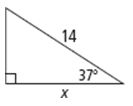
Choose the correct ratio.
a)
sin(37)=x/14
b)
cos(37)=x/14
c)
tan(37)=x/14
d)
sin(37)=14/x
119.
Find the length of side w.
a)
21.4 cm
b)
18.0 cm
c)
36.5 cm
d)
43.6 cm
120.
Find x round to the nearest tenth.
a)
46.1
b)
4.9
c)
16.4
d)
26.9
121.

Find the height(h)?

a)

2000

b)

50

c)

500

d)

1732.05

122.
The original figure prior to a transformation.
a)
Pre-image
b)
Image
123.
The result of a transformation.
a)
Pre-image
b)
Image
124.
Determine where X' would be if you translated X 3 units to the left and 9 units down.
a)
(-4, 4)
b)
(-10, 2)
c)
(-4, -5)
d)
(-1, 5)
125.
How is trapezoid ABCD translated to trapezoid A'B'C'D'?
a)
Translated 5 units down and 5 units to the right
b)
Translated 5 units down and 1 to the right
c)
Translated 8 units down and 5 units to the right
d)
Translated 5 units down and 4 units to the right
126.
If the dotted figure is the image, the original figure was reflected over the ...
a)
x-axis
b)
y-axis
127.
Reflect the point (2, -4) over the y-axis.
a)
(-4, 2)
b)
(-2, 4)
c)
(-2, -4)
d)
(2, 4)
128.
Reflect (6, -3) over the line x-axis.
a)
(6, 3)
b)
(-6, -3)
c)
(-3, 6)
d)
(3, -6)
129.
If you were to rotate ABCD 180°  about the origin, what would the coordinate of A' be?
a)
(-5, 5)
b)
(-3, -5)
c)
(-5, 3)
d)
(-3, 3)
130.
Rotate the point (-5,8) around the origin 270 degrees counterclockwise. State the image of the point.
a)
(-8,5)
b)
(8,-5)
c)
(8,5)
d)
(5,-8)
131.
Triangle B is rotated 90° clockwise with the origin as the center of rotation to create a new figure. Which triangle shows the new location?
a)
A
b)
B
c)
C
d)
D
132.
Does the image show a Dilation? If yes, did the image enlarge, reduce or none of the above?
a)
Yes, enlarge
b)
Yes, reduce
c)
No
133.
What scale factor was used to produce the image?
a)
2
b)
3
c)
1/3
d)
1/2
134.
State the coordinate of the image of the given point B (-10,-6) under a dilation with center at the origin with the given scale factor k = 1/2.
a)
(5,3)
b)
(20,12)
c)
(-20,-12)
d)
(-5,-3)
135.
If a line segment has a length of 12 units and after a dilation the image length is 4 units, what was the scale factor?
a)
3
b)
1/3
c)
8
136.
The distance from the center of a circle to the boundary of a circle (half of the diameter).
a)
Chord
b)
Diameter
c)
Radius
d)
Inscribed Angle
137.
A segment with 2 endpoints on the circle.
a)
Chord
b)
Diameter
c)
Radius
d)
Inscribed Angle
138.
What does "circumference" mean?
a)
Space a circle takes up
b)
Distance around a circle
c)
Line from one side of a circle to another
d)
Line from center of circle to side
139.
Find the arc length.  Leave your answer in terms of π.
a)
7/4π
b)
7/2π
c)
1/8π
d)
45π
140.

Find the length of the minor arc.

a)

199π\frac{19}{9}\pi cm

b)

389π\frac{38}{9}\pi cm

c)

57619π\frac{576}{19}\pi cm

d)

3136π\frac{31}{36}\pi cm

141.
What is 5π/6 radians in degrees?
a)
180
b)
150
c)
360
d)
120
142.
What is 7π/4 radians in degrees?
a)
300
b)
135
c)
315
d)
45
143.
What is 120 degrees in radians?
 
a)
2π/3
b)
π/3
c)
5π/3
d)
4π/3
144.
What is 240 degrees in radians? 
a)
π/3
b)
4π/3
c)
5π/3
d)
2π/3
145.
Find the measure of angle ABD.
a)
14
b)
51
c)
37
d)
65
146.
Solve for x.
a)
29
b)
33
c)
41.5
d)
50
147.
What is the measure of angle 2?
a)
80
b)
45
c)
125
d)
40
148.
What is the value of x?
a)
22
b)
25
c)
15
d)
20
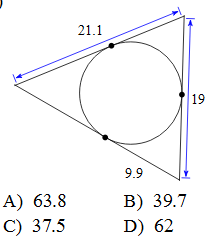
149.
Find the perimeter of the triangle.
a)
A
b)
B
c)
C
d)
D
150.
Find the value of x
a)
10
b)
15
c)
12
d)
19
151.
a)
9
b)
10
c)
15
d)
14
152.
Find the value of x
a)
4
b)
18
c)
3
d)
9
153.
What are the coordinates of the center and the radius of the circle with equation:
(x - 4)2 + (y - 3)2 = 25 ?
a)
Center (4,3)
Radius = 5 units
b)
Center (4,3)
Radius = 25 units
c)
Center (-4,-3)
Radius = 25 units
d)
Center (-4,-3)
Radius = 5 units
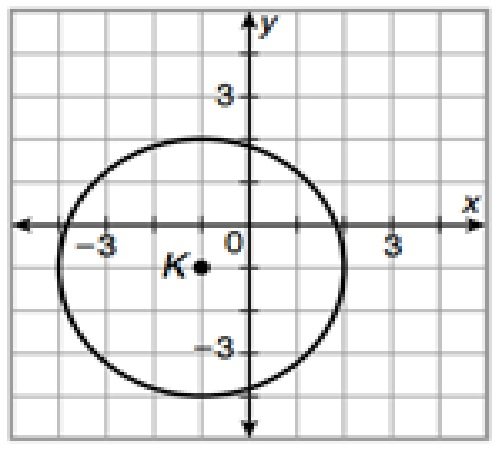
154.
What is the equation of the circle?
a)
(x+1)2 + (y +1)2 = 3
b)
(x+1)2 + (y -1)2 = 3
c)
(x+1)2 + (y +1)2 = 9
d)
(x-1)2 + (y -1)2 = 9
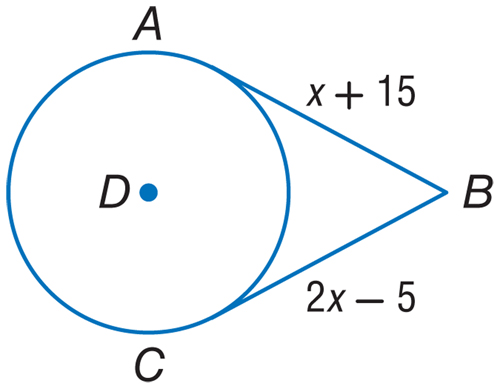
155.
Find x.  Assume that segments that appear to be   tangent are tangent.
a)
11.2
b)
18.0
c)
25.0
d)
30.0
156.

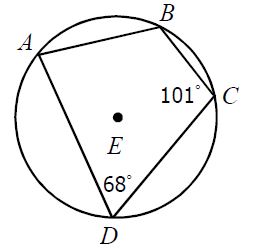
What is the measure of angle A?

a)

34°

b)

180°

c)

112°

d)

79°

157.

What is x?

a)

15

b)

23

c)

2

d)

92

158.

Find the area of the kite.

a)

19.5

b)

78

c)

39

d)

27

159.
a)
4,326 in2
b)
1,512 in2
c)
2,317.5 in2
d)
2,163 in2
160.

What is the area of the rhombus?

a)

264 m2

b)

448 m2

c)

121 m2

d)

255 m2

161.
What is the area of this circle?
a)
16π
b)
c)
d)
16π²
162.
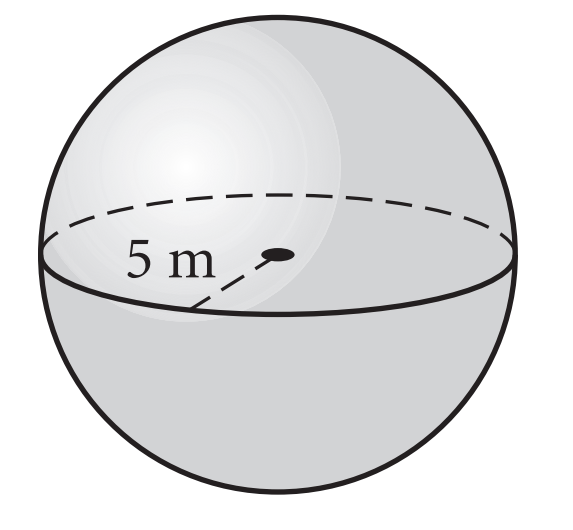
Find the volume of the Sphere
a)
78.5 m3
b)
392.5 m3
c)
523.6 m3
d)
62.8 cm3
163.
A basketball has a radius of 6 inches.  What is the volume of the basketball
a)
904.32
b)
150.72
c)
1356.48
d)
452.16
164.
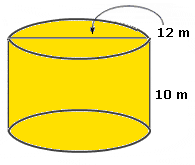
 Find the volume of the Cylinder
a)
7230
b)
6621
c)
1130
d)
907
165.
Michael has a very large soup pot shaped like a cylinder that has a height of 15  inches and a radius of 6 inches. How much soup can Michael’s soup pot hold?
a)
4239 in3
b)
423.9 in3
c)
1695.6 in3
d)
 1695.6 in2
166.
V = ?
a)
14.13 in3
b)
56.52 in3
c)
169.56 in3
167.
Find the volume of the cone. Round your answers to the nearest tenth. Use 3.14 for π.
a)
127.3 yd3
b)
347.6 yd3
c)
287.7 yd3
d)
147.7 yd3
168.

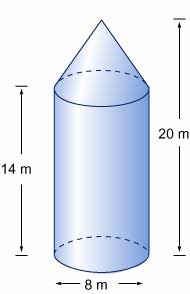
Find the volume of the following shape.

(What two solids are being added together??)

a)

4155.27 m3

b)

1038.82 m3

c)

804.24 m3

d)

1005.31 m3

169.
Which equation would you use to find the volume of this composite figure?
a)
π(2)²(8) + 4/3π(2)³
b)
π(2)²(4) + 4/3π(2)³
170.
Which equation would you use to find the volume of this composite figure? 
a)
834/3π(8)³
b)
834/3π(4)³
c)
83 + (1/2)(4/3)π(4)³