wayground logo

Free Printable Worksheets

Font size

S
M
L
XL
Worksheets

HA2 Logs and Exp Mixed Review

Total questions: 169

Worksheet time: 11hrs 7mins

Name
Class
Date
1.

Expand

a)

A

b)

B

c)

C

d)

D

2.
log88
a)
8
b)
-8
c)
1
d)
0
3.
log334
a)
3
b)
4
c)
1
d)
0
4.
a)
A
b)
B
c)
C
d)
D
5.
a)
log (a+ b25)
b)
log (a− b25)
c)
log (ab25)
d)
log (a5/b25)
6.
Rewrite logb(xn)
a)
nlogbx
b)
(logbx)n
c)
xnlogbx
d)
logb(xn)
7.
Expand
a)
A
b)
B
c)
C
d)
D
8.
Expand
a)
A
b)
B
c)
C
d)
D
9.
Logarithmic functions are the inverse of...
a)
Linear Functions
b)
Exponential Functions 
c)
Quadratic Functions 
d)
Polynomial Functions 
10.
Rewrite logvn = a in exponential form.
a)
va = n
b)
na = v
c)
vn = a
d)
an = v
11.

Change y = ax into log form.

a)

x = logay

b)

y = logax

c)

x = logya

d)

y = log a

12.

 What is log104\log10^4 ? (Hint: change into expon. form first)

a)

10

b)

4

c)

10410^4  

d)

1

13.

What is lne2\ln e^2 ?  (Hint: what is the hidden base of ln?)

a)

1

b)

e

c)

2

d)

e2e^2  

14.

Expand: log(4x)

a)

log4-logx

b)

log4+logx

c)

4logx

d)

xlog4

15.

Rewrite as a single logarithm:

log3 + log7\log3\ +\ \log7  

a)

log 10

b)

log 21

c)

log 3/7

d)

log 3/log 7

16.

Expand  log4(3xy)\log_4\left(3xy\right)  

a)

log4(3) + log4(x) log4(y)\log_4\left(3\right)\ +\ \log_4\left(x\right)-\ \log_4\left(y\right)

b)

3log4(x) + 3log4(y)3\log_4\left(x\right)\ +\ 3\log_4\left(y\right)

c)

log4(3) + log4(x)+ log4(y) \log_4\left(3\right)\ +\ \log_4\left(x\right)+\ \log_4\left(y\right)\

d)

4log(3) + 4log(x)+ 4log(y) 4\log\left(3\right)\ +\ 4\log\left(x\right)+\ 4\log\left(y\right)\

17.

Condense into a single logarithm.
log25+log29+log2w\log_25+\log_29+\log_2w  

a)

log2(14w)\log_2\left(14w\right)  

b)

log2(45w)\log_2\left(45w\right)  

c)

log2(14w)\log_2\left(\frac{14}{w}\right)   

d)

log2(14+w)\log_2\left(14+w\right)  

18.

Expand:   log(xy)\log\left(\frac{x}{y}\right)  

a)

logx+logy

b)

xlogy

c)

log(x-y)

d)

logx-logy

19.

Which are equivalent to:


log242\log_24^2

(There is more than 1 correct answer) 

a)

4log224\log_22  

b)

2log422\log_42  

c)

2log242\log_24  

d)

4

e)

2

20.

Which are equivalent to:


2log392\log_39  
(There is more than 1 correct answer)

a)

log392\log_39^2  

b)

log329\log_32^9  

c)

4

d)

3

e)

9

21.

Condense into one log:   2log3(x)+log3(y)2\log_3\left(x\right)+\log_3\left(y\right)  

Remember to use the power property first!

a)

log3(2xy) \log_3\left(2xy\right)\

b)

log3(x2y)\log_3\left(x^2y\right)

c)

log3(xy)2\log_3\left(xy\right)^2

d)

2log3(xy)2\log_3\left(xy\right)

22.

Condense into a single log expression.

a)
b)
c)
d)
23.

Expand:   this has a mix of Product and Quotient Prop.:

log(8xyz) \log\left(\frac{8x}{yz}\right)\  

a)

log8+logx-logy-logz

b)

log8+logx-logy+logz

c)

log(8x)-log(yz)

d)

8logx-ylogz

24.
Evaluate blogb(x)
a)
x
b)
b
c)
1
d)
0
25.
Expand.
a)
1/3 log x + log y + log z
b)
1/3 log x + 1/3 log y + 1/3 log z
c)
1/3 log x - 1/3 log y - 1/3 log z
d)
3 log x + 3 log y + 3 log z
26.
Evaluate logb(bx)
a)
1
b)
0
c)
x
d)
b
27.
Solve for x:
4x- 5 = 12
a)
0.489
b)
2.552
c)
0.893
d)
2.044
28.
log2(x + 5) = 3
a)
3
b)
4
c)
5
d)
6
29.
Expand ln xy2z3
a)
6(lnx + lny - lnz)
b)
lnx + 2lny - 3lnz
c)
lnx + (1/2)lny + (1/3)lnz
d)
lnx + 2lny + 3lnz
30.
Write 2 log x  - log y as a single logarithm
a)
log x2  y
b)
log x2  y2
c)
log x2/y
d)
log (x / y)2
31.

Rewrite into exponential form

a)
b)
c)
d)
32.

Rewrite into exponential form

a)
b)
c)
d)
33.

Rewrite into log form

a)
b)
c)
d)
34.

Rewrite into log form

a)
b)
c)
d)
35.

Evaluate

a)

A

b)

B

c)

C

d)

D

36.

Evaluate

a)

A

b)

B

c)

C

d)

D

37.

Evaluate

a)

A

b)

B

c)

C

d)

D

38.

Evaluate

a)

A

b)

B

c)

C

d)

D

39.

Solve

a)

A

b)

B

c)

C

d)

D

40.

Solve

a)

A

b)

B

c)

C

d)

D

41.

Find all valid solutions

a)

A

b)

B

c)

C

d)

D

42.

Find all valid solutions

a)

A

b)

B

c)

C

d)

D

43.

Find all valid solutions

a)

A

b)

B

c)

C

d)

D

44.

Find all valid solutions

a)

A

b)

B

c)

C

d)

D

45.

Find all valid solutions

a)

A

b)

B

c)

C

d)

D

46.

Solve

a)

A

b)

B

c)

C

d)

D

47.

Solve

a)

A

b)

B

c)

C

d)

D

48.

Solve

a)

A

b)

B

c)

C

d)

D

49.

Solve

a)

A

b)

B

c)

C

d)

D

50.

Solve

a)

A

b)

B

c)

C

d)

D

51.

Solve

a)

A

b)

B

c)

C

d)

D

52.
Solve: 7-x = 49
a)
x = 1
b)
x = -1
c)
x = 2
d)
x = -2
53.
Sovle for x:
5-3x - 1 = 25
a)
x = -1
b)
x = -4
c)
x = -3
d)
x = 1
54.
Solve 33 = 34x + 2
a)
x = ¼
b)
x = -¼
c)
x = ½
d)
x = -½
55.
Solve 8 = 25x+7
a)
x = ⅘
b)
x = ¼
c)
x = -⅘
d)
x = -¼
56.
83x+3 = 86
a)
x=28
b)
x=3
c)
x=1
d)
x=12
57.

Solve each equation. Select the closest answer.

a)

4.5

b)

1.5

c)

1.8

d)

5

58.
Log with a base "e" (loge) is the same thing as...
a)
"e"
b)
Natural Logarithm (LN)
c)
Common Logarithm (Log)
d)
Natural Log, base "e"
LNe
59.
Solve the equation for x.
a)
5.352
b)
4.326 E91
c)
2.324
d)
1.89
60.
To solve 8 = 25x+7, you would need to re-write 8 as what base?
a)
8
b)
4
c)
2
d)
Cannot be determined
61.
To solve 36 = 6x, re-write 36 as what base and exponent?
a)
36
b)
63
c)
62
d)
312
62.
Solve 8 = 25x+7
a)
b)
¼
c)
-⅘
d)
63.
Solve 33 = 34x + 2
a)
¼
b)
c)
½
d)
64.
Solve for n:
2-2n = 26
a)
-1
b)
-7
c)
5
d)
-3
65.
Solve for b:
43b - 3 = 1/16
a)
7
b)
-1/4
c)
1/2
d)
1/3
66.
Solve for p:
4p+2 = 64
a)
-16/9
b)
1
c)
8
d)
7/6
67.

Solve the following exponential equation:
98x=27x39^{8-x}=27^{x-3}  

a)

x=5x=5  

b)

x=5x=-5  

c)

x=15x=\frac{1}{5}  

d)

x=15x=-\frac{1}{5}  

68.

Solve the following exponential equation:
(12)2x=43\left(\frac{1}{2}\right)^{2x}=4^3  

a)

x=3x=3  

b)

x=52x=-\frac{5}{2}  

c)

x=3x=-3  

d)

x=52x=\frac{5}{2}  

69.
813-x = (1/3)5x-6
a)
6
b)
-6
c)
9/2
d)
3/2
70.
Solve the equation for x.
a)
x = 2
b)
x = 3
c)
x = 8
d)
x = 64
71.

solve for x.

32x134=33^{2x-1}\cdot3^4=3  

a)

1/2

b)

5/8

c)

-1

d)

8/5

72.
Solve
a)
A
b)
B
c)
C
d)
D
73.
7n+10- 8 = 6
a)
-7.374
b)
-8.643
c)
-7.360
d)
-8.853
74.
log(x+6) = 1
a)
4
b)
4.222
c)
-5
d)
-9.550
75.
Solve
a)
A
b)
B
c)
C
d)
D
76.
Solve: 98-x = 27x-3
a)
x = 5
b)
x = -5
c)
x = 1/5
d)
x = -1/5
77.

The value of a book is $58 and depreciates at a rate of 7% per year. Write an exponential function to find the value of the book after 8 years.

a)

$32.46

b)

$76.32

c)

$54.26

d)

$73.62

78.

The population of a small town is 1600 and is increasing at a rate of 3% per year. Write an exponential function to model this situation. Then find the population of the town after 10 years.

a)

2,150 people

b)

1,738 people

c)

2,128 people

d)

1,819 people

79.

The population in Haywardsville is decreasing at a rate of 2.5% per year. If the population in 2000 was 28,000, what will be the expected population in 2015 if this rate of decrease continues? hint* t=15

a)

19,153

b)

19,285

c)

18,956

d)

19,172

80.

A population of 937 people is slowly declining.
Every year the population drops by 4.5%. What is the population after 3 years?

a)
1,069 people
b)
894 people
c)
816 people
d)
854 people
81.
The original value of a painting is $1400, and the value increases by 9% each year. Write an exponential growth function to model this situation.
a)

y=1400(1+0.09)x

b)
y=1.09(1400)x
c)

y=1400(1-0.09)x

d)
y=1.09x
82.
Suppose you deposit $3000 in a savings account that pays interest at an annual rate of 4%. If no other money is added or withdrawn from the account, how much will be in the account after 10 years?
a)
$3122.18
b)
$4994.50
c)
$4440.73
d)
$86,776.40
83.
Daniel’s Print Shop purchased a new printer for $35,000. Each year it depreciates at a rate of 5%. How much will the printer be worth in 8 years?
a)
$23,219.72
b)
$136.72
c)
$51,710.94
d)
$16,710.94
84.

This is an example of:

a)

Linear Growth

b)

Linear Decay

c)

Exponential Growth

d)

Exponential Decay

85.

This is an example of:

a)

Linear Growth

b)

Linear Decay

c)

Exponential Growth

d)

Exponential Decay

86.

This is an example of: f(x)= 25 ( 0.20)xf\left(x\right)=\ 25\ \left(\ 0.20\right)^x  

a)

Linear Growth

b)

Linear Decay

c)

Exponential Growth

d)

Exponential Decay

87.

How do you know that this was exponential decay? f(x)= 25 ( 0.20)xf\left(x\right)=\ 25\ \left(\ 0.20\right)^x  

a)

Because the 25 was bigger than one

b)

Because the 0.20 was bigger than one

c)

Because the 25 was less than one

d)

Because the 0.20 was less than one

88.

This is an example of: f(x)= 0.25 ( 1.3)xf\left(x\right)=\ 0.25\ \left(\ 1.3\right)^x  

a)

Linear Growth

b)

Linear Decay

c)

Exponential Growth

d)

Exponential Decay

89.

How do you know that this was exponential growth? f(x)=0 .25 ( 1.3)xf\left(x\right)=0\ .25\ \left(\ 1.3\right)^x  

a)

Because the 0.25 was bigger than one

b)

Because the 1.3 was bigger than one

c)

Because the 0.25 was less than one

d)

Because the 1.3 was less than one

90.

This function represents the number of ants in a colony f(x)=3 ( 2)xf\left(x\right)=3\ \left(\ 2\right)^x How many ants did you begin with? 

a)

There was 2 ants

b)

There was 3 ants

c)

The equation doesn't tell us

91.

This function represents the number of ants in a colony f(x)=3 ( 2)xf\left(x\right)=3\ \left(\ 2\right)^x What is the growth rate?

a)

The ants are growing by 3 times

b)

The ants are growing by 2 times

c)

The equation doesn't tell us

92.

If the decay rate is 20%, which of the following represent the decay factor?

a)

0.2

b)

0.8

c)

1.2

d)

1.8

93.

If the growth rate is 80%, what is the growth factor?

a)

0.2

b)

0.8

c)

1.2

d)

1.8

94.

 A flea medicine breaks down at a rate of 20% per hour.  This is the rate of decay of the medicine. The initial dose is 60 milligrams. Which of the following represent the equation the models the amount of flea medicine left in an animal?

a)

y=60(.2)xy=60\left(.2\right)^x  

b)

y=20(60)xy=20\left(60\right)^x  

c)

y=60(.8)xy=60\left(.8\right)^x  

d)

y=60(1.2)xy=60\left(1.2\right)^x  

95.

Jack invest $600 earning 5% interest rate. How much will he have after 5 years?

a)

$630

b)

$729.30

c)

$765.77

d)

$4556.25

96.
Classify the model as Exponential GROWTH or DECAY.
A=1200(.85)6
a)
Growth
b)
Decay
97.
A population of fish starts at 8,000 and decreases by 6% per year. What is the population of fish after 10 years?
a)
14327
b)
4309
c)
839
d)
7680
98.
If 10 mg of iodine 131 is given to a patient, how much is left after 24 days? The half-life of iodine-131 is 8 days.
a)
1.25mg
b)
1.25g
c)
10g
d)
10mg
99.
The half-life of strontium-90 is 25 years. How much strontium-90 will remain after 100 years if the initial amount is 4.0 g?
a)
3.0g
b)
0.25mg
c)
0.3g
d)
0.25g
100.
If the half-life of uranium-232 is 70 years, how many half-lives will it take for 10 g of it to be reduced to 1.25 g?
a)
1 half-life
b)
2 half-lives
c)
3 half-lives
d)
4 half-lives
101.
Imagine you have 50,000 atoms of uranium-238. If U-238 has a half-life of 4.5 billion years, how many U-238 atoms will be left after 4.5 billion years? 
a)
25,000
b)
50,000
c)
12,500
d)
0
102.
You have 100 grams of radioactive C-14. The half life of C-14 is 5730 years. 
How many grams are left after 1 half life? 
a)
100 grams
b)
25 grams
c)
2 grams
d)
50 grams
103.
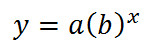
In an exponential function, what does the 'a' represent? 
a)
SLOPE
b)
RATE OF CHANGE
c)
Y-INTERCEPT
d)
COMMON RATIO
104.
Describe the equation
y = 100 * 2x
a)
It starts with 100 and is tripling
b)
It starts with 100 and is doubling
c)
It starts with 2 and is being multiplied by 100 each time
d)
It starts with 100 and is adding 2 each time
105.
Linear, exponential, or neither?
Amount triples each year
a)
Linear
b)
Exponential
c)
Neither
d)
All of the above
106.
Linear, exponential, or neither?
Amount increases $10 per year
a)
Linear
b)
Exponential
c)
Neither
d)
All of the above
107.

Suppose the population of a species of insects doubles every year. There are 1600 insects initially. The function for the scenario would be?

a)

f(x)=2x+1600f\left(x\right)=2x+1600

b)

f(x)=1600×2f\left(x\right)=1600\times2

c)

f(x)=16002xf\left(x\right)=1600\cdot2^x

108.

Write and exponential function for the following problem: Mrs. Madison starts the year off with 100 pencils. Each week, half of the pencils disappear. How many would be left after x weeks?

a)

y=100(2)xy=100\left(2\right)^x

b)

y=100(12)xy=100\left(\frac{1}{2}\right)^x

c)

y=2x + 100y=2x\ +\ 100

d)

y=(12)xy=\left(\frac{1}{2}\right)^x

109.

What would be the "a" value (initial value) for this problem?

A local zoo has a population of 32 meerkats. They are doubling every 5 years. How many would there be in 10 years?

a)

32

b)

2

c)

5

d)

10

110.

What would be the "b" value (multiplier) for this problem?

A local zoo has a population of 32 meerkats. They are doubling every 5 years. How many would there be in 10 years?

a)

32

b)

2

c)

5

d)

10

111.

Solve this problem: When the apocalypse began, there were 5 zombies. Each day that number tripled. How many zombies would there be after a week (7 days)?

a)

22

b)

9,218

c)

10,935

d)

915

112.

Write an equation for this problem: Mrs. Madison brings in 3 dozen donuts for your class. Each hour, y'all eat a third of them. How many donuts would be left after x hours?

a)

y=3(13)xy=3\left(\frac{1}{3}\right)^x  

b)

y=3(23)xy=3\left(\frac{2}{3}\right)^x  

c)

y=36(23)xy=36\left(\frac{2}{3}\right)^x  

d)

y=36(13)xy=36\left(\frac{1}{3}\right)^x  

113.

Solve the problem: Mrs. Madison has discovered she likes to crochet. She went out an bought 7 skeins of yarn to start her collection. That collection has doubled each month. How many skeins of yarn would she have after 6 months?

a)

512 skeins

b)

448 skeins

c)

98 skeins

d)

235,298 skeins

114.
Where is the asymptote?
a)
x = 1
b)
y = 1
c)
x = -1
d)
y = -1
115.
What is the domain?
a)
(-∞, ∞)
b)
(0, ∞)
c)
[1, ∞)
d)
(1, ∞)
116.
What is the domain and range of
f(x) = log 3 (x + 1)?
a)
D: (− ∞, ∞) R: (−1, ∞)
b)
D: (− ∞, ∞) R: (1, ∞)
c)
D: (−1, ∞) R: (− ∞, ∞)
d)
D: (1, ∞) R: (− ∞, ∞)
117.

A vertical shift will affect a logarithm's asymptote.

a)

False

b)

True

118.

Describe the transformations from the parent function.

a)

Right 1 Up 5

b)

Right 1 Down 5

c)

Left 1 Up 5

d)

Left 1 Down 5

119.
What is the Domain?
a)
(-3,∞)
b)
(5,∞)
c)
(3,∞)
d)
(-5,∞)
120.
Classify the following graph.
a)
Exponential Growth
b)
Exponential Decay
c)
Logarithmic
121.
Classify the following graph.
a)
Exponential Growth
b)
Exponential Decay
c)
Logarithmic
122.

Change to exponential form.

loga2 = 5

a)

a2 = 5

b)

52 = a

c)

a5 = 2

d)

25 = a

123.
Logarithms are the inverse of ___________.
a)
Trees
b)
Quadratics
c)
Square
d)
Exponential
124.

Identify the percent (%) increase or decrease for the following function.


f(x) = 35 (1 – 0.06)x

a)

Increase by 6%

b)

Decrease by 0.06%

c)

Increase by 0.06%

d)

Decrease by 6%

125.

What is the percent (%) of increase or decrease in the following function?


f(x) = 3000 (1 + 0.4)x

a)

Decrease by 4%

b)

Increase by 4%

c)

Increase by 40%

d)

Decrease by 40%

126.

Write the function for the info below.


Initial Value: 25,000

Decay: Decrease by 5%

a)

f(x)=0.05(25,000)x

b)

f(x) = 0.95(25,000)x

c)

f(x) = 25,000 (0.95)x

d)

f(x) = 25,000 (1.05)x

127.

Luke purchased a car for $18,500. It will depreciate (decrease in value) 16% each year. Write an equation to represent the scenario.

a)

f(x)= 18,500 (1 + 0.16)x

b)

f(x)= 0.16 (18,500)x

c)

f(x)= 18,500 (1 - 0.16)x

d)

f(x)= 0.84 (18,500)x

128.

Jimmy purchased a rare coin for $350. It will appreciate (increase) in value by about 6% each year. Write the equation that represents this.

a)

f(x)=350(0.06)x

b)

f(x)=0.06(350)x

c)

f(x)=350(1 - 0.06)x

d)

f(x)=350(1 + 0.06)x

129.

Describe the graph of f(x) = log x changed to

f(x) = 3log(x + 1) - 5

a)

vertical stretch by 3 and shift right 1 and 5 units down

b)

vertical stretch by 3 and shift left 1 and 5 units down

c)

vertical compress by 3 and shift right 1 and 5 units down

d)

vertical compress by 3 and shift left 1 and 5 units down

130.

What is the growth or decay rate of h(t) = 15(.45)t

a)

growth rate 45%

b)

decay rate 45%

c)

growth rate 55%

d)

decay rate 55%

131.

Which equation matches this graph?

a)
b)
c)
d)
132.

Which graph matches the equation?

a)
b)
c)
d)
133.

Which equation matches this graph?

a)
b)
c)
d)
134.

Does the equation represent an exponential function?

a)

Yes

b)

No

135.

Does the equation represent an exponential function?

a)

Yes

b)

No

136.

Determine the range for the function.
f(x)=2x4+5f\left(x\right)=2^{x-4}+5  

a)

y > 4

b)

y > 2

c)

y > 3

d)

y > 5

137.

What is the asymptote of y = 2(x-3) ?

a)

y = 0

b)

y = -3

c)

x = 0

d)

x = -3

138.

What is the asymptote for the equation y=2x+57y=2^{x+5}-7  ?

a)

y = -7

b)

y = 7

c)

y = 5

d)

x = 2

139.

Write the equation of the graph.

a)

f(x) = 5x + 2

b)

f(x) = 3x - 2

c)

f(x) = 3x + 2

d)

f(x) = -3x +2

140.
What is the transformation?
a)
Left 5
b)
Right 5
c)
Up 5
d)
Down 5
141.

Determine the horizontal asymptote for the function

f(x) = 3(2)x-4 + 5

a)

x=4

b)

y=4

c)

x=5

d)

y=5

142.

On the graph y = 3x + 4 shown , what is the y=intercept?

a)

(0,1)

b)

(0,4)

c)

(0,5)

d)

There is no y-intercept

143.

On the graph y = 4x + 2.

What is the domain?

a)

x > 0

b)

x > 2

c)

x > 4

d)

All real numbers

144.

What is the horizontal asymptote for the graph of

f(x)=2(3)x ?

a)

y=2

b)

y=0

c)

y=3

d)

x=-4

145.

What is the range of the function shown?

a)

(0,12)

b)

(-2, 5)

c)

(0, ∞)

d)

(-∞, ∞)

146.

What is the domain and range of the function y=2x ?

Use the graph to help!

a)

Domain: (,)\left(-\infty,\infty\right)

Range: (0,)\left(0,\infty\right)

b)

Domain: (,)\left(-\infty,\infty\right)

Range: (,)\left(-\infty,\infty\right)

c)

Domain: (0,)\left(0,\infty\right)

Range: (0,)\left(0,\infty\right)

d)

Domain: (4,)\left(-4,\infty\right)
Range: (,)\left(-\infty,\infty\right)

147.

Solve: log2(x)=3\log_2\left(x\right)=3  

a)

88  

b)

66  

c)

99  

d)

None of the above

148.

Solve for x.

log(3x+5)=log(17)\log\left(3x+5\right)=\log\left(17\right)

a)

x = 5

b)

x = 4

c)

x = 12

d)

x = 3

149.

Solve:

log2(x + 3)=5

a)

x=2

b)

x=29

c)

x=7

d)

x=32

150.

Determine the correct set-up for:

log4(x-1) - log4(x+7) = log46

a)

log4(x-1)/(x+7)=log4(6)

b)

log4(x-1)(x+7)=log4(6)

c)

log4(x+7)/(x-1)=log4(6)

d)

(x-1)(x+7)=6

151.
log5(4x-7)=log5(x+5)
a)
3
b)
12
c)
4
d)
7
152.

log2(x+3)=4

a)

16

b)

13

c)

3

d)

10

153.
log(2x) - log(5) = log(30)
a)
6/5
b)
45/2
c)
75
d)
-3/8
154.

Solve log5 (x + 3) = log5 x + log5 3

a)

3/2

b)

9/2

c)

2/3

d)

No Solution

155.

log 7 10 + log 7 (2x + 5) = 2

a)

x = 17

b)

x = -1/20

c)

x = -9/5

d)

x = -13/2

156.

log (7x + 2) − log 3 = 1

a)

x = 11/7

b)

x = -5/21

c)

x = 0

d)

x = 4

157.

Solve the equation for x

a)

1.771

b)

0.5646

c)

1.6203

d)

1.8456

158.

Solve the equation for x

a)

1.6023

b)

0.7122

c)

0.6477

d)

1.544

159.

Solve the equation for x

a)

1.585

b)

3.169

c)

0.792

d)

1.084

160.

Solve for x

a)

1.631

b)

2.262

c)

1.734

d)

1.465

161.

Solve for x

a)

1.893

b)

2.807

c)

3.169

d)

2.971

162.

Solve for x

a)

-0.4605

b)

1.5395

c)

3.5395

d)

-0.4731

163.

Solve for x

a)

-0.659

b)

-0.528

c)

-2.159

d)

-0.478

164.
a)

0.1487

b)

0.2568

c)

0.1699

d)

0.1135

165.

Solve for x

a)

1.641

b)

1.825

c)

1.709

d)

1.908

166.

Solve for x

a)

0.562

b)

1.237

c)

1.431

d)

0.431

167.

Converting forms: Convert the given exponential equation into its logarithmic form.

3x=y3^x=y  

a)

log3x=y\log_3x=y  

b)

log3y=x\log_3y=x  

c)

logxy=3\log_xy=3  

d)

logyx=3\log_yx=3  

168.

Condensing Logs: Use properties of logarithms to condense the given problem to a single log with no coefficient.

a)

A

b)

B

c)

C

d)

D

169.

Condensing Logs: Use properties of logarithms to condense the given problem to a single log with no coefficient.

2log6a+log6b3logc2\log_6a+\log_6b-3\log c  

a)

log6(a2bc3) \log_6\left(\frac{a^2}{bc^3}\right)\  

b)

log6((ab)2c3)  \log_6\left(\frac{\left(ab\right)^2}{c^3}\right)\ \  

c)

log6(a2bc3)\log_6\left(\frac{a^2b}{c^3}\right)  

d)

log6(abc)23 \log_6\left(\frac{ab}{c}\right)^{\frac{2}{3}}\