
 Worksheets
Math 2 Honors SM1 Final Review
Total questions: 168
Worksheet time: 13hrs 3mins
Match each radical expression to its equivalent exponential form.
√18
181/2
∛27
271/3
∛(272)
272/3
∛(273)
273/3
272
272/2
Which of these shows √(500x⁴y⁶) in simplest terms?
2x²y²√25x
5x²y³√20x
10x²y³√5
4x²y²√5
8x²y³√10x
Rationalize the denominator of (4 - √5) / (2 + √2).
(4 - 4√2 - 2√5 + √10) / 2
(8 - 4√2 - 2√5 + 2√10) / 8
(8 - 4√2 - 2√5 + 2√10) / 6
(8 - 4√2 - 2√5 + 2√10) / 4
(8 - 4√2 - 2√5 + √10) / 2
Match each polynomial expression with its equivalent simplified form.
3x2−52x+5
−2x(6−x)+5(x2−8x+1)
3x2−28x+5
−2x(6−x)+5(x2+6x+1)
7x2+28x+5
2x(6+x)+5(x2+6x+1)
7x2−52x+5
−2x(6−x)+5(x2−16x+1)
7x2+52x+5
2x(6+x)+5(x2−16x+1)
Which of these expressions is equivalent to 4x(x - 2) - 5(x - 2)? Select ALL that apply.
x - 2(4x - 5)
4x2−3x−10
(x - 2)(4x - 5)
(x - 2)(4x + 5)
4x2−13x+10
Which are the solutions to the equation (x+3)2=49 ? Select all that apply.
x = 4
x = -10
x = -7
x = 3
x = -2

16x2 − 5x + 2. The area of the play area, the smaller rectangle, is 10x2 + 3x − 1. Write an expression to represent the area of the sidewalk.

A rectangular piece of paper has area 4x2 + 3x + 2. A square is cut from the rectangle and the remainder of the rectangle is discarded. The area of the discarded paper is 3x2 + x + 1. What is the area of the square?
7x2 + 4x + 3
x2 + 2x + 1
x2 + 4x + 1
x2 -2x - 1
The sum of
(4a3 - 8a - 4a2) and (7a3 - 7 - 6a) is...
11a3 - 4a2 - 14a - 7
5a3 - 4a2 - 14a - 7
5a3 - 4a2 - 20a - 7
5a3 - 9a2 - 20a - 7
x2 + 12
x2 + 36
Factor completely. 16p2 - 8p + 1
(4p-1)2
(4p+1)2
(p-4)2
(4p-1)(4p+1)
(p-4)(p+4)
FACTOR COMPLETELY
3x2 + 8x + 5
FACTOR COMPLETELY
6x2 - 11x - 10
x4-9x2
Not Factorable
2k2-14k-60
3x5 - 27x3
Not Factorable
Factor −6n2−5n+6
HINT: Factor out the negative first! −ax2−bx−c=−(ax2+bx+c)
Type in answer with no spaces
[e.g. ?(n+?)(n-?)]
(a)

What are the factors of this polynomial?
(x - 2)(x + 1)
(x - 2)(x - 1)
(x + 2)(x + 1)
(x + 2)(x - 1)
Match each polynomial with the correct label for factoring.
GCF Only
9x2−64x
Difference of
Two Squares
9x2−64
Sum of Two Squares
9x2+64
Difference of
Two Cubes
64x3−1
Sum of
Two Cubes
x3+64
Factor:
x2 - 25
( x + 5 ) ( x - 5 )
( x - 5 ) ( x - 5 )
( x + 5 ) ( x + 5 )
Not Factorable

Rationalize the denominator
√3 ( 4√5 + √12)
4√15 + √36
4√15 + 6
12√5 + √40
4√8 + √15
None of these

Distribute and Simplify
6(−53+5)
−152+30
−152+15
None of these
−518+30

y2z10xy
20yzxy
xy2z10y
yz20xy
Multiply and simplify if possible:
4x7⋅6x2
4x3 5x2
2x4 6x
6 4x9
2x 6
None of these
Multiply and simplify if possible:
5x⋅10x5
15x6
5x4
5x62
5x32


For the function above, is the discriminant positive, negative, or zero?

For the function above, is the discriminant positive, negative, or zero?
For the function below, is the discriminant positive, negative, or zero?
___________
y = x² + 4x + 4
Positive
Negative
Zero
______________
How many solutions does it have?
0 Real
(aka 2 imagainary)
1 Real
2 Rational
2 Irrational
Determine the value of the discriminant and name the nature of the roots for the following:
x2 + 7x + 13
Remember: b2 - 4ac
400, 2 real roots
0, 1 real repeated root
-400, 2 imaginary roots
-3, 2 imaginary roots
1 What does the discriminant tell us?
The maximum or minimum
The y-intercept
The number and type of solutions
The axis of symmetry
2 A function has a discriminant of 4.
How many x-intercepts does it have?
0
1
2
4
2 A function has a discriminant of 0.
How many x-intercepts does it have?
0
1
2
5
______________
How many x-intercepts does it have?
Solve the following equation using the quadratic formula:
3x2+16x+5=0
x=31, x=5
x=−31, x=−5
x=−1, x=−15
x=1, x=15
What is the discriminant and how many solutions would this quadratic have?
x2 - 6x + 9 = 0
0, No Real Solutions
0, 1 Real Solution
72, 2 Real Solutions
-72, No Real Solutions
What is the discriminant and how many solutions would this quadratic have?
-8x2 + 6x - 4 = 0
-92, No Solutions
164, 2 Solutions
-164, No Solutions
92, 2 Solutions
What is the discriminant and how many solutions would this quadratic have?
4x2 + 6x - 4 = 0
-28, No Solutions
28, 2 Solutions
100, 2 Solutions
-100, No Solutions

Which is FALSE about the graph pictured?
The discriminant is negative.
The y-intercept is (0, -1).
The discriminant is 0.
The A value is negative.
What is the discriminant for 5x2 + x − 2 = 0
-39
42
-41
none of these
Use the quadratic formula and completing the square to solve.
x2+2x−4=0
1.23, -3.23
0.41, -2.41
3.23, -1.23
no solution
Use the quadratic formula and completing the square to solve.
2x2+4x+1=0
3.73, 0.26
-0.06, -1.93
1.70, 0.29
-0.29, -1.70
Solve
x2 - 2x = 8?
x = 2 or x = -4
x = 1 or x = -8
x = 4 or x = -2
x = 8 or x = -1
3x2-48=0
x= 4
x= - 4
x= - 4, 4
x= - 16,16
9x2 = 4 + 7x
To solve a quadratic by graphing is to find where the parabola crosses the x-axis. We call these the ___. Select all that apply.
zeros
x-intercepts
solutions
roots
y-intercept
Which of the following graphs would have a NEGATIVE discriminant?


Is the graph of the following quadratic equation concave up or concave down?
y=-x²+2x-3
Concave up, because the a value is positive
Concave up, because the b value is positive
Concave down, because the a value is negative
Concave down, because the b value is negative
Solve by Factoring & ZPP and the Quadratic Formula:
x2 + 44 = -15x
{-8, 2}
{-7, 5}
{-11, -4}
{-11}
Solve the following Quadratic my the method of your choice. 3(x+1)2+9=15
x=1±2
x=3±2
x=−1±2
x=−3±2
Simplify 6−18±122
−3±22
−3±122
−18±22
2−6±42
Simplify 612±216
2±66
2±366
2±6
34,−32
Use the quadratic formula to find the solutions for
y = -x2 - 5x + 12
None of these


What is the simplified form of (-6i)(3i)
-18
-18i
18
-18i2
None of these
What is the simplified form of (-3 + 2i)(1- 4i)
-2 - 2i
5 + 14i
-11 -10i
-3 -8i
None of these
What is the simplified form of (8 -3i)2?
73
16 - 6i
55 + 48i
55 - 48i
None of these
3i(4 - i)
9i
-3 +12i
12 - 3i
3 + 12i
None of these

What is the simplified form of the above?
7/10 + 11/10 i
13/10 +1/10 i
5/4 - 3/2i
7/10 - 11/10 i
None of these
Simplify i37
1
i
-i
-1
Simplify i24
i
1
-1
-i
(5-2i) + (-7+8i)
None of these
3i(-2 + 4i)
None of these
None of these
3i - (4 + 7i)
None of these

f(x)=6x−2
Find f−1(x)
2x−6
6x+2
2x+6
6(x+2)
None of these

no

Which is the inverse of the table?


When using composition to verify 2 functions are inverses, g(f(x)) and f(g(x)) must equal
x
1
f(x)
g(x)
0
Find the correct order to find the inverse of f(x)= 2x-5
y=2x-5
2y-5=x
2y= x+5
y=2x+5
f−1(x)=21x+25

Use function composition to determine if f(x) and g(x) are functions or not
Inverse Functions
Not Inverse Functions

Use function composition to determine if f(x) and g(x) are functions or not
Inverse Functions
Not Inverse Functions

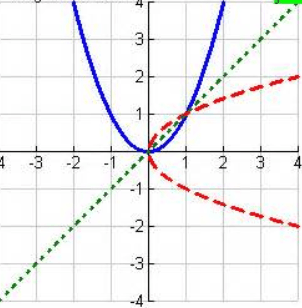
What's the best description?
They are both functions, but not inverse functions.
They are reflected over y=x, but they are not both functions.
They are not reflected over y=x, and they are not both functions.
They are inverse functions.
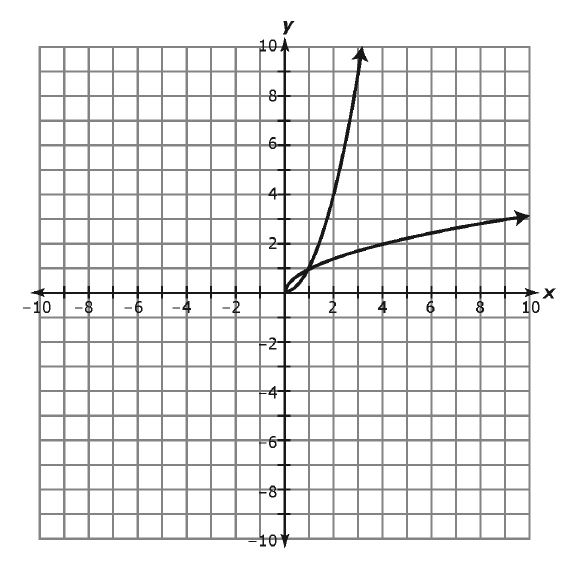
What's the best description?
They are both functions, but not inverse functions.
They are reflected over y=x, but they are not both functions.
They are not reflected over y=x, and they are not both functions.
They are inverse functions.
Which of the following is NOT TRUE about inverse functions?
Inverse functions are reflections of each other over the line y = x.
You find the inverse by switching x and y in the ordered pairs.
The domain of a function always becomes the domain of its inverse.
The domain of a function always becomes the range of its inverse.

Are these equations inverses?
Yes
No
Find the graph of f(x)=x2


Find the graph of f(x)=x3
Find the graph of f(x)=3x

This graph shown is increasing on the interval
(−∞, 0)
(0, ∞)
(−∞, ∞)

This graph shown is increasing on the interval
(−∞, 0)
(0, ∞)
(−∞, ∞)
What is the end behavior of f(x) = 3x6 as x goes to negative infinity?
positive infinity
negative infinity
zero
Which statement is true about the end behavior of the function
y = -3x2?
As x approaches negative infinity, y approaches 0.
As x approaches positive infinity, y approaches negative infinity.
As x approaches positive infinity, y approaches 0.
As x approaches negative infinity, y approaches positive infinity.
What is the domain of f(x) = 4x2?
(-∞, +∞)
(0, ∞)
(-∞, 0)
(1, ∞)


What is the end behavior of f(x)=5x3 as x goes to positive infinity?
∞
−∞
0
5
3
What is the range of f(x) = 4x5?
(-infinity, +infinty)
y>0
y<0
(-infinity, 0) U (0, +infinity)
What is the end behavior of f(x) = 5x3 as x goes to positive infinity?
positive infinity
negative infinity
zero
What is the end behavior of f(x) = 3x6 as x goes to negative infinity?
positive infinity
negative infinity
zero
Match the following parent functions graphs to their equations

f(x)=x

f(x)=x2

f(x)=x3

f(x)=x1

f(x)=x

Select ALL symmetries displayed in the graph.
symmetry with respect to the x-axis
symmetry with respect to the y-axis
symmetry with respect to the origin
all of the above
none of the above

The function with the graph depicted is an even function.
True
False
If a function has symmetry with respect to the origin and the point (-3, 5) is on the graph, which other point must be on the graph?
(-5, 3)
(5, -3)
(3, -5)
(-3, 5)
If a function has symmetry with respect to the origin and the point (-3, 5) is on the graph, which other point must be on the graph?
(-5, 3)
(5, -3)
(3, -5)
(-3, 5)
If a function has symmetry with respect to the x-axis and the point (1, 4) is on the graph, which other point must be on the graph?
(-1, -4)
(-1, 4)
(1, -4)
(4, 1)
If a function is an even function and the point (-2, 7) is on the graph, which other point must be on the graph?
(-2, -7)
(2, 7)
(2, -7)
(-7, 2)

Select ALL symmetries displayed in the graph.
symmetry with respect to the x-axis
symmetry with respect to the y-axis
symmetry with respect to the origin
all of the above
none of the above

Identify the type of symmetry based on the graph:
i. symmetric with respect to the x-axis
ii. symmetric with respect to the y-axis
iii. symmetric with respect to the origin
i only
ii only
iii only
i, ii, and iii
Describe the transformations of Function
from Parent Function
g(x)=x+4−6
Shift Left 4
and
Shift Down 6
Shift Left 4
and
Shift Up 6
Shift Right 4
and
Shift Down 6
Shift Up 4
and
Shift Left 6
The Domain of
g(x)=8x+4−6
is All Real Numbers except ___?
No Restrictions.
X can be anything
x can't be less than -4
x can't be greater than -4
x can't be less than -6
x can't be greater than -4
The Domain of
g(x)= 3x+4−6
is All Real Numbers except ___?
No Restrictions.
X can be anything
x can't be less than -4
x can't be greater than -4
x can't be less than -6
x can't be greater than -4
The Domain of
g(x)= 5x+4−6
is All Real Numbers except ___?
No Restrictions.
X can be anything
x can't be less than -4
x can't be greater than -4
x can't be less than -6
x can't be greater than -4
State the transformations of the function from the Parent Function
g(x)=(x−2)2+3
Shift Left 2
and
Shift Down 3
Shift Right 2
and
Shift Up 3
Shift Right 2
and
Shift Down 3
Shift Left 2
and
Shift Up 3
The Range is
g(x)=−(x−2)2+3
(-infinity , 2]
(-infinity , 3]
[2 , infinity )
[-2 , infinity )
[3 , infinity )


Identify the parent function of the graph.
Square Root
Linear
Quadratic
Cubic
Cube Root

When a coordinate reflects over the y-axis the x-coordinate...
changes to its opposite sign
stays the same
When a coordinate reflects over the y-axis the y-coordinate...
changes to its opposite sign
stays the same

The blue triangle is reflected over the x-axis. True or False?
True
False

The blue figure is reflected over the x-axis. True or False?
True
False
What is the rule for a reflection over the y-axis?
(x,y)→(-x,y)
(x,y)→(x,-y)
(x,y)→(-x,-y)
(x,y)→(y,x)
What is the rule for a reflection over the x-axis?
(x,y)→(-x,y)
(x,y)→(x,-y)
(x,y)→(-x,-y)
(x,y)→(y,x)

The complex ( a+bi ) conjugate can be found by...
Changing the sign of both a and b
Changing the sign of a
Changing the sign of b
Switching the a and b values
What is the conjugate of 2 + √3
2 + √3
2 - √3
-2 + √3
-2 - √3


Graph the function below one using 1 transformation at a time and in the proper order

Graph the function below one using 1 transformation at a time and in the proper order

Graph the function below one using 1 transformation at a time and in the proper order
A diver is standing on a platform above the pool. He jumps form the platform with an initial upward velocity of 8 ft/s. Use the formula h t = −16 t2 + 8t + 24, where h is his height above the water, t is the time, v is his starting upward velocity, and s is his starting height. How high is the platform?
.25 ft
24 ft
25 ft
8 ft
4 seconds
-2 seconds
-6 seconds
6 seconds
The height of an object thrown into the air can be modeled by the formula y=−16x2+70x+95 , where y is in feet after x seconds.
What is the height of the object after 5 seconds?
95 feet
45 feet
70 feet
171.56 feet
The height of an object thrown into the air can be modeled by the formula y=−16x2+70x+95
, where y is in feet after x seconds.
What is the initial height of the object?
70 feet
95 feet
149 feet
-16 feet
A ball is thrown into the air with an upward velocity. Its height, h, after t seconds is given by the function below.
h=−16t2+64t+960
How many seconds did it take for the ball to reach its maximum height?
10 seconds
64 seconds
960 seconds
2 seconds
Jason jumped off of a cliff into the ocean in Acapulco while vacationing with some friends. His height as a function of time could be modeled by the function h(t) = –16t2 + 16t + 480, where t is the time in seconds and h is the height in feet. How long does it take Jason to hit the water?
-16 seconds
-6 seconds
0 seconds
6 seconds
Members of the math club launch a model rocket from ground level with an initial velocity of 96 ft/sec. This can be modeled with the function h(t) = -16t2 + 96t. When does the rocket hit the ground?
7 seconds
6 seconds
3 seconds
8 seconds
You jump off a 24 foot high cliff and your fall is modeled by the function:
h(t) = -16t2 + 8t + 24
When would you reach 16 feet above the water?
8 seconds
1 second
1/2 second
1/4 second
You jump off a 24 foot high cliff and your fall is modeled by the function:
h(t) = -16t2 + 8t + 24
What is the Domain?
All Real Numbers
[ 0 , 25 ]
[ 0 , 1.5 ]
[ 0 , 24 ]
[ -1 , 1.5 ]
You jump off a 24 foot high cliff and your fall is modeled by the function:
h(t) = -16t2 + 8t + 24
What is the Range?
All Real Numbers
[ 0 , 25 ]
[ 0 , 1.5 ]
[ 0 , 24 ]
[ -1 , 1.5 ]

If each mark on the x-axis represents one second, when did the object reach the ground?
2.5 seconds
6 seconds
5.5 seconds
5 seconds
The domain of
y=(x+2)(x−3)(x−1)(x+4) ?
is All Real Numbers except ___?
(Check all that applies.)
x=−2
x=−1
x=3
x=4
Find the range of
y=x+12
*Hint: Find the inverse's domain
y=−1
y=0
y=1
y=2
Find the domain of
y=x+12
is All Real Numbers except ___?
x=−1
x=0
x=1
x=2
Find the domain for the function. f(x)= 2x -1 / 3x + 6
x cannot equal to 2
x cannot equal to -2
x cannot equal to 3
All real numbers

R: All real number y≠ 1
R: All real number y≠ -3
R: All real number y≠ 1
R: All real number y≠ 3
What is the domain and range?
D : (−∞,−3)∪(−3,∞)
R: (−∞,1)∪(1,∞)
D : (−∞,1)∪(1,∞)
R: (−∞,−3)∪(−3,∞)
D : (−∞,3)∪(3,∞)
R: undefined
D: (−∞,−1)∪(−1,∞)
R: (−∞,3)∪(3,∞)

What is the domain and range?
D: (−∞,1)∪(1,∞)
R: (−∞,2)∪(2,∞)
null
R: (−∞,21)∪(21,∞)
D: (−∞,−2)∪(−2,∞)
R: (−∞,−1)∪(−1,∞)

What is the domain and range of this rational function?
D: (−∞,∞), x=4
R: (−∞,∞), y=0
D: (−∞,∞)
R: (−∞,∞)
D: (−∞,4)
R: (−∞,∞)
D: (−∞,∞)
R: (−∞,0)
The daily cost of hiring a plumber, y, to work x hours on a repair project can be modeled using a linear function. The plumber charges a fixed cost of $80 plus an additional cost of $45 per hour. The plumber works a maximum of 8 hours per day.
For one day of work, what is the range of the function for this situation?
0≤x≤8
80≤y≤440
0≤x≤10
45≤y≤685
The height in inches of concrete being poured for a foundation can be found using the function y=15+2.5x, where x is the number of minutes. If the concrete is poured between 5 and 10 minutes, find the domain and range of this situation.
Domain: 5≤x≤10 Range: 27.5≤y≤40
Domain: 27.5≤x≤40 Range: 5≤y≤10
Domain: {5, 6, 7, 8, 9, 10} Range: {28, 29, 30, ..., 40}
Domain: {28, 29, 30, ..., 40} Range: {5, 6, 7, 8, 9, 10}
Leslie's car travels about 25 miles per gallon of gas.
This situation can be represented by function f(x) = 25x
Her car needs 14 gallons of gas to be full. What is a reasonable RANGE?
y≥25
0≤y≤14
y≤14
0≤y≤350


Write the expression in radical form: x43
4x3
3x4
x.75
x2


b12a6
a4b12
b6a12
a6b101
What is the inverse to g(x)=3x+5−2 ?
g−1(x)=
Write the inverse of each function: 9. y = x - 2
y=(x+2)2
y=x2+2
y = x+2
y=x2−2
What is the inverse of the function y = x+8 ?
y=x2−8
y = x2+8
y = x−8
y = x+8
Find the inverse of f(x) = x2 - 5


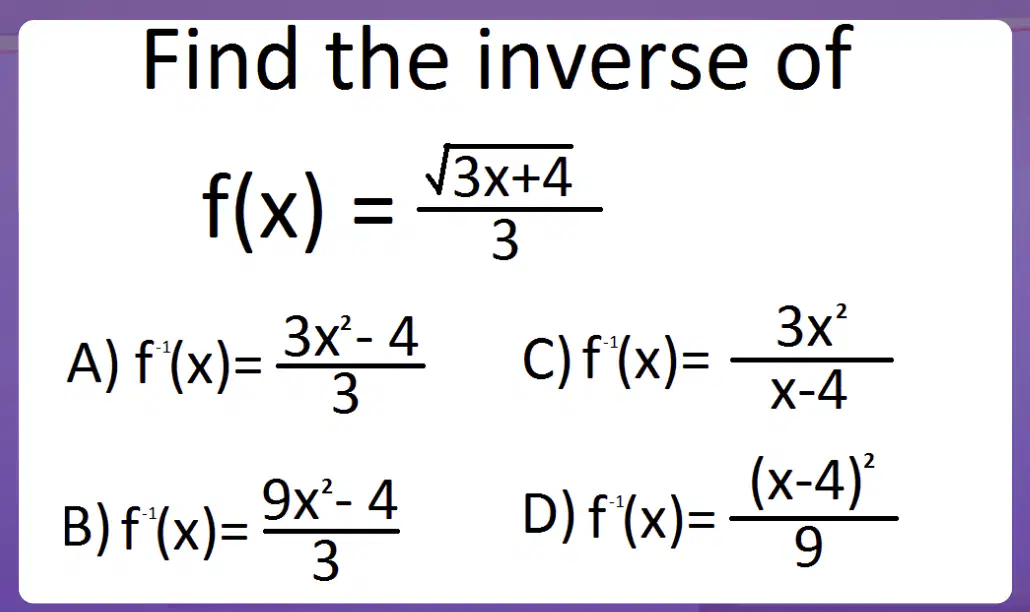
A
B
C
D
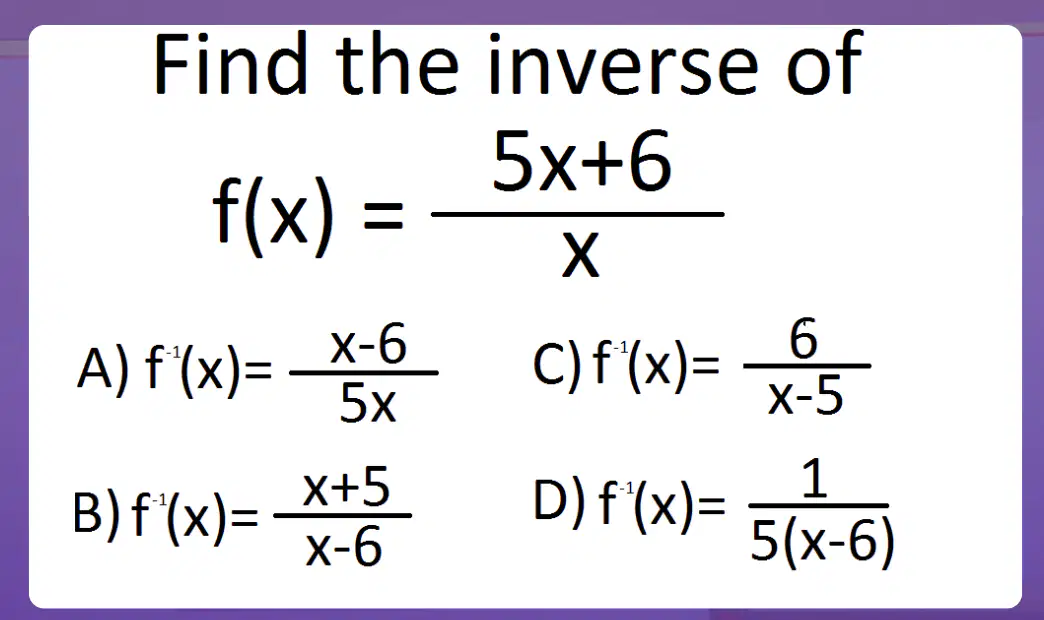
A
B
C
D
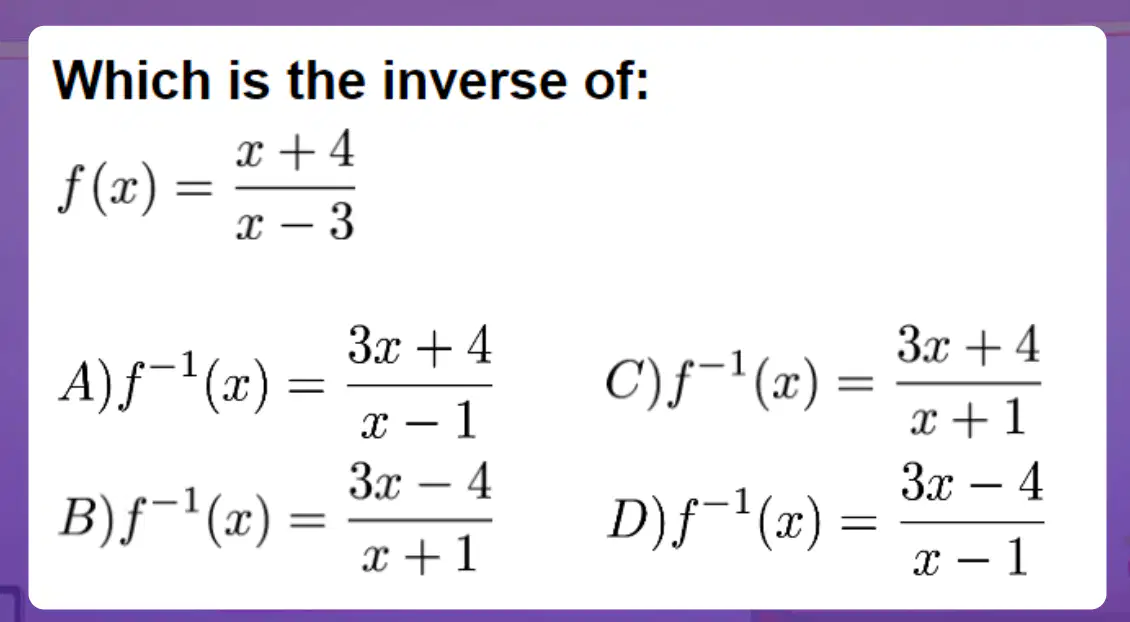
A
B
C
D

