wayground logo

Free Printable Worksheets

NEW

Font size

S
M
L
XL
Worksheets

Histo EOW Review 14Jul2023

Total questions: 24

Worksheet time: 32mins
Name
Class
Date
1.
Which of the following is correct?
a)
Endomysium surrounds individual muscle fibers.
b)
epimysium surrounds individual muscle fibers.
c)
Perimysium surrounds individual muscle fibers.
d)
Endomysium is made of dense irregular connective tissue.
2.
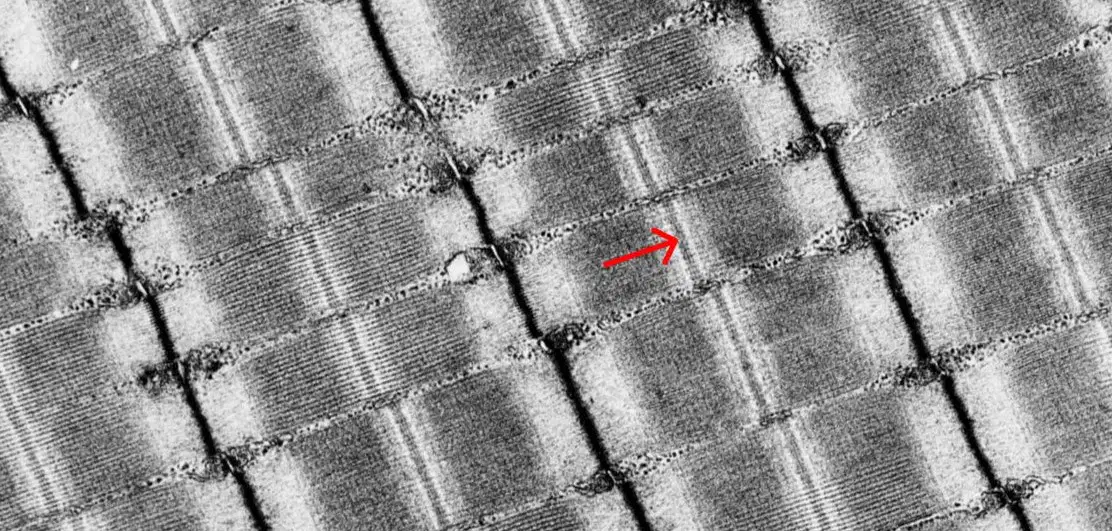
Identify the structure indicated by the arrow.
a)

M-line

b)

I-band

c)

Z-line

d)

A-band

3.
Identify the structure outlined by the box.
a)

perimysium

b)

endomysium

c)

epimysium

d)

loose connective tissue

4.
Identify the structure outlined by the circle.
a)

myofibril

b)

muscle fiber

c)

sarcomere

d)

muscle fascicle

5.
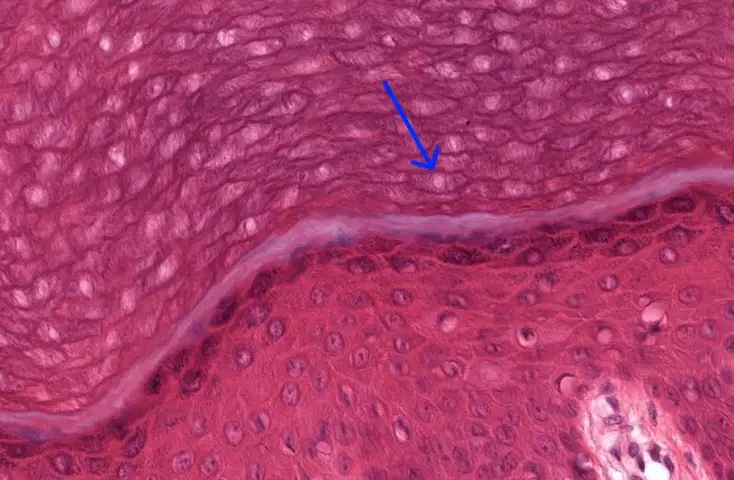
To which epidermal layer does the indicated cell belong?
a)

stratum granulosum

b)

stratum corneum

c)

stratum basale

d)

stratum spinosum

6.
Identify the layer of epidermis indicated by the arrow.
a)

stratum granulosum

b)

stratum corneum

c)

stratum basale

d)

stratum spinosum

7.
Identify the correct statement regarding skeletal muscle.
a)
Upon depolarization, the sarcoplasmic reticulum releases potassium into the surrounding muscle tissue.
b)
Sarcolemma are invaginations of the plasma membrane surrounding muscle cells.
c)
Sarcolemma surrounds smooth and skeletal muscle.
d)
The sarcoplasmic reticulum stores calcium, which is necessary for muscular contraction.
8.
To which epidermal layer does the indicated cell belong?
a)

stratum corneum

b)

stratum spinosum

c)

stratum granulosum

d)

stratum basale

9.
Which of the following regions contains only thick filaments?
a)

A

b)

B

c)

C

d)

D

10.
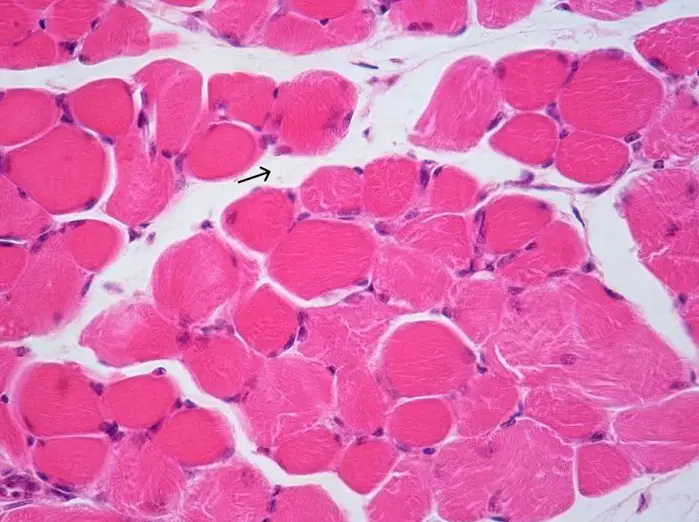
Identify the structure indicated by the arrow.
a)

epimysium

b)

loose connective tissue

c)

endomysium

d)

perimysium

11.
Which of the following is correct?
a)
A triad consists of a terminal cisterna sandwiched between two T-tubules.
b)
T-tubules are invaginations of the sarcolemma that store calcium.
c)
By extending deep into a muscle, T-tubules permit synchronous contraction of muscle fibers.
d)
Terminal cisterna are thickened extensions of the sarcolemma.
12.
Identify the outlined epidermal layer.
a)

stratum corneum

b)

stratum lucidum

c)

stratum granulosum

d)

stratum basale

13.
Which of the following regions contains only thin filaments?
a)

A

b)

B

c)

C

d)

D

14.
Identify the outlined epidermal layer.
a)

stratum spinosum

b)

stratum corneum

c)

stratum granulosum

d)

stratum basale

15.
Which region of the body contains smooth muscle?
a)
left ventricular wall
b)
aorta
c)
quadriceps tendon
d)
temporal lobe of the brain
16.
Identify the structure indicated by the arrow.
a)

dense irregular connective tissue

b)

epimysium

c)

endomysium

d)

perimysium

17.
Which of the following is true?
a)
One muscle cell is composed of many fascicles.
b)
Sarcomeres are the contractile units of skeletal muscle.
c)
Endomysium surrounds individual myofibrils.
d)
Each myofibril contains only one sarcomere.
18.
Identify the outlined structure.
a)

fascicle

b)

myofibril

c)

cardiomyocyte

d)

skeletal muscle fiber

19.
Identify the tissue.
a)

skeletal muscle

b)

smooth muscle

c)

cardiac muscle

d)

dense irregular connective tissue

20.
Identify the structure outlined by the box.
a)

adherens junction

b)

desmosome

c)

gap junction

d)

Z-line

21.
Which of the following regions shortens during muscular contraction?
a)
M-line
b)
H-zone
c)
A-band
d)
Z-line
22.
Identify the structure outlined by the box.
a)

myofibril

b)

muscle fiber

c)

sarcomere

d)

muscle fascicle

23.
Identify the correct statement.
a)
During muscular contraction, adjacent Z-lines move further apart.
b)
I-bands and H-zones shorten when myosin heads walk along actin filaments during muscle contraction.
c)
The A-band shortens during muscular contraction.
d)
During muscular contraction, the overlap between thick and thin filaments decreases.
24.
Which of the following statements best describes smooth muscle?
a)
It consists of long, cylindrically-shaped cells.
b)
Nuclei are peripherally located.
c)
Smooth muscle cells are often multinucleated.
d)
It is not covered by perimysium or epimysium.