
 Worksheets
Praxis Review 2 - Homework 7/23
Total questions: 27
Worksheet time: 25mins
Oxidation is the _________ of electrons.
loss
gain
sharing
transfer
Reduction is the ___________ of electrons.
loss
gain
sharing
transfer
Mg → Mg2+ + 2e–
2Ca(s) + O2(g) --> 2CaO(s), calcium is __________
In a redox reaction, spectator ions...
become oxidised
become reduced
remain unchanged
Substance that oxidizes another substance by accepting its electrons.
reducing agent
oxidation number
combustion
oxidizing agent
which element, if any, is oxidized?
4Fe + 3O2 --> 2Fe2O3

What happens to the equilibrium if we add methane (CH4)?
It shifts left, towards the reactants
It shifts right, towards the products
It does not shift
What happens to the equilibrium if we remove water (H2O)?
It shifts left, towards the reactants
It shifts right, towards the products
It does not shift
What happens to the equilibrium if we remove heat?
It shifts left, towards the reactants
It shifts right, towards the products
It does not shift
What happens to the equilibrium if we add hydrogen (H2)?
It shifts left, towards the reactants
It shifts right, towards the products
It does not shift
2SO2(g)+O2(g) ⇌ 2SO3(g) + Heat
Adding SO2(g) will
shift equilibrium right
shift equilibrium left
increase rate of reaction
have no change
2SO2(g)+O2(g) ⇌ 2SO3(g) + Heat
Increasing the temperature will...
shift equilibrium right
shift equilibrium left
increase pressure
have no change
2SO2(g)+1O2(g) ⇌ 2SO3(g) + Heat
Increasing the volume of the container will...
shift equilibrium right
shift equilibrium left
slow rate of reaction
have no change
2SO2(g)+1O2(g) ⇌ 2SO3(g) + Heat
Increasing the pressure on the system will...
shift equilibrium right
shift equilibrium left
slow rate of reaction
have no change
2SO2(g) + O2(g) ⇌ 2SO3(g) + Heat
Using a catalyst
shift equilibrium right
shift equilibrium left
increase the rate of reaction
have no change
2SO2(g) + O2(g) ⇌ 2SO3(g) + Heat
Using a catalyst
shift equilibrium right
shift equilibrium left
increase the rate of reaction
have no change
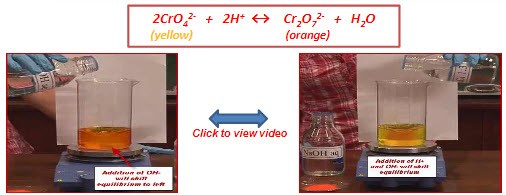
2CrO42- + 2H+→Cr2O72- + H2O
What will happen when OH- ions are added to the system? HINT: They remove the H+ ions.
Position of equilibrium will shift to right and become more orange
Position of equilibrium will shift to left and become more yellow
Position of equilibrium will shift to right and become more yellow
OH- ions will not react, and thus no change is seen.
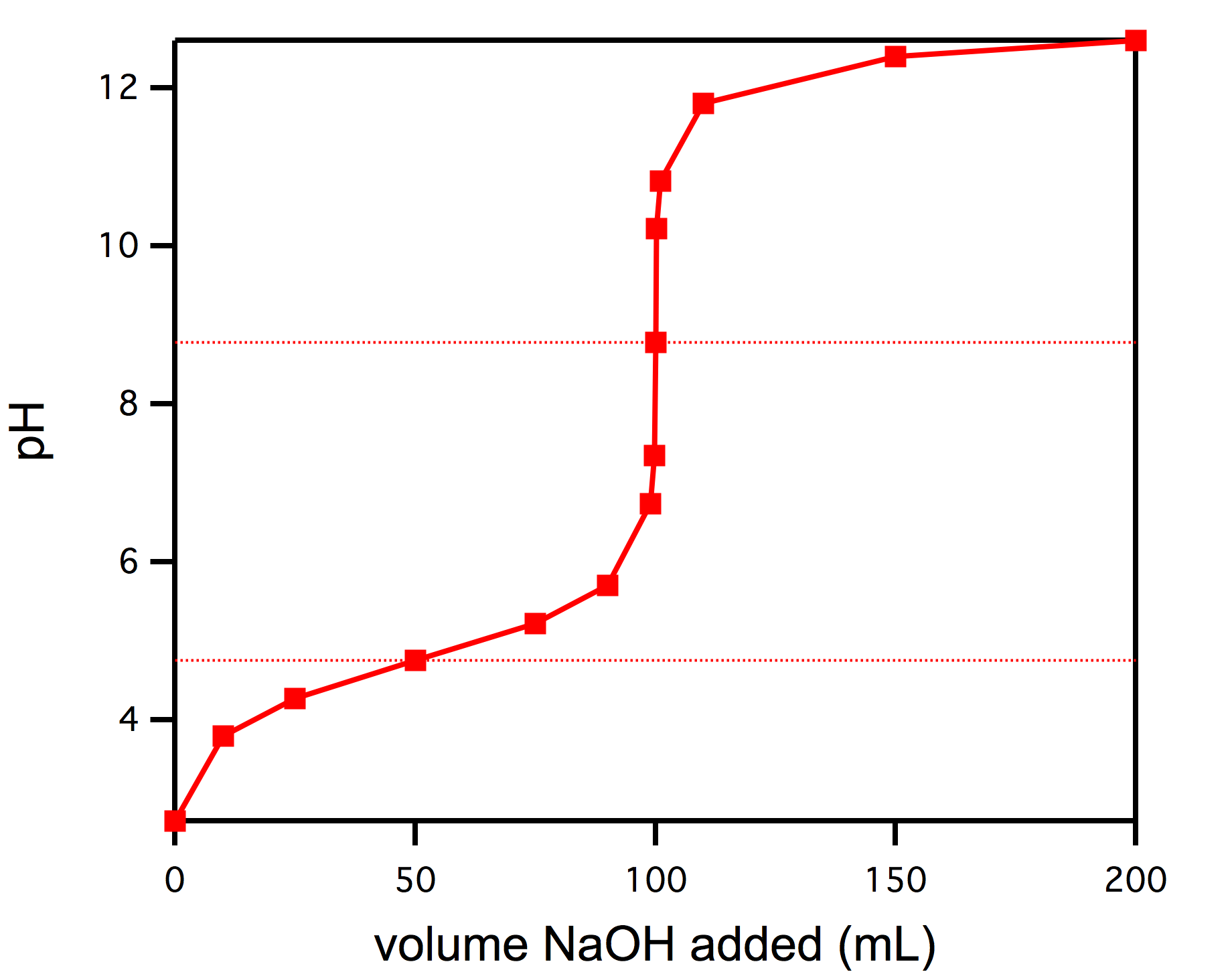
What is the pH at the equivalence point.
The pH is approximately 5
The pH is approximately 6
The pH is approximately 8
The pH is approximately 9


What volume (in mL) of NaOH solution is required to reach the equivalence point?
22.00
20.00
11.00
10.00
Find the equilibrium constant, Keq, for the following equation. The initial concentrations of AB and A2D are 0.30M before they are mixed, and when equilibrium is reached, the equilibrium concentration of A2D is 0.20M. (Use and ICE table to guide your calculations - and remember the double sided arrow tells us the reaction could be going forward or backward).
2 AB(g) + C2D(s) ↔ A2D(g) + 2 CB(s)
(a)

