
Font size
 Worksheets
RG - Sarawak
Total questions: 142
Worksheet time: 1hrs 23mins
Sarawak can be divided into four tectonostratigraphic zones according to their geological history (Haile, 1974) which are
___, ___, ___ and ___.
West Borneo Basement Complex
Miri Zone
Sibu Zone
East Borneo Complex
Kuching Zone
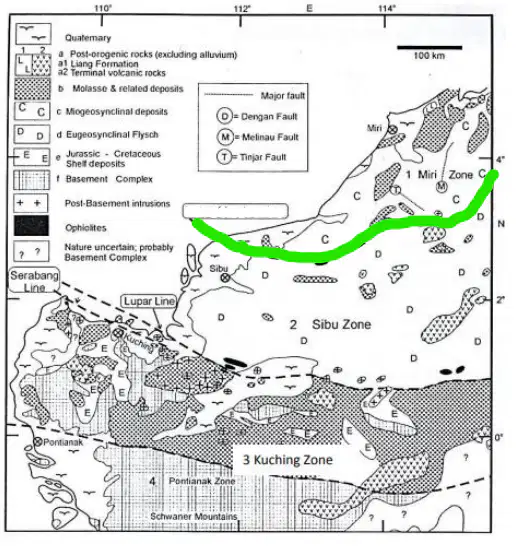
What is the geological feature highlighted in green coloured line.
Tukau-Mersing Line
Tatau-Mukah Line
Tukau-Mukah Line
Tatau-Mersing Line
What are the MAJOR faults that can be found in Sarawak?
Tatau-Mersing Line
Tukau-Mersing Line
Lupar Line
Serabang Line
Miri Zone is _______ by _______ strata.
overlain,
lower Miocene
overlain,
upper Miocene
underlain,
lower Eocene
underlain,
upper Eocene
Miri Zone is dominated by which depositional environment sediments?
shallow marine shelf
submarine fan
deep marine shelf
deep marine
Miri Zone were deposited upon ____________.
older oceanic crust
younger continental crust
younger oceanic crust
older continental crust
The sedimentary rock formations in Miri Zone are
Belaga Formation
Buan Formation
Lupar Formation
Tatau Formation
Nyalau Formation
Which of the following is not the sedimentary rock formation in Miri Zone?
Nyalau Formation
Liang Formation
Buan Formation
Belaga Formation
The _______ to _______ Rajang Group (flysch) forms the Sibu Zone
Upper Cretaceous,
Lower Eocene
Upper Miocene,
Lower Eocene
Upper Miocene,
Upper Pleiocene
Upper Cretaceous.
Upper Eocene
The Upper Cretaceous to Upper Eocene Rajang Group (flysch) forms the Sibu Zone and ________ the _______ Zone,
underlies,
Miri
underlies, Kuching
overlies,
Miri
overlies, Kuching
The Sarawak Orogeny caused _________ and _________ characterized by steep dips of the Rajang Group.
strong faulting
low grade metamorphism
high grade metamorphism
strong folding
The overlying formations (molasse) are much ________ and _________, except in certain zones.
less deformed
more deformed
highy metamorphosed
unmetamorphosed
The overlying formations (molasse) are much less deformed, and unmetamorphosed, except in _________.
isolated fault zones
isolated shear zones
localized fault zones
localized shear zones
The thickness of Tatau Formation is
2500m
3000m
3500m
2000m
What is the age of of Tatau Formation sediments?
Lower Eocene to Miocene
Middle Eocene to Oligocene
Upper Eocene to Miocene
Middle Oligocene to Miocene
What type of sediment makes up the Tatau Formation?
carbonates
clastic
Where can you observe Ransi Member of the Tatau Formation?
Ransi Hill
Lubok Antu
Baram-Tinjar area
Tutong Hill
Which are the three lithofacies of Ransi Member?
Thick-bedded, coarse-grained conglomerate
Medium-grained, cross-bedded sandstone
Clay and shale with subordinate siltstone and limestone
Thin to medium-bedded coarse-grained, bioturbated sandstone
Which is the lithofacies of tbe UPPER part of Ransi Member?
Thick-bedded, coarse-grained conglomerate
Medium-grained, cross-bedded sandstone
Clay and shale with subordinate siltstone and limestone
Thin to medium-bedded coarse-grained, bioturbated sandstone
Which is the lithofacies of the MIDDLE part of Ransi Member?
Thick-bedded, coarse-grained conglomerate
Medium-grained, cross-bedded sandstone
Clay and shale with subordinate siltstone and limestone
Thin to medium-bedded coarse-grained, bioturbated sandstone
Which is the lithofacies of the LOWER part of Ransi Member?
Thick-bedded, coarse-grained conglomerate
Medium-grained, cross-bedded sandstone
Clay and shale with subordinate siltstone and limestone
Thin to medium-bedded coarse-grained, bioturbated sandstone
In Tatau Formation, the lower contact with the underlying Belaga Formation is ________.
fault
disconformity
angular unconformitu
nonconformity
The Tatau Formation grades ________ into the rest of the formation.
upwards
downwards
sidewards
Tatau Formation rest ___________ the Belaga Formation.
conformably below
conformably on
unconformably below
unconformably on
Buan Formation is predominantly (a) .
What are the lithologies of Buan Formation?
grey shale, mudstone, sandstone and a few limestone
thin beds of siltstone
and
fine to medium grained sandstone
Thick sequence of sandstone, pebbly sandstone, fossiliferous mudstone with abundant coal and lignite
hard fine to medium grained sandstones alternating with shale
The age of Nyalau Formation is
(a)
_________ overlies Buan Formation.
Tatau Formation
Setap Shale
Nyalau Formation
Begrih Formation
What is the lithology of Nyalau Formation?
Hard fine to medium grained sandstones alternating with shale
thick shale-sandstone turbidite sequences
thin beds of siltstone and fine to medium grained sandstone
thin beds of siltstone and fine to medium grained sandstone
What can be encountered in Nyalau Formation?
foraminiferal evidence
thrust fault
low grade metamorphosed rock
coal beds
What is present in the sandstone of Nyalau Formation?
cross-bedding
foraminiferal evidence
flysch
ripples
Which type of trace fossil can be found in Nyalau Formation?
footprints
copriolites
trails
Ophiomorpha burrow
The depositional environments of Nyalau Formation.
shallow marine to estuarine
estuarine to deep marine
shallow littoral to inner neritic
deep littoral to middle neritic
The thickness of Nyalau Formation is
(a)
Nyalau Formation is ____________ by Sibuti Formation in the ________.
conformably overlain,
east
unconformably overlain,
west
conformably underlain,
east
unconformably underlain, west
Nyalau Formation (a) with Setap Shale in the Northeast.
Sibut Formation can be found in which part of Sarawak?
south
north
west
central
east
Choose the correct answer based on the lithology of Sibuti Formation.
Clay and shale with subordinate siltstone and limestone
thick sequence of sandstone, pebbly sandstone, fossiliferous mudstone
thin beds of siltstone and fine to medium grained sandstone
grey shale, mudstone, sandstone and a few limestone
Which is NOT the correct answer based on the depositional environment of Sibuti Formation?
inner neritic
deep marine
shallow marine
What evidence indicate that one of the depositional environment for Sibuti Formation is in shallow marine environment?
presence of turbidites
presence of ripples
presence of flysch
In Setap Shale, there are presence of thick extensive monotonous succession of ______ with subordinate thin ______ beds and a few thin lenses of _______.
shale, limestone,
sandstone
sandstone,
shale,
limestone
limestone,
sandstone,
shale
shale,
sandstone.
limestone
What are the common lithologies in Setap Shale?
limestone
mudstone
sandstone
grey shale
marble
The depositional environments of Setap Shale.
shallow marine
deep marine
inner neritic
deep neritic
What reason indicates that Setap Shale was deposited in shallow marine environment.
foraminiferal evidence
Ophiomorpha burrows
turbidites characteristic
present of ripples
Where did Setap Shale changes to very sandy Lambir Formation?
West Sarawak
South Sarawak
East Sarawak
North Sarawak
Setap Shale can also be found in _________.
Central zone
West Zone
East Zone
Thickness of Setap Shale.
600m
1600m
2600m
3600m
Balingian Formation has a thick sequence of _______, pebbly _______, fossiliferous ______ with abundant ________.
sandstone,
sandstone,
mudstone,
coal and lignite
sandstone, sandstone,
siltstone,
limestone
shale,
sandstone,
mudstone,
coal and lignite
shale, sandstone,
siltstone, limestone
Depositional environment of Balingian Formation is
fluvial to lacustrine
swamp to estuarine
inner neritic to deep marine
estuarine to lagoonal
In Central Zone, Balingian Formation rest __________ Lambir Formation.
conformably below
unconformably on
conformably on
unconformably below
In Central Zone, Balingian Formation is ___________ by Begrih Formation.
unconformably underlain
conformably underlain
unconformably overlain
conformably overlain
In North Zone, Lambir Formation is (a) by Miri Formation.
The upper part of Miri Formation is dominated by ________.
granite
shale
limestone
sandstone
The lower part of Miri Formation is mainly (a) .
The depositional environment for Begrih Formation is mainly _________ and _________.
inner neritic
non marine
fluviatile
shallow marine
Begrih Formation contained abandoned ________ deposits.
channel
submarine fan
lacustrine
Begrih Formation is ____________ by Liang Formation.
conformably underlain
unconformably underlain
conformably overlain
unconformably overlain
Liang Formation is the succession of _____ and ____ with abundant _____ and some _____.
clay,
sand,
coal,
pumice
shale,
sand,
lignite,
pumice
clay,
sand,
lignite,
tuff
The deposition environment of Liang Formation is
lacustrine to fluvial
coastal plain to shallow marine
fluvial to estuarine
inner neritic to deep marine
_____________ is the boundary between Miri Zone and Sibu Zone.
Lupar Line
Serabang Line
Tatau-Mersing Line
Tatau-Mersing Line is _________ complex.
lithologically
stratigraphically
structurally
Tatau-Mersing Line consist of __________ to __________ rocks.
Oligocene,
Miocene
Paleocene,
Eocene
Paleocene, Oligocene
Eocene,
Oligocene
Tatau-Mersing Line consists of (a) rocks.
The ophiolitic rocks present in Tatau-Mersing Line are
tuff
basalt
lignite
chert
Tatau-Mersing Line is a major _______ zone.
strike-slip fault
reverse fault
thrust fault
normal fault
Tatau-Mersing Line is a ____________.
boundary between Sibu Zone and Kuching Zone
terrane suture
reverse fault
Part of the southwestern boundary of the Rajang Group is __________ along Lupar Line.
rolled
faulted
folded
uplifted
Rajang group rocks is ____________ against Lubok Antu Melange.
overlain
juxtaposed
metamorphosed
Which of the following is a zone of melange?
Miri Zone
Balingian Formation
Lubok Antu
Belaga Formation
Rajang group divided into _______ and _______
Sibu Zone
Belaga Formation
Begrih Formation
Lupar Formation
Sibu Zone rocks are almost ____________ age.
Lower Paleocene to Middle Oligocene
Upper Cretaceous to Upper Eocene
Lower Cretaceous to Middle Paleocene
Upper Paleocene to Upper Oligocene
Rocks of __________ underlie Sibu Zone.
Rajang Group
Lubok Antu Melange
Begrih Formatoin
Which formations are part of Rajang Group?
part of Begrih Formation
Lupar Formation
Belaga Formation
part of Danau Formation
Rajang Group is deformed into
Rajang Fold-Thrust Belt
Rajang Fault-Thrust Belt
Rajang Group rocks are intensely ________, ________. _________.
thrust
folded
uplifted
low grade metamorphose
Belaga Formation has a thick ___________ turbidite sequences.
limestone-coal
shale-sandstone
sandstone-mudstone
sandstone-basalt
Belaga Formation is deposited upon __________ crust.
oceanic
continental
The deposition of Belaga Formation is deposited during __________.
Late Cretaceous
Early Cretaceous
The deposition of Belaga Formation ended in the _______ age.
Oligocene
Eocene
Paleocene
The deposition of Belaga Formation was ended by
Sarawak Orogeny
Tatau-Mersing Line
Rajang Fold-Thrust Belt
Which is the oldest formation at the base of the Rajang Group?
Lupar Formation
Danau Formation
Belaga Formation
Belaga Formation is __________ and _________.
highly deformed, steeply dipping
slightly deformed, slightly dipping
Belaga Formation rocks were ________ in ___________ time.
folded,
Middle to Early
Eocene
uplifted, Late to Middle Eocene
Belaga Formation is surrounded by young formation which are
Tatau Formation
Setap Shale
Balingian Formation
Nyalau formation
Which formation is younger?
Belaga Formation
Nyalau Formation
Belaga turbdite was formed as a result of being ______, _______ and _______.
compressed
rolled
uplifted
sheared
The collision between _______ and ______ blocks formed the Belaga turbidite.
Sundaland
Sibumasu
Luconia
Sukhotai
The collision between Sundaland and Luconia blocks led to the _________ of Rajang Sea.
rifting
subduction
Rajang Sea was subducted beneath ___________.
south Borneo Block
Sundaland block
Luconia block
Lupar Line is the boundary between
Sibu Zone and Kuching Zone
Miri Zone and Kuching Zone
Sibu Zone and Miri Zone
__________ comprises of blocks of chert, sandstones,shale, limestone, gabbro, basalt and serpentinite ina sheared, cleavely clay matrix.
Rajang Fold-Thrust Belt
Lubok Antu Melange
Begrih Formation
Kuching Zone
Lubok Antu Melange is interpreted as a tectonic melange formed during
Oligocene
Paleocene
Eocene
Miocene
Lubok Antu Melange is ________ by the flysch-like deep sea sediments
overlain
underlain
Lubok Antu Melange is overlain by _______ like deep sea sediment
turbiditic
flysch
ripple
Lubok Antu Melange is interbedded with ___________ and intruded by __________.
rhyolitic tuff, gabbro
pillow basalt, gabbro
pillow basalt, granite
rhyolitic tuff, granite
Lupar Formation is _________ by the _________ member of Belaga Formation.
overlain, basal
underlain, basal
What evidence suggest the age of Lupar Formation as Upper Cretaceous
flysch
burrow
Ophiomorpha
foraminiferal
Kuching Zone is located to the ________ part of Sarawak
southwestern
northwestern
Age of rocks in Kuching Zone
Late Palaeozoic and Mesozoic
Early Mesozoic and Middle Cenozoic
Palaeozoic and Early Mesozoic
Kuching zone consist of
Jurassic – Cretaceous shelf deposits
related non-marine deposits
molasses
flysch-like deep sea sediments
Kuching Zone deposits on the
central of the West Borneo Basement Complex
edge of the West Borneo Basement Complex
Age of the marine limestone in the central region south of Kuching
Upper Carboniferous-Triassic
Upper Carboniferous-Jurassic
Lower Carboniferous-Jurassic
Lower Carboniferous-Triassic
Kuching Zone is in close association with the limestone are basic to intermediate ______ rocks and _______ age.
metamorphic,
Early Triassic
sedimentary,
Middle Triassic
volcanic,
Late Triassic
In Kuching Zone, limestone is _______ by ________ mainly siliclastic sequences
underlain,
Triassic-Cretaceous
underlain,
Jurassic-Cretaceous
overlain,
Triassic-Cretaceous
overlain,
Jurassic-Cretaceous
In Kuching Zone, Cretaceous (a) intrude the Cretaceous and older rocks.
In Kuching Zone, the uppermost part is a mixed of terrestrial to marine environment ________ rocks.
siliclastic
carbonates
volcanic
The age of uppermost part of Kuching Zone is
(a)
West Borneo Basement is located at most _______ zone.
easterly
southerly
northerly
westerly
West Borneo Basement composed of ___________ age of basement rocks.
Permian to Jurassic
Permian to Cretaceous
Carboniferous to Jurassic
Carboniferous – Permian
The basement rocks of West Borneo Basement is intruded by _________ age of __________ rocks.
Cretaceous,
plutonic
Cretaceous,
volcanic and plutonic
Permian,
plutonic
Permian, volcaninc and plutonic
The age of oldest rocks in West Borneo Basement is ____________ .
Middle-Upper Carboniferous to Permian
Middle-Upper Carbnoiferous to Cretaceous
Permian to Cretaceous
Permian to Triassic
The oldest rocks in West Borneo Basement composed are of
mica-schist
ryholitic tuff
hornfels
metaquartzites
West Borneo Basement was intruded by ___________ plutonic suites.
Late Triassic to Middle Cretaceous
Middle Jurassic to Late Cretaceous
Middle Triassic to Late Cretaceous
Late Jurassic to Middle Cretaceous
Which are parts of the lithology for the plutonic suites intrusion in West Borneo Basement?
quartz diorite
tuff
diorite
tonalite
granite
Which is the northern edge of Sundaland?
Sibu Zone
Kuching Zone
Miri Zone
West Borneo Basement
The West Borneo Basement is the northern edge of Sundaland separated by the __________.
Rajang Sea
Tatau-Mersing Line
Rajang Fold-Thrust Belt
Schwaner Mountains
The Miri Zone was the southern edge of __________ Microcontinent.
Luconia
West Natuna
Sundaland
The Luconia Block moved _______ to collide with the West Borneo Basement
northwards
southwards
eastwards
westwards
The collision between Luconia Block and e West Borneo Basement occured during
Late Mesozoic to Middle Cenozoic
Early Mesozoic to Late Cenozoic
Late Mesozoic to Early Cenozoic
Middle Mesozoic to Early Cenozoic
The collision between Luconia Block and West Borneo Basement led to ________ of _________ sediments of the Sibu Zone.
uplifting, deep sea
folding, deep sea
faulting, shallow marine
rotation,
shallow marine
The collision between Luconia and West Borneon Complex exposed the deep sea ________ sequence of ______ Formation.
turbiditic,
Begrih
turbiditic,
Belaga
flysch,
Begrih
flysch,
Belaga
The West Borneo Basement forms the __________.
intrusion by plutonic suites
Serabang Line
Lupar Line
Schwaner Mountains
The West Borneo Basement that forms the mountains, appears to extend _______ to underlie the _______ basins.
eastwards,
Barito and Kutei
eastwards,
Tertiary Melawi and Ketungau
westwards,
Barito and Kutei
westwards,
Tertiary Melawi and Ketungau
The West Borneo Basement that forms the mountains, appears to extend _______ to underlie the _______ basins.
eastwards,
Barito and Kutei
eastwards,
Tertiary Melawi and Ketungau
northwards,
Barito and Kutei
northwards,
Tertiary Melawi and Ketungau
Before the advent of plate tectonic theory, tectonic evolution of Sarawak was interpreted in the context of the __________ theory (Haile, 1969).
geosynclinal
eugeosynclinal
geanticline
Deepwater turbiditic rocks in the Sibu zone was interpreted as _________ deposits.
eugeosynclinal
miogeosynclinal
geanticlinal
Upper Eocene-Recent neritic coastal sediments of Miri zone as (a) deposits
Geosynclinal concepts have been replaced by __________ theory.
paleogeographical
geomechanic
plate tectonic
biostratigphy
Pre-Tertiary tectonic development of Sarawak can be traced back in time in the context of the breakup of _______ and evolution of the __________.
Gondwanaland,
Tethys Ocean
Sundaland,
Rajang Sea
Sundalan,
Tethys Ocean
Gondwanaland,
Rajang Sea
West Borneo Basement may have been contiguous with the __________ which is part of the _________ craton
Tethys Ocean,
Sundaland
Sundaland,
Tethys Ocean
East Malaya Block,
Gondwanaland
East Malaya Block,
Sundaland
What were the tectonic evolution occurences during Late Carboniferous to Early Permian?
Shallow marine sedimentation
Deep marine sedimentation
West Borneo Basement separated from Gondwanaland
West Borneo Basement still attached to Gondwanaland
At the age of Late Carboniferous to Early Permian, the occurences of shallow marine sedimentation formed the _________ Formation.
Terbat
Begrih
Hebat
Ketungau
Rearrange the following tectonic evolution of West Borneo Basement:
I) Collision of WBB and Luconia Block led to uplifting of Sibu Zone sea sediments to expose deep sea turbiditic sequence of Belaga Fm.
II) WBB (northen edge Sundaland) separated by Rajang Sea from Miri Zone (southern edge Luconia Microcontinent)
III) In Late Mesozoic to Early Cenozoic, Luconia block move southwards to collide with WBB
IV) Basement forms Schwaner Mt., appear to extend eastwards underlying Barito & Kutei basins, northwards beneath Tertiary Melawi & Ketungau basins (Kuchong Zone)
I, III, II, IV
II, III, I, IV
IV, II, III, I
III, IV, II, I
Rearrange the following tectonic evolution during the Middle Permian to Early Triassic age:
I) After the interruption, sedimentation of continental to shallow marine deposits (Sadong Formation)
II) Marine sedimentation continued into Jurassic and Cretaceous associated with basic volcanism (Bau Limestone and Kedadom and Pedawan formations)
III) Sedimentation interrupted by suturing of East Malaya to Cathaysia
IV) Widespread andesitic to basaltic lavas and pyroclastics (Serian Volcanics)
III, II, I, IV
I, II, III, IV
IV, II, I, III
III, I, IV, II
What happened during the Early to Middle Cretaceous tectonic evolution?
sedimentation of continental to shallow marine deposits
Deposition interrupted by folding
Deposition of Pedawan Formation ended with folding and igneous activity
Luconia block move southwards to collide with WBB
What happened during the Late Cretaceous age of tectonic evolution?
sedimentation of continental to shallow marine deposits
Deposition interrupted by folding
Deposition of Pedawan Formation ended with folding and igneous activity
Luconia block move southwards to collide with WBB
Select all the correct occurrences of Tectonic Evolution during Late Cretaceous age.
Deep marine turbidite (Belaga Formation) sedimentation occurred in a remnant ocean basin
Deposition interrupted by folding
Western Sarawak was already uplifted resulted in continental sedimentation (Kayan Fm)
Similar turbiditic rocks occur in the inner Baram-Tinjar area (NE Sarawak) as Mulu and Kelalan formations
By late cretaceous western Sarawak was already uplifted resulted in continental sedimentation (Kayan Fm) which continued into _______ with deposition of __________ Sandstone
Eocene,
Sadong Formation
Miocene,
Sadong Formation
Miocene,
Silantek and Plateau
Eocene,
Silantek and Plateau
During Late Cretaceous, the Deep marine turbidite (Belaga Formation) sedimentation occurred in a remnant ocean basin maybe associated with __________ existed along ______ valley/Line.
subduction zone,
Lupar
subduction zone,
Serabang
divergent zone,
Lupar
divergent zone,
Serabang
________ represents the onshore extension of Sarawak Basin that developed during Late Eocene on the ________ active continental margin formed the ____________.
Miri Zone, faulted,
West Borneo Basement and Sibu Zone.
Kuching Zone,
faulted,
SIbu and Miri Zones
Sibu Zone,
uplifted,
Kuching and Miri Zones
Miri Zone, uplifted,
Kuching and SIbu Zones
Kuching and Sibu zones interpreted as _________ crustal material added to the West Borneo Basement.
Mesozoic-Late Cenozoic
Paleozoic-Mesozoic
Mesozoic-Early Cenozoic
Late Mesozoic to Early Cenozoic evolution is a manifestation of _______ and ______ processes at the northern margin of western Borneo associated with closure of the Rajang Sea.
extension, collision
subduction, faulting
subduction, collision
extension,
faulting

