wayground logo

Free Printable Worksheets

NEW

Font size

S
M
L
XL
Worksheets

Year 9 Triangle and Quadrilateral Geometry Quiz

Total questions: 44

Worksheet time: 1hrs 28mins
Name
Class
Date
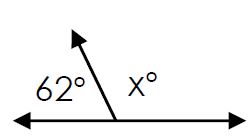
1.
a)
x = 118
b)
x = 108
c)
x = 28
d)
x = 58
2.
complementary, supplementary, or neither?
a)
Complementary
b)
Supplementary
c)
Neither
3.
Acute angles are?
a)
Always over 180 degrees 
b)
Less than 90 degrees
c)
exterior but green 
d)
75 plus 25 degrees
4.
Obtuse Angle measures ?
a)
90-110 degrees 
b)
85 degrees
c)
less than 90 degrees
d)
90-180 degrees
5.
What are complementary angles?
a)
Angles that add up to 180°
b)
Angles that add up to 90°
c)
Angles that are equal to each other
d)
Angles that are opposite of each other when lines intersect.
6.
What are supplementary angles?
a)
Angles that add up to 180°
b)
Angles that add up to 90°
c)
Angles that are equal to each other
d)
Angles that are opposite of each other when lines intersect
7.
Parallel lines 
a)
two lines that never cross
b)
make hamburgers on Fridays
c)
Lines that move side to side 
d)
Make frosty shakes out of chocolate ice cream 
8.

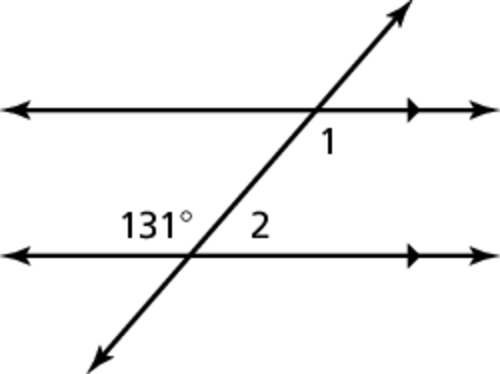
Name the angle relationship of 1 & 2

a)

Alternate Angles

b)

Co-interior Angles

c)

Corresponding Angles

d)

Vertically Opposite Angles

9.

Name the angle relationship of 1 & 2.

a)

Co-interior Angles

b)

Alternate Angles

c)

Corresponding Angles

d)

Vertically Opposite Angles

10.

Find angle 22  

a)

131°131\degree  

b)

180°180\degree  

c)

49°49\degree  

11.

Find the angle at xx

a)

105

b)

75

c)

180

d)

85

12.

These angles are _______ because together they make 90 degrees.

a)

Complementary

b)

Supplementary

c)

Vertical

13.

Find  C\angle\ C

a)

∠C=116°

b)

∠C=64°

c)

∠C=180°

d)

∠C=26°

14.

Find the value of XX

a)

95

b)

85

c)

35

d)

45

15.

Find the value of SS

a)

63

b)

43

c)

137

d)

157

16.

Solve for XX

a)

6

b)

140

c)

20

d)

90

17.

Find the value of VV

a)

161

b)

59

c)

39

d)

141

18.
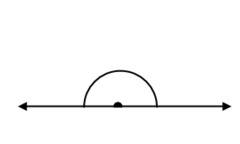
What type of angle is shown?
a)
acute
b)
obtuse
c)
right
d)
straight
19.
Find the measure of the missing angle.
a)
90o
b)
100
c)
130o
d)
50o
20.

Solve for mm

a)

m=52

b)

m=123

c)

m=47

d)

m=57

21.

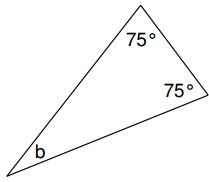
Find the value of angle bb

a)

75 degrees

b)

20 degrees

c)

30 degrees

d)

55 degrees

22.
This is what kind of angle?
a)
obtuse
b)
right
c)
straight
d)
acute
23.

Which of the following angles can you add together to equal angle dd

a)

Angle a and Angle b

b)

Angle b and Angle c

c)

Angle a and Angle c

d)

Angle a and Angle b and Angle c

24.
Which of the following terms best describes Angle d? 
a)
Remote interior angle
b)
Corresponding angle
c)
Exterior angle
d)
Interior angle
25.

What is the value of angle b?

a)

36o

b)

56o

c)

63o

d)

117o

26.
The Triangle Sum Theorem states that the sum of all angles in a triangle is ______. 
a)
45°
b)
90°
c)
180°
d)
360°
27.

Find the missing angle

a)

112

b)

34

c)

146

d)

46

28.

Find the missing pronumeral xx

a)

26

b)

36

c)

85

d)

144

29.
What do the angles in an equilateral triangle measure?
a)
30, 60, 90
b)
45, 45, 90
c)
60, 60, 60
d)
35, 55, 90
30.
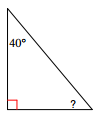
Find the missing angle
a)
30 degrees
b)
60 degrees
c)
90 degrees
d)
Not enough information
31.
.
.
.
.
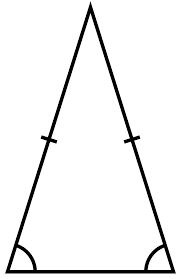
What is the name of this kind of triangle?
a)
Right
b)
Scalene
c)
Isosceles
d)
Equilateral
32.
.
.
.
What is the name of this kind of triangle?
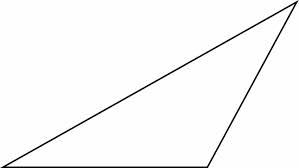
a)
Right
b)
Scalene
c)
Isosceles
d)
Equilateral
33.
What kind of triangle is this?
a)
Acute
b)
Right
c)
Sparkly
d)
Obtuse
34.
How many acute angles must an acute triangle have?
a)
2
b)
1
c)
4
d)
3
35.
Find the missing angle.
a)
29° 
b)
39° 
c)
49° 
d)
59° 
36.
Name that shape. 
a)
square
b)
square
rhombus
c)
quadrilateral
parallelogram
rhombus
d)
quadrilateral
parallelogram
square
37.
Name that shape.
a)
trapezoid
b)
quadrilateral
c)
parallelogram
d)
rhombus
38.
How many degrees are in the missing angle?
a)
60°
b)
114°
c)
70°
d)
360°
39.
What is the sum of a Quadrilaterals interior angles?
a)
180
b)
360
c)
400
d)
240
40.

The shown quadrilateral is a rectangle. If AB is 10 what is the length of DC

a)

10

b)

5

c)

15

41.
What do a rhombus and a rectangle have in common?
a)
they are both parallelograms
b)
they always have four right angles
c)
they are not polygons
d)
they have five sides
42.
A square can be a rhombus.
a)
True
b)
False
43.

In a parallelogram opposite angles are

a)

Equal

b)

Not equal

c)

Can't say

d)

None of these

44.

Adjacent angles of a parallelogram are

a)

Equal

b)

Complementary

c)

Supplementary

d)

None of these