wayground logo

Free Printable Worksheets

Font size

S
M
L
XL
Worksheets

Easy Physics 1 (Ch: 1, 2 & 3)

Total questions: 20

Worksheet time: 10mins

Name
Class
Date
1.

Which of the following is FALSE about dimensional analysis?

a)
Technique or method in which the physical quantity can be expressed in terms of combination of basic quantities.
b)
A measure of physical quantity (without numerical values)
c)
Dimension on the left hand side of an equation (L.H.S.) equals to the dimension on the right hand side of an equation (R.H.S)
d)
Dimensions can be added or subtracted
2.

Which of the following quantities is a scalar quantity?

a)
Displacement
b)
Work
c)
Velocity
d)
Force
3.

How do you calculate average velocity?

a)
A time interval divided by a change of displacement
b)
A time interval multiply by a change of displacement
c)
A change of displacement divided by a time interval
d)
Addition of a time interval and a change of displacement.
4.

The rate of change of velocity is called

a)
Force
b)
Speed
c)
Distance
d)
Acceleration
5.

Which of the following represents the displacement?

a)
area under acceleration-time graph
b)
area under velocity-time graph
c)
gradient under acceleration-time graph
d)
gradient under velocity-time graph
6.

A projectile is launched from the ground. Assuming that air resistance is negligible, which of the following statements is FALSE?

a)
The motion involves constant velocity along the horizontal and constant acceleration along the vertical.
b)
The vertical component of the velocity along the motion is constant.
c)
The horizontal component of the velocity along the motion is constant.
d)
The path made by the projectile is a parabolic.
7.

Linear momentum is a

a)
scalar quantity
b)
force
c)
product of velocity and mass
d)
product of mass and acceleration
8.

The principle of conservation of linear momentum states that

a)
the total initial momentum of all objects interacting with one another is not equal the total final momentum
b)
the total initial momentum of all objects interacting with one another is equal to the total final momentum.
c)
the total initial momentum of all objects interacting with one another is more than the total final momentum
d)
the total momentum of all objects interacting with one another is always remains not conserved
9.

Elastic collision and inelastic collision can be differentiated by

a)
kinetic energy
b)
momentum
c)
force
d)
impulse
10.

What is the Dimension for the following Base physical quantity:

Mass

a)

[M]

b)

[L]

c)

[T]

d)

[𝜃]

e)

[A]

11.

Free fall body has constant acceleration that is also called as acceleration due to gravity which has the value of....

a)

9.8 ms19.8\ ms^{-1}

b)

9.81 ms19.81\ ms^{-1}

c)

9.8 ms29.8\ ms^{-2}

d)

9.81 ms29.81\ ms^{-2}

12.

What is the dimension of π?

a)
L⁻¹T
b)
ML⁻¹
c)
ML⁻²
d)
1
13.

Physical quantity that CANNOT BE DERIVED in terms of other physical quantities is called

a)

non-physical quantity

kuantiti bukan fizik

b)

base quantity

kuantiti asas

c)

dimensionless quantity

kuantiti tanpa dimensi

d)

derived quantity

kuantiti terbitan

14.

What is the SI unit for length?

a)

cm

b)

m

c)

km

d)

mm

15.

Which one is a derived quantity?

a)

area

b)

temperature

c)

mass

d)

electric current

16.

10-9 = ?

a)

tera

b)

pico

c)

giga

d)

nano

17.

What is the dimension for work?

a)

Joule

b)

( ML2T-2 )

c)

[ ML2T-2]

d)

ML2T-2

e)

kg m2 s-2

18.

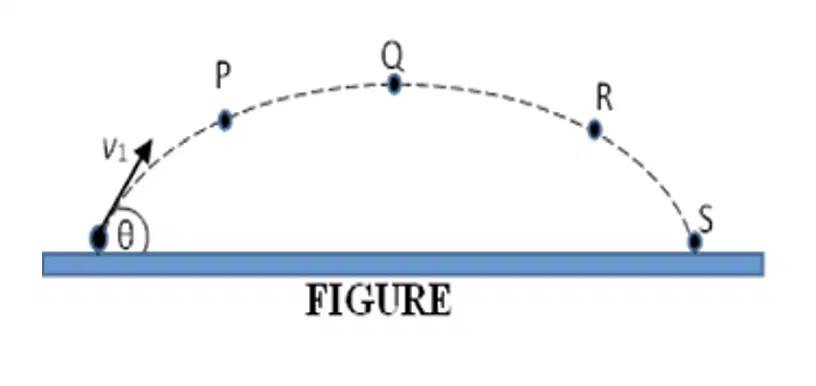
FIGURE above shows the positions of an object undergoes projectile motion at different time, t. At which point, one of velocity’s components of the object is zero?

a)
Point P
b)
Point Q
c)
Point R
d)
Point S
19.

What is the magnitude of force F?

a)

153.21 N

b)

200 N

c)

128.56 N

20.

What is the resultant of the two vectors shown above?

a)

+5

b)

-5

c)

+15

d)

-15