
 Worksheets
SCIENCE FINAL TEST PREPARATION - SEMESTER 1
Total questions: 71
Worksheet time: 38mins
A mechanism which is conducted by organisms to adjust to new environments in order to survive is known as....
Variation
Adaptation
Characteristics
Traits
Adaptation of the polar bears which would best help them survive in harsh winter is....
thick fur
long legs
big eyes
hard scale
The gills have allowed a fish to adapt to live underwater because gills allow the fish to....
swim underwater
eat jellyfish
protect from enemies
breathe underwater
The birds' beak shape depends on....
place they live
their diet
bird's exercise
the weather

The feature that helps this animal survive in its environment is....
looking like a dangerous animal
being the same color as the place it lives (camouflage)
having sharp claws or a strong shell
having only a few young and caring for them
Which is the learned behavior?
horse eating hay
snake eating mice
shape of beak
monkey riding bicycle
Which of the following is an inherited trait?
skateboarding
playing football
eye colour
write a novel

Which feature of a rose helps it grow without being eaten by large animals?
bright petal
sharp thorns
small seeds
deep roots
How do adaptations help animals?
to escape from predator
to hunt its prey
to survive in harsh conditions
all of these are correct

Predict which moth would increase in population
light
dark

This kind of bird's beak is designed to....
catch insects
get nectar
catch fish
dig the ground

What adaptation can this animal do to protect itself from predators?
mimicry
camouflage
pretend to die
change colour
Structural adaptation, also known as....
Chemical adaptation
Behavioral adaptation
Physical adaptation
Body part adaptation

What adaptation can this animal do to survive in its environment?
Having fat layers/blubbers under their skin
Having long and bushy eyelash
having salt glands
What the adaptation that this animal can do to survive in their environment
Which of the following is NOT the special characteristic possessed by plants to protect themselves from predators?
Thorn
sap
chlorophyll
poison
A hump on a camel's back is for...
chewing the food
helping the camel to kneel on the hot sand
protecting the eyes from sand
storing fat and nutrition for a long time
The modified leaves on cacti help them to....
live in the sand
reduce transpiration
absorb water
absorb sunlight
What is structural adaptation?
Biological mechanism by which organisms adjust to the new environments or to change from their old environment
An internal feature of an organism
Actions/response of an organism that helps them to survive in their environment
Physical features of an organism that help them thrive in their habitat.
The instinct of an animal is something the animal....
is born with
has learned
master from practicing
get from exercising

Fish and other animals travel in groups for protection and to find food.
What type of adaptation is this?
Structural
Behavioral
Physiological
Physical

Salmon spend most of their lives in the ocean even though they were hatched from eggs in rivers or streams. When they are ready to reproduce, they leave the ocean and return to where they were hatched.
What type of adaptation is this?
Structural
Behavioral
Physiological
Physical

When threatened, skunks will spray toxins that leave a smell on other animals.
What type of adaptation is this?
Structural
Behavioral
Physiological
Physical

A cell has _____ poles.
Three
Two
Four
Five

This is the symbol for a_____.
Motor
Wire
Bell
Bulb

This is the symbol for a...
Bulb
Voltmeter
Ammeter
Motor

This is the symbol for a...
Wire
Cell
Battery
Ammeter

This is the symbol for a...
Battery
Cell
Motor
Wire

Which diagram matches this circuit picture?


7. Choose the correct symbol of a wire.


Which component would best complete this circuit?
battery

This is the symbol for....
A Motor
A Cell


An incomplete circuit is shown.
To complete the circuit, a wire should be placed from....
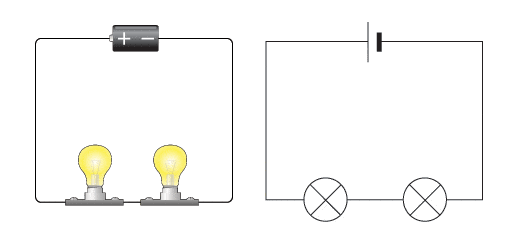
One of the advantages of _________ circuits is that they ensure all components in the circuit have the same voltage
as the source.For instance, all bulbs in a string of lights have the same brightness.
open
multiple
series
parallel

This diagram represent a.......... circuit
series circuit
parallel circuit


Which of the planets is closest to the Sun?
Earth
Mars
Mercury
Venus
What do you call the path a planet goes through as it moves around the Sun?
Axis
Orbit
Revolution
Rotation
Whiat lies between the orbit of Mars and Jupiter?
Asteroid Belt
Kuiper Belt
Oort Cloud
Pluto
What type of galaxy is the Milky Way?
Elliptical Galaxy
Irregular Galaxy
Barred Spiral Galaxy
Spiral Galaxy
How do we call a celestial body that orbits planet?
Asteroid
Comet
Meteoroid
Moon
Which is true about a 'Meteorite'?
It is a space rock which enters the atmosphere
It is a space rock which is more than 3 feet in size
It is a space rock which falls to the surface of the Earth
It is a space rock which floats in the outer space between Mars and Jupiter
A ____________ is a pattern of stars in the sky.
Asteroid
Comet
Constellation
Galaxy


Venus


Jupiter, Saturn, Uranus, Neptune are....
Inner Planets (Terrestrial)
Outer Planets (Jovian)

Outer Planets (Jovian)
Inner Planets (Terrestrial)
The following is NOT the characteristic of Terrestrial planet.
Made mostly of rock/iron
Relatively small in size
Have solid surface
Made mostly of gas/ Ice
Which is NOT the characteristic of Jovian Planet?
Massive in size
Near from the Sun
The surface is not solid
Have many moons
The sun is actually ...
a star
a comet
a planet
an asteroid
Irregular-shaped rocky object that orbit the Sun between Mars and jupiter are ...
stars
comets
asteroids
planets
Correct statement about meteor is ...
made up of gas
located near Moon
rocks that orbit the Sun
it is also called as shooting stars

Planet that has almost the same size as Earth which is also known as twin planet is....
Pluto
Mars
Saturn
Venus

The only planet that supports life is ....
Mars
Neptune
Earth
Saturn

Planet that rotates on a tilted axis and looks like it is laying on its side is ...
Earth
Mars
Pluto
Uranus
An Egyptian astronomer, Ptolemy said that ...
The Moon, Earth planets and stars revolved around Sun
The Moon, Sun planets and stars revolved around Earth
Earth and planets are spherical
planet's rotation caused by Earth rotation
A comet's ... can be millions of miles long.
crash
disappear
dust
tail
Comets are made of ice, frozen gases, and ...
crash
disappear
dust
tail

