
 Worksheets
biochem: carbohydrates
Total questions: 75
Worksheet time: 38mins
Carbon based molecules that have several hydroxyl groups (C-OH)
glycans
lipids
proteins
Energy source
polysaccharides
simple sugars
glycoconjugates
energy storage and structural components
polysaccharides
simple sugars
glycoconjugates
cellular communication, protection, and protein diversification
polysaccharides
simple sugars
glycoconjugates
Glycoproteins (antibodies, viral coat proteins), Proteoglycans (aggrecan, syndecan, glypican), and glycolipids (blood antigens, membrane anchors) are all ____.
simple sugars
polysaccharides
glycoconjugates
glucose homopolymers(cellulose, starch, glycogen) and disaccharide heteropolymers (chitin, keratan sulfate) are all ____.
simple sugars
polysaccharides
glycoconjugates
monosaccharides, disaccharides, oligosaccharides are all _____
glycoconjugates
simple sugars
polysaccharides
Which of the following is the simplest sugar possible?
5 carbon sugar
6 carbon sugar
3 carbon sugar
How are carbohydrates classified?
by how many carbons they have
whether or not they contain an alcohol
by the carbonyl group they contain
Dihydroxyacetone
aldose
ketose
glyceraldehyde
aldotriose
ketotriose
have identical molecular formulas but differ in order of attachment
stereoisomers
constitutional isomer
diastereoisomers
epimers
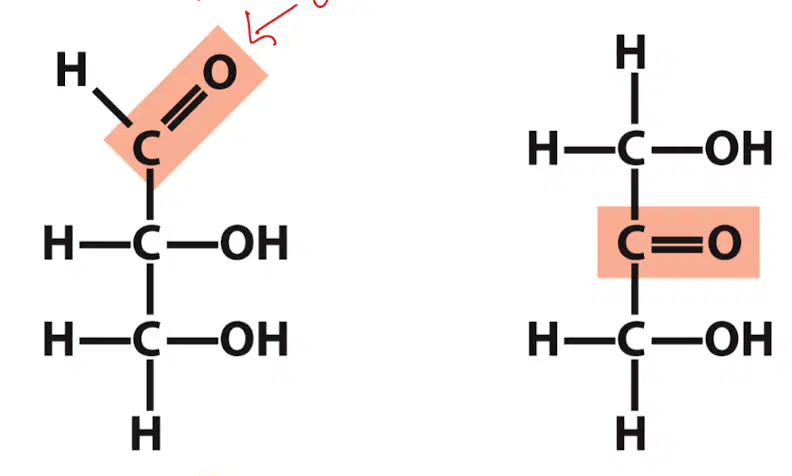
which of the following?
Epimer
constitutional isomer
stereosomer
enantiomer
isomers that differ in spatial arrangement are ___.
epimers
constitutional isomer
stereoisomers
diastereomer
stereoisomers that are nonsuperimposable mirror images
diastereoisomer
constitutional isomer
epimer
enantiomers
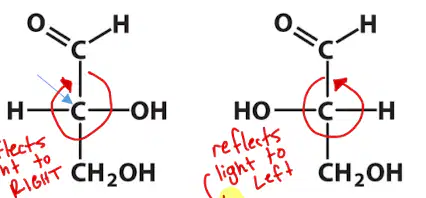
which of the following?
enantiomer
constitutional isomer
diastereomer
epimer
most hexoses in living organisms are ____.
L stereoisomer
D stereoisomers
Sugars have chirality.
True
False
steroisomers that are not mirror images
enantimer
epimer
diastereomer
constitutional isomer
possible stereoisomers equal 2^n
True
False
How many possible diastereoismers would a 6 carbon aldose with 4 symmetric carbons have?
64
16
4
0
Diastereomers have the same physical properties.
True
False
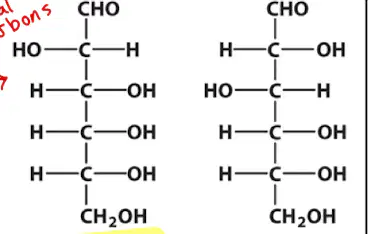
Which of the following?
epimer
diastereoisomers
constitutional isomer
enantiomer
differ at one chiral center (differ at 1 asymmetric center)
constitutional isomer
enantiomer
epimer

which of the following
epimer
enantiomer
constitutional isomer
6 carbon aldoses are the most commonly seen sugars in biochemical processes.
True
False
What is the standard 6 carbon sugar?
mannose
fructose
glucose
galactose
What form of common monosaccharides predominate in solution?
cyclic form
linear form
a 5 carbon ring
fructose
glucose
mannose
glucopyranose
What is the 5 carbon ring of fructose called?
purine
pyrimidine
galactose
furan
During cyclization, what part of the sugar attacks the carbonyl carbon on a linear sugar?
the ketone
the last carbon
the OH group (alcohol)
The hydroxyl is below the ring.
a- form
B-form
The OH is above the ring.
a-form
B-form
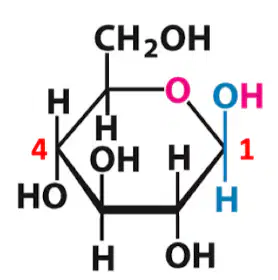
Which one?
alpha form
beta form
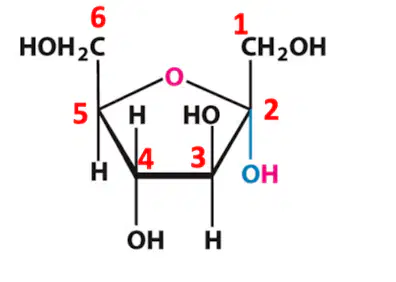
which one?
alpha
beta
sugars that react with oxidizing agents are called _____
non-reducing sugars
reducing sugars
sugars that do not react with oxidizing agents
nonreducing sugars
reducing sugars
anomeric carbon is the reducing end of sugars.
True
False
Glucose is a nonreducing sugar.
True
False
Glycosylation of hemoglobin has no effect on the oxygen binding ability of hemoglobin.
True
False
Glycosylation of hemoglobin lasts the entire life of the red blood cell.
True
False
Uncontrolled diabetics will have less glycosylated hemoglobin in their blood.
True
False
compounds that contain a single carbonyl group and 2 or more hydroxyl groups.
polysaccharide
oligosaccharide
monosaccharide
2 sugars linked together by O-glycosidic bonds.
disaccharide
monosaccharide
oligosaccharide
polysaccharide
2 or more sugars linked by O-glycosidic bonds (play key role in cell-cell interaction).
monosaccharide
oligosaccharide
polysacchride
formed when many monosaccharides are bonded together.
oligosaccharide
monosaccharide
polysaccharide
Glucose and Glucose form
maltose
sucrose
lactose
glucose and fructose form
maltose
sucrose
lactose
glucose and galactose form
maltose
sucrose
lactose
What type of linkage does sucrose have?
a-1, B-2 linkage
a-1, a-4 linkage
B-1, B-4 linkage
What type of linkage does lactose have?
a-1,a-4
a-1,B-2
B-1,B-4
What kind of linkage does maltose have?
a-1,a-4
a-1,B-2
B-1,B-4
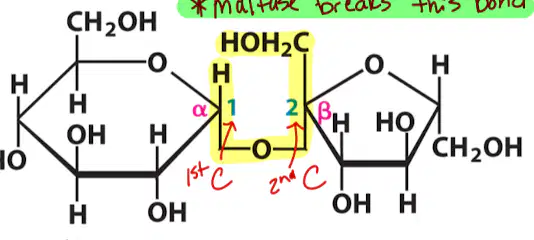
which one?
maltose
sucrose
lactose

which one?
maltose
sucrose
lactose
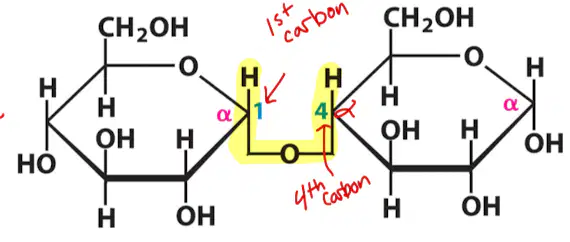
which one?
maltose
sucrose
lactose
one monomer unit that is all the same
homopolysaccharides
heteropolysaccharides
homopolysaccharides are found in humans and plants while heteropolysaccharides are not.
True
False
storage form of glucose in plants
glycogen
starch
nonbranched form of starch?
amylopectin
amylose
glycogen
branched form of starch?
amylopectin
amylose
glycogen
what is the structural polysaccharide in plants? (not the storage form)
amylopectin
amylose
cellulose
glycogen
what is the difference between cellulose and glycogen?
cellulose has B-1,4 glycosidic bonds while glycogen has a-1,4 glycosidic bonds
cellulose has a-1,4 glycosidic bonds while glycogen has B-1,4 glycosidic bonds
cellulose has N linkages while glycogen has O linkages
starch and glycogen both have a-1,4 linkages.
True
False
amines are joined to glucose through
O-glycosidic bonds
N-glycosidic bonds
ester linkages
alcohols are joined to glucose through
O-glycosidic bonds
N-glycosidic bonds
ester linkages
phosphates are joined to carbohydrates through
O-glycosidic bonds
N-glycosidic bonds
ester linkages
phosphates add positive charge to sugars.
True
False
Play structural roles or act as lubricants.
glycoproteins
proteoglycans
mucins or mucoproteins
membrane proteins
glycoproteins
proteoglycans
mucins or mucoproteins
selubricants
glycoproteins
proteoglycans
mucins or mucoproteins
carbohydrates can connect to serine through either an O-linkage or an N-linkage.
True
False
proteoglycan-glycosaminoglycans are a type of polysaccharide based on a repeating disaccharide in which
one of the sugars is an amino sugar
not this one
chondroitin-4-sulfate
in connective tissues
anticoagulant
in joints and eye
hyaluronate
in joints and eyes
connective tissue
anticoagulant
glycoconjugate where a lipid is attached to a sugar.
glycoprotein
glycolipid

