wayground logo

Free Printable Worksheets

Font size

S
M
L
XL
Worksheets

Molecular Genetics Test Review

Total questions: 75

Worksheet time: 2hrs 34mins

Name
Class
Date
1.

A mutation in a strand of mRNA results in a premature stop codon in the middle of the sequence. Which best describes the result of this type of mutation?

a)

The resulting protein translated from this sequence will be too short and will not function properly.

b)

The resulting protein translated from this sequence will be too long and will not function properly.

c)

There will be no effect. Mutations only matter if the mistake is in the tRNA sequence.

d)

There will be no effect. Mutations only matter if the mistake is in the DNA sequence.

2.

The diagram shows a cellular process in which a double-stranded molecule of nucleic acid gives rise to a single-stranded molecule of nucleic acid. Which best describes the process shown?

a)

DNA is transcribed into RNA.

b)

RNA is transcribed into DNA.

c)

DNA is translated into RNA.

d)

RNA is translated into DNA.

3.

A molecule is observed traveling to the ribosome where it undergoes a change by releasing an attached subunit. Which may best describe this molecule?

a)

DNA

b)

mRNA

c)

rRNA

d)

tRNA

4.

The overall roles of DNA and RNA are illustrated. Which process is represented at Point 3?

a)

transcription

b)

replication

c)

translation

d)

mutation

5.

Which is the greatest consequence of transcription being blocked in the nucleus?

a)

The DNA would not be copied into RNA.

b)

The RNA would not be copied into DNA.

c)

The mRNA would not be transferred to rRNA.

d)

The protein would not be assembled in the cytoplasm.

6.

This is a diagram of a DNA molecule. Which type of bond, denoted by the arrows, allows DNA to be readily replicated?

a)

ionic bond

b)

peptide bond

c)

covalent bond

d)

hydrogen bond

7.

Which most directly affects the sequence of amino acids in a protein?

a)

the DNA in the nucleus of the cell

b)

the amino acids found in the cytoplasm

c)

the type of cell in which the protein is made

d)

the region of the cell in which the protein is made

8.

How are all living organisms similar?

a)

They are made of cells with the same types of organelles.

b)

They contain the same types of tissues to carry out life functions.

c)

They use the same proteins and amino acids to carry out life processes.

d)

They contain the same four nitrogen bases which code for specific proteins.

9.

What is the significance of the sequence of nucleotides in DNA in a cell’s nucleus?

a)

It codes for specific fatty acids that link together to form lipids.

b)

It codes for specific starches that link together to form organelles.

c)

It codes for specific amino acids that link together to form proteins.

d)

It codes for specific monosaccharides that link together to form carbohydrates.

10.

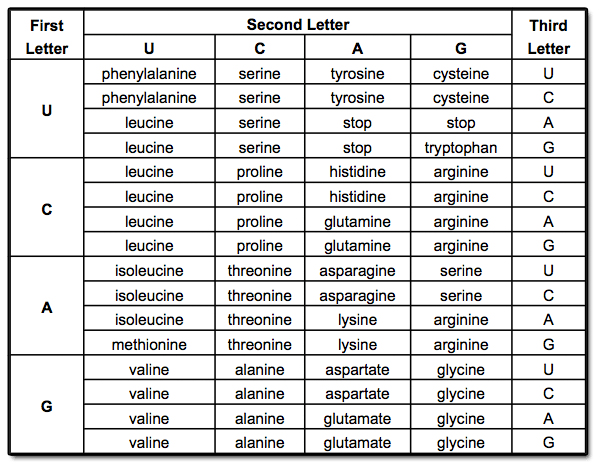
This is an mRNA codon chart. An organism has the DNA sequence TAC TGC CCA ATA. Why is it possible for a different organism with the DNA sequence TAC TGT CCG ATG to produce the same protein?

a)

because the DNA sequence for both organisms is the same length

b)

because more than one codon codes for the same amino acid sequence

c)

because the first base in each codon determines the amino acid sequence

d)

because the mRNA sequence for both organisms contains the same bases

11.

What does DNA determine?

a)

traits of living things

b)

traits of nonliving things

c)

organization of living things

d)

Did Not Attempt

12.

How many parts make up a nucleotide?

a)

One

b)

Two

c)

Three

d)

Four

13.

What are the parts of a nucleotide? Choose all that apply.

a)

pentose sugar

b)

nucleotide

c)

nitrogenous base

d)

phosphate group

14.

What are the names of the nitrogenous bases found in DNA? Choose all that apply.

a)

adenine

b)

cytosine

c)

thymine

d)

guanine

e)

uracil

15.

Adenine pairs with what in DNA?

a)

thymine

b)

cytosine

c)

guanine

d)

adenine

16.

Cytosine always pairs with...

a)

thymine

b)

cytosine

c)

guanine

d)

adenine

17.

What is the shape of DNA?

a)

double helix

b)

single helix

c)

squiggle

d)

twisty step looking thing

18.
Who was given credit for determining the shape of DNA? 
a)
Avery
b)
Watson and Darwin
c)
Watson and Crick
d)
Franklin and Crick
19.
What process is shown in the diagram?
a)

DNA replication

b)
transcription
c)
mitosis
d)
translation
20.
What does DNA stand for?
a)
Deoxyribonucleic acid
b)
Denitrogenous acid
c)
Deribonucleic acid
d)
Diribonucleic acid
21.
Which shows the correct complementary base pairing for DNA?
a)
C-A, T-G
b)
A-G, C-T
c)
C-G, U-A
d)
T-A, G-C
22.
Which sequence of DNA bases would pair with this partial strand
ATG TGA CAG
a)
ATG TGA CAG
b)
TAC ACT GTC
c)
GTA AGT GAC
d)
CAT TCA CTG
23.
How does RNA differ from DNA?
a)
RNA contains uracil and deoxyribose
b)
RNA contains ribose and thymine
c)
RNA contains uracil and ribose
d)
RNA contains adenine and ribose
24.
How would the DNA sequence GCTATA be transcribed to mRNA?
a)
GCUAUA
b)
CGATAT
c)
CGAUAU
d)
GCUTUT
25.
Which of the following describes RNA?
a)
RNA is usually double-stranded and contains the base thymine
b)
RNA is usually single-stranded and contains the base uracil
c)
RNA is longer than DNA and uses five bases to encode information
d)
RNA is made in the nucleus of eukaryotic cells and stays there to carry out its functions
26.
In messenger RNA, each codon specifies a particular
a)
nucleotide
b)
enzyme
c)
amino acid
d)
promoter
27.
Which of the following statements about the genetic code is true?
a)
A codon can specify more than one amino acid
b)
Every codon specifies a different amino acid
c)
Some codons specify the same amino acid
d)
Some codons have no function at all
28.
Changes is DNA sequences that affect genetic information are known as
a)
replications
b)
mutations
c)
transformations
d)
translations
29.
A substance that can cause a change in the DNA code of an organism is called a 
a)
toxin
b)
mutagen
c)
nitrogenous base
d)
nucleotide
30.
What determines the code, or information, of a DNA molecule?
a)
the shape (structure) of the nitrogen bases
b)
the order (sequence) of the nitrogen bases
c)
the color of the nitrogen bases
d)
the frequency (number) of nitrogen bases
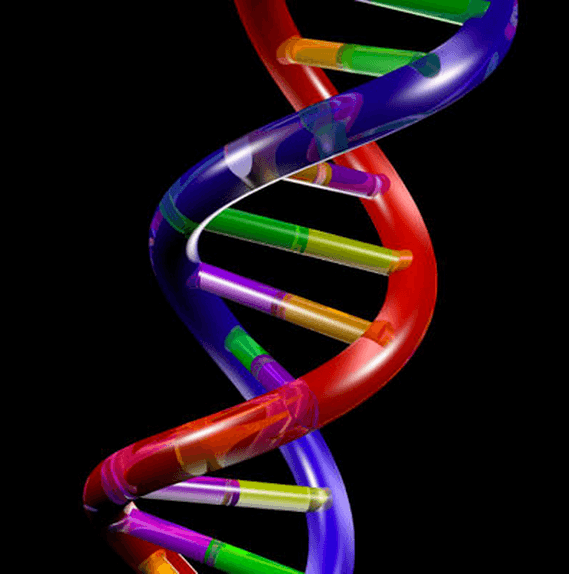
31.
What does this picture represent?
a)
amino acid
b)
base pairing
c)
nucleotide
d)
the DNA molecule
32.
What is the difference between DNA and RNA in terms of bases?
a)
RNA contains uracil in place of thymine
b)
RNA contains uracil in place of adenine
c)
RNA contains uracil in place of guanine
d)
RNA contains uracil in place of  cytosine
33.

What binds together to create proteins?

a)

Sugars

b)

Nucleotides

c)

Lipids

d)

Amino Acids

34.

What is produced by transcription?

a)

mRNA

b)

rRNA

c)

tRNA

d)

DNA

35.

Where does translation occur?

a)

In the cytoplasm

b)

At a ribosome

c)

In the cytoplasm at a ribosome

d)

In the nucleus

36.

What is produced by translation?

a)

rRNA

b)

mRNA

c)

Proteins

d)

Lipids

37.

What is a codon?

a)

A set of 3 nucleotides on mRNA

b)

A set of 3 nucleotides on DNA

c)

A whole strand of mRNA

d)

An amino acid

38.

What type of RNA is responsible for bringing amino acids to the ribosome?

a)

mRNA

b)

tRNA

c)

rRNA

d)

DNA

39.

What does tRNA "transfer"?

a)

amino acids

b)

nucleic acids

c)

nucleotides

d)

AUG

40.

How many nucleotides make up a single codon?

a)

3

b)

5

c)

4

d)

1

41.

What is the order for Protein Synthesis?

a)

Transcription -> Translation -> Protein

b)

Translation - > Transcription -> Protein

c)

Protein -> Transcription -> Translation

d)

Translation -> Protein -> Transcription

42.

Where does Transcription occur

a)

Nucleus

b)

Ribosome

c)

ER

d)

Mitochondria

43.
DNA holds the code for
a)
lipids
b)

nucleus

c)

production of proteins

d)

nucleotides

44.
There is a segment of DNA that codes for every trait that a person has. These segments of DNA are found on
chromosomes and are called ________.
a)
Deoxyribonucleic acid
b)
Genes
c)
Heredity
d)
Recessive Traits
45.
Which sequence of DNA bases would pair with this partial strand
CAT TCA CTG
a)
ATG TGA CAG
b)
TAC ACT GTC
c)
GTA AGT GAC
d)
CAT TCA CTG
46.
Which of the following units are repeatedly joined together to form a strand of DNA?
a)
amino acids
b)
nucleotides
c)
fatty acids
d)
polysaccharides
47.
The enzyme that unwinds the DNA to prepare for replication
a)
helicase
b)
replicase
c)
polymerase
d)
synthase
48.
In what phase of the cell cycle does DNA replication take place?
a)
G1
b)
S
c)
G2
d)
M
49.
Which enzyme is responsible for adding nucleotides?
a)
Topoisomerase
b)
DNA Polymerase
c)
Ligase
d)
Primase
50.
The process of DNA replication is called semi conservative because it results in
a)
none of these
b)
Two DNA molecules.  One original molecule and one with two new strands
c)
two exact copies with new strands
d)
two identical molecules, each with 1 original strand and one new.
51.
The function of _____ is to transport amino acids in the cytoplasm to the ribosome.
a)
rRNA
b)
tRNA
c)
mRNA
d)
DNA
52.
The process of going from DNA to mRNA is called
a)
Transcription
b)
Translation
c)
Transportation
d)
Transient
53.
The process where mRNA is read and made into an amino acid chain.
a)
Transcription
b)
Translation
c)
Transportation
d)
Transient
54.
In proteins, the amino acid order is determined by 
a)
nitrogenous bases in RNA
b)
random placement
c)
nitrogenous bases in DNA
d)
there is no order
55.
This molecule carries genetic information from the nucleus to the ribosomes in the cytoplasm.
a)
rRNA
b)
tRNA
c)
mRNA
d)
DNA
56.
What is the mRNA strand that would result from the DNA template strand CCTA?
a)
GGAT
b)
CCAT
c)
GGAU
d)
CCAU
57.
Which of these nitrogenous bases is NOT in RNA?
a)
Uracil
b)
Thymine
c)
Cytosine
d)
Guanine
58.
What amino acid is represented by the codon UUA?
a)
Phenylalanine
b)
Tyrosine
c)
Leucine
d)
Stop codon
59.
What process is going on in this photo? 
a)
Transcription 
b)
Translation 
c)
Replication 
d)
All the above 
60.

What is the location in the cell for translation?

a)

nucleus

b)

mitochondria in cytoplasm

c)

ribosome in cytoplasm

d)

chloroplast in cytoplasm

61.

What process is happening in the diagram?

a)

transcription

b)

translation

c)

dna replication

d)

mitosis

62.

On which molecule can an anticodon be found?

a)

mRNA

b)

DNA

c)

tRNA

d)

rRNA

63.

A DNA nucleotide may be made up of a phosphate group, along with

a)

deoxyribose sugar and uracil

b)

ribose sugar and cytosine

c)

deoxyribose sugar and thymine

d)

ribose sugar and adenine

64.
Which phrase best describes translation?
a)
converts mRNA into a polypeptide
b)
catalyzes bonds between amino acids
c)
produces RNA from DNA molecules
d)
recycles tRNA molecules for reuse
65.

What is recombinant DNA

a)

DNA from 2 different organisms combined

b)

DNA from 2 different ribosomes

c)

DNA that is separated out from a vector

66.

"transgenic" refers to an animal that:

a)

Has DNA from another organism spliced into its genome

b)

Has undergone DNA modification

c)

Has unique genes for its species

67.

In which ways can genetic engineering can improve crops

a)

Make them pest or drought resistant

b)

Make them more nutritious

c)

Make them larger

d)

All answers are correct

68.
Gel electrophoresis enables scientists to
a)
separate DNA fragments.
b)
combine DNA fragments.
c)
count the genes in DNA.
d)
insert DNA in cells.
69.
Polymerase chain reaction is used to
a)
determine the sequence of DNA.
b)
make copies of a DNA sequence.
c)
selectively breed plants and animals.
d)
produce mutations in bacteria.
70.
What type of bonds hold the two strands of DNA together?
a)
Hydrogen bonds
b)
Covalent bonds
c)
Dipole-Dipole bonds
d)
Ionic bonds
71.

If two double-stranded DNA molecules are used at the beginning of a polymerase chain reaction (PCR) process, how many double-stranded DNA molecules can be obtained after two cycles?

a)

2

b)

4

c)

8

d)

32

72.
If a segment of double-stranded DNA has 40 percent A, how much of it is C?
a)
40
b)
10
c)
15
d)
20
73.

Which type of mutation occurs when there is an addition or removal of a base?

a)

missense mutation

b)

nonsense mutation

c)

frameshift mutation

d)

point mutation

74.

Occurs when the DNA change does not alter the amino acid sequence of the polypeptide.

a)

Frameshift Mutation

b)

Insertion

c)

Missense mutation

d)

Silent Mutation

75.
Where do mutations occur?
a)
DNA and RNA
b)
DNA 
c)
RNA
d)
mRNA and tRNA