
 Worksheets
Earth Science PreTest
Total questions: 50
Worksheet time: 54mins
What is the underlying force that drives plate tectonics?
Ocean tides
Volcanic eruptions
The rock cycle
Convection currents
Which of the following plate interactions is most likely to form a mountain range?
A transform boundary between ocean plates
A transform boundary between continental plates
A convergent boundary between continental plates
A subduction zone between a continental plate and an ocean plate
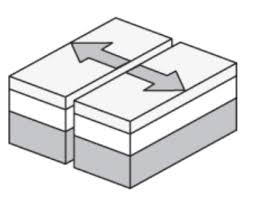

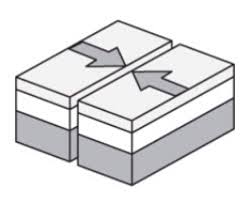
At which plate boundary will you NOT find volcanoes?
Convergent continental-oceanic
Divergent ocean-ocean
Convergent continental-continental
Convergent oceanic-oceanic
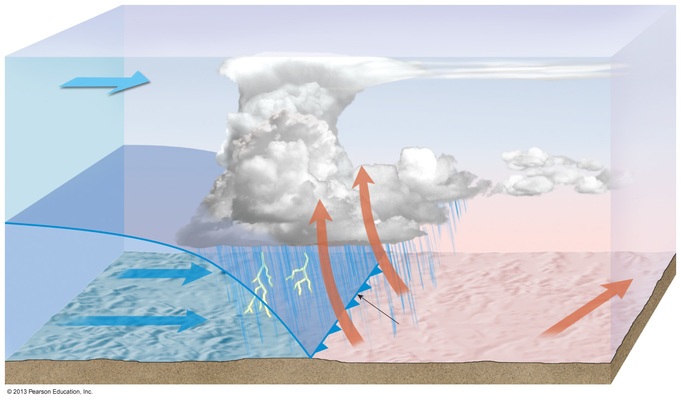
How does the ocean effect (provide the energy for) the formation of hurricanes?
Ocean water is warm and heats the air above it
Ocean water is cool and cools the air above it
Ocean water contains salt that reacts with air, changing air pressure
Ocean water contains algae that make oxygen, changing the air's composition
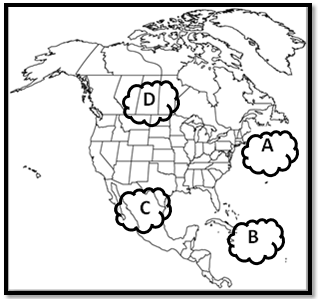

Which of the following statements are true? (Choose all that apply)
The planets orbit in a perfect circle
The plants move faster when they are closer to the sun and slower when they are further from the sun
The farther a planet is from the sun the faster the orbit
(P2 = a3)
Some scientists have predicted that buildup of greenhouse gases will contribute to the occurrence of more hurricanes. Which is the MOST likely assumption used in making this prediction?
Acid rainfall will cause a decrease in oceanic surface temperatures.
Increased atmospheric carbon dioxide will cause increased ocean surface temperatures.
Any measurable increase in ocean surface temperatures must be caused by human activities.
Saturation of nitrogen in the atmosphere will cause a wide range of ocean surface temperatures.
Which graph best shows the general relationship between air pressure and altitude?


Weathering and erosion are processes that constantly change Earth’s surface. How do weathering and erosion differ?
Weathering acts quickly. Erosion acts slowly
Weathering acts underground. Erosion acts above ground.
Weathering breaks down materials. Erosion moves materials.
Weathering is caused by wind. Erosion is caused by water.

What is the source of energy for the water cycle?
gravity
transpiration
the oceans
the Sun
The theory that says Earth's continents once made up an ancient supercontinent, and have been drifting apart ever since, is called the theory of...
Pangaea
Plate Tectonics
Natural Selection
Gravity

Why does oceanic crust subduct under continental crust?
The oceanic crust is more dense.
The oceanic crust is less dense.
The oceanic crust is hotter.
The oceanic crust is cooler.
Global warming affects sea levels. Which of these is a likely consequence if the trend of global warming continues in coming decades?
Melting glaciers will cause flooding of coastal towns and cities.
Melting glaciers will cause flash flooding in mountainous regions.
Evaporation will cause the formation of fjords and U-shaped valleys.
Evaporation will cause sea levels to drop enlarging coastal areas.
In the rock cycle, what is happening when a rock changes from igneous rock to sedimentary rock?
Melting and cooling
Heat and pressure
Weathering and Compaction
None of the above


Why do we have night and day?
Earth's rotation
Earth's revolution around the Sun
The Sun rotating
The moon blocking the sun


Where did the water in Earth's early oceans come from?
the escape of water vapor and other gases from the molten rocks of the Earth
a comet which hit the earth
an asteroid that collided with the earth
the moon
How is sedimentary rock formed?
Rock is heated and forms crystals.
Rocks are weathered and eroded
Organic material is compressed and layers of particles are cemented together
Magma cools and forms crystals
Which evidence best supports the theory that the continents have moved over time?
The shape of the landmasses seem to fit together
The weather that happens in different continents
The climate differences all over the world
The limited amount of freshwater available
Low-pressure systems are usually associated with ________ weather.
cold and dry
cloudy and rainy
sunny and dry
warm and humid
15.1 What are the two most common gases in the atmosphere?
hydrogen and oxygen
nitrogen and water vapor
hydrogen and nitrogen
oxygen and nitrogen
Which of the following is the very reason why porosity is important soil property?
It indicates the ability of the soil to deform without breaking.
It indicates the amount of water available for plant growth.
It indicates the ability of the water to flow through soil.
It indicates how well soil particles stick together.
What do you call the chain of volcanoes around the Pacific Ocean?
Pacific Volcanoes
Pacific Chain of Volcanoes
Pacific Ring of Fire
None of these
Which item refers to the point of origin of an earthquake?
epicenter
focus
magnitude
intensity
Check all that applies. Which of the following describes a divergent boundary?
I. mostly found at the sea floor
II. two plates that glide past each other
III. results in the formation of trenches
IV. two plates that move away from each other
These rocks are formed through the cooling and solidification of magma.
Sedimentary
Metamorphic
Extrusive igneous
Intrusive igneous
Which of the following is not a gas giant?
Jupiter
Mercury
Uranus
Saturn

What moon phase is located at point 2
Waning crescent
Waxing crescent
Waning gibbous
Waxing gibbous

