
 Worksheets
Diagnostic Test M1 Biology Y11
Total questions: 16
Worksheet time: 8mins
Which type of cells do all sense organs contain?
ciliated
effector
mesophyll
receptor
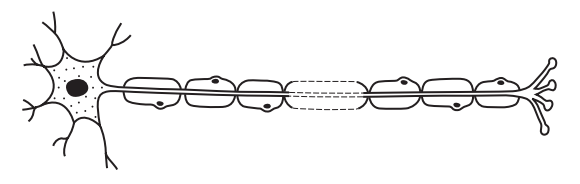
The diagram shows a cell.
What type of cell is shown?
ciliated cell
motor neurone
relay neurone
sensory neurone
When a bright light is shone into the eye, the diameter of the pupil decreases.
What is this an example of?
accommodation
a simple reflex
photosynthesis
voluntary response

The diagram shows a section through part of the human eye.
When a person looks at an object which is close to their eye, which of the following takes place?
suspensory ligaments slacken; lens becomes fatter
suspensory ligaments slacken; lens becomes thinner
suspensory ligaments tighten; lens becomes fatter
suspensory ligaments tighten; lens becomes thinner
A bright light suddenly shines into a person’s eyes.
What happens?
The lenses become more concave.
The lenses become more convex.
The pupils become larger.
The pupils become smaller.
When a person is frightened, adrenalin is released by the adrenal glands.
What are the effects of the adrenalin?
breathing rate decreased; heart beat rate decreased
breathing rate decreased; heart beat rate increased
breathing rate increased; heart beat rate decreased
breathing rate increased; heart beat rate increased
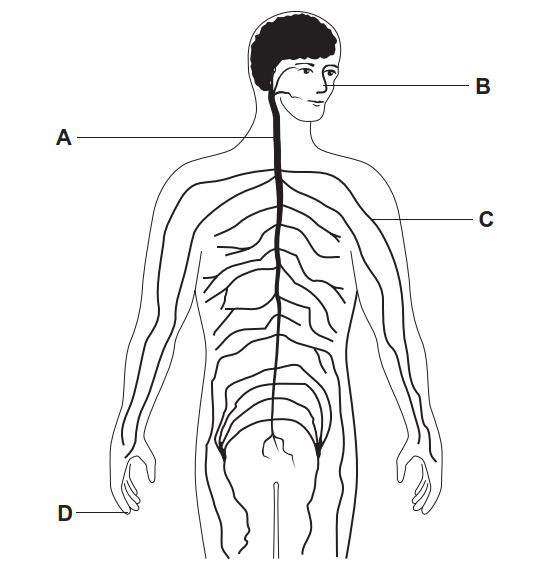
The diagram shows the human nervous system.
Which letter indicates a part of the central nervous system?
A
B
C
D
Which structure of the eye contains light receptor cells?
Retina
Lens
Cornea
Iris
What do we refer to when we say "accommodation"?
How eye is adapted for converting light
How eye is protected from too much light
How eye reacts to too little light
How eye is adapted to see near or far

The diagram shows a person sweating in hot weather. What part is played by the sweat glands during the process of sweating?
Effector
Receptor
Sense Organ
Stimulus
How do liver cells respond to increased insulin levels in the blood?
They absorb glucose and convert it to glycogen
They absorb glucose and convert it to glucagon
They break down glucagon and release the glucose into the blood
They break down glycogen and release the glucose into the blood
They release glucagon into the blood
Which of these would allow you to increase your body temperature if it went below 37oC?
Sweating
Vasoconstriction
Vasodilation
Shivering
Increase in metabolism (respiration)
What term is used to describe a version of a gene?
allele
genotype
phenotype
heterozygous

