
Font size
 Worksheets
OSI and TCP/IP Layers
Total questions: 48
Worksheet time: 24mins
Network/Internet
Which 2 layers in the OSI model correspond to only one layer each in the TCP/IP model?
Transport
Network
Session
Physical
Data Link
Routers operate at which layer of the OSI model?
physical
transport
network
MAC sublayer of the data link layer
session
Which of the following are benefits of using a layered network model?
A . it specifies how changes to one layer must be propagated through the other layers
B . it facilitates troubleshooting
C . it focuses on details rather than general functions of networking
D . it breaks the complex process of networking into more manageable chunks
E . it allows layers developed by different vendors to interoperate.
A and B only
B, D, and E
A and C only
none of the above
all of the above
The layers of the OSI model, from the top down, are:
application, presentation, session, transport, network, data link, physical
session, presentation, data transport, MAC, network, physical
physical, data link, network, transport, session, presentation, application
presentation, application, session, network, transport, data link, physical
application, encryption, network, transport, logical link control, physical
Which of the following operate at the presentation layer?
A . MIDI
B . FTP
C . SMTP
D . TFTP
E . JPEG
A and B
A, C, and E
C and E
A and E
none of the above
Which of the following are transport layer protocols?
TCP and UDP
IP
FTAM
IP and TFTP
TFTP
Which of the following are considered to be the upper layer protocols?
presentation and session
application and presentation
application, presentation, and session
application, presentation, session, and transport
application
Flow control takes place at which layer?
physical
transport
network
MAC sublayer of the data link layer
session
Encryption takes place at which layer?
application
presentation
session
transport
data link
True or False: The network layer uses physical addresses to route data to destination hosts.
True
False
Error detection and recovery takes place at which layer?
transport
presentation
data link
application
network
Which layer establishes, maintains, and terminates communications between applications located on different devices?
application
presentation
session
network
data link
IP is implemented at which OSI model layer?
transport
session
data link
network
logical link control
Which layer handles the formatting of application data so that it will be readable by the destination system?
application
presentation
session
transport
data link
Which of the following are presentation layer standards?
(choose the best answer)
A. MIDI
B. TIFF
C. JPEG
D. MPEG
E. GIF
C and D
B, C, and E
B, C, D, and E
A only
all of the above
Which layer translates between physical (MAC) and logical addresses?
network
data link
transport
physical
session
Repeaters and hubs operate at which layer?
network
data link
transport
physical
session
What are the sublayers of the data link layer?
MAC and IPX
hardware and frame
MAC and LLC
WAN and LAN
TFTP and telnet
Which layer is responsible for packet sequencing, acknowledgments, and requests for retransmission?
The MAC sublayer of the data link layer
transport
physical
application
network
In the current TCP/IP model, the Application, Presentation, & Session layers from the OSI model are combined into which layer?
Data Link
Physical
Transport
Application
Network
What protocol(s) is used at the Network layer?
Transmission Control Protocol (TCP)
Both options are protocols used at the Network layer
Internet Protocol (IP)
Why were the Data Link & Physical layers divided into two separate layers in the current TCP/IP model?
Because the number of protocols grew too large for the link layer to handle it by itself
Because networks use different types of transmission media (ethernet wire, fiber optic cable, and radio signals) to transmit bits
Because the original TCP/IP model was too complicated for many typical uses
True or False: the application layer defines how applications use the network, not how the applications actually work
True
False
Transport layer protocols
convert the data into bits to be transmitted
use port numbers to track sessions
address the traffic for its destination
What information is found in a TCP header?
Destination port
Source port
Both options are found in a TCP header
What is the FIRST thing the destination does at the network layer with a packet it receives?
Pass the packet to the transport layer
Remove the IP header
Reassemble the data once it receives all the packets
What information is found in the frame header?
Both are found in a frame header
Destination MAC address of the next device in the path to the ultimate destination
Source MAC address
What is done with the data at the physical layer?
The physical layer header is added to the frame to prepare it for transmission
Both occur at the physical layer
The data is converted into its intended transmission media (electrical, light, radio wave) and sent down its transmission path
Data Link and Physical are combined into what layer in TCP/IP?
Network Layer
Sub Network Layer
Frame Layer
Data Processing Layer
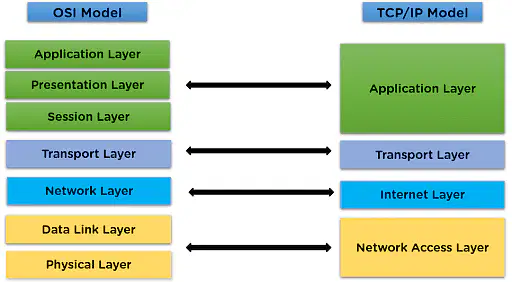
Is the term "Network layer" interchangeable with "Internet layer"
True
False

