
NEW
Font size
 Worksheets
หลังเรียน 1
Total questions: 40
Worksheet time: 13mins

How many VALENCE ELECTRONS does Chlorine have?
2
7
8
10
17
How many valence electrons does Mg have? (use the PTable)
1
2
3
4
5

Ionic bonds typically form between
A metal and a nonmetal
Two nonmetals
Two metals
A metalloid and a metal

Why do elements form chemical bonds?
Because they're friendly
To create a new element
To become stable
Because they all need to gain more electrons
If you were to draw the lewis dot structure for Germanium (Ge), how many dots would you put around it?
2
4
6
8

Cations _______ electrons, becoming _______ charged.
Gain; positively (+)
Gain; negatively (-)
Lose; positively (+)
Lose; negatively (-)

Anions ____ electrons, becoming _____ charged.
Gain; positively (+)
Gain; negatively (-)
Lose; positively (+)
Lose; negatively (-)

Nonmetals (like Cl) typically ____ electrons when they form ionic bonds.
Gain
Lose
Keep the same

Metals (like Na) typically _____ electrons in the formation of ionic bonds.
Gain
Lose
Keep the same
Ionic bonds happen because of the ____ of valence electrons.
sharing
transfer
keeping
covering
Oxygen is in group 6 of the periodic table, which ion would it form?
O-
O+
O2-
O2+
Which of the below is an ionic compounds?
Ni
MgCl2
H2O
CH4


Which structure represents the sodium chloride lattice?
A
B
C
D
Mg (s) --> Mg (g)
Ionisation
Combustion
Formation
Atomisation
The enthalpy change when 1 mole of 1+ ions is formed from 1 mole of gaseous atoms.
Lattice breaking
Atomisation
Ionisation
Formation
Mg (g) --> Mg+ (g) + e-
Ionisation
Combustion
Formation
Hydration
Na+ (g) + Cl- (g) --> Na+ (aq) + Cl- (aq)
Formation
Solution
Combustion
Hydration

What enthalpy change does the number 4 represent?
Formation
1st ionisation energy (Na)
1st electron affinity (Na)
Atomisation (Na)
Which equation represents the process that occurs when the standard enthalpy of atomisation of iodine is measured?
½ I2(s) → I(g)
I2(s) → 2I(g)
½ I2(g) → I(g)
I2(g) → 2I(g)
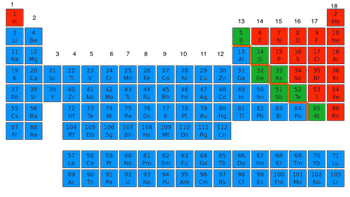
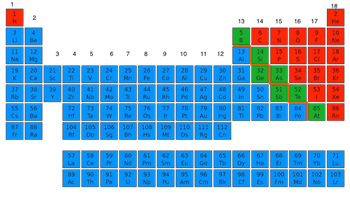
จากสูตรเคมีของสารประกอบไอออนิก CuCO3 จงหาประจุของ Cu
0
+1
+2
+3

The number of covalent bonds form in group 17
One
Two
Three

Which of the following is the correct LD Diagram for Hydrogen Cyanide, HCN?
A
B
C
D
Which is the correct molecular structure for carbon dioxide CO2?


H2O has how many lone pairs?
0
1
2
3

What is the correct formula for this molecule?
CH
C1H4
CH4
C4H

How many protons and electrons does a carbon atom have?
6 protons, 6 electrons
6 protons, 4 electrons
4 protons, 6 electrons
Not enough information

