Wayground logo

Free Printable Worksheets

Font size

S
M
L
XL
Worksheets

Chemistry Test 1: Atoms, the Periodic Table, and Density

Total questions: 44

Worksheet time: 1hrs 4mins

Name
Class
Date
1.

Where is number one pointing at?

a)

Nucleus

b)

Protons

c)

Neutrons

d)

Electron cloud

2.

The smallest unit of an element that maintains the properties of that element

a)

proton

b)

atomic mass unit

c)

electron

d)

atom

3.

A subatomic particle that has a positive charge and that is found in the nucleus of an atom

a)

proton

b)

neutron

c)

electron

d)

nucleus

4.

A subatomic particle that has no charge and is found in the nucleus of an atom

a)

proton

b)

neutron

c)

electron

d)

nucleus

5.
Which element has an atomic number of 6?
a)
Carbon
b)
Nitrogen
c)
Xenon
d)
Sodium
6.
Which element has the LOWEST Atomic Number out of the following? (HINT - they are all listed in the Halogen column)
a)
Bromine (Br)
b)
Chlorine (Cl)
c)
Iodine (I)
d)
Astatine (At)
7.

What are electrons?

a)

an atom’s central regions, which is made up of protons and neutrons

b)

subatomic particles that have negative charges

c)

subatomic particles that have neutral charges

d)

subatomic particles that have positive charges

8.

What subatomic particles make up the nucleus of an atom?

a)

electrons

b)

protons

c)

neutrons

d)

leptons

e)

mesons

9.
What is the electrical charge of a proton?
a)
1+
b)
1-
c)
neutral
d)
2-
10.
Electrons have virtually no mass (weight).
a)
True
b)
False
11.
Which is an electron?
a)
A
b)
B
c)
C
12.
Which is a proton?
a)
A
b)
B
c)
C
13.
Which is a neutron?
a)
A
b)
B
c)
C
14.
What is the mass of a proton?
a)
about 1/1800th of an amu
b)
0 amu
c)
1 amu
d)
2/3 amu
15.
What does the 1.00794 stand for?
a)
Hydrogen
b)
atomic number
c)
atomic mass
d)
atomic explosion
16.
The blue atoms are called 
a)
metals
b)
nonmetals
c)
metalloids
d)
noble gases
17.
Each column in the periodic table is called a 
a)
period
b)
group
c)
cluster
d)
unit
18.
The atomic number tells you what?
a)
number of electrons
b)
number of protons
c)
number of neutrons
d)
both electrons and protons in an atom.
19.
The atoms along the staircase are called 
a)
metals
b)
nonmetals
c)
metalloids
d)
noble gases
20.

Which element is a metalloid?

a)

H

b)

Re

c)

Ne

d)

B

21.

The three main groups of elements are metals, nonmetals, and

a)

inert gases.

b)

alkali metals.

c)

radioactive isotopes.

d)

semiconductors/metalloids.

22.

Each column of the periodic table is

a)

an element.

b)

a group.

c)

an isotope.

d)

a period.

23.

Most elements are

a)

metals.

b)

nonmetals.

c)

metalloids.

d)

semiconductors.

24.

Where are most nonmetals located on the periodic table?

a)

in the bottom row

b)

on the left side and in the middle

c)

on the right side

d)

in the top row

25.

From this element key of Nitrogen, determine the atomic mass of nitrogen

a)

7

b)

7.01

c)

14.01

d)

21.01

26.

Look at the periodic table. Which list of elements forms a group on the periodic table?

a)

Li, Be, B, C, N, O, F, and Ne

b)

He, Ne, Ar, Kr, Xe, and Rn

c)

B, Si, As, Te, and At

d)

Sc, Ti, V, Cr, Mn, Fe, Co, Cu, Ni, and Zd

27.

Using the periodic table, which element is a metalloid?

a)

carbon

b)

silicon

c)

oxygen

d)

aluminum

28.

Where are most nonmetals located on the periodic table?

a)

in the bottom row

b)

on the left side and in the middle

c)

on the right side

d)

in the top row

29.

The _________________ are a small group of elements that have both metallic and nonmetallic properties.

a)

Oxygen Group

b)

Nitrogen Group

c)

Metalloids

d)

Halogens

30.

The vertical columns on the periodic are called _______________.

a)

Rows

b)

Periods

c)

Groups

d)

Valence

31.

The horizontal rows of the Periodic Table are called ______________.

a)

Periods

b)

Groups

c)

Families

d)

Halogens

32.
What is the formula for density?
a)
density = mass x volume
b)
density = mass / volume
c)
density = mass + volume
d)
density = mass - volume
33.
Frank has an eraser. It has a mass of 4g, and a volume of 2cm3. What is its density?
a)
8 g/cm3
b)
2 g/cm3
c)
1/2 g/cm3
d)
24 g/cm3
34.
Jack has a rock. The rock has a mass of 14g and a volume of 2cm3. What is the density of the rock?
a)
7 mL
b)
7 g/cm3
c)
28 g/cm3
d)
1/7 g/cm3
35.
Why do some substances float on water?
a)
they are warmer than water
b)
they are cooler than water
c)
they are more dense than water
d)
they are less dense than water
36.
A crayon has a mass of 10g and volume of 5 mL. What is the density?
a)
30 g/mL
b)
15 g/mL
c)
1 g/mL
d)
2 g/mL
37.
Frank has a paper clip. It has a mass of 9g and a volume of 3cm3. What is its density?
a)
3 g/cm3
b)
1/3 g/cm3
c)
27 g/cm3
d)
39 g/cm3
38.
Frank has an eraser. It has a mass of 4g, and a volume of 2cm3. What is its density?
a)
8 g/cm3
b)
2 g/cm3
c)
1/2 g/cm3
d)
24 g/cm3
39.
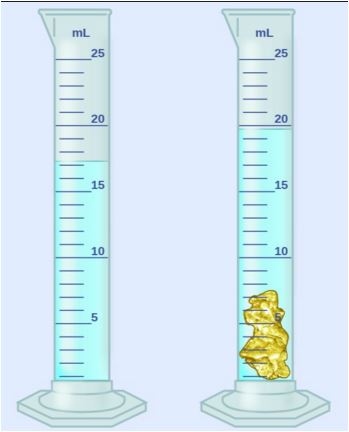
An irregularly shaped piece of gold was lowered into a graduated cylinder holding a volume of water equal to 17 ml. The height of the water rose to 20 ml. If the mass of the gold was 27 g, what was its density?
a)
9 g/mL
b)
10.5 g/mL
c)
6.5 g/mL
d)
8 g/mL
40.
How much water has been displaced in the image shown?
a)
40 mL
b)
65 mL
c)
20 mL
d)
25 mL
41.
How much water has been displaced in the image shown?
a)
80 mL
b)
100 mL
c)
20 mL
d)
60 mL
42.

An object is is placed into 45 mL of water. The water rises to 48 mL. What is the volume of the object?

a)

3 mL

b)

93mL

c)

8 mL

d)

83 mL

43.
The tool used to measure the mass of a substance or object is a ______________.
a)
balance
b)
graduated cylinder
c)
ruler
d)
thermometer
44.

What 2 measurements are used for DENSITY

a)

Mass and Weight

b)

Mass and Acceleration

c)

Mass and Volume

d)

Length and Width